

The Wall Street Journal once used ‘Read Ambitiously’ as a slogan, but it became a challenge I took to heart. If that old slogan still speaks to you, this weekly curated newsletter is for you. Every week, I will summarize the most important and impactful headlines across technology, finance, AI and enterprise SaaS. Together, we can read with an intent to grow, always be learning, and refine our lens to spot the best opportunities. As Jamie Dimon says, “Great leaders are readers.”
You can enjoy this week’s Reading Ambitiously as a podcast entirely generated by AI. If you haven’t experienced this technology yet, definitely give this a try!

In the news:
OpenAI teams up with SoftBank and Oracle on $500B data center project (TechCrunch)
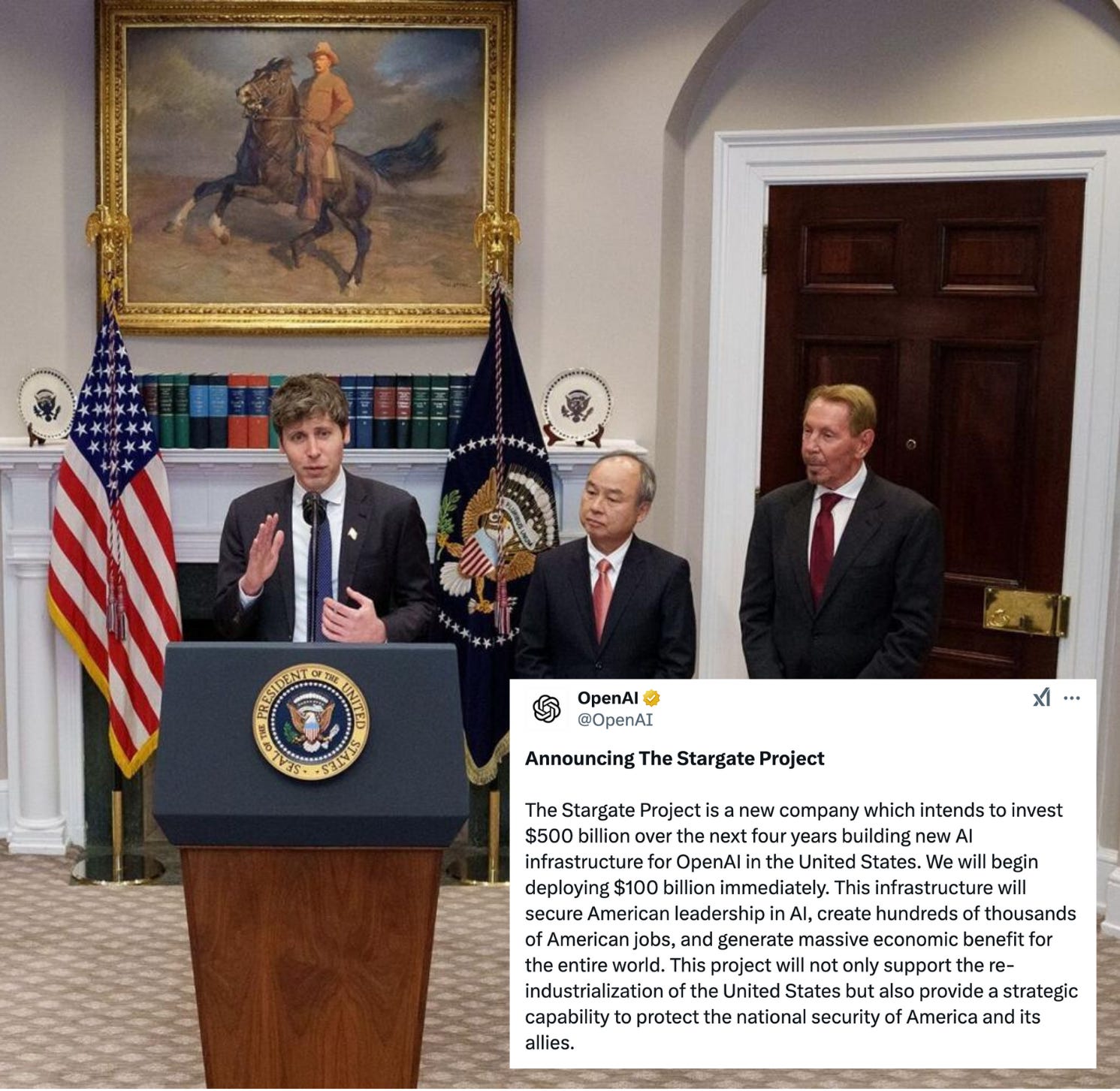
→ Why does it matter? OpenAI, SoftBank, Oracle, and others are teaming up to lead a staggering $500 billion investment in building AI data centers in the United States. That’s a big number. To put it into perspective, NASA’s Apollo program in the 1960s, even adjusted for inflation, cost far less than Stargate’s proposed spending on AI data centers.
Elon Musk has suggested they might not have the funds.

Others have said, 'Stargate' Squares Some AI Circles. One of the more memorable reactions came from Satya Nadella at Davos: “Look, all I know is I’m good for my $80B.” 🎤💥 Notably, Microsoft is not an official capital partner of Stargate on Day 1.

Yet, Stargate, or at least its intent, is a big deal. Let’s put aside the financials for a moment to discuss why.
Powering AI clusters and data centers will require enormous amounts of energy. How much energy are we talking about? According to Leopold Aschenbrenner, an ex-OpenAI researcher, a lot. By 2030, if we see another leap in AI capabilities akin to the jump from GPT-2 to GPT-4, we’re looking at a +4 orders-of-magnitude increase in compute power.
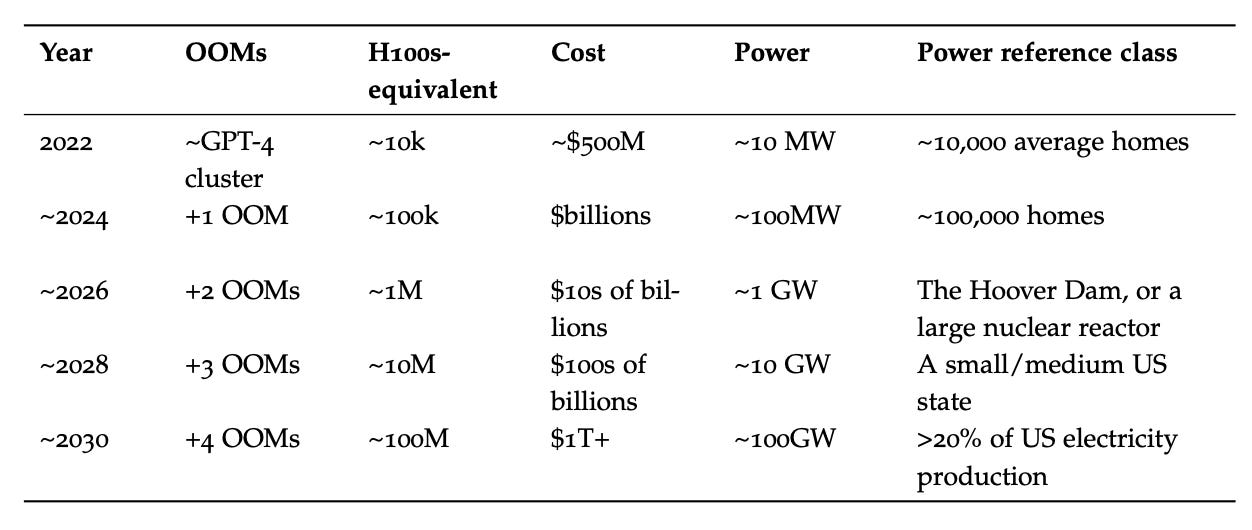
To put that in perspective: Microsoft and OpenAI are rumored to be building a $100 billion AI training cluster. When fully operational, it could consume as much energy as a small to medium-sized U.S. state. A $1 trillion cluster—inevitable at this pace—could require 20% of the entire U.S. electrical grid.
Last year, Sam Altman was reportedly scouting investments, energy access, and infrastructure outside the U.S., including in the Middle East. This raises concerns. For such a powerful technology, keeping these clusters on U.S. soil is paramount—for a lot of reasons.
Whether you believe the current administration’s Project Stargate is the answer or not, the key takeaway is this: Serious investment and partnership with the government in AI are essential for U.S. leadership. Responsible, thoughtful infrastructure development must follow, with clusters powered by domestically sourced—ideally clean—energy.
Announcing Project Stargate is just the appetizer for what is in store this year with AI. The real course? The global AI race and ensuring the U.S. leads it responsibly, sustainably, and securely—it’s a once-in-a-generation opportunity.

Best of the rest:
🤔 o1 Isn’t a Chat Model (and That’s the Point) - How Ben Hylak shifted from skepticism to fandom by addressing his “skill issue” with o1. - Latent Space
🧠 Google’s New Neural-Net LLM Architecture Tackles Exploding Costs - Google separates memory components in its new neural-net architecture to manage the soaring costs of capacity and compute. - VentureBeat
🔗 Why Oracle and Salesforce Should Merge - Exploring the strategic and financial benefits of a potential merger between Oracle and Salesforce. - The Information

Charts that caught my eye:
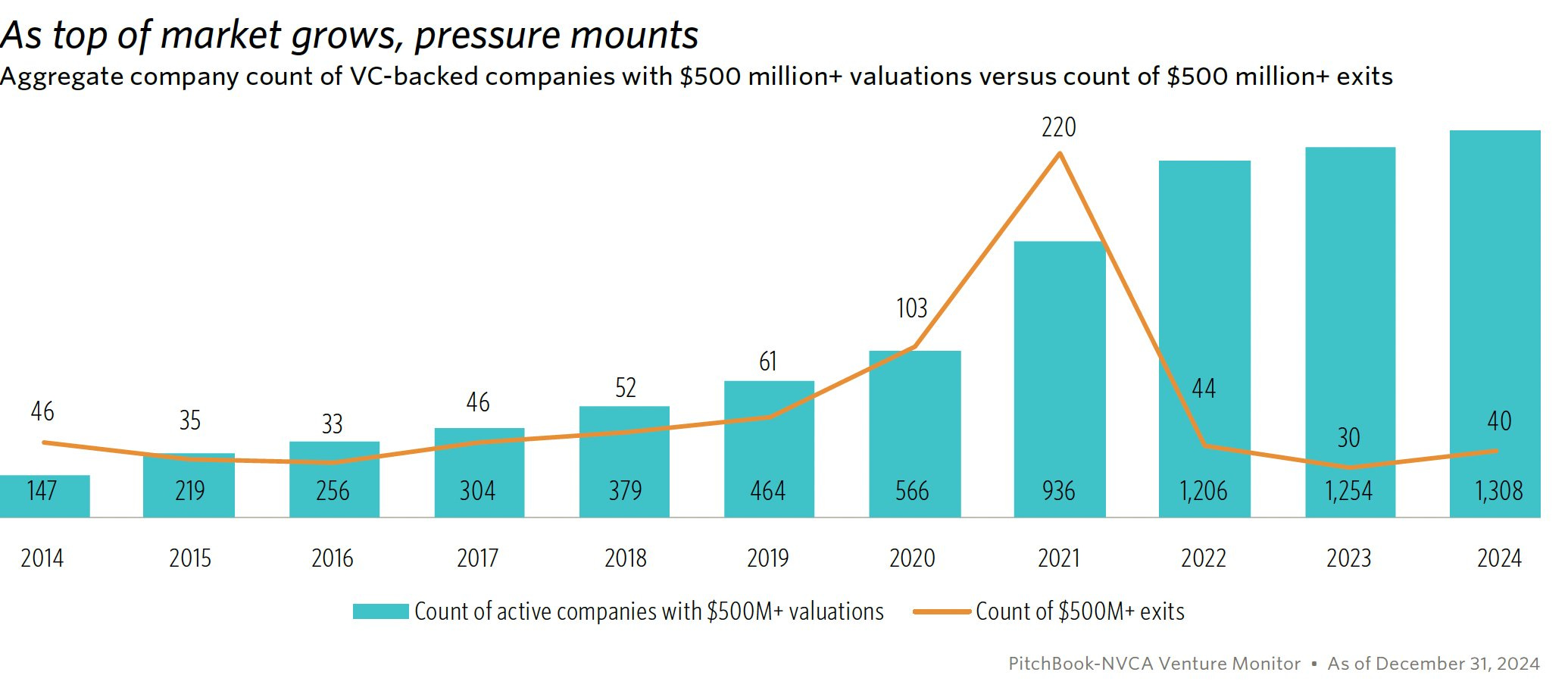
→ Why does it matter? There are 1,308 companies today worth more than $500M. Yet in 2024, only 40 of them achieved a $500M+ exit. This chart highlights the stark reality of the power law in venture capital: success isn’t evenly distributed. It’s about being in the right companies at the right time.

→ Why does it matter? “Time spent with your children peaks in the early years of their lives and declines sharply thereafter. There’s a devastatingly short window during which you are your child’s entire world. Don’t blink and miss it.” - Sahil Bloom
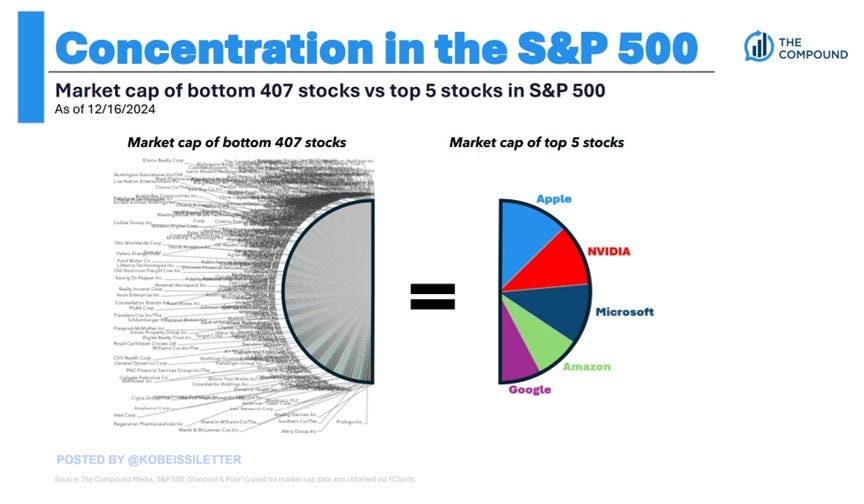
→ Why does it matter? The market cap of the S&P 500’s top 5 stocks is now equal to the size of the bottom 407 stocks. These 5 stocks are worth now nearly as much as China and Hong Kong's stock markets combined!

Tweets that stopped my scroll:

→ Why does it matter? Investing legend Charlie Munger on the power law that exists in the market for highly talented individuals.
“Argentina players lack the humility to understand what every Barça player has understood: as soon as you receive the ball, you look up & see if Messi is in space. It’s very simple: give the fking ball to Messi.” - John Carlin

→ Why does it matter? Chinese startup DeepSeek has launched DeepSeek-R1, a model that not only rivals but reportedly outperforms OpenAI’s o1 in math and coding tasks. Astonishingly, DeepSeek-R1 is over 27 times more cost-effective and was trained in just two months. Researchers and developers are buzzing with excitement, though they’re reserving full judgment until they can conduct thorough testing themselves.

→ Why does it matter? Jeff Bewkes is certainly eating those words!

→ Why does it matter? Last week, OpenAI announced ‘Tasks’; now, they’re unveiling ‘Operator’, an AI agent designed to perform those tasks for you. Operator can automate various web-based activities, such as making restaurant reservations, purchasing groceries, and filing expense reports. Operator interacts with web pages by clicking, scrolling, and typing, much like a human user.

Worth a watch or listen at 1x:
→ Why does it matter? Anthropic Founder & CEO, Dario Amodei is optimistic and more confident than ever about navigating AI scaling laws.
→ Why does it matter? Howard Marks, the savvy founder of Oaktree Capital who foresaw the dot-com bust (bubble.com January 2, 2000), is now eyeing the AI boom with a mix of intrigue and caution. In his latest memo, he acknowledges the buzz around AI but doesn’t see the wild, “no price too high” mindset that typically signals a bubble. While tech giants are riding high, Marks believes the current market, though pricey, hasn’t lost its marbles yet. Worth a listen!
→ Why does it matter? At Davos, Workday CEO Carl Eschenbach discussed how employers will need to onboard digital co-workers just like they do humans. Consider all the permissions, policies, access controls, and entitlements that agents will need to navigate the enterprise. In Carl’s words, “the future depends on human and digital labor.”

Quotes & eyewash:
“Let us recall that true humility consists of two things: the first is knowing our limitations, and the second is getting the help we need.” - Robert Moore
Bill Gates once had the radio removed from his car. When asked why, he said he didn't want any distractions from thinking about Microsoft. This level of single-minded focus is what builds empires.
Distractions are the assassins of great work. You don't need more time; you need more focus.
Time expands when we eliminate interruptions—our attention, not the clock, ultimately limits what we can achieve.
KOBE BRYANT’S 10 RULES:
Get better every single day
Prove them wrong
Work on your weaknesses
Execute what you practiced
Learn from greatness
Learn from wins and losses
Practice mindfulness
Be ambitious
Believe in your team
Learn Storytelling
→ Why does it matter? Kobe’s rules to live by. Confidence through preparation!
“We’re not on this stage just because of talent or ability,” Bryant said. “We’re up here because of 4 a.m. We’re up here because of two-a-days or five-a-days. We’re up here because we had a dream and let nothing stand in our way. If anything tried to bring us down, we used it to make us stronger.”