

The Wall Street Journal once used ‘Read Ambitiously’ as a slogan, but it became a challenge I took to heart. If that old slogan still speaks to you, this weekly curated newsletter is for you. Every week, I will summarize the most important and impactful headlines across technology, finance, AI and enterprise SaaS. Together, we can read with an intent to grow, always be learning, and refine our lens to spot the best opportunities. As Jamie Dimon says, “Great leaders are readers.”
Thanks to GenerativeAI and our friends at GoogleNotebookLM, you can enjoy this week’s Reading Ambitiously as a podcast entirely generated by AI. If you haven’t experienced this technology yet, definitely give this a try!

In the news:
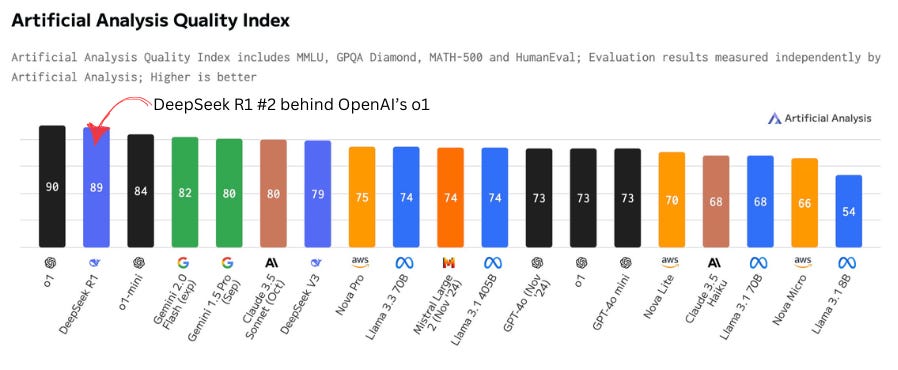
→ Why does it matter? If you subscribe to Reading Ambitiously, you’ve likely seen the headlines about DeepSeek.
What happened:
A Chinese AI model, DeepSeek, is forcing a reckoning in Silicon Valley. It’s nearly as powerful as leading models from OpenAI and Google—but it claims to have achieved this with a fraction of the resources.
How big is that fraction?
“OpenAI’s GPT-4 o1 charges $15 per million input tokens and $60 per million output tokens. DeepSeek R1? $0.14 per million input and $2.19 per million output. Orders of magnitude difference.” — Jamin Ball
DeepSeek R1 is 93% cheaper per API call than OpenAI’s o1 and can run locally on a high-end workstation like a Mac Studio. As of this writing, Apple stock is up 3.2%.
The stakes:
DeepSeek R1 is being called AI’s Sputnik moment and the AI Black Swan.
It raises fundamental questions:
Do AI giants like Google, Meta, OpenAI, and Anthropic deserve their sky-high valuations?
Is spending hundreds of billions on massive data centers and Nvidia-powered infrastructure necessary?
Does America need the projected trillion-dollar investment in electricity generation that has fueled utility stocks?
Is open-source AI catching up to its closed-source counterparts?
And then there’s the timing:
DeepSeek launched just one week after Trump’s announcement of the $500B Project Stargate. Coincidence—or something else?
All this uncertainty triggered a $1.2T+ market correction on Monday.
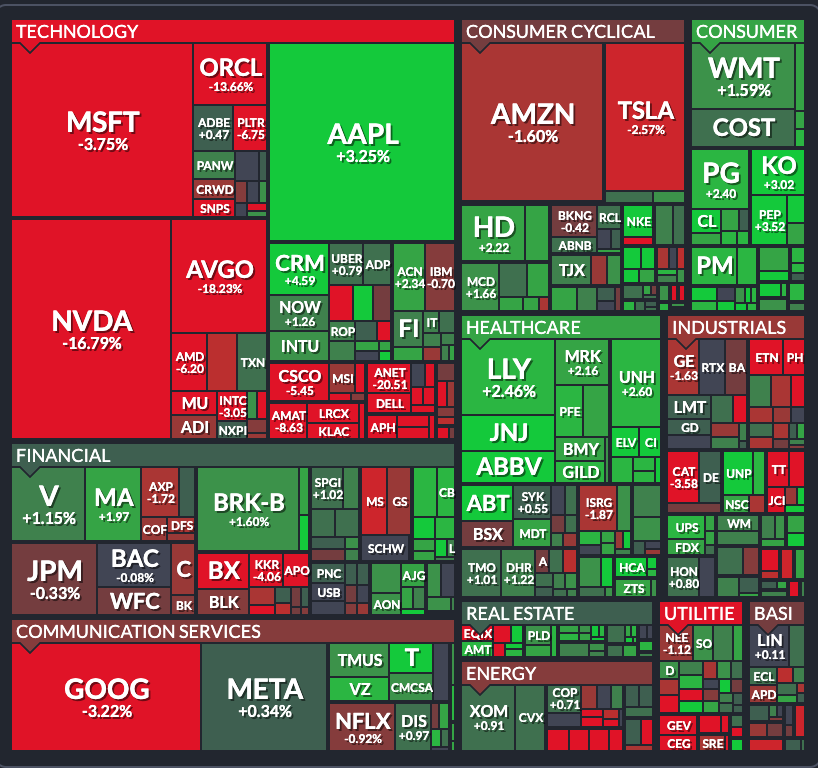
There are too many angles to cover in Reading Ambitiously! But here are a few that stand out:
Where did DeepSeek even get access to all these Nvidia chips amists US export restrictions?
Microsoft CEO, Satya Nadella thinks this a Jevon’s Paradox moment
One angle we have to dig into this week: DeepSeek R1 is open source under the MIT license. According to HuggingFace, DeepSeek has already been respun 500+ times — meaning the model has been updated, tweaked, or improved by the community. Meanwhile, leading providers like OpenAI and Anthropic remain closed-source.
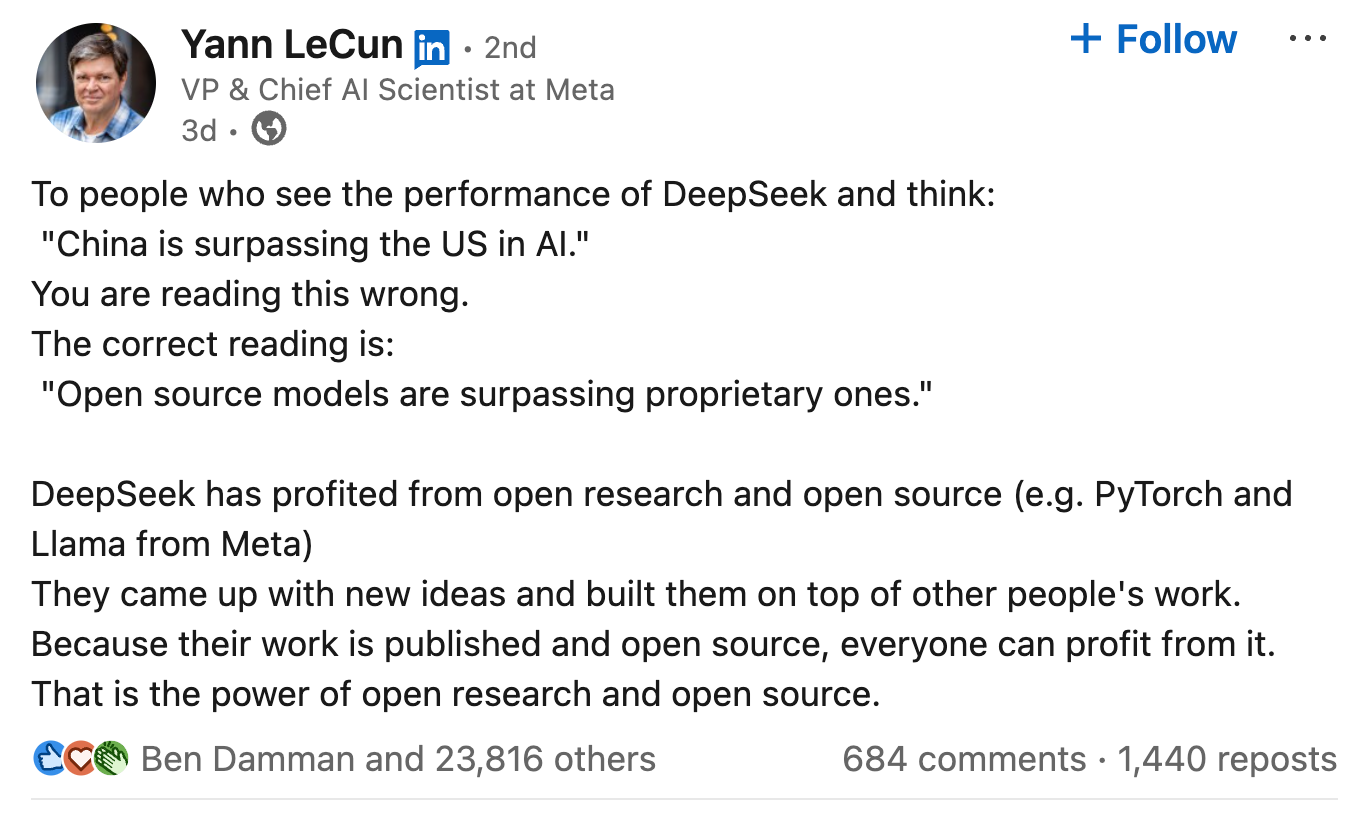
The performance gap between DeepSeek R1 and OpenAI’s o1 is razor-thin.
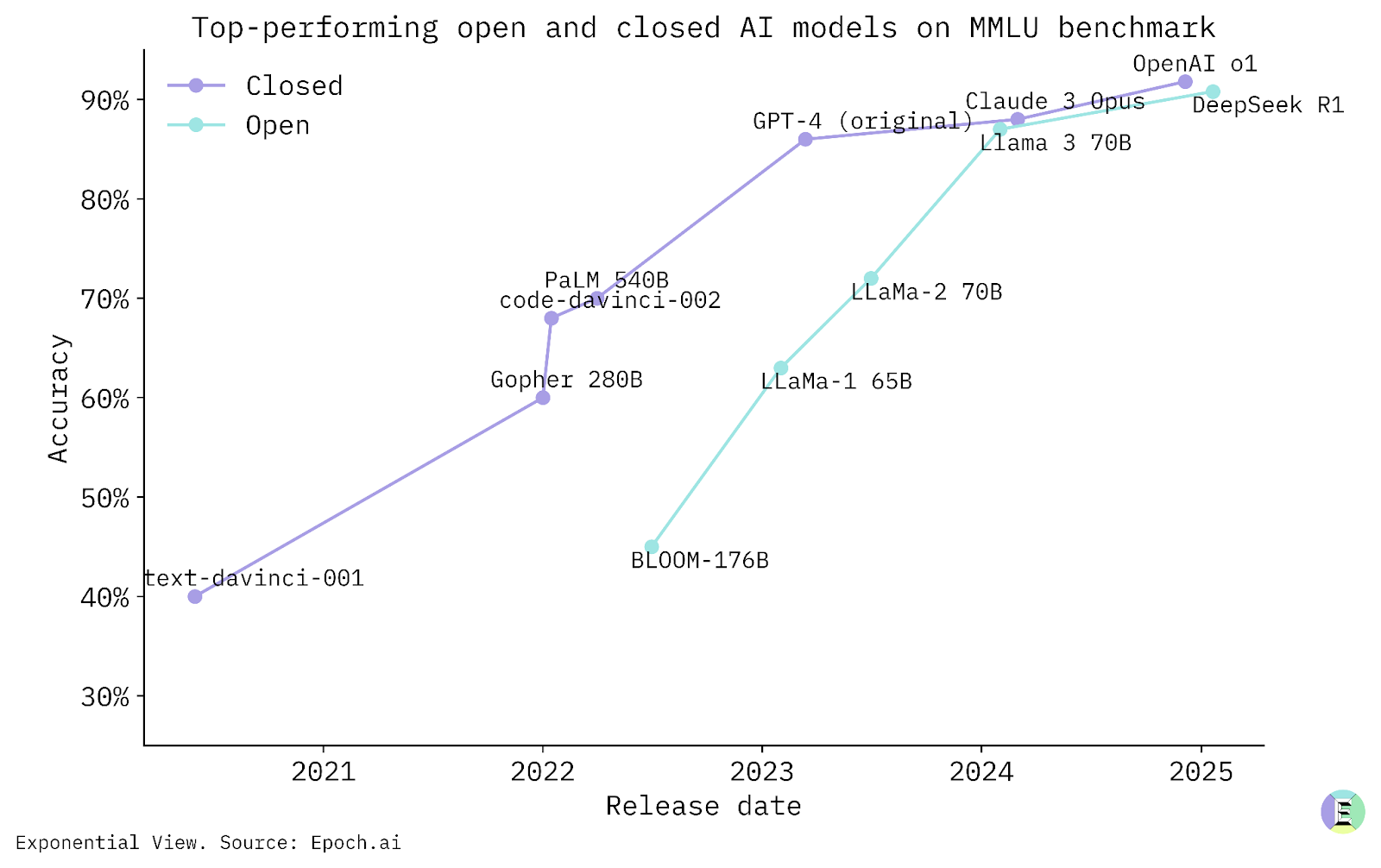
Technological paradigm shifts tend to follow familiar patterns. The open vs. closed debate has played out in every era—mainframe, client/server, cloud.
“History never repeats itself, but it does often rhyme.” — Mark Twain
Who better to weigh in than Reading Ambitiously friend Scott McNealy (Co-founder & CEO, Sun Microsystems and Partner at Flume Ventures)?
Scott was at the center of the last major open vs. closed showdown, going head-to-head with Bill Gates, who championed a tightly controlled, closed Microsoft ecosystem.
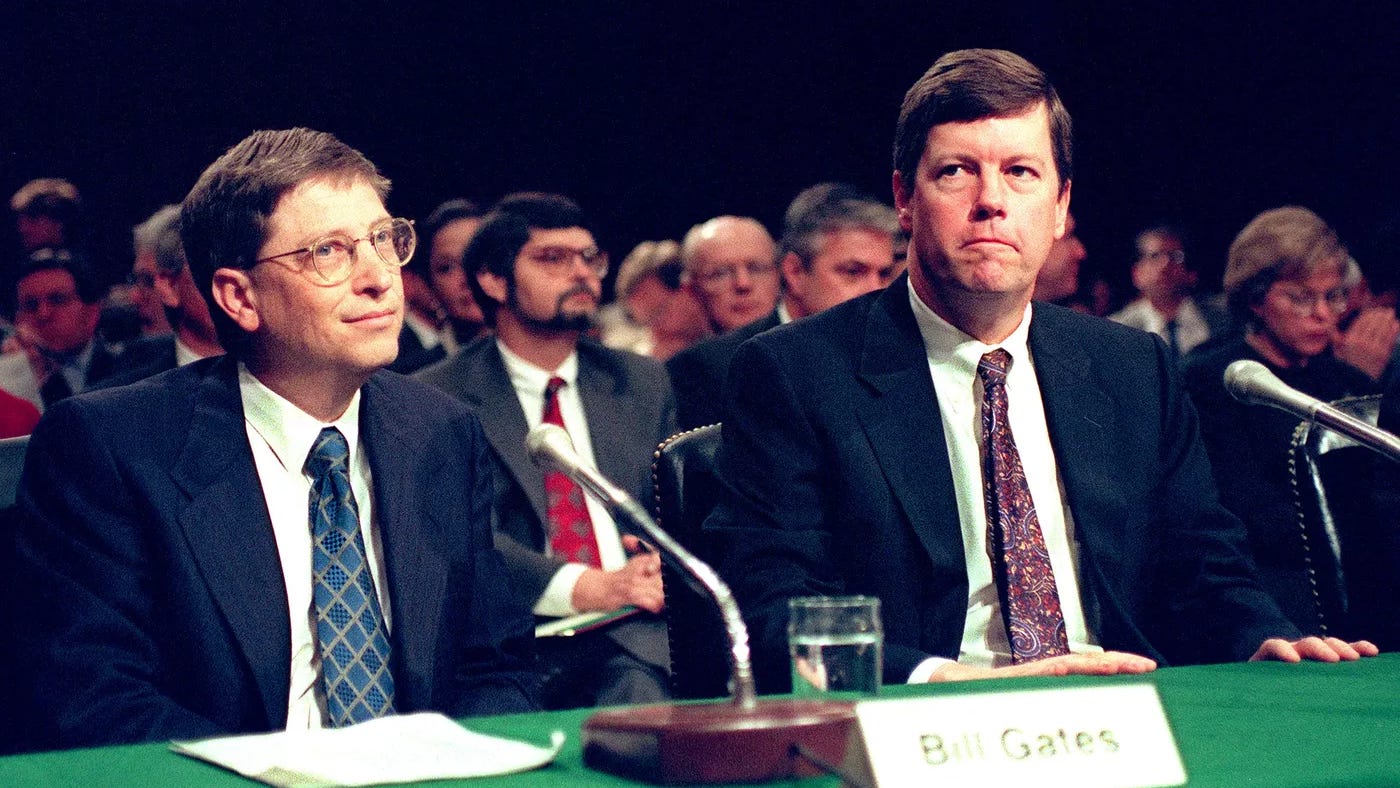
Scott, how should we frame the open vs. closed debate?
Open models are never as successful monetarily as proprietary ones. Look at Microsoft—very proprietary, very successful. If everyone is driving on the Apple side of the road, it’s great for Apple. If you can win and get the market to tip, you’ll be a trillionaire. Bezos did it. Gates got everyone to use Windows and Lotus. The switching costs are high, and the exit costs are even higher.
At Sun Microsystems, we were part of the world that said, “Let’s share.” We lowered the barriers to exit so we couldn’t overcharge. We built much of the internet—everyone uses it, but no one paid us a tax to do so.
What are some of the benefits of an open vs. closed approach?
Open-source code is far safer. If there’s a secret in proprietary code, the only people who know it are inside the company. If there’s a bug or a backdoor, someone within that company knows about it. And humans? Fundamentally, they can’t keep secrets.
What struck you about DeepSeek’s approach to creating efficiencies in their model?
They’re shifting from centralized to decentralized. Open source allows interoperability. Instead of a massive, monolithic mainframe LLM, DeepSeek has deconstructed it. They’ve created novel orchestration methods—only activating the necessary parts of the model. It’s distributed computing for AI.
Bill Joy (Co-founder, Sun Microsystems) used to say, “There has never been a well-funded startup that was successful.” Constraints on capital force invention. The Chinese don’t have as much money as we do, so they have to get very clever.
How Should Investors Process the DeepSeek News?
DeepSeek may expose inefficiencies in the traditional venture capital model. More funding rarely guarantees results. At Sun, we reached profitability with only a modest revenue increase—and we sustained that trajectory. Today’s market leaders must strike that same balance: achieving financial discipline drives more innovative at a reasonable cost.
What did you learn from the last major paradigm shift that applies here?
This is déjà vu all over again. The “throw money at it” approach—the big proprietary hairball—doesn’t always win. Sometimes it does. The question is: Do I have enough money, enough smart people, and enough of a head start to build the hairball? Can I ensnare everyone’s data into an Oracle database and charge enormous sums because the barrier to exit is so high?
The strategy is simple: Go big, huge. Pour in massive money early, execute well, and maybe I’ll be the next Steve Jobs or Elon Musk.
DeepSeek, however, has chosen a different path—open, distributed, and partner-driven rather than building a giant monolith. I call it a “little AI network,” and it’s got me excited.
Thanks so much, Reading Ambitiously friend and industry legend Scott McNealy, for sharing your point of view!

Best of the rest:
🤖 Goldman Sachs Rolls Out an AI Assistant for Employees - Goldman Sachs introduces a generative AI assistant for bankers, traders, and asset managers, with plans to evolve it to embody the expertise of a seasoned Goldman employee, according to CIO Marco Argenti. - CNBC
🚀 OpenAI’s Stargate Deal Heralds Shift Away From Microsoft - The partnership that kickstarted the AI boom faces strain as OpenAI and Microsoft clash over computing resources, signaling a potential pivot. - The Wall Street Journal
💰 SoftBank in Talks to Invest as Much as $25 Billion in OpenAI - The largest-ever investment in OpenAI would help fund its commitment to the Stargate AI infrastructure venture. - The Wall Street Journal

Charts that caught my eye:
What’s in your stack: The state of tech tools in 2025 (Lenny’s Newsletter)
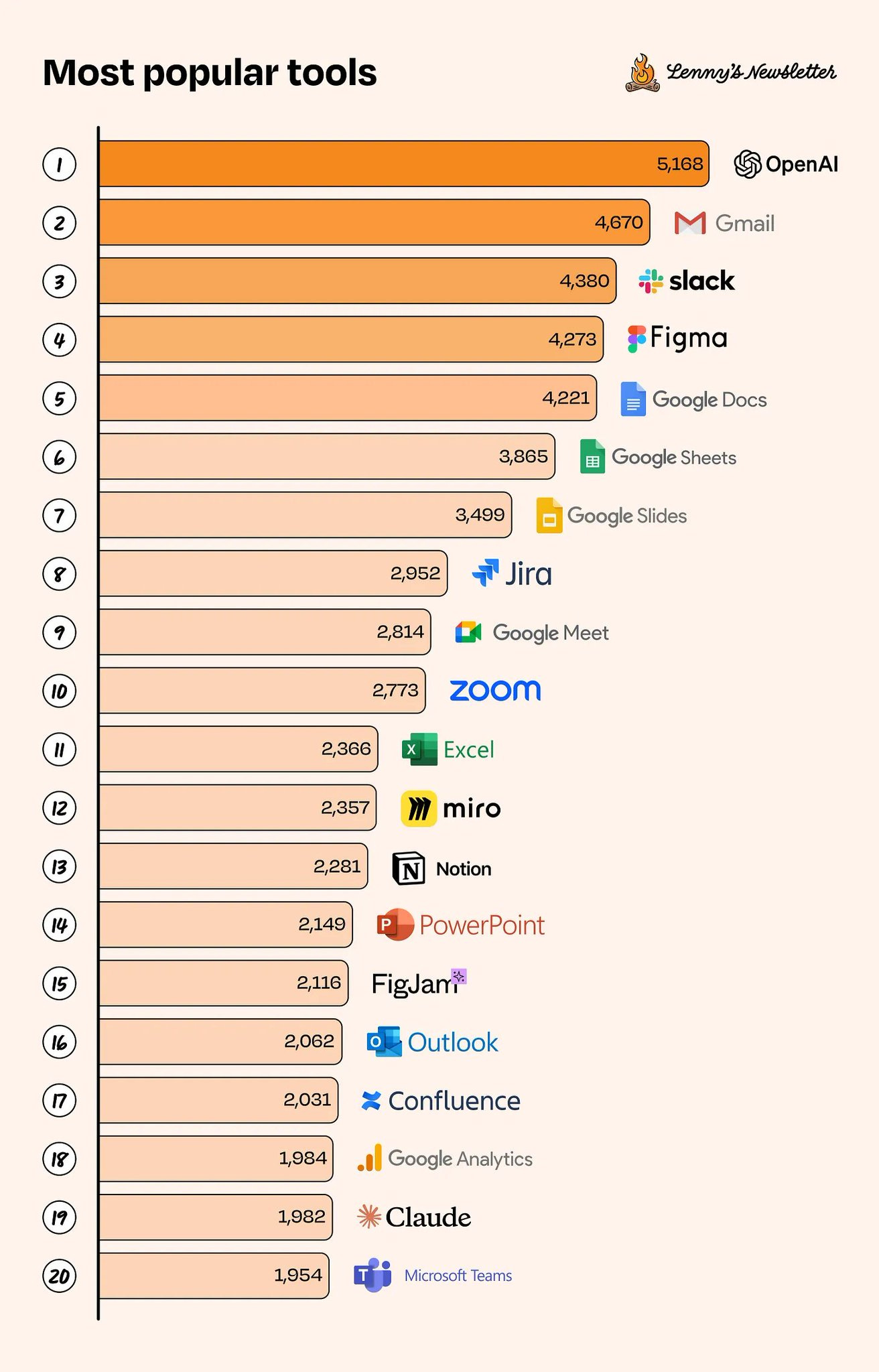
→ Why does it matter? The team at Lenny’s Newsletter surveyed over 6,500 people to answer a simple question: “What’s in your stack?” It’s remarkable how quickly OpenAI has climbed to the top of the list of tools we rely on to get work done. Respondents shared how they’re pairing OpenAI with Anthropic’s Claude or Perplexity as a “thought partner.” Personally, I subscribe to the paid versions of nearly all these AI tools—and for good reason!
Google invests further $1bn in OpenAI rival Anthropic (Financial Times)
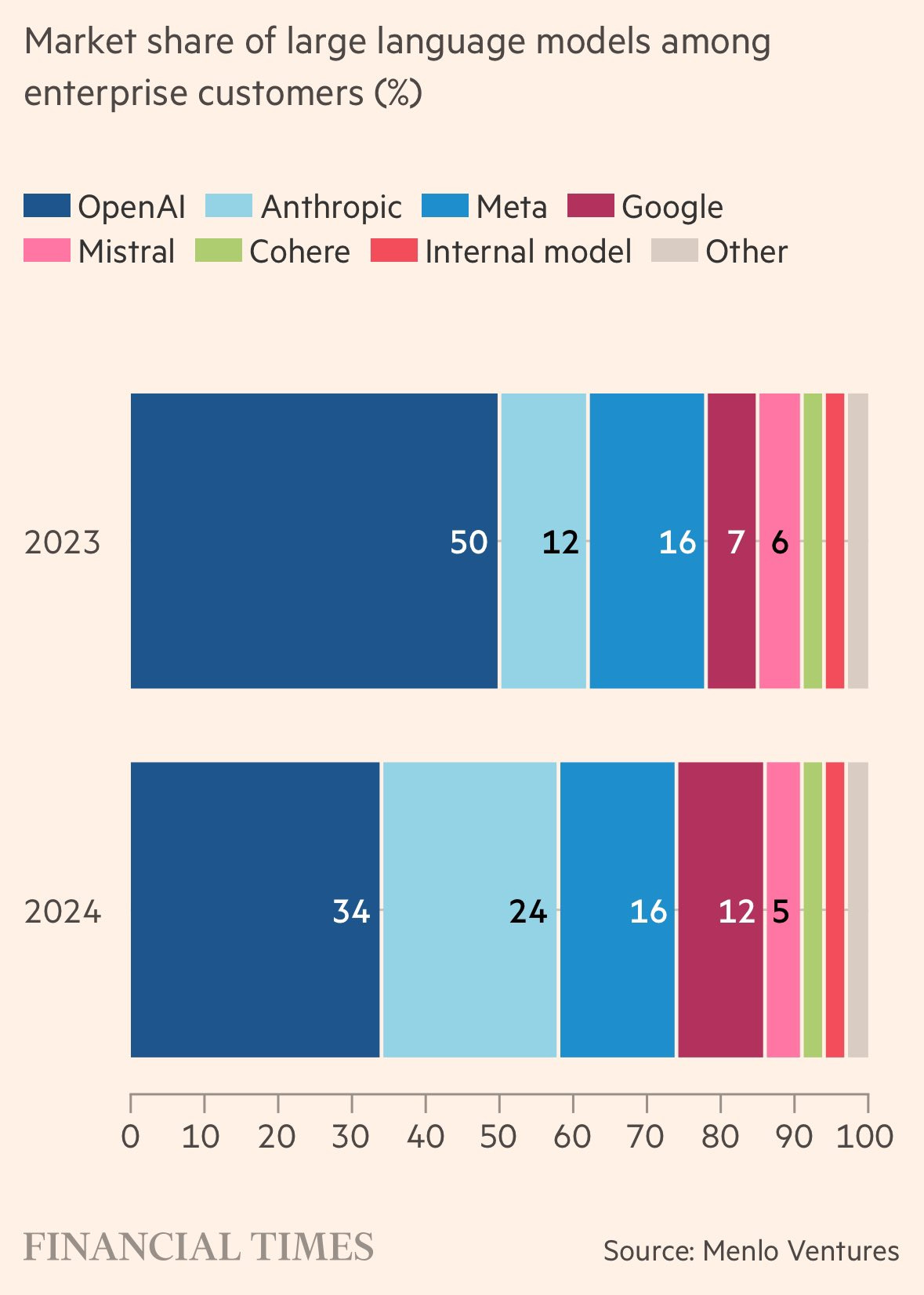
→ Why does it matter? Wow, OpenAI’s enterprise market share is down 16% YoY! Anthropic is closing in fast on the enterprise LLM market.
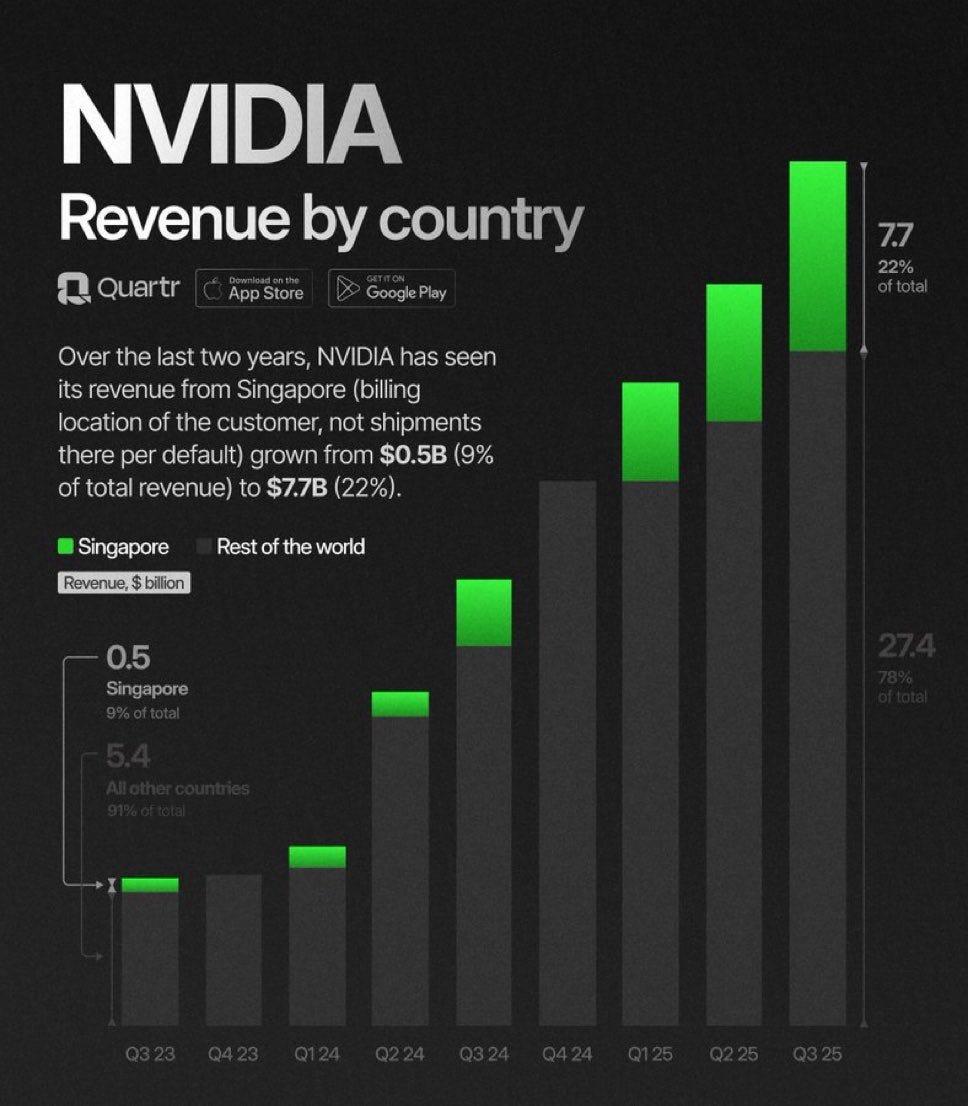
→ Why does it matter? Nvidia’s revenue from Singapore is on pace to exceed $10 billion per year. Makes you wonder—did DeepSeek find a way around U.S. chip export restrictions by sourcing Nvidia GPUs through Singapore? Here’s Alexandr Wang’s (CEO, ScaleAI) hot take.

Tweets that stopped my scroll:

→ Why does it matter? SailPoint is officially the first software IPO of 2025! Alex Clayton and his team always do a great job dissecting the S-1. $800M ARR—now that’s a high bar for going public.
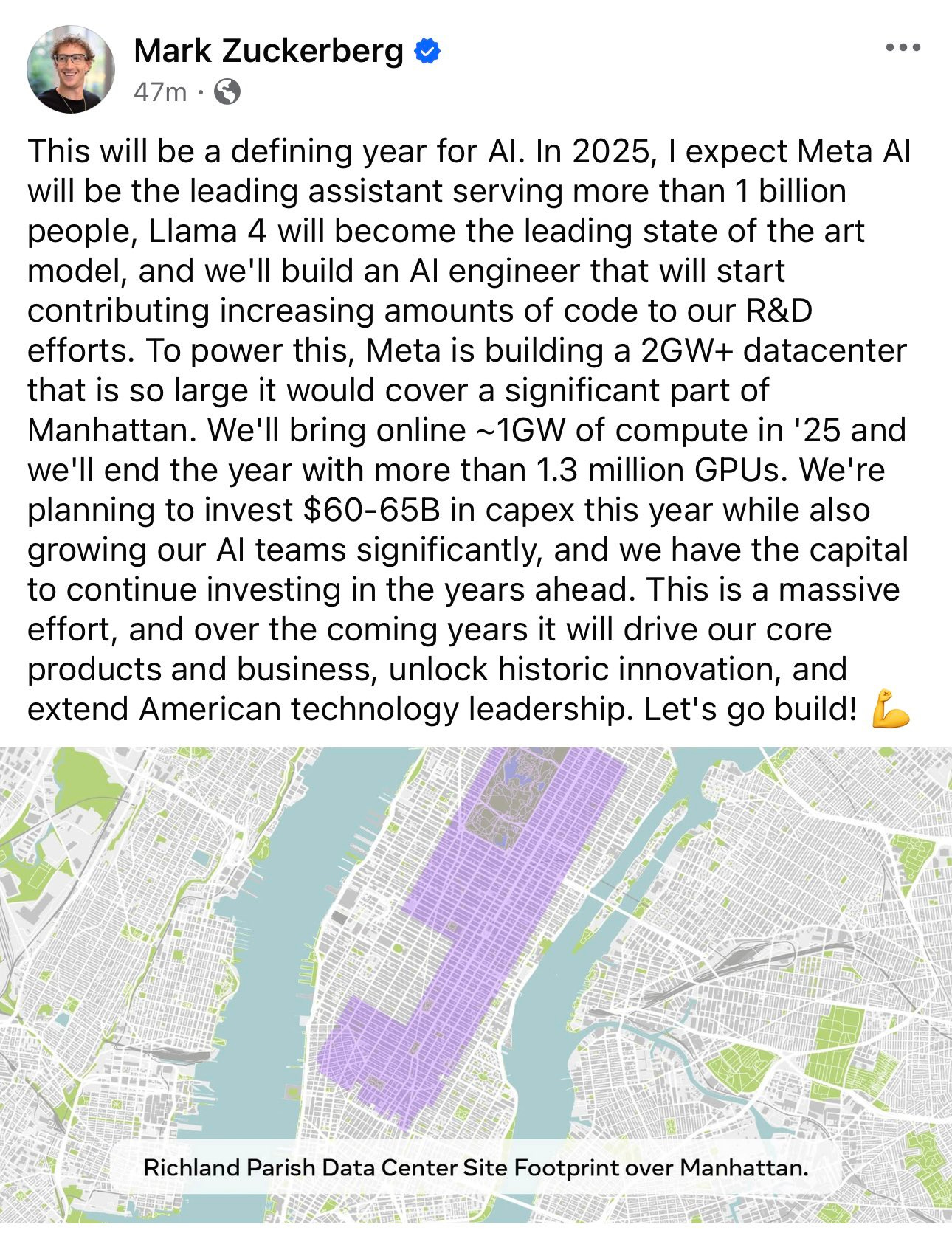
→ Why does it matter? Zuck is building massive data centers that could take up most of Midtown Manhattan. Let that sink in.
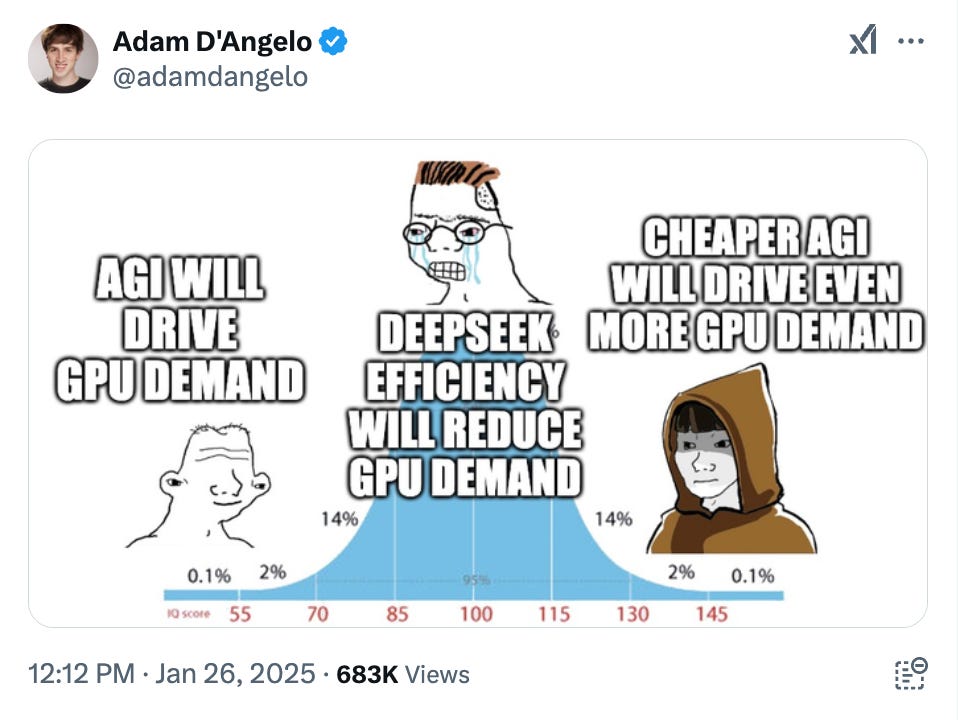
→ Why does it matter? During OpenAI’s 2024 board shake-up, Adam D’Angelo was the only member who survived. His most recent Tweet with the IQ Bell Curve (or Midwit) meme, which humorously illustrates different takes on AI’s impact on GPU demand:
Left side (low IQ): AGI will increase GPU demand.
Right side (high IQ): Cheaper AGI will do the same.
Middle (midwits): DeepSeek’s efficiency will actually reduce GPU demand.
If you know, you know!

Worth a watch or listen at 1x:
→ Why does it matter? Ray Dalio, Founder & CIO of Bridgewater Associates, sat down with David Friedberg to discuss America’s debt crisis—how the Fed’s money printing is fueling inflation and why rising interest rates or a slowing economy could make it harder for the U.S. to service its debt. Worth a listen, especially with Dalio’s new book coming in 2025!

Quotes & eyewash:

📸: shot at Sequoia National Park (source)
DeepSeek’s move is wild and matching top AI models at a fraction of the cost will have implications across many sectors that are all banking on the infrastructure promises of the current power-hungry US versions of AI. I wonder how long it will take Anthropic and others to reverse-engineer what they are doing and if that will drive down costs.