

Enjoy this week’s Big Idea read by me:

The big idea: AI and the paradox of skill

Would you still get hired for that first job in today’s world? Would you still have been admitted to your alma mater?
If the bar feels higher, and you sometimes wonder, you are not alone.
Over the weekend, a friend described an early-career job candidate who absolutely crushed their case interview. We asked the wondering question out loud: Were we that skilled when we interviewed for our first jobs?
Maybe. But probably not.
The market is more skilled and thus more competitive today. And luck plays a bigger role than we like to admit.
Michael Mauboussin, Head of Consilient Research at Morgan Stanley’s Counterpoint Global, refers to this as the Paradox of Skill. In activities where both skill and luck drive outcomes, as average skill rises, the spread in performance narrows. With less separation in skill, luck explains more of who wins.
Consider golf. When Tiger Woods arrived on tour in 1998, his dominance triggered talk of “Tiger-proofing” golf courses. His drives were too long, and he was precise. He was breaking the game.
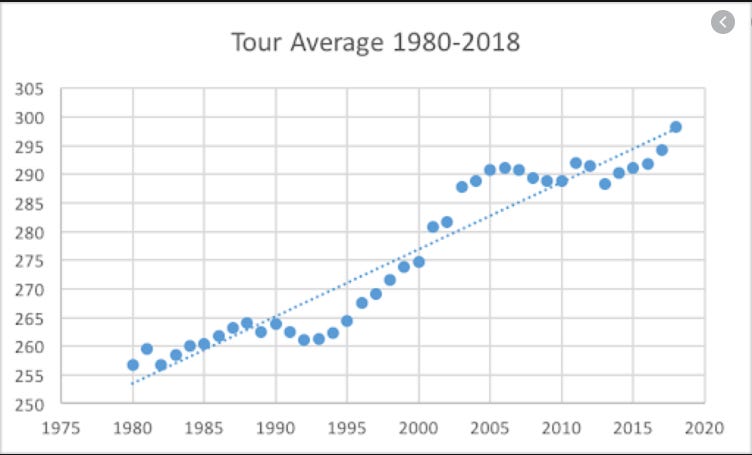
But over the subsequent decades, the field caught up. The average driving distance increased from approximately 257 yards in 1980 to around 295 yards by 2018. Better coaching, technology, and training equipment. The entire field improved.
Scores went lower as a result. Records were set more frequently. And winning got harder because everyone got better.
Just look at what the #2 golfer in the world today is doing two hours before his 7:20 am tee time.

The paradox isn’t confined to sports. It’s evident across industries and markets. Technology, knowledge, and improved training raise the bar. As skill increases, competition intensifies. Staying in the top performance decile becomes increasingly difficult.
Which brings us back to that early-career candidate who crushed their interview.
They had something we didn’t have at the start of our careers: access to a free interview coach and data scientist called ChatGPT, available 24 hours per day, trained on a knowledge base from Harvard Business School, the institution that invented the case study.
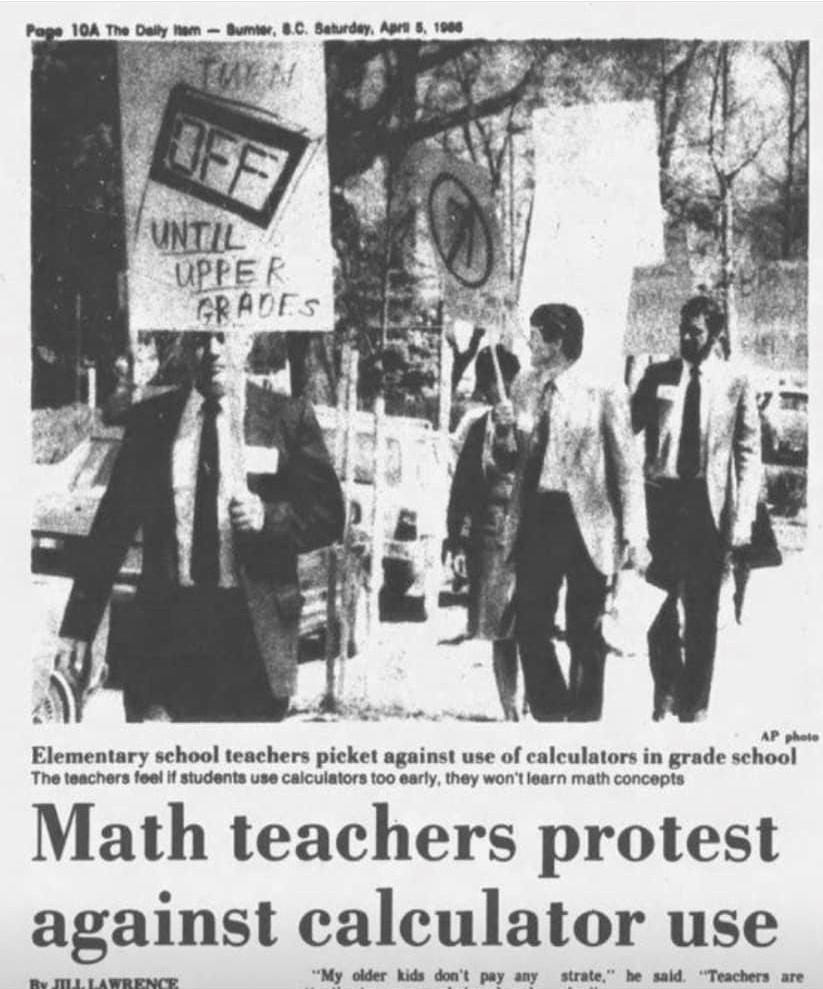
Is that an unfair advantage? Maybe. In 1996, math teachers protested against the use of calculators in the classroom.
Or is it rational, since AI is expected to be used reflexively on the job anyway?
Maybe both are true. But here’s what’s happening: AI is raising everyone’s skill level, and that’s going to make the field more competitive. In arenas where we’ve historically competed on technical skill, AI is now democratizing many of those skills. And when combined with your actual brain, AI can provide a real edge. And it’s going to make skills that only humans can do even more valuable.
AI has a lot of skills, and it’s gaining more
A skill can be defined as the reliable ability to produce a result under constraints. It combines knowledge, method, and execution.
A few weeks ago, my daughter was in the ER with a broken wrist. When the X-rays came back, we uploaded them to ChatGPT. It diagnosed the fracture immediately, all before the doctor had a chance to confirm the diagnosis.
I know some of you are rolling your eyes. What if AI made a mistake? The stakes are high, and it’s entirely possible. Of course, the human doctor came in to verify the diagnosis.
But the opposite can also be true. What if AI can identify what doctors miss because it has the skills to do so? A few years ago, Johns Hopkins reported that medical error was the third leading cause of death in the United States, behind only cancer and heart disease.
And it turns out that while my daughter did incur a traditional buckle fracture of the wrist, weeks later, when we got her cast off, the healing showed new bone on the ulna as well, a part of her wrist that wasn’t flagged as fractured at the time. Indeed, when I asked ChatGPT to re-review the X-rays after learning this information, it identified a subtle buckle of the distal ulna that had been missed initially.
The AI had the skills to see it all along. And doctors will no doubt have this technology to help augment their skills.
It’s happening in software too. For years, the scarcest resource in that game was technical skill. The ability to write code and architect systems.
Code generation tools like Cursor, Devin, and Codex are all focused on building AI with the skills of a software engineer. And their systems now possess the skills to write software, and they’re getting better at it. Some believe that’s driving the cost of code generation ultimately to zero.
The game is not going to end as AI doomers proclaim. The AI is going to augment in more cases than it replaces. But as Mauboussin observed, you’re going to have to use AI to remain in the top performance quartile of your trade. Because AI can perform many of these skills better, faster, and more cost-effectively than we ever could.
Which raises a good question: in a world where technical skills become more abundant, a different kind of skill increases in value. The human-only skills AI can’t replicate.
Thinking and the intangibles
First of all, you’re going to have to think independently. The AI is there to augment skill, and give us access to knowledge. Too many people are no longer doing the work and outsourcing their brains to AI. AI should help you be better, not be you. We’re all developing an AI-slop filter, and there is no better way to get written off than to have your audience think your work is slop.
Second of all, there are human-only capabilities that become exponentially more valuable when technical skills are abundant.
Judgment in ambiguity. Decisions rarely come with clean data and clear outcomes. Knowing when to pivot, when to double down, and when conventional wisdom is wrong requires judgment developed through experience and context that extends beyond any training set. Some call it the “gut” feel.
Taste. Steve Jobs didn’t need market research to know the iPhone should have one button. Taste is an aesthetic judgment that defies algorithmic optimization. It’s knowing what’s good before the data proves it.
Knowing which problems to solve. AI can solve the problem you give it. But identifying which problems are worth solving? Which opportunities matter? That’s still deeply human. As Peter Thiel says, “The most contrarian thing of all is not to oppose the crowd but to think for yourself.”
Building trust. You can train an AI to say the right things. But trust, the kind that makes people bet on you, that makes talent join you, investors write checks, is built through consistency, vulnerability, and shared experience over time.
Relationships and networks. AI can draft the email, but it can’t build the relationship. The soft tissue of human connection remains irreplaceable.
AI compresses the time and cost of execution. What it doesn’t compress is the value of choosing well and leading effectively.
The people who will thrive aren’t those who resist AI or those who simply outsource their brains to it. They’re the ones who use AI to augment their skills, increase their performance, and then focus their newfound human capacity on thinking and the intangibles.
If AI can write the code, you focus on product vision and speaking to customers.
If AI can analyze the X-ray, you focus on patient care and communication.
If AI can draft the brief, you focus on legal strategy and client relationships.
If AI can build the financial model, you focus on which investments to make.
The question isn’t whether you should use AI. You should. Everyone will. Or at least the top performers in their respective arenas. And when everyone does, first we have to actually use our brains, and second, focus this newfound capacity on the work that only humans can do.

Best of the rest:
💸 OpenAI Becomes Most Valuable Private Company – A $6.6 billion secondary sale valued OpenAI at $500 billion, but employees left $10.3 billion in stock on the table, signaling deep conviction that the upside is still ahead. – CNBC
🍏 Apple Puts John Ternus in the Succession Spotlight – As Tim Cook approaches retirement and COO Jeff Williams exits, Apple insiders increasingly view hardware chief John Ternus as the frontrunner to eventually succeed Cook, even as no formal move has been made. – Bloomberg
💸 Founders are using creative accounting to boost lofty ‘ARR’—the hottest startup metric in Silicon Valley – Fortune details how AI founders are stretching the definition of “recurring” revenue to keep pace with headline-grabbing growth stories, turning a once-trusted SaaS benchmark into a new form of startup theater. – Fortune
🕵️ Hacking group claims theft of 1 billion records from Salesforce customer databases – TechCrunch reports that the Lapsus$/ShinyHunters collective launched a dark web extortion site claiming to have stolen massive troves of customer data from Salesforce-hosted databases, pressuring victims to pay up even as Salesforce denies any platform breach. – TechCrunch

Charts that caught my eye:
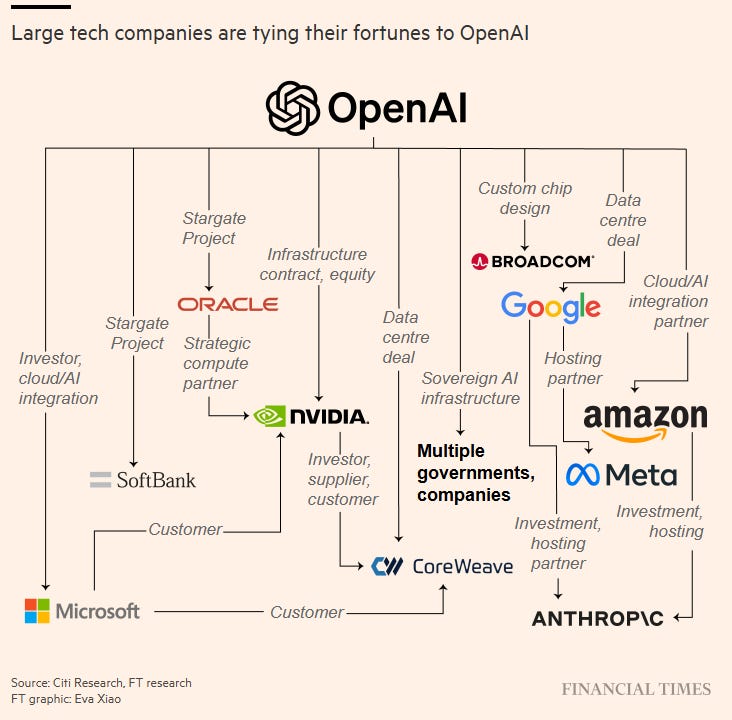
→ Why does it matter? Chart of the week here from the FinancialTimes!
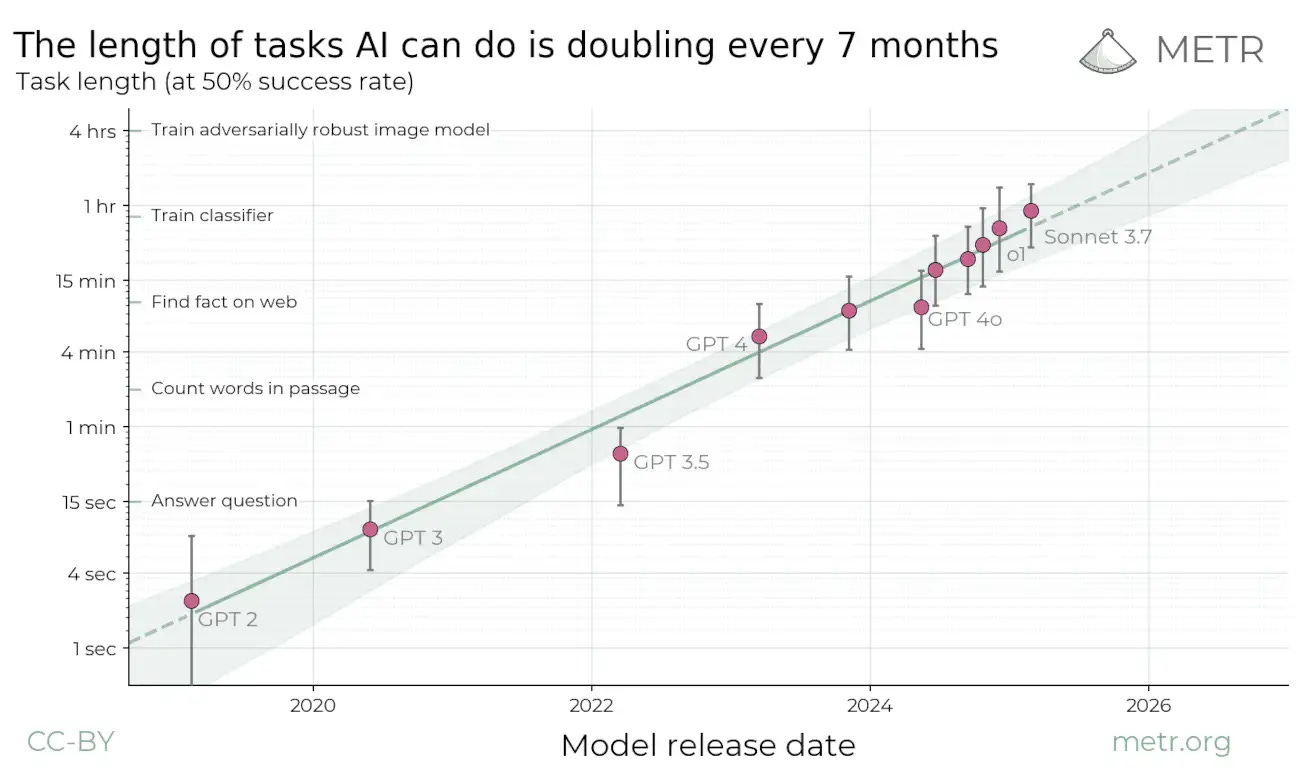
→ Why does it matter? There is no doubt, AI is getting better. But at what rate? and pace? The length of tasks AI can complete is doubling every 7-months, should we continue on this trajectory, which I believe we will, AI will be capable of an 8-hour work day by 2026.

→ Why does it matter? As we’ve pointed out here, AI CAPEX spending is remarkable! GoldmanSachs is tracking all these announcements.
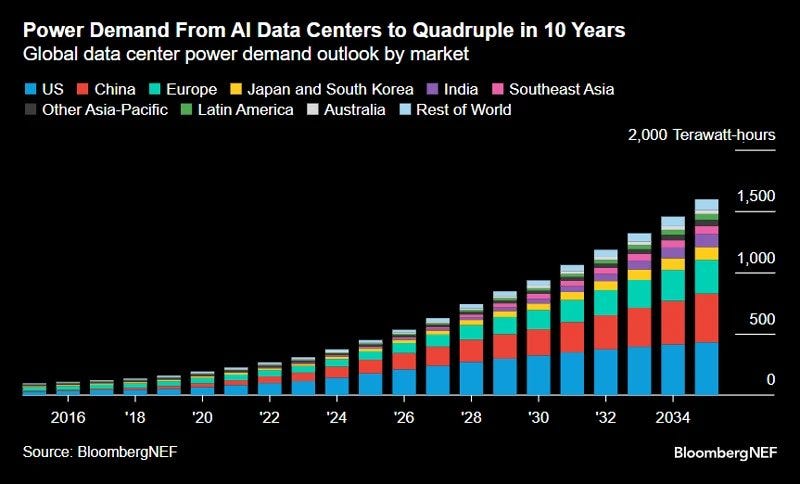
→ Why does it matter? I think it’s now a competition between Bloomberg, WSJ, and FT to see who can make the exact same data look the prettiest. We’re going to need a lot of power!

Tweets that stopped my scroll:

→ Why does it matter? Worth the 59 seconds of your time to see how ChatGPT is launching their metaphorical app store.

→ Why does it matter? The AI-generated headshots have significantly improved. This is worth a quick try with Google’s SOTA model, Nano Banana. Some tips & tricks in the comments.

Worth a watch or listen at 1x:
→ Why does it matter? Richard Sutton is the father of reinforcement learning, winner of the 2024 Turing Award, and author of The Bitter Lesson. According to Dwarkesh, Richard’s position is this: LLMs aren’t capable of learning on-the-job, so no matter how much we scale, we’ll need some new architecture to enable continual learning. And once we have it, we won’t need a special training phase — the agent will just learn on-the-fly, like all humans, and indeed, like all animals. This new paradigm will render our current approach with LLMs obsolete.
→ Why does it matter? Orlando Bravo, Founder & CEO of Thoma Bravo is bullish on enterprise software. Obviously! Helpful to hear the way he frames up the AI opportunity for SaaS.
→ Why does it matter? Feels like it’s more and more rare to hear from Bezos these days. Always great to get his take on the world!

Quotes & eyewash:
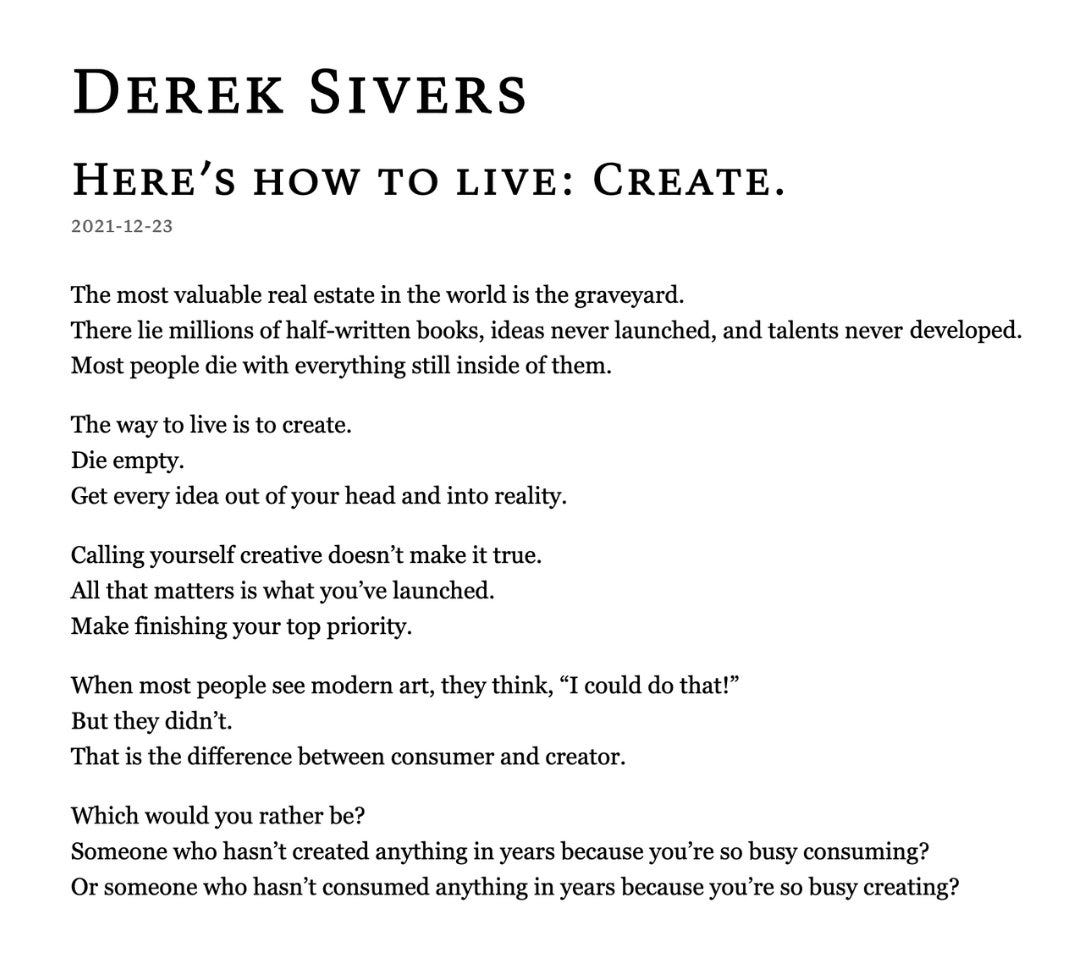
→ Why does it matter? Always be creating!
Complexity increases because adding is easy and removing is dangerous.
Whenever there’s a problem, we add: a new person, requirement, or process. We never subtract.
Why?
Because everything that already exists has a champion. That clause in the tax code, that step in the process, that feature in the product ... someone fought for it, and they’ll fight you if you try to remove it.
So we become professional complexity managers. Entire careers are built managing unnecessary mass. But this is the opportunity. While everyone else adds mass to the system, removing it creates an unfair advantage. The lighter you are, the faster you move.
Removing what shouldn’t exist creates more value than any addition could.
The mission:
The Wall Street Journal once used “Read Ambitiously” as a slogan, but I took it as a personal challenge. Our mission is to give you a point of view in a noisy, changing world. To unpack big ideas that sharpen your edge and show why they matter. To fit ambition-sized insight into your busy life and channel the zeitgeist into the stories and signals that fuel your next move. Above all, we aim to give you power, the kind that comes from having the words, insight, and legitimacy to lead with confidence. Together, we read to grow, keep learning, and refine our lens to spot the best opportunities. As Jamie Dimon says, “Great leaders are readers.”
Disclaimer: This content is for informational purposes only and does not constitute financial, investment, or legal advice. Readers should do their own research and consult with a qualified professional before making any decisions.