

Enjoy this week’s Big Idea read by me:

The big idea: knowledge work vs. judgment work

“The whole experience was stunning, I knew I had just seen the most important advance in technology since the graphical user interface.”
Cordially, Bill Gates was saying “oh sh*t”. This is going to change everything.
We’ve all had “oh sh*t” moments with new technology. The first time we used the internet. The first time we unlocked an iPhone. Ride in a Waymo, and you’ll likely say it again. My own “oh sh*t” tally has gone off the charts in the past two years because of AI, self-driving cars, advances in crypto and stablecoins, and rockets being captured by chop sticks.
And while I may be saying “oh sh*t,” others are still saying “so what.” The first iPhone? Mocked for lacking a keyboard. The internet? Written off as too slow for commerce.
First comes dismissal, when the new technology seems trivial. “It doesn’t work.” “It’s a toy.” “It’s just hype.” Then comes displacement, when it starts to work and incumbents pivot. “It doesn’t work here.” Video games, not business. Startups, not enterprise. Side projects, not production. Finally comes diffusion, when it becomes indispensable and people stop asking if it works. The question changes to how to use it well and how to govern it.
This cycle repeats not because technology changes, but because we don’t. Each phase threatens a group’s identity, incentive, or sense of control. “It doesn’t work” is often a shorthand defense mechanism for “it doesn’t fit how I work.”
The psychology of resistance
Resistance is rarely technical. It is psychological. Every new technology threatens someone’s sense of mastery.
Technologists once dismissed the cloud because it undermined their control of hardware.
Traders resisted algorithms because it blurred the line between intuition and automation.
Creatives push back on generative tools because it questions where originality begins and ends.
When your competence is built on a craft, anything that changes the craft feels like an attack. The instinct for the majority is not to evaluate but to defend. To protect the status earned in the old system.
Earlier this year, OpenAI’s model earned a gold medal in the International Mathematical Olympiad, a competition long seen as the apex of human problem-solving. The news didn’t make major headlines. But in the math community, it landed with force. Dave White, a professional mathematician, wrote on X:
“As someone who has a lot of their identity and their actual life built around ‘is good at math,’ it’s a gut punch. It’s a kind of dying.”
He described the feeling through a simple metaphor. For years, he said, it was like being “the only person who could talk to dogs.” You study their language. You earn their trust. You find belonging in what makes you different. Then one morning you wake up, and the universal dog translator is on sale at Walmart for $4.99.
What he captured is deeper than fear of replacement. It’s the fear that the identity you built, the one that made you valuable, that gave you status, that defined your worth, no longer applies.
Organizations absorb this resistance at scale. Teams delay adoption, justifying it as caution. Leaders slow down pilots, reframing fear as prudence. Culture becomes a protective immune system, ready to reject the unfamiliar. The reasons sound rational such as risk, compliance, reputation. But beneath it all lies the real dilemma: identity preservation.
An identity built on rare skills and knowledge that now must be rebuilt around new leverage.
The work of reinvention
We stand at the edge of a shared identity crisis. What makes this moment unusual is not that change is coming, but that it will arrive for so many of us at once.
I feel it too. I have spent my career building skills and gaining knowledge that AI has now. My shelves are filled with books that mark that journey. But now I can open ChatGPT and ask it to synthesize the frameworks of Geoffrey Moore, Clay Christensen, Michael Porter, Peter Drucker, and Rita McGrath, then apply them to my specific situation. I can ask it to simulate a debate between Kahneman and Taleb on my decision. I can feed it my company’s metrics and have it channel Andy Grove’s paranoia or Jim Collins’ discipline.
Not just the bestsellers. The obscure ones too. The academic papers I highlighted in business school. All of it, the entire long tail of business knowledge accumulated over decades, accessible in seconds.
It will give me 80% of what those minds would say. Maybe 90%. And here’s what’s uncomfortable: for most decisions, that’s enough. The question isn’t whether AI can replace deep expertise. It’s whether the marginal value of the last 10%, my 10%, is still worth what it used to be.
Knowledge that took years to acquire can now be accessed in seconds. The knowledge is democratized. But, what to do with it? That’s judgment and AI doesn’t have it.
This is where identity gets tested. If I define myself by what I know, AI feels like a threat. If I define myself by how I use what I know, by the questions I ask and the decisions I make, it becomes leverage.
The mathematicians who defined themselves by solving hard problems are grieving. The ones who defined themselves by knowing which problems to solve are rejoicing.
That’s the difference between knowledge work and judgment work. And right now, we’re all being asked which one we’ve actually been doing.

Best of the rest:
🤖 Cursor’s 300 C-Suite Meetings in 90 Days – The AI coding startup is on a tear, holding 300 exec-level meetings in three months as it races to turn enterprise interest into a $500M business built on workflow integration and trust, not just flashy demos. – Upstarts Media
💸 OpenAI Prepares $1 Trillion IPO – The ChatGPT maker is laying the groundwork for a public listing as soon as 2026, aiming for a valuation up to $1 trillion after restructuring its foundation and loosening dependence on Microsoft—a move that could redefine how AI companies fund trillion-dollar infrastructure ambitions. – Reuters
🏃 Why I Run – In this deeply personal essay, Atlantic CEO Nicholas Thompson reflects on how running became both an escape from and a tribute to his father, tracing a lifelong effort to channel discipline, avoid self-destruction, and understand the complicated inheritance of ambition and control. – The Atlantic
🤖 An Opinionated Guide to Using AI Right Now – Ethan Mollick distills late-2025 best practices, explaining when free models are enough, when to pay for agentic systems, and how to use deep research and data connections to actually get work done. – One Useful Thing

Charts that caught my eye:
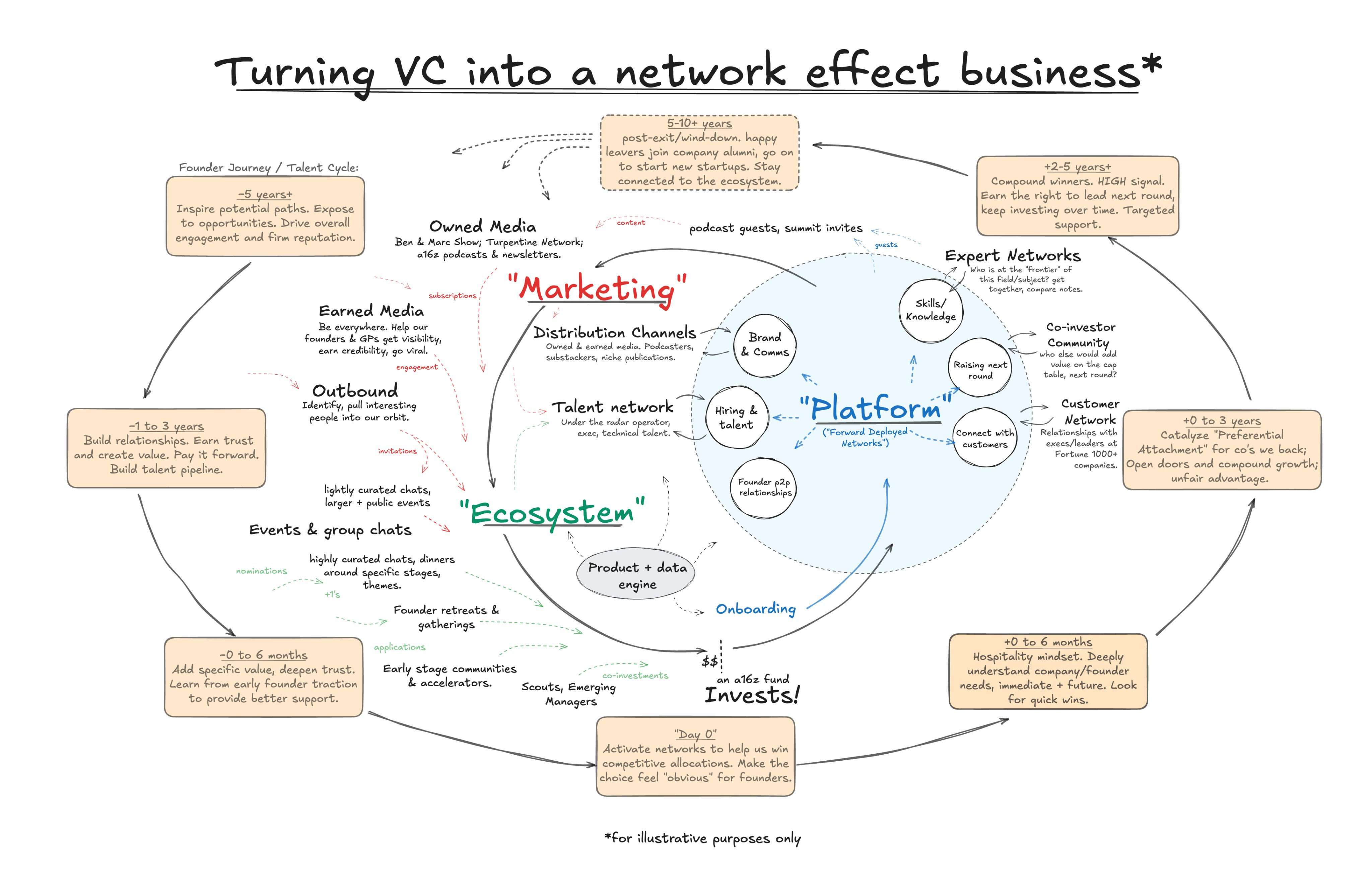
→ Why does it matter? Venture capital has always relied on networks, but most firms never learned how to scale them. Each new investment splits a partner’s attention, and the firm’s advantage erodes as it grows. David Booth’s idea reframes the problem and a16z hired him to implement it. If preferential attachment is how startups compound, then venture firms should build the same loop for themselves. The goal is to turn relationship capital into network infrastructure—where every founder, operator, and investor strengthens the system for the next. In that model, the firm stops acting like a service provider and starts behaving like a platform. The result is a structure where capital, talent, and trust reinforce one another, creating true compounding over time.
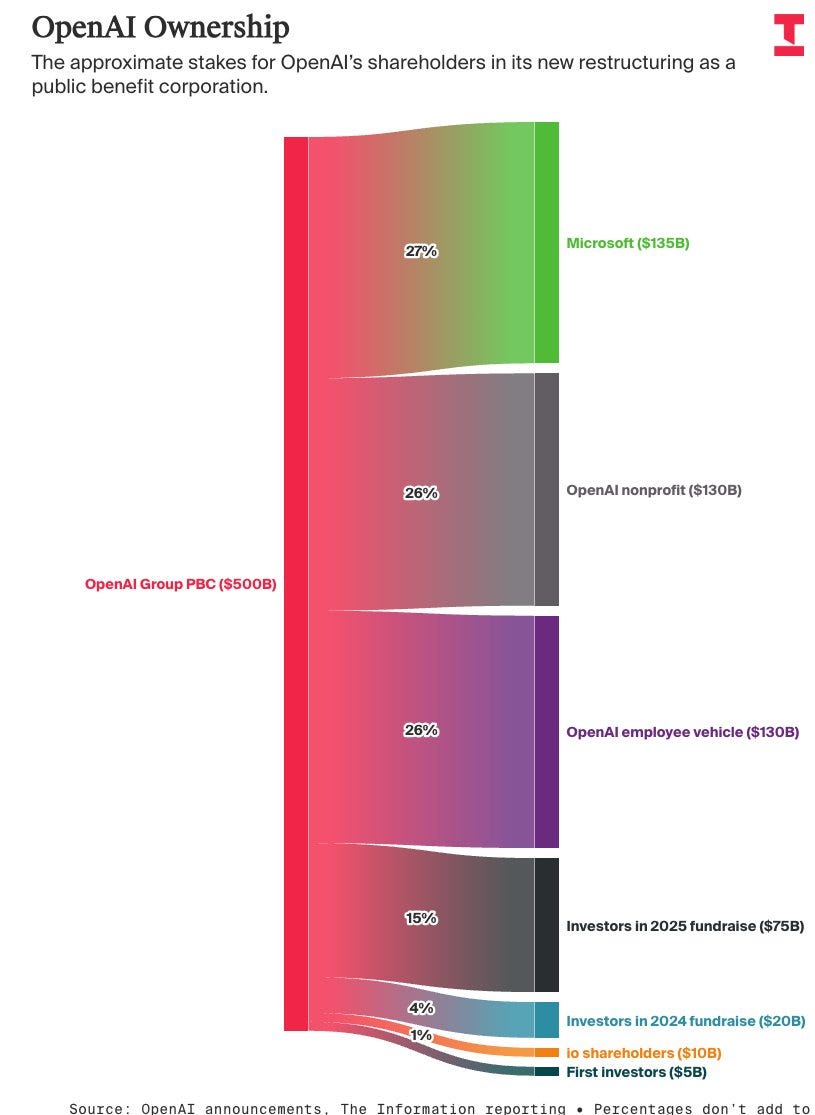
→ Why does it matter? OpenAI’s conversion to a public benefit corporation lets OpenAI raise capital and work with others, but Microsoft keeps the essential economics. It holds exclusive rights to the API and model IP through 2032, earns revenue share, and secures $250 billion in Azure commitments. OpenAI gains room to build, while Microsoft anchors the supply chain for intelligence itself.

Tweets that stopped my scroll:

→ Why does it matter? In my opinion, high agency may be the most important characteristic to look for when acquiring talent. Be the person that others want to call first.

→ Why does it matter? Wide-ranging conversation with Gavin here on whether or not we’re in an AI bubble and the future of SaaS. Worth a listen!

Worth a watch or listen at 1x:
→ Why does it matter? Pete Leyden got his start at WIRED during the early dotcom era. Since then, he’s built a career around one big question: where are we now, and where are we headed over the next decade, the next quarter century? His new book, The Great Progression: 2025 to 2050, argues that 2025 marks the start of an 80-year cycle of transformation. Convenient timing, perhaps, but a thought-provoking thesis all the same.
→ Why does it matter? GTC is Nvidia’s Super Bowl, and Jensen does not disappoint with his opening keynote. If you only watch the first 10 minutes or so about technological progress, you’ll be glad you did!

Quotes & eyewash:

→ Why does it matter? Might be this year’s scariest costume.
The mission:
The Wall Street Journal once used “Read Ambitiously” as a slogan, but I took it as a personal challenge. Our mission is to give you a point of view in a noisy, changing world. To unpack big ideas that sharpen your edge and show why they matter. To fit ambition-sized insight into your busy life and channel the zeitgeist into the stories and signals that fuel your next move. Above all, we aim to give you power, the kind that comes from having the words, insight, and legitimacy to lead with confidence. Together, we read to grow, keep learning, and refine our lens to spot the best opportunities. As Jamie Dimon says, “Great leaders are readers.”
Disclaimer: This content is for informational purposes only and does not constitute financial, investment, or legal advice. Readers should do their own research and consult with a qualified professional before making any decisions.
Thanks for writing this, it clarifies a lot. The distinction between knowledge work and judgment work is critical for understanding tech shifts. Your analysis of the dismissal-displacement-diffusion cycle is spot on. It realley explains the governance chalenges we face.
Love your big idea this week! It hits home.