


The big idea: Keep your bathrooms clean
Reading time: 2 minutes

There’s a lot of talk right now about AI getting so good at writing code that traditional software moats could disappear.
Here’s an idea for one that won’t: keep your bathrooms clean.
Over the weekend, we made our first family trip to Disney World. One highlight was lunch with Cinderella, in a castle surrounded by a giant moat. We will remember it for the rest of our lives.
I’ll also remember the bathrooms.
Magic Kingdom was packed, and so were the bathrooms, but every time I went in, it was immaculate. Counters wiped down, soap dispensers full, paper towels stocked.
That attention to detail kept showing up throughout the trip. When we got out of the Uber at our hotel, the staff greeted us by name. At one point, we spilled popcorn, and they cleaned it up within minutes. When we couldn’t figure out our meal plan credits, Disney employees quickly said, “Ah, no problem, this one is on us.”
We met only a small subset of the employees working at the resorts and parks, but their care was remarkably consistent. An army paying attention to the little things that made our day magical.
Keeping the bathrooms clean is one of the many lessons I’ve learned working for Dave Duffield. At PeopleSoft, it was actually business rule number one. His reasoning was pretty simple. A customer who walks into a dirty bathroom might reasonably wonder whether you’re putting the same care into your software. The little things people can see shape their confidence in everything else you do.
People notice what gets your attention. They learn from what gets rewarded, what gets ignored, and how they’re treated themselves. When an employee takes the time to solve a customer’s problem, the company's response teaches everyone else something about its priorities.
Over time, those decisions become the culture. Customers learn what and who they can count on.
Anyone can decide to keep their bathroom clean. Getting that same attention to detail across an entire company, every day, is a much bigger undertaking. You have to hire people who share those beliefs, take good care of them, and support them in doing the work. Including when it costs something.
Jim Collins and his research colleagues spent years comparing great companies with similar businesses that hadn’t achieved the same results. A central lesson was that the greats lived their core values while continually changing and improving.
The belief that customers deserve an exceptional experience can be immutable. The products you sell, the technology you use, and the way you serve those customers should all be open to change.
If AI helps you solve customer problems faster, improve your product, or deliver more value for what you charge, you should be eager to use it. That may mean changing something that has worked well for you.
A competitor may be able to reproduce more of your product. Your customers will still have to decide whom they want to do business with. Every promise you keep, problem you solve, and improvement you make gives them another reason to choose you.
At Disney, we experienced that all day. The castle and the princesses were wonderful. But the people who cared about all those little details made the whole trip unforgettable.
So many ordinary moments that led to something extraordinary. Now that’s a moat.

Best of the rest:
🐝 The Dot and the Swarm — Ethan Mollick explores how AI agents are learning to organize themselves, suggesting that coordinating AI may be easier than we thought and reshaping how companies get work done. — One Useful Thing
🏭 The Infinite SaaS Factory — Satya Nadella argues that AI agents will transform enterprise software from a collection of apps into personalized workflows, built on the business logic and data that make companies run. — Satya Nadella on X
🧪 Powerful open model is set to shake up AI race — Nvidia-backed Reflection is bringing a new open-weight model to market, giving businesses a cheaper way to build customized AI systems while challenging Chinese models and closed-model incumbents. — Axios
🎰 Broadcom CEO compares AI investors to casino gamblers — Hock Tan warns that many investors don’t understand their AI bets, questioning whether enterprise spending and money-losing AI labs can deliver lasting returns. — Bloomberg
🤖 What happens when your agent finally gets around to it? — Sarah Guo explores how personal AI agents could move idle cash, dispute medical bills, and finish the chores we keep postponing. Businesses that profit from our inattention could face customers who comparison-shop relentlessly without lifting a finger. — Sarah Guo
🛠️ AI agents learn to improve their own harnesses — Researchers trained a model to rewrite the code that controls another agent’s model calls, tools, and information flow. Using feedback from trial runs, it improved performance on reasoning and question-answering tasks unseen during training, with no further changes to either model’s weights. — arXiv

Charts that caught my eye:
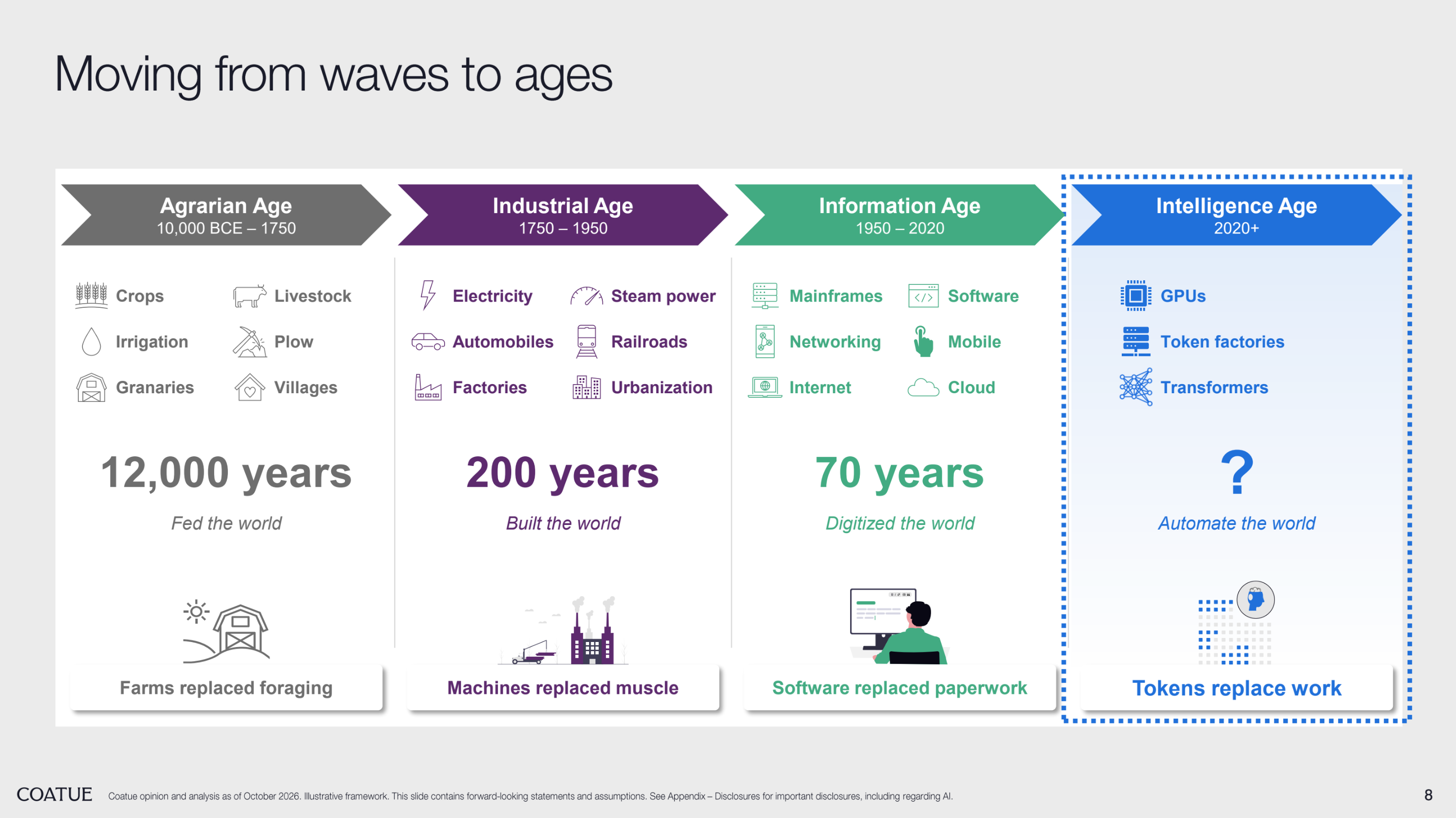
→ Why does it matter? Coatue’s latest Public Markets update has so many gems. Full deck is available here.
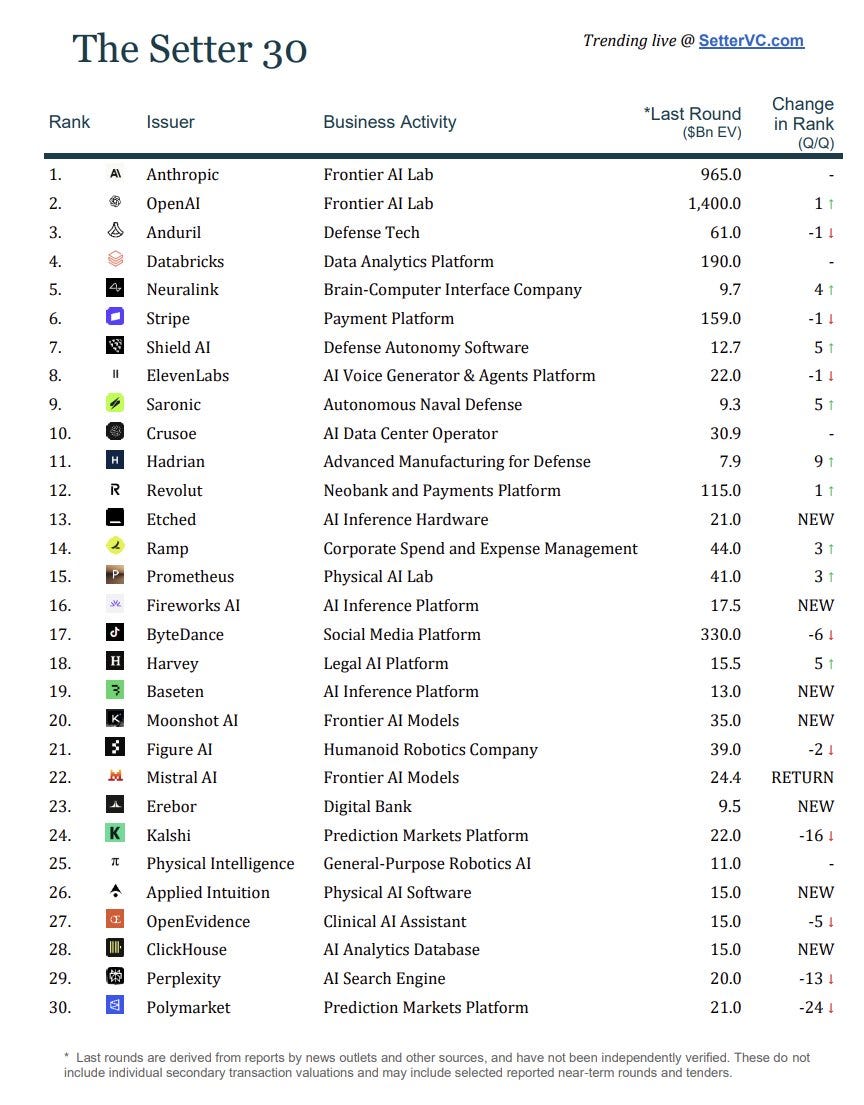
→ Why does it matter? SetterVC's look at the most in-demand private companies in the secondary market. AI dominates the list, with growing investor interest in defense technology and infrastructure. An interesting window into where private market capital wants exposure.

Tweets that stopped my scroll:

→ Why does it matter? Wild story. If you see an ant in your kitchen, there is likely more than one.

→ Why does it matter? A developer used AI agents to recreate and open-source seven Adobe applications, including Photoshop and Premiere, software franchises worth billions of dollars. The clones are still far from complete, yet he claims he will reach full feature parity within a month. An interesting example of how AI is reducing the cost of replicating software that took decades to build.

→ Why does it matter? Clara Shih is a force. After founding Hearsay and leading AI at Salesforce and Meta, she’s now building New Work Foundation, an AI-native nonprofit that helps young workers develop the skills, tools, and community they need to navigate an AI-reshaped economy. Check out her recent 60 Minutes interview!

→ Why does it matter? Worth the read. #6 caught my attention.

→ Why does it matter? Meta is back at the AI frontier with Muse Wonder Full, and Zuckerberg’s team is keeping the momentum going. They’ve now released Muse Spark Open, an open-weight model, and partnered with longtime rival Apple to run it locally on the new Mac Studio. An interesting development for American open-weight AI and the growing ability to run powerful models outside the cloud.
Worth a watch or listen at 1x:
→ Why does it matter? Alexandr Wang and Meta’s Muse come up a lot in this week’s RA, but I particularly enjoyed his conversation with David Senra. Wang describes the “PM smoothie” problem, where everyone contributes their favorite ideas until the product loses its identity. With Muse, Meta deliberately kept the team small, fewer than 200 people across model and product development, to preserve a single, coherent vision. A good reminder that great products require focus, restraint, and a willingness to leave good ideas on the table.
→ Why does it matter? Zuck: "We're gonna write this check for like $100 billion, $200 billion. I'm like, Alex, are you sure this is going to work?"
→ Why does it matter? Legendary Hollywood agent Ari Emanuel shares some incredible stories in this conversation with David Senra. I enjoyed it so much that I immediately picked up his new memoir, Roll the Calls. I’m a few chapters in, and it’s even better.

Quotes & eyewash:

→ Why does it matter? Flying cars wasn’t on my 2026 bingo card! 🤯
The mission:
The Wall Street Journal once used “Read Ambitiously” as a slogan, but I took it as a personal challenge. Our mission is to give you a point of view in a noisy, changing world. To unpack big ideas that sharpen your edge and show why they matter. To fit ambition-sized insight into your busy life and channel the zeitgeist into the stories and signals that fuel your next move. Above all, we aim to give you power, the kind that comes from having the words, insight, and legitimacy to lead with confidence. Together, we read to grow, keep learning, and refine our lens to spot the best opportunities. As Jamie Dimon says, “Great leaders are readers.”
Disclaimer: This content is for informational purposes only and does not constitute financial, investment, or legal advice. Readers should do their own research and consult with a qualified professional before making any decisions.