


The big idea: The case for a more decentralized AI Future
Reading time: 3 minutes

Hello, Mission Control. It’s day ~100 of an ongoing personal project where I have forced myself to reach for AI on nearly every job to be done. Call it full immersion. If you want to learn a language, go live somewhere where they speak it. Eventually, you’ll learn to get around. And I’d say, with this particular project, that’s where I’m at: able to get around.
I have set up dozens of project folders, designed to maintain context. I’ve provided access to email, calendars, and my browser. Every time a new “to-do” comes in, I ask AI to take the first shot.
So, how’s it going? Well, I’d say at best, it’s clunky. Let me explain.
On my Mac Mini, the primary product I use is called ChatGPT Work, which was built by OpenAI. ChatGPT Work is a harness, the software developed around the model to help it get the context it needs and keep it on track. ChatGPT Work was originally called Codex, and it was intended for software developers. And software development is not what I am asking my AI to get done for me, it’s more so everyday knowledge work.
Thus, I have had to configure a lot. I am constantly updating my agents instruction sets, trying to improve how they coordinate with one another, attempting to maintain context across conversations. Dot, the “always on” assistant, often has no idea what we’re talking about and struggles to connect a task we just completed with a new one. The system is constantly spitting out these verbose Markdown files that I simply don’t have time to read.
It’s sort of a mess. And I kind of love it. In a hobbyist early adopter type of sense. I seriously don’t mind gardening this setup because I’m super curious to learn how it all works. So I’m happy to do it.
But the strategist in me thinks, gosh, it’s going to be really hard for OpenAI and Anthropic to be everything for everyone. The AI product I really need? It’s more and more the instructions, configuration, custom connections and workflows that I’ve been building to make the AI do what I want it to do.
Those things reflect how I work. What I want it to remember, what it can do without asking me, and when I need to be involved. Someone else could use the same model and want a very different setup.
In 1945, economist Friedrich Hayek wrote about “the knowledge of the particular circumstances of time and place.” Knowing the general rules only gets you so far. Knowing the people and the situation helps you actually decide and do.
There is no doubt that general-purpose AI is useful. These models have learned from enormous amounts of information, basically the entire public internet. I am not surprised that most people use them as a better version of Google search.
But to help with our work, AI needs to know more about the particular job. What did we promise this customer? Which information is current? Does this need someone’s approval?
What I think this leads to is a much more decentralized AI future than we may be predicting at the moment. A lot of attention goes to OpenAI and Anthropic, and it should. But I suspect a lot of the finished product will come from people who understand the work well enough to put all of this together.
If that’s where we’re headed, here’s what I’d expect.
More small and open-weight models doing particular jobs. A system pulling details out of invoices may be able to use a smaller, cheaper model, then call on a larger one when something needs more reasoning. A business could use several models without its employees needing to know which one is handling each task.
More AI built around a company’s own information and ways of working. For an investment firm, that might mean preparing for a meeting using previous investment memos, the latest company numbers and the questions the team still needs answered. The model supplies part of the capability. The firm supplies the knowledge of what to look for.
And more choices about who runs it. Some companies will want systems they control themselves. Others will pay someone to build and look after them. Some work could happen on a device, other work in the cloud.
If you know a particular industry really well, I think there’s a lot you could do here. You know the jobs people need done and where the existing software leaves them doing the rest by hand. OpenAI and Anthropic could do very well supplying the models, while you build the product around that work.
Further evidence, a lot of the product we need is not the model itself, it’s what you build around it.

Best of the rest:
🎭 The Many Failures of Larry David — Before Seinfeld and Curb Your Enthusiasm, Larry David’s career was a string of disappointments. Blake J. Harris explores the stubborn creative conviction that made him difficult to employ—and eventually impossible to imitate. — Colossus
⏳ If your team is too busy doing their ‘normal job’ to experiment with AI, you’re preparing them to be replaced — Geoffrey Huntley argues that managers owe their teams time to learn AI tools, warning that keeping everyone buried in today’s work leaves them unprepared for how software development is changing. — Geoffrey Huntley
🚀 How to be more ambitious: A tutorial for humans with models — Felix Rieseberg offers a practical guide to aiming higher with AI: work backward from the outcome you want, dig into raw data with expert methods, and borrow techniques from other fields—with independent checks to see whether the results hold up. — Felix Rieseberg
👥 How employment is changing at Anthropic — Anthropic’s internal study finds rising output, a shrinking share of junior technical hires, and employees increasingly managing teams of AI agents. Human attention has become the bottleneck, while hiring managers put more weight on autonomy and judgment. — Anthropic

Charts that caught my eye:
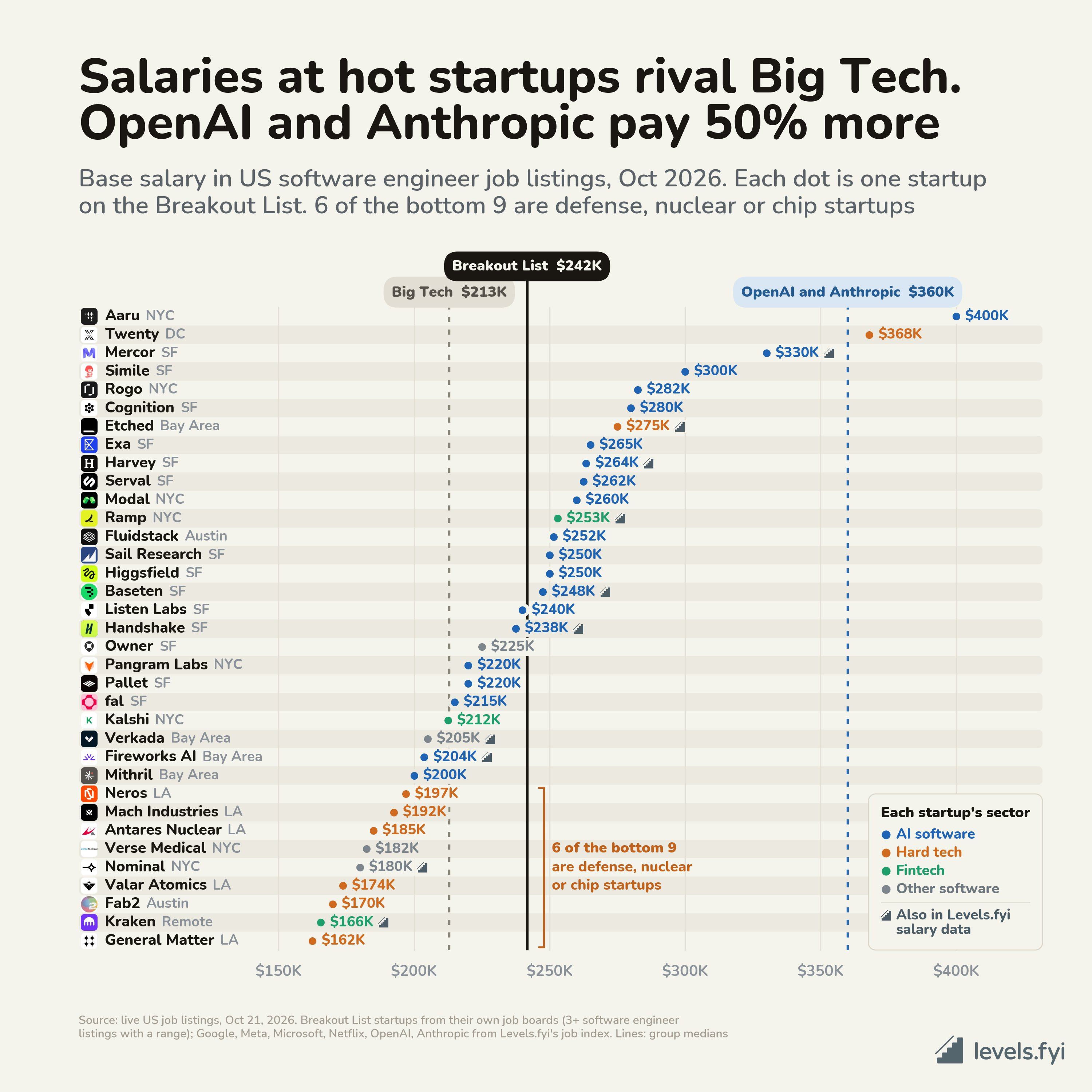
→ Why does it matter? The talent market for who individuals who understand AI has never been more competitive. OpenAI & Ant now paying 69% more than traditional big tech!
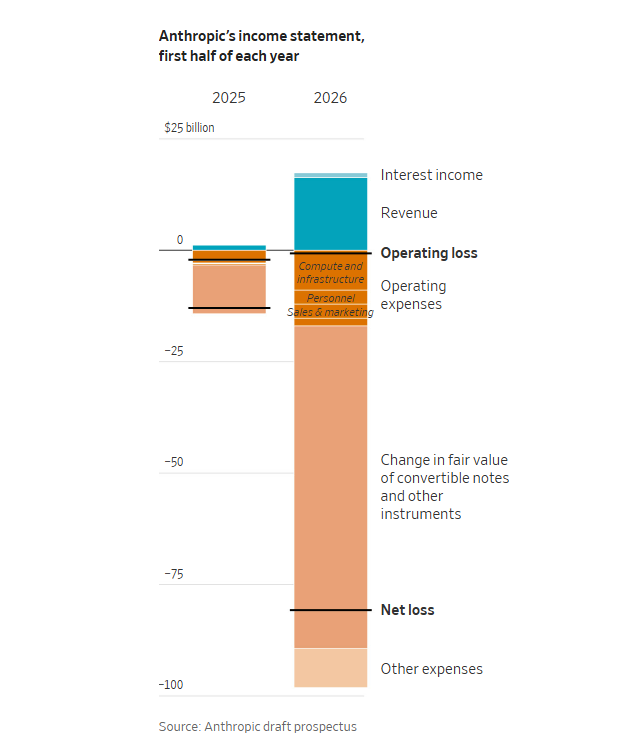
→ Why does it matter? Pretty wild chart from Anthropic’s draft IPO prospectus. Imho, the wildcard here is the revenue mix. I don’t know the exact split, but I’d bet the majority comes from enterprise/API customers. Meanwhile, Anthropic is subsidizing heavy users on its $100–200 monthly subscriptions. According to SemiAnalysis, you can get roughly $10k of API-equivalent usage for $200 on Claude Max, depending on the model and workload. That doesn’t mean it costs Anthropic $10k, but it’s a massive discount. Enterprise API customers pay for usage. Heavy subscribers are getting a bargain.
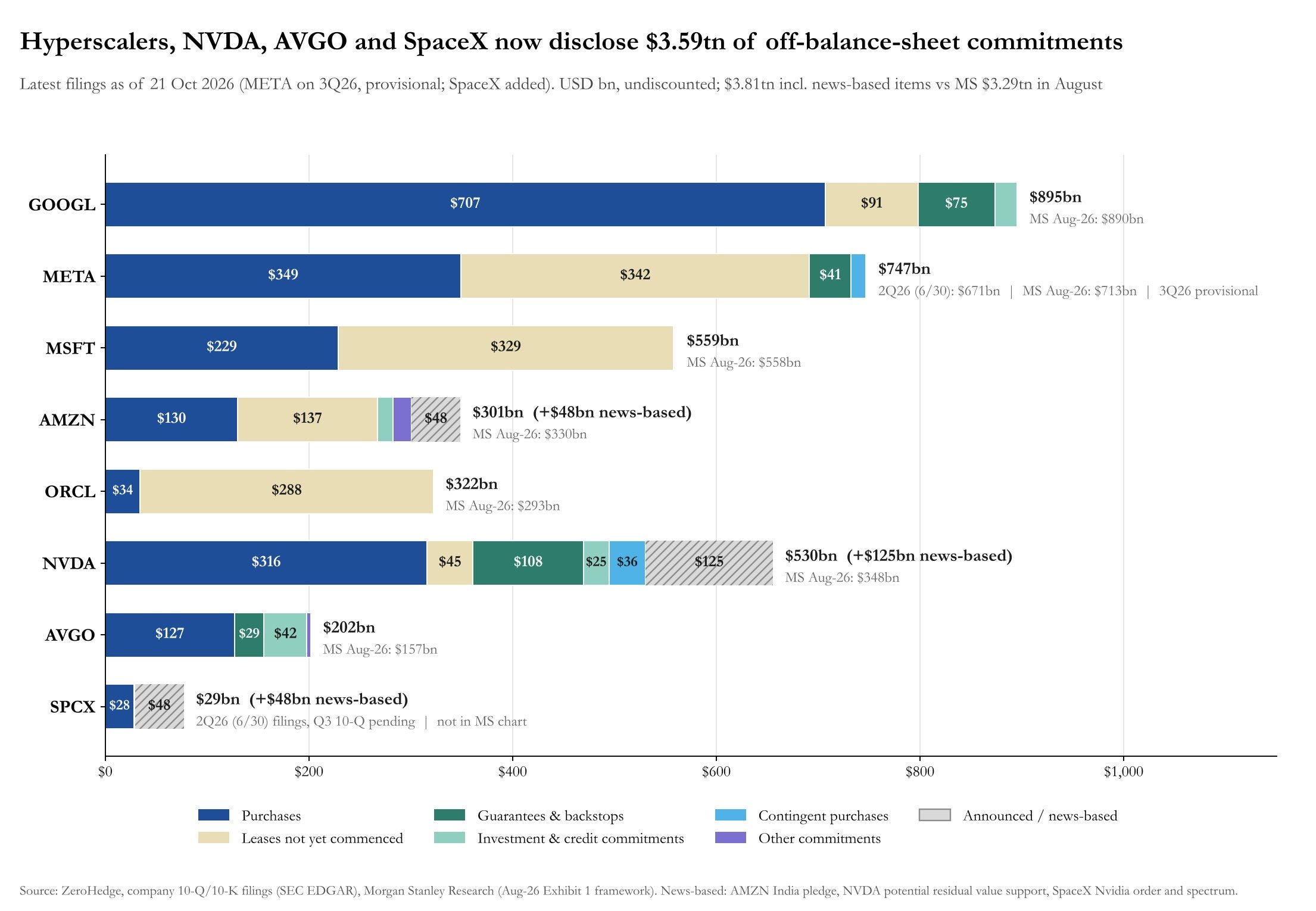
→ Why does it matter? Pretty good summary of the nearly $3.6 trillion in off-balance-sheet commitments supporting the AI infrastructure buildout. These purchase commitments, leases and guarantees are pulling banks and private credit into financing it. The AI bet now extends well beyond tech stocks.

Tweets that stopped my scroll:

→ Why does it matter? They’re calling it Black October. A wave of cybersecurity attacks, with AI helping attackers move faster. The internet was never designed with AI in mind, and I think it’s going to get worse before it gets better. Please use a password manager like 1Password, turn on two-factor authentication, keep your devices and home router updated, set a family code word, and consider an identity protection service like Aura.

→ Why does it matter? This may feel like we’re living in the Matrix. Scientists built a computer model from a real fruit fly’s brain wiring, and Odyssey says it’s now flying around an AI-generated world. You’ve likely heard of these “world models,” which some AI researchers think could be the next big breakthrough. The idea is to simulate how the world behaves so AI can learn by interacting with it. Pretty wild.

→ Why does it matter? Meet Claude Duet, Anthropic’s competitor to GrokBot and Dots, plus OpenClaw and Hermes on the open-source side. It flags what needs your attention, keeps working while you’re away, and checks with you before acting on your behalf. Imho, this is the next most exciting form factor in AI.
Worth a watch or listen at 1x:
→ Why does it matter? Ken Griffin covers a lot of ground here: capital markets, GPUs, the AI buildout, geopolitical conflicts and the upcoming midterms. Worth a watch!
→ Why does it matter? This interview was so good. I had never heard the story about Marc Stad turning $1 million into $4 million investing in MercadoLibre as a summer intern at IGSB, or walking into TPG’s office and leaving six hours later with a job. Marc offers a ton of helpful life and career advice. I especially loved the stories about his mentors and the role they’ve played in his life.
→ Why does it matter? The story about Ryan Serhant getting an actor friend to pose as a hedge fund manager for his Million Dollar Listing audition is pure gold. Half-eaten bagel, Financial Times under his arm and all. A ton of helpful advice here on sales, confidence and creating your own opportunities.
→ Why does it matter? Marques Brownlee is the best reviewer in tech, imho. I love The Verge, too. If you’re interested in the iPhone Duo, this is one of the better reviews. Worth a watch!

Quotes & eyewash:
“If you do build a great experience, customers tell each other about that. Word of mouth is very powerful.” — Jeff Bezos
→ Why does it matter? There is nothing more powerful than your customers telling others they’d do it again.
The mission:
The Wall Street Journal once used “Read Ambitiously” as a slogan, but I took it as a personal challenge. Our mission is to give you a point of view in a noisy, changing world. To unpack big ideas that sharpen your edge and show why they matter. To fit ambition-sized insight into your busy life and channel the zeitgeist into the stories and signals that fuel your next move. Above all, we aim to give you power, the kind that comes from having the words, insight, and legitimacy to lead with confidence. Together, we read to grow, keep learning, and refine our lens to spot the best opportunities. As Jamie Dimon says, “Great leaders are readers.”
Disclaimer: This content is for informational purposes only and does not constitute financial, investment, or legal advice. Readers should do their own research and consult with a qualified professional before making any decisions.