

The Wall Street Journal once used ‘Read Ambitiously’ as a slogan, but it became a challenge I took to heart. If that old slogan still speaks to you, this weekly curated newsletter is for you. Every week, I will summarize the most important and impactful headlines across technology, finance, AI and enterprise SaaS. Together, we can read with an intent to grow, always be learning, and refine our lens to spot the best opportunities. As Jamie Dimon says, “Great leaders are readers.”
Thanks to GenerativeAI and our friends at GoogleNotebookLM, you can enjoy this week’s Reading Ambitiously as a podcast entirely generated by AI. If you haven’t experienced this technology yet, definitely give this a try!

In the news:

🕵️♂️ How Google Spent 15 Years Creating a Culture of Concealment - To avoid antitrust suits, Google systematically told employees to destroy messages, avoid certain words, and copy lawyers on communications - The New York Times
→ Why does it matter? Major regulatory actions and antitrust lawsuits often coincide with technological paradigm shifts, such as the transitions from mainframe to client/server and from client/server to the cloud. Historically, we’ve seen cases like the DOJ vs. IBM during the mainframe era and the DOJ vs. Microsoft during the rise of client/server computing. Now, the focus has shifted to the cloud era, with the DOJ taking on Google and Big Tech. This week, antitrust officials are reportedly considering requiring Google to spin off its Chrome browser business, reminiscent of the DOJ’s challenge to Microsoft over bundling Internet Explorer with Windows. This development is part of a broader antitrust battle surrounding Google that has been building since 2020.
• October 2020: The U.S. Department of Justice (DOJ) filed an antitrust lawsuit against Google, alleging it maintained an illegal monopoly in search and search advertising markets. (Wikipedia)
• January 2023: The DOJ initiated a second lawsuit, accusing Google of monopolizing the digital advertising technology market. (Wikipedia)
• August 2024: A federal judge ruled that Google violated antitrust laws by monopolizing the search market. (Reuters)
• October 2024: The DOJ proposed remedies, including potential divestitures of assets like the Chrome browser (worth as much as ~$20B) and Android operating system, to address Google’s search monopoly. (Reuters)
While Google navigates regulators, Artificial Intelligence is here — in many ways, thanks to them! They wrote the seminal paper Attention Is All You Need, which brought us large language models. They have one of the largest datasets in the world, the Google Index, to train AI on. DeepMind (acquired by Google in 2014) has historically had some of the best AI Researchers in the world.
So, will Google be more like Microsoft, who ultimately took full advantage of the emerging paradigm we know today as cloud? Or will they be more like Xeroc PARC, which, too, had invented much of the foundational technology of their era but failed to commercialize it the way Apple and Microsft did? Don’t count them out yet. Remember, they were the 17th entrant into the crowded search industry, of which today they are the market leader. Stay tuned!

Best of the rest:
🌟 Hard Truths and Principles for Life - A cursed fact of the world is that the most important life lessons often sound like clichés. Here are a few hard-earned principles to keep in mind. - Nabeel Qureshi’s Blog
🔮 From Prediction Markets to Info Finance - Vitalik Buterin (inventor of the Ethereum blockchain) explores how “info finance” can address modern trust challenges in politics, science, and commerce—beyond the success of prediction markets like Polymarket. - Read on Vitalik’s Blog
🕰️ AI’s Slowdown Is Everyone Else’s Opportunity - As AI’s rapid growth cools, businesses get a much-needed pause to focus on delivering meaningful returns on investment. - Bloomberg Opinion
🖥️ Relevance! Relevance! Relevance! At 50, Microsoft Is an AI Giant, Open-Source Lover, and as Bad as It Ever Was - Under Satya Nadella, Microsoft transformed from lumbering and uncool to an AI giant, while grappling with its enduring flaws. - WIRED
🧖♂️ Want to Network in Silicon Valley? Bring a Bathing Suit. Instead of bars and restaurants, saunas are the new place for investors and founders to socialize and raise money. - The Wall Street Journal

Charts that caught my eye:
🤖 RIP to RPA: The Rise of Intelligent Automation - Generative AI is enabling true automation through agents, surpassing traditional Robotic Process Automation (RPA). - a16z
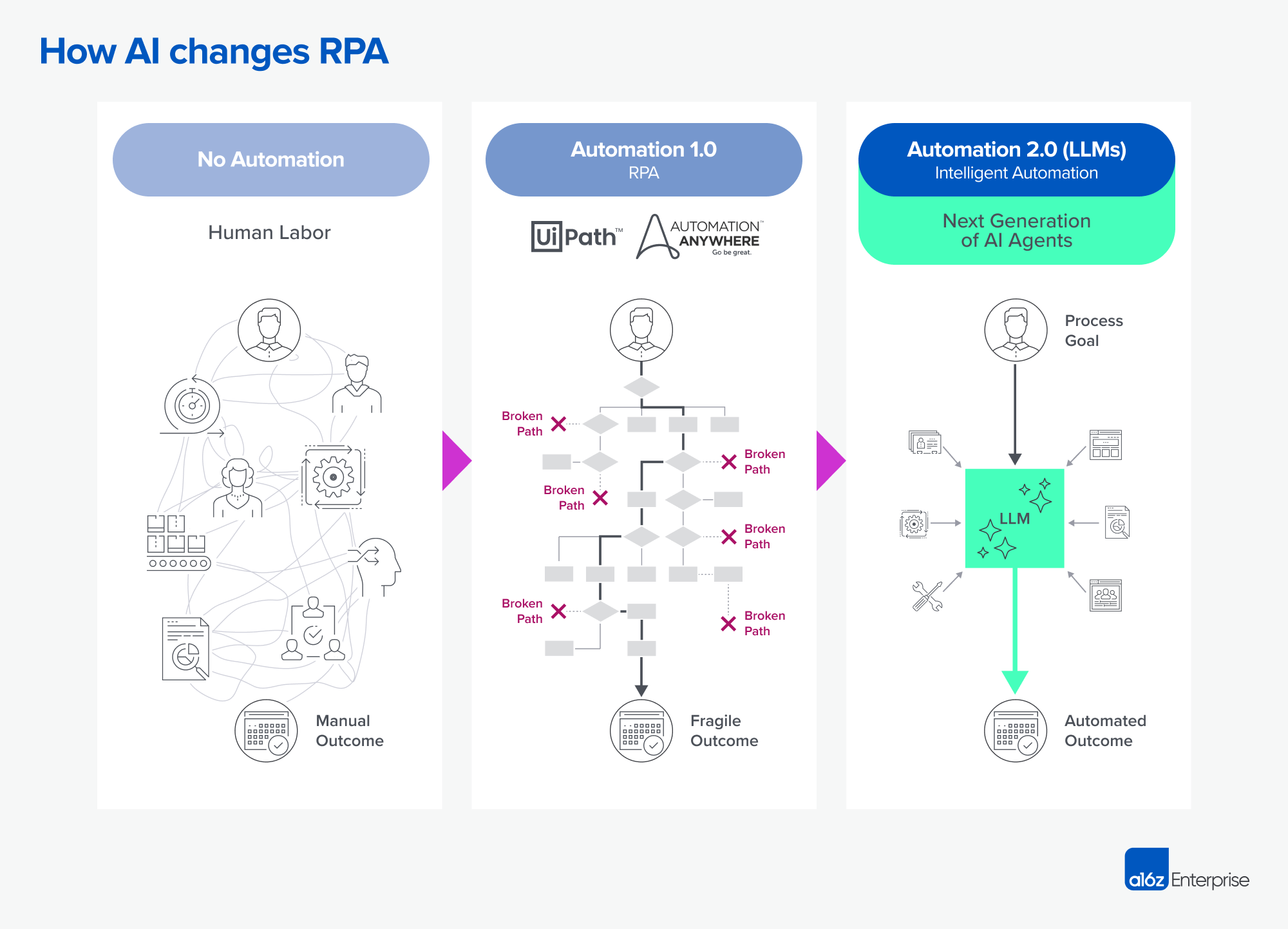
→ Why does it matter? RPA stands for Robotic Process Automation. Here is an overly simplified definition from ChatGPT.
Imagine you have a robot friend who’s great at copying and pressing buttons on a computer. This robot can handle all the boring tasks you don’t want to do, like clicking on the same boxes, typing the same words, or moving files from one folder to another. It works super fast, never gets tired, and doesn’t make mistakes. That’s called Robotic Process Automation, or RPA—it’s like giving your robot a list of chores to do on your computer so you can go play while it works!
Over the past decade, leaders like UiPath, Automation Anywhere, and BluePrism have built the best RPA tools. Global System Integrators like Deloitte and Accenture love RPA. They’ll come into your business and configure these “bots” to use your ERP system and automate mundane tasks. The problem? These bots rely entirely on hard-coded rules and logic — they cannot think, learn and improve. AI Agents? They can. Now these RPA tools are potentially going to become entirely obsolete.
📊 Healthcare Administrators vs. Physicians: Explosive Growth in the U.S. Between 1975 and 2010, healthcare administrators grew by a staggering 3200%, compared to a modest 150% growth in physicians, according to Athena Health’s analysis of Bureau of Labor Statistics data. - ResearchGate
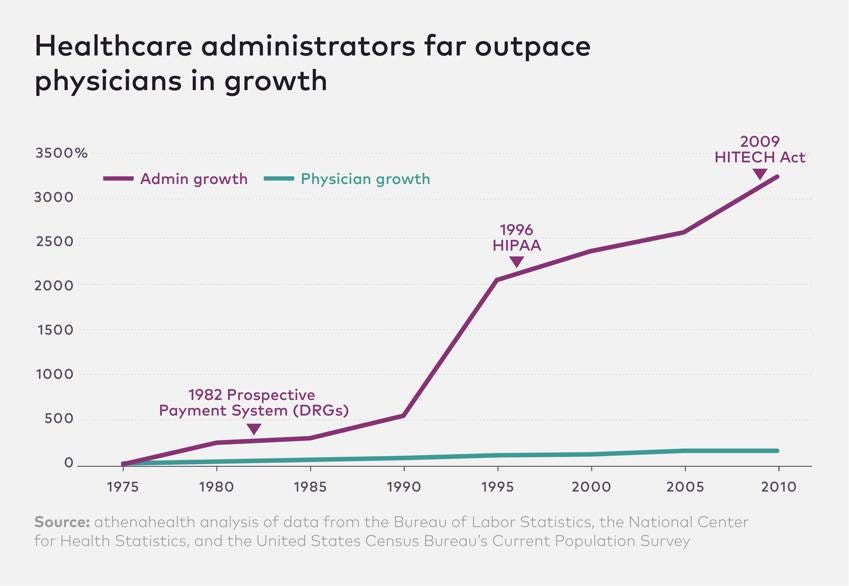
→ Why does it matter? We need to point AI at this. 🤯

Tweets that stopped my scroll:

→ Why does it matter? It’s like the Sims but instead with AI brains?! I find this research so fascinating. This is very similar to the Agent Hospital (May 2024) research which simulated an entire hospital run by AI Agents.

→ Why does it matter? This is only the 3rd SaaS IPO of 2024. Check out Meritech’s S-1 breakdown here.

Worth a watch or listen at 1x:
→ Why does it matter? This is a very good interview. Marc Rowan is the Founder & CEO of Apollo Global. Marc is rumored to be a candidate for US Treasury Secretary (we are currently writing this on 11-21). Marc’s firm, Apollo Global, manages $680B of assets, almost entirely in fixed-income private markets. Interested in how private markets are reshaping the global investing landscape? Give this a listen!
→ Why does it matter? From the Knowledge Project, “Adam Karr shares how to select and excel in the 'game' you play in life by channeling your obsessions, understanding different investment strategies, and focusing on first principles.” I loved the story about Kobe Bryant shooting hoops at 4am!

Quotes & eyewash:
You Are What You Read, Even If You Don’t Always Remember It - Jim Nielsen
The goal of a book isn’t to get to the last page, it’s to expand your thinking.
V4 | Economics | Trade-offs by Shane Parrish
Life is full of trade-offs. Every choice has a cost. When you say yes to one thing, you say no to others. This is how the world works. It’s like gravity. You can’t escape it.
Opportunity cost is what you give up when you make a choice. It’s the thing you can’t have because you picked something else. Say you have a free evening. You can work on your startup or go to a movie. If you work, you miss the fun. If you go to the movie, you miss the chance to make progress. Every choice has an opportunity cost because you implicitly say no to many other things every time you say yes to something. You need to know your opportunity costs. This helps you make good trade-offs.
A trade-off is giving up one thing to get something else. It’s choosing between options. Each has good and bad points. Trade-offs are about priorities. When you make something, you face trade-offs. If you want it fast, you might lose some features. If you want it cheap, you might use lower-quality materials.
In life, we face trade-offs all the time. Do you take the high-paying job with long hours? Or the low-paying one with more free time? Do you spend money now or save for later?
Making good trade-offs is about weighing the opportunity costs and benefits of each option and choosing the one that aligns best with your goals and values. It’s not always easy, but being conscious of the trade-offs you’re making can help you make better decisions.
Wisdom is anticipating the consequences of your choices. In life and business, success is about making good trade-offs. It’s not about having it all. It’s about having what matters most. We all value different things. That’s what makes life rich. Opportunity cost is what you give up when choosing; trade-offs are the balancing acts you perform when deciding between competing options. They’re two sides of the same coin—whenever you make a trade-off, you incur an opportunity cost for the options you didn’t choose. The key in both cases is to be thoughtful and intentional about your choices.