

The Wall Street Journal once used ‘Read Ambitiously’ as a slogan, but it became a challenge I took to heart. If that old slogan still speaks to you, this weekly curated newsletter is for you. Every week, I will summarize the most important and impactful headlines across technology, finance, AI and enterprise SaaS. Together, we can read with an intent to grow, always be learning, and refine our lens to spot the best opportunities. As Jamie Dimon says, “Great leaders are readers.”
Thanks to GenerativeAI and our friends at GoogleNotebookLM, you can enjoy this week’s Reading Ambitiously as a podcast entirely generated by AI. If you haven’t experienced this technology yet, definitely give this a try!

In the news:
A System of Agents brings Service-as-Software to life (Foundation Capital)
How builders can tap into the $4.6 trillion opportunity as AI transforms software from tool to worker.
→ Why does it matter? There have been multiple technological revolutions in the world of enterprise software: Mainframe → Client/Server → Cloud —> Mobile. A new one is emerging right now: Artificial Intelligence.
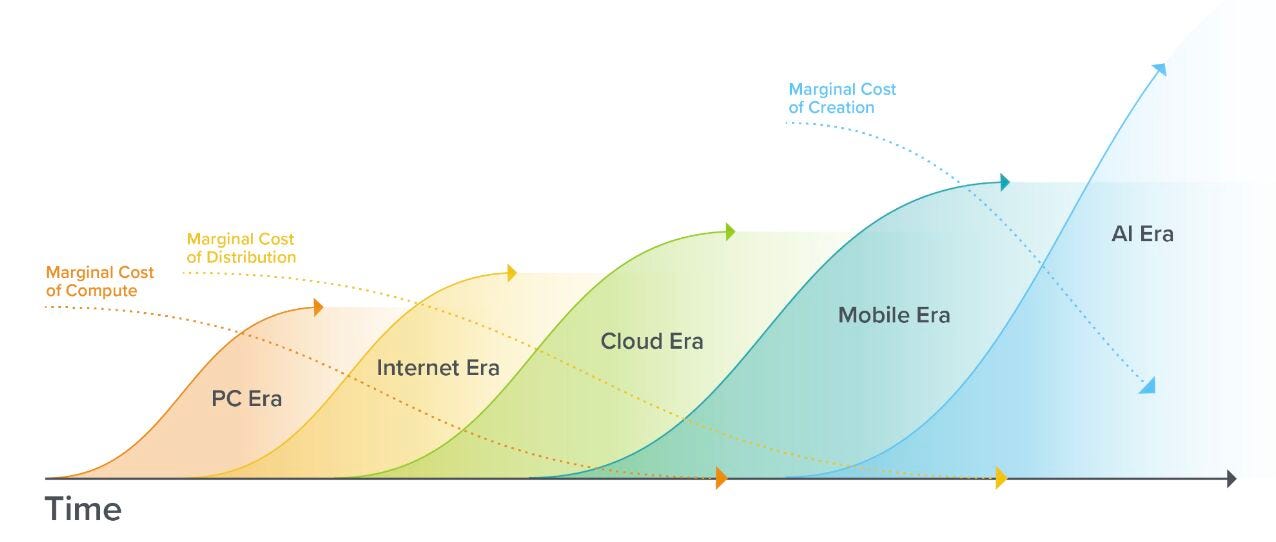
What’s a technological revolution? Here’s a great definition from my favorite economist on the subject, Ms. Carlota Perez:
A technological revolution can be defined as a powerful and highly visible cluster of new and dynamic technologies, products and industries, capable of bringing about an upheaval in the whole fabric of the economy and of propelling a long-term upsurge of development. It is a strongly interrelated constellation of technical innovations, generally including an important all-pervasive low-cost input, often a source of energy, sometimes a crucial material, plus significant new products and processes and a new infrastructure. The latter usually changes the frontier in speed and reliability of transportation and communications, while drastically reducing their cost.
- Technological Revolutions and Financial Capital: The Dynamics of Bubbles and Golden Ages (2002)
Cloud was born out of the convergence of multiple technologies that made it possible to deliver software as a service (SaaS). What does that mean? The idea is simple: You access the software over the Internet.
Before the cloud, you had to build expensive data centers and IT infrastructure. After the cloud, your vendor took on that responsibility, hence we say “as a service.” Sometimes, an iceberg helps to visualize this.
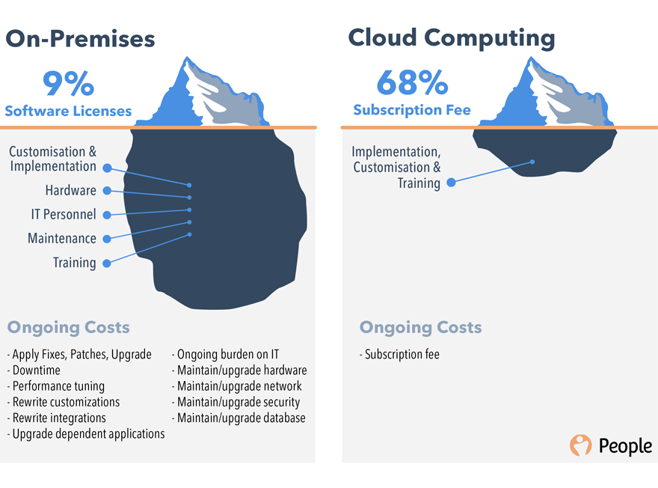
A few months back, a mentor told me, “The last “S” in SaaS is starting to evolve.” In an AI-native world, “service” can mean way more than just IT infrastructure and security… a whole lot more. Here is how Foundation Capital describes it:
AI companies are leading a transition from Software-as-a-Service to Service-as-Software, turning the table on the very essence of SaaS. In the software business, a company may sell access to its platform or tool, but customers are still responsible for using that tool to achieve the desired outcome. In the services business, responsibility for achieving the desired outcome sits with the company selling the service. Instead of QuickBooks, you offer tax services—in this case, conducted by an AI accountant. The upside of this change is huge—a $4.6 trillion opportunity, since the global services market dwarfs the software market in size.
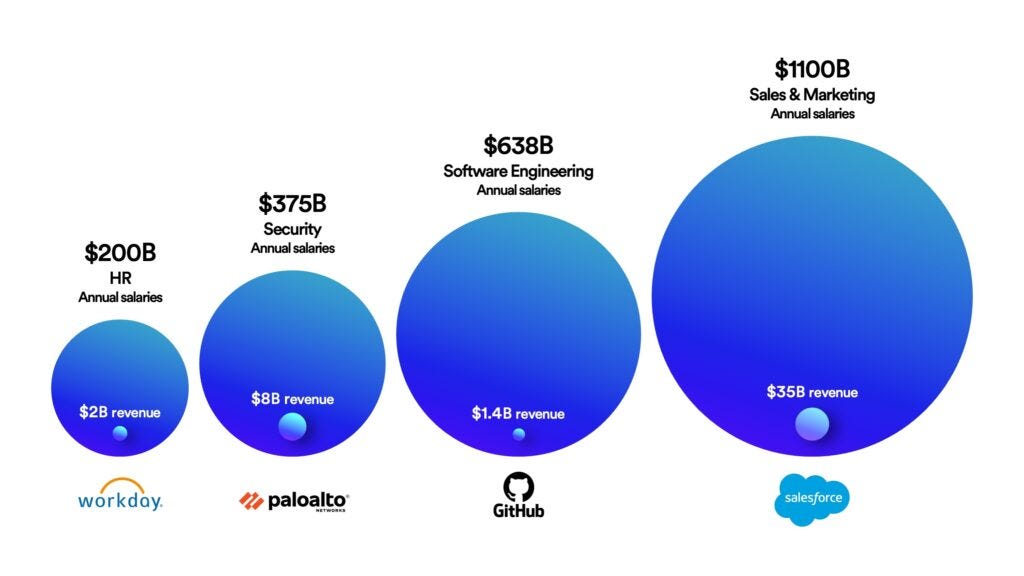
The idea is simple: with AI — particularly AI Agents—software doesn’t just assist with work; it actually does the work. And when software can handle tasks directly, the markets for software companies get a whole lot bigger.
So, is AI coming for all our jobs? I doubt it—at least not anytime soon. I think it’s actually pushing us toward higher-value work. It’ll handle about 70% of the most tedious tasks, freeing us up to put our brains to work on the top 30%. Every big tech leap—from the printing press to the telegraph, electricity, and modern computing—shifted us toward more valuable roles and opened up new economic opportunities. I’m betting this time will be no different.

Best of the rest:
🤖 T-Mobile and OpenAI Strike $100 Million AI Deal - The Information
✨ Highlights from last week’s earnings calls:
Microsoft on AI - “We're excited that only 2.5 years in, our AI business is on track to surpass $10 billion of annual revenue run rate in Q2. This will be the fastest business in our history to reach this milestone.”
Google on AI - “Today, more than 25% of all new code at Google is generated by AI, then reviewed and accepted by engineers. This helps our engineers do more and move faster.”
Meta on AI - “Meta AI now has more than 500 million monthly actives.”

Charts that caught my eye:
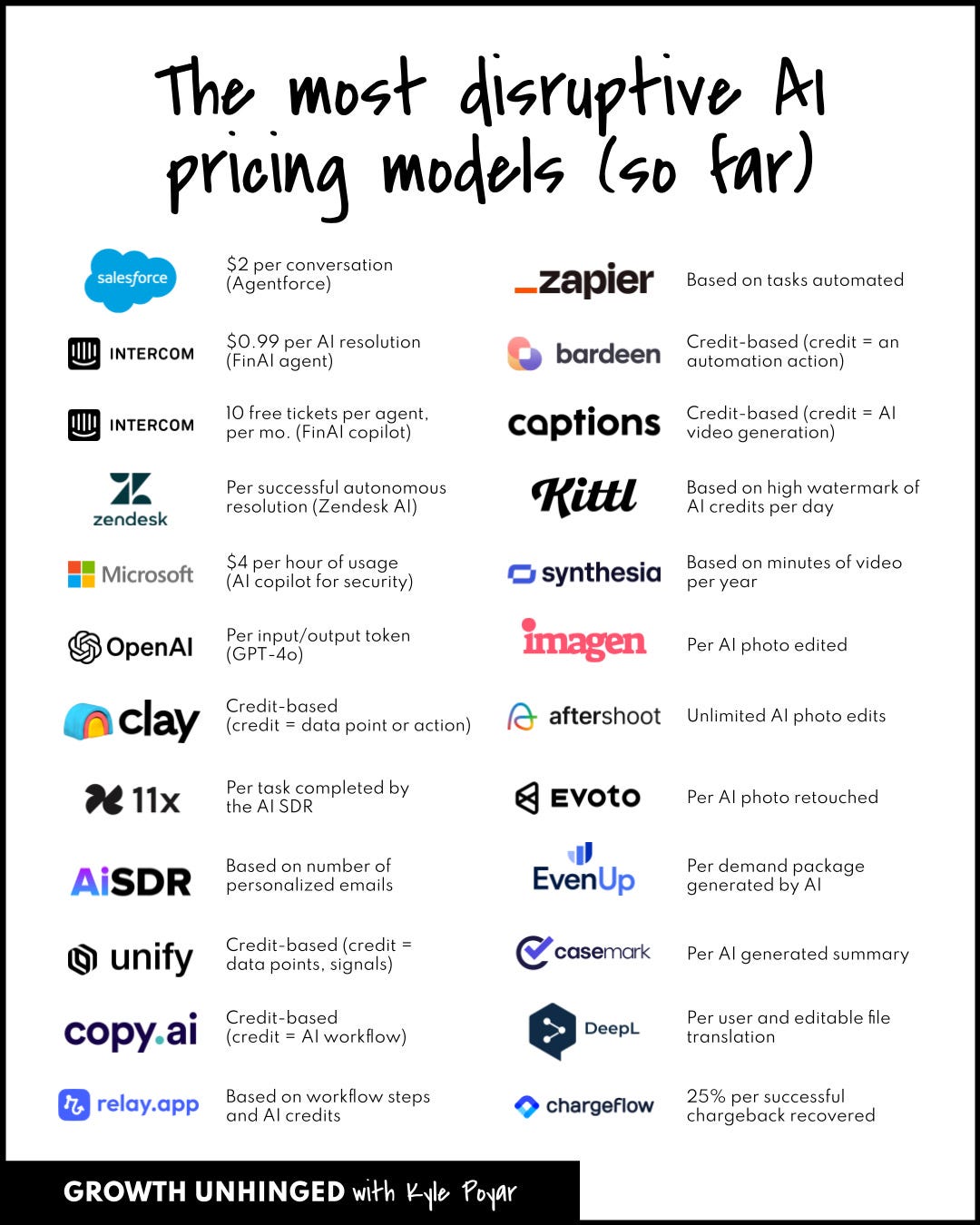
→ Why does it matter? Here are 24 examples of how AI products are priced, including SalesForce.com’s announcement last week of $2/conversation. It is very interesting as there are no “user-based” models like much of the software in today's market.
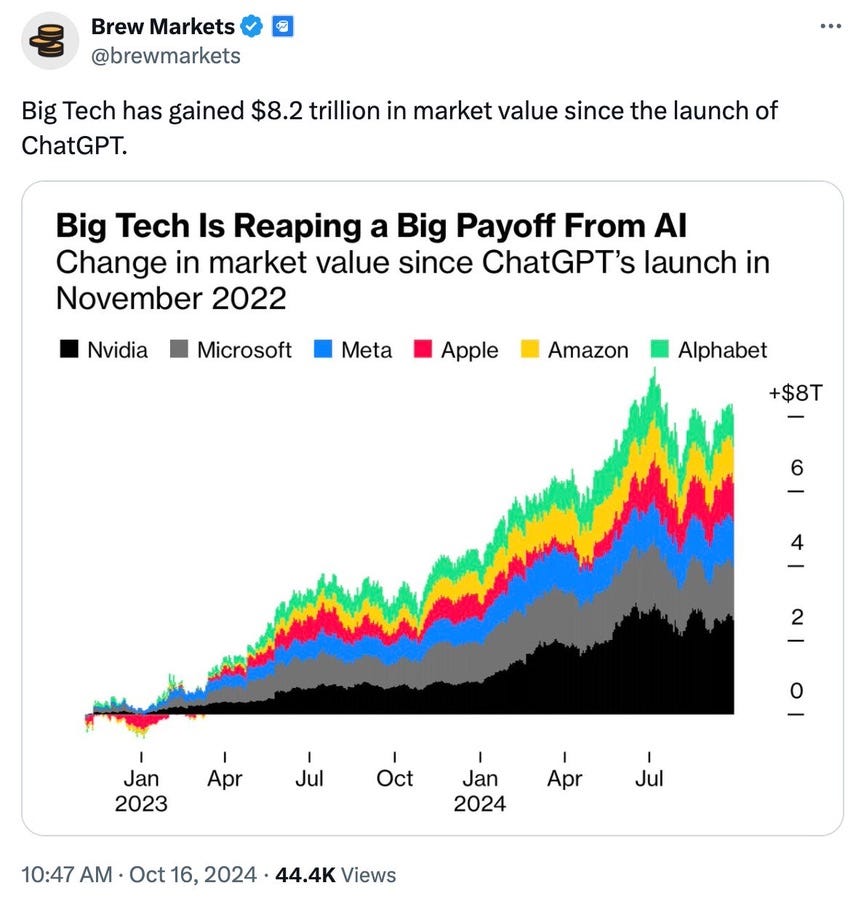
→ Why does it matter? Wow!

Tweets that stopped my scroll:

→ Why does it matter? Tobi Lutke is the Founder & CEO at Spotify. This 10-minute talk is about his experience building AI Agents. My favorite line: “Pay attention when things go from being impossible to really hard. Once they're really hard, figure out how to attack them so that you can be first.”
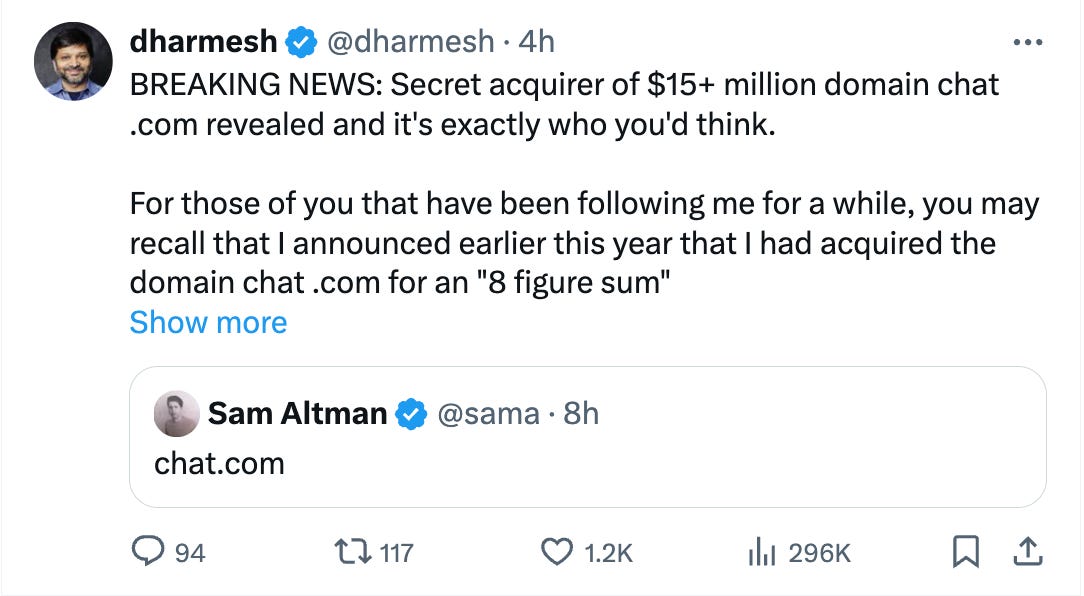
→ Why does it matter? OpenAI acquired the domain name “chat.com” for $15M! Evidence of their continued push into consumer and challenger to Google? Altman recently tweeted that one of his favorite new ChatGPT features is using it to “search the web”… That sounds like a Google competitor to me. TechCrunch has the scoop here.

Worth a watch or listen at 1x:
→ Why does it matter? My 5-year-old daughter says, “I don’t know how to do that… yet.” Here’s a quick, 10-minute must-watch on the difference between a growth and a fixed mindset.
→ Why does it matter? When Druck speaks, people listen!
📉 No clear signs of a US recession
📈 Inflation might not have peaked yet (think deregulation, tariffs)
🔭 Invest for the future—focus 18-24 months ahead
💪 Bullish on Nvidia: grads shifting from crypto to AI
⏰ Morning routine: up at 4:00am, ☕️ coffee, then 📄 WSJ / 📰 FT / 🗞️ NYT

Quotes & eyewash:
Mental Models - Physics & Relativity by Shane Parrish
“Relativity is the idea that our perceptions and judgments are not absolute, but are shaped by our unique vantage points and frames of reference. It’s the understanding that our experiences are subjective.
We each inhabit a particular web of experiences. This context shapes how we see the world, what we notice and overlook, what we value and dismiss.
Two people can look at the same event and come away with vastly different interpretations based on their unique frames of reference. Consider two people standing in the same room: They experience the same absolute temperature differently. One can feel hot while the other feels cold, even though the temperature is the same.
However, relativity is not the same as relativism— the idea that all perspectives are equally valid. Recognizing the relativity of our perceptions doesn’t mean we don’t have to make judgments about validity. Rather, it’s a call to examine our assumptions, seek out diverse perspectives, and expand our frames of reference.
We all have blind spots— things we cannot see. Understanding that our perceptions are relative allows us to open ourselves to other ways of seeing. If you’re wondering where to get started, try asking others what they see that you can’t. Apply your judgment to their responses and update your beliefs accordingly.”