


The big idea: Outages. Good guys? Bad guys? Both?
Reading time: 3 minutes

First, the FAA ground stop, then a series of outages across the industry, including Microsoft and the NSA. Were these outages related to cyberattacks? We don’t know yet. But what if good actors also played a role?
One rumor is that companies rushing to fix security problems with AI help are causing unintended system outages in the process.
Earlier this year, I built AmbitiousOS with the help of Claude Code.
I’m not a software engineer, and AmbitiousOS isn’t my full-time gig. Multiple weeks can go by when I just don’t have the time to keep up with it. That’s the problem. Last week, when Astra 6.2 dropped, I did what I normally do with any new model. I pointed it at the AmbitiousOS codebase and said, “Review it all.”
Turns out, in just a few weeks since I last did this, the review flagged security problems affecting 29 pieces of software used to run it. Two were rated critical. Finding them doesn’t mean someone had broken in. But these were vulnerabilities that could be exploited to do exactly that.
Now, think about the risk if I’d connected AmbitiousOS to my company’s systems. Multiply that by everyone who has access to Claude Code.
I suspect this helps explain, in part, why Goldman Sachs took Claude Code away from its trading teams.
Other people’s software
When building software, it’s very common to re-use existing software to speed up development. These borrowed pieces are called packages. The ones your system needs to work are its dependencies.
Developers make these packages available through online catalogs. Many are open source, meaning you can use and change the code under the author’s terms. An AI coding tool can install them while building what you’ve asked for.
Astra’s review counted more than 750 packages across AmbitiousOS and the tools used to build it. That’s a lot of software maintained by people I’ve never met.
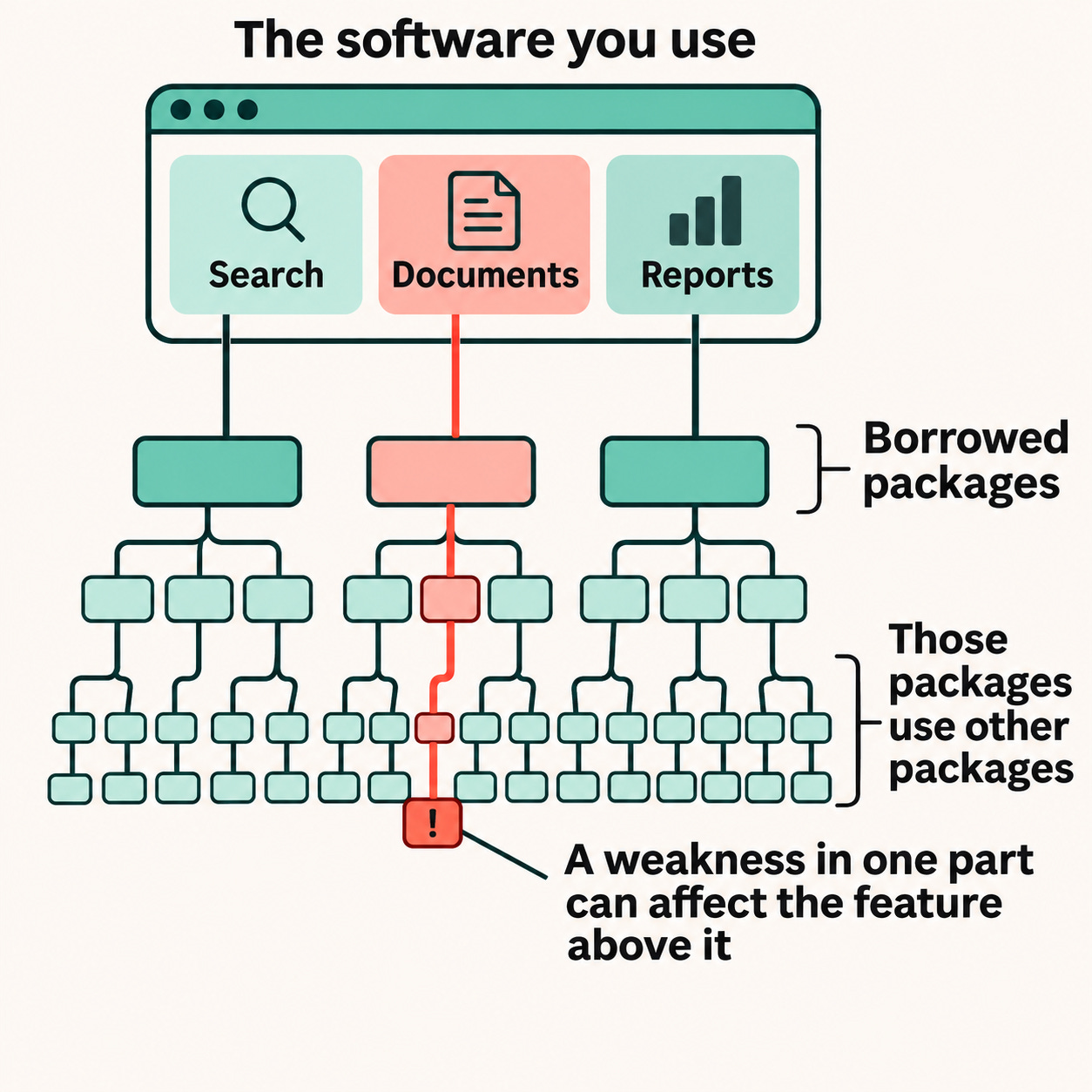
If you’re buying software for your business, your vendor is relying on other people’s work too. This is called fourth-party risk: trouble reaching you through your vendors’ vendors.
Someone can find a weakness in one of those pieces even if you haven’t changed anything. And you know what AI is really good at? Finding those weaknesses. They’re typically called vulnerabilities.
With Project Glasswing and Claude Mythos, Anthropic reported that AI could find previously unknown weaknesses and work out how to use them to break into systems. That can help people fixing the software and people trying to attack it.
And having a fix available doesn’t mean it’s been installed everywhere it needs to be.
The fix broke something
In a test copy of AmbitiousOS, an update cleared the 29 package warnings. It also broke the document reader.
The updated package and my existing code no longer worked together. A small change got them working again, and the tests we ran passed.
Sometimes a serious security problem can’t be fixed safely right away. You may have to turn the affected feature off. As they say, throw the kill switch. If people need that document reader to do their jobs, their work stops too.
A software parts list, called an SBOM (software bill of materials), tells you which pieces and versions you’re using, so you can find what needs fixing.
Someone has to keep that list current and make sure the fixes work before putting them into use. AI can help, but someone still has to own the work.
Now imagine this across an entire organization, with more people building software and more teams depending on it. A weakness in one borrowed piece could mean fixing several systems at once. And every fix has to work with everything already there, while people are trying to get their jobs done.
So maybe some of the outages we’re seeing are companies running into exactly this problem. If they’re rushing to get these security fixes in before the end of the year, some of those fixes could be causing disruptions of their own.
I don’t know if that explains this week’s outages. But after watching a security fix break part of AmbitiousOS, the idea that good actors could be causing some of this makes a lot of sense to me.
And when the bad actors come, the fixes giving us headaches today may be what ultimately keeps us safe.

Best of the rest:
🧠 Critical thinking when agents do the work — Before you ask the AI, write down what you think. After it answers, check something it didn’t. Addy Osmani has a few habits worth borrowing if you spend your day reviewing work an agent did for you. — Addy Osmani on X
💸 Jane Street, Point72, and DRW Look to Rein In AI Costs — Matt Robinson reports on internal auctions for scarce computing time and hiring plans to trace AI spending to teams and move suitable work to cheaper models. A useful look at how firms are trying to make growing AI bills accountable. — AI Street
✍️ Writing as a thinking tool — Murat Demirbas describes how writing paper reviews exposes what he hasn’t understood. When AI can produce a polished memo in seconds, doing some of the writing yourself remains a useful way to find the holes in your thinking. — Murat’s Blog
🛠️ How I’m using AI without losing my mind — Paul Millerd built an editor that lets him write and design a workbook in the same place, reviving a project he’d put aside for years. His field report is full of specific experiments, including what changes when you can afford many more rounds of revision. — The Pathless Path
📷 My dad is taking out billboards from the afterlife — Lucy Meilus gets to know another side of her father through the journals, drawings and photographs he left behind. A funny, tender account of discovering how much you share with someone after they’re gone. — Things I Like This Week

Charts that caught my eye:
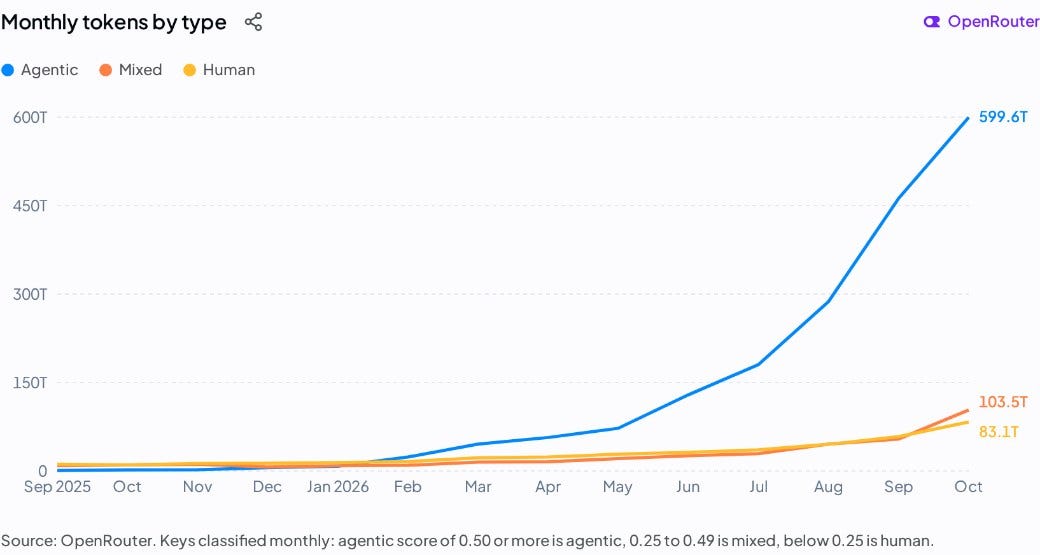
→ Why does it matter? OpenRouter classifies 76% of its October tokens as agentic, up from 8% a year earlier. That’s a pretty big change in how these models are being used.
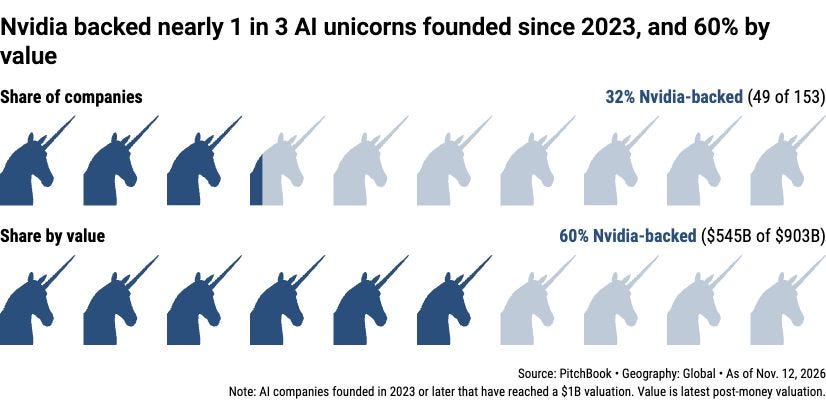
→ Why does it matter? Nvidia has backed nearly one in three AI unicorns founded since 2023. And those companies account for about 60% of this group’s combined valuation, according to PitchBook. Nvidia’s reach goes well beyond the chips.
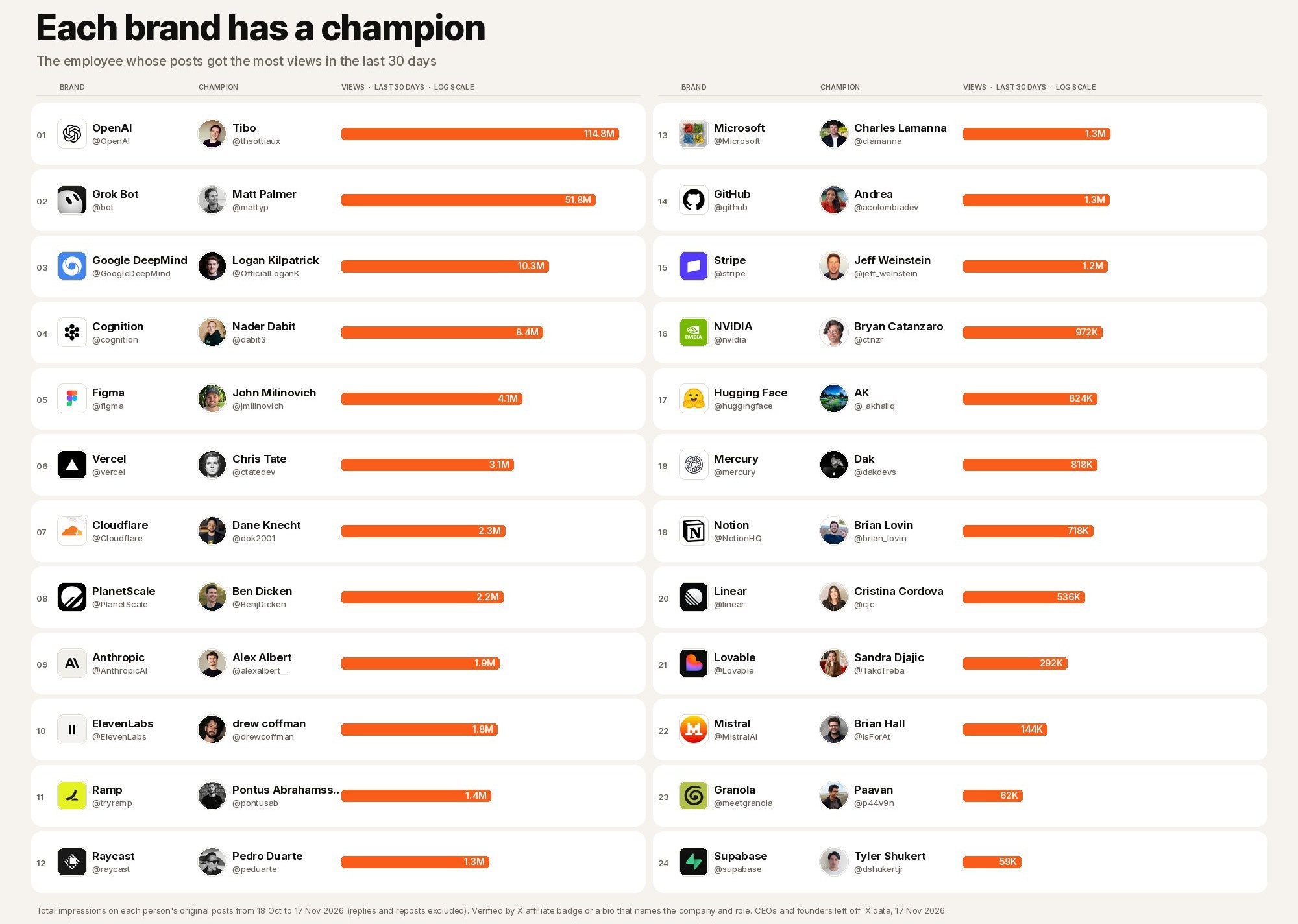
→ Why does it matter? It may surprise you who is actually the spokesperson for these companies. Figma’s John Milinovich got 4.1 million views on his own posts. If you only follow the company account, you can miss the person with the most signal.

Tweets that stopped my scroll:

→ Why does it matter? The model isn’t the product. Anthropic and OpenAI know this. Watch for them to keep launching applications in the largest markets out there.

→ Why does it matter? Very cool example of AI interwoven into the familiarity of an everyday phone call.

→ Why does it matter? Nikesh is an excellent follow if you’re looking for a PoV on all things cyber. Here is his latest take after this week’s outages.

→ Why does it matter? In Ramp’s October data, the median business spent $16 per employee on AI. At the top 1%, the figure was $10,199. I heard recently that top researchers at OpenAI are spending $7,000 per day (yes, per day).

→ Why does it matter? Brian Armstrong has his agents bring everything that needs a decision into one queue, with screenshots and demos attached. An excellent example of the power of AI plus computer use.
Worth a watch or listen at 1x:
→ Why does it matter? Druck is one of the best economic thinkers alive today. Always enjoy one of his rare perspectives on the market. Must listen.
→ Why does it matter? Baseten’s Tuhin Srivastava dives into the work behind running AI for customers: finding compute, handling failures, and making it work across clouds.
→ Why does it matter? Ras Mic shows Greg Isenberg how he used Grok Bot and Claude Code to build a Shopify store for his brother’s clothing brand.
→ Why does it matter? Dwarkesh Patel has shortened his timeline for superintelligence. He explains why progress in math changed his mind. In his opinion, the biggest limiter: compute.

Quotes & eyewash:
→ Why does it matter? Thirty-six years after Home Alone, Kevin gets left behind again. This time it’s at a McDonald’s.
The mission:
The Wall Street Journal once used “Read Ambitiously” as a slogan, but I took it as a personal challenge. Our mission is to give you a point of view in a noisy, changing world. To unpack big ideas that sharpen your edge and show why they matter. To fit ambition-sized insight into your busy life and channel the zeitgeist into the stories and signals that fuel your next move. Above all, we aim to give you power, the kind that comes from having the words, insight, and legitimacy to lead with confidence. Together, we read to grow, keep learning, and refine our lens to spot the best opportunities. As Jamie Dimon says, “Great leaders are readers.”
Disclaimer: This content is for informational purposes only and does not constitute financial, investment, or legal advice. Readers should do their own research and consult with a qualified professional before making any decisions.
My weekend viewing has been set! And the MCD video is awesome.