

Enjoy this week’s Big Idea:

The big idea: AI will not save you. Change management might.
Reading time: 8 minutes

A line often credited to Charles Darwin captures it: survival belongs not to the strongest or the smartest, but to the most responsive to change. And in 2026, every company will have an AI component to their strategy, thus moving that line from biology to the boardroom.
Many conversations about AI focus on the technology and its providers, such as OpenAI, Anthropic, and Google. However, the real story belongs to the organizations that are trying to change how their people work on a Tuesday afternoon.
That is why leaders like Tobi Lütke at Shopify are asking employees to make AI use reflexive, not optional. The expectation is to reach for AI by default in every task where it can help. The question is how you turn that expectation into reality, in the grain of daily work.
Most people use AI today like a better version of Google. It is capable of much more. It can be an operating system, an invisible layer that rewires how work gets done. Once it is part of the daily routine, going without it feels like stepping back in time. The organizations that win will not be the ones who talk about AI the most. They will be the ones who reconfigure how work gets done.
At Ridgeline, AI has been implemented with this in mind, as a disciplined change management program touching company values, tooling, incentives, and career paths. This week, I’m thrilled to be joined by Erica Lied, Ridgeline’s Head of Human Resources and one of the key architects behind our endeavor to make AI reflexive at Ridgeline.
Erica and the team recently collaborated with an outside firm, Superintelligent, which rated our AI agent readiness at 71 out of 100. We were initially disappointed, but then we learned that it was the highest score they had ever given, and it was still labeling us in a “pilot” phase.
What’s valuable to our readers is what went into achieving that score. What follows are parts of the playbook that can be adapted and improved upon inside your organization. We hope some of what has worked for us can inform your AI program.
A simple map for difficult change
The first thing we suggest is to give yourselves a map for change. We like John Kotter. His central insight is that lasting change is a social process that follows a sequence. You build urgency, enroll the right people, make the future concrete, clear the path, and only then does behavior change.
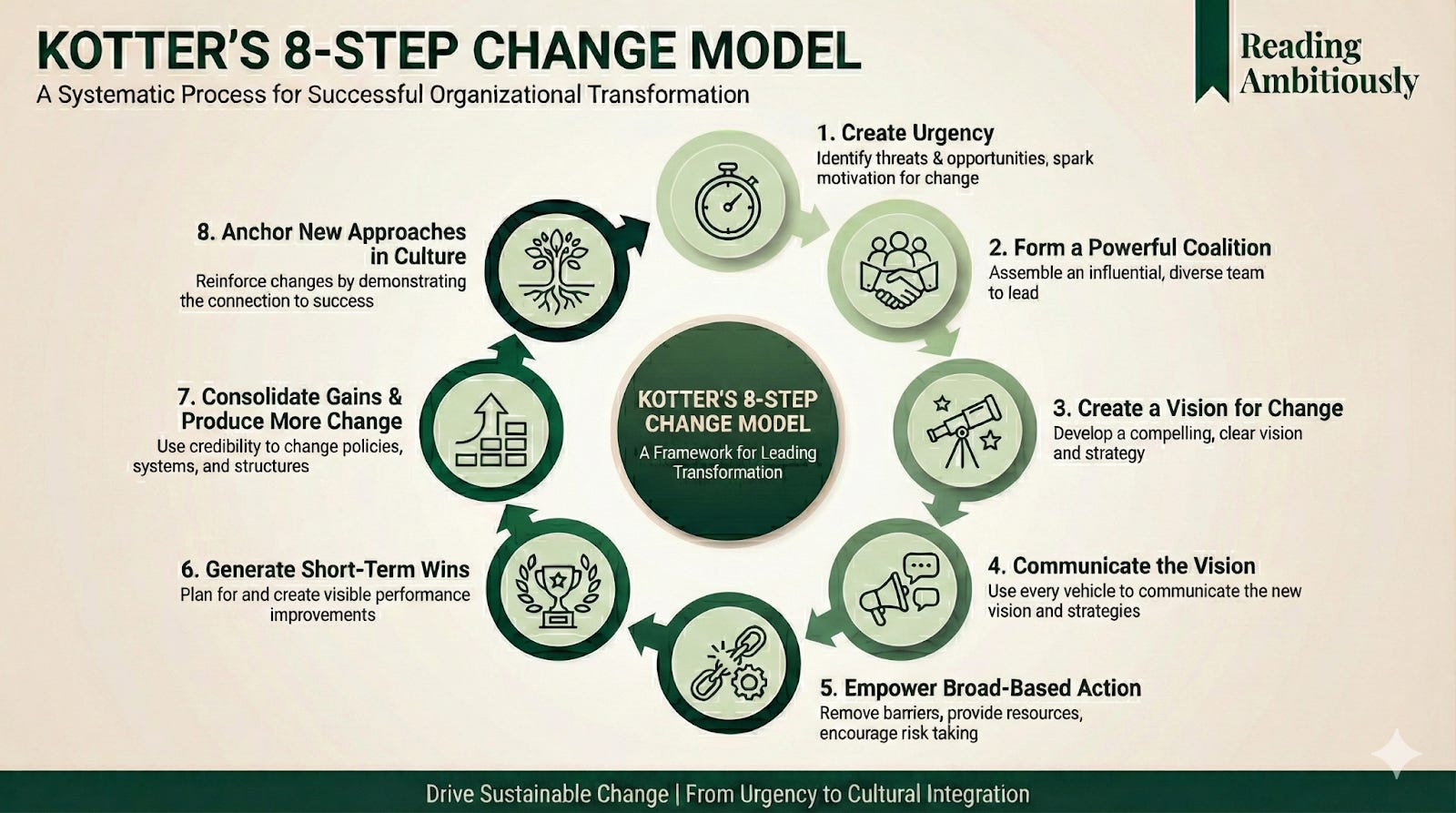
We used Kotter’s model as the backbone for our own program at Ridgeline. From there, we translated each phase into specific decisions, routines, and experiments. We learned a lot!
How we ran this playbook at Ridgeline
Here is what we tried, what we learned, and what is working so far.
1. Start with urgency and curiosity, not fear (Create a sense of urgency)
We licensed ChatGPT for every employee at Ridgeline. We opted to give everyone the tools and not restrict AI to a small group. That way we could all learn by doing.
We did not lead with “AI will replace you.” We led with “AI will remove the grind from your day.”
Innovation is a core value at Ridgeline, and so we tied our AI implementation to living that value.
Our CEO also set a clear expectation and gave permission: use AI reflexively, in any task where it can help.
2. Build a coalition that people actually trust (Build a guiding coalition)
We started with a champions group of twenty plus early adopters. Their job was not to write strategy. It was to run experiments in their own functions and share with best practices. Quickly, we saw the limits. Champions have day jobs. They can evangelize, but they cannot architect the whole system.
So we added more structure. We created a Ridgeline AI group with four critical sub teams focused on being in the business and imagining the future state of work and reskilling the team.
Senior leaders signaled that AI was part of their remit, not someone else’s project. The tiger team kept the trains moving.
3. Turn the vision into workflows (Form a clear vision)
We forced ourselves to answer narrower questions about adoption. What does AI mean for implementation consultants this quarter? For support. For engineering. For sales.
The newly created leverage engineering team focused on helping non-technical functions reinvent their workflows with AI.
In each case, we defined a small number of target workflows where AI could potentially alter the slope, including drafting and QA, documentation, customer communication, configuration, and internal analytics. That provided people with a concrete picture of the future and a starting point.
4. Talk about it until you are tired of hearing yourself (Communicate the vision)
We used every channel we had. Company meetings, our CEOs weekly note, AI town halls, team meetings, open Slack channels (#ai-best-practices-and-news is a popular one).
We shared short screen recordings of real use cases. We celebrated experiments that worked and the ones that did not.
We hosted a company-wide Hackathon focused exclusively on AI and 65 teams participated.
5. Remove friction and democratize access (Remove barriers)
We treated access to tools as a design problem, not a procurement problem. We ran a proof-of-concept program that allowed anyone to propose trialing a new AI product.
We set aside a centralized budget for enterprise contracts with a select set of best-in-class tools, rather than scattering experiments across dozens of vendors.
Security and legal set clear guardrails so people knew what was allowed.
Most importantly, we encouraged reuse. Prompts, patterns, and agents were meant to be shared, not hoarded.
The question was always “How can we make this the default for everyone who does this work.”
6. Engineer visible wins (Generate short-term wins)
In the first year, we measured activity. How many people were using tools? How often. In what contexts? It was a rough proxy, but it told us whether curiosity was spreading. We published a monthly leaderboard that mapped usage to ski runs, from green to black, as a nod to our Tahoe roots. It was lighthearted, but it signaled that learning AI was part of the job.
We also hosted more hackathons and agent competitions with real prizes. The point was not the events. It was the stories that emerged from them. Hours saved on specific tasks. New insights unlocked. Better customer experiences.
Over time, we shifted from vanity metrics to measuring impact. Hours removed from key workflows. The measurement got harder, but it also got more meaningful. Measurement is a big focus in 2026.
7. Keep the pressure on (Sustain acceleration)
After the first wave of enthusiasm, it would have been easy to let AI fade into the background. We tried to do the opposite. We revisited tools that were not pulling their weight. If our employees weren’t logging in, we questioned if they needed to retain access.
The goal is not big bang transformation. It is a steady increase from the baseline.
8. Put AI into the career system (Anchor change in culture)
The final step is still a work in progress, but the direction is clear. AI is now a part of our career frameworks. It is part of how we describe roles and levels. Over time, it will become more explicit in performance conversations and incentives. We want people to be rewarded for leverage, not just effort.
When AI becomes part of how you define great work, it stops being a special project. It becomes culture.
Why it matters
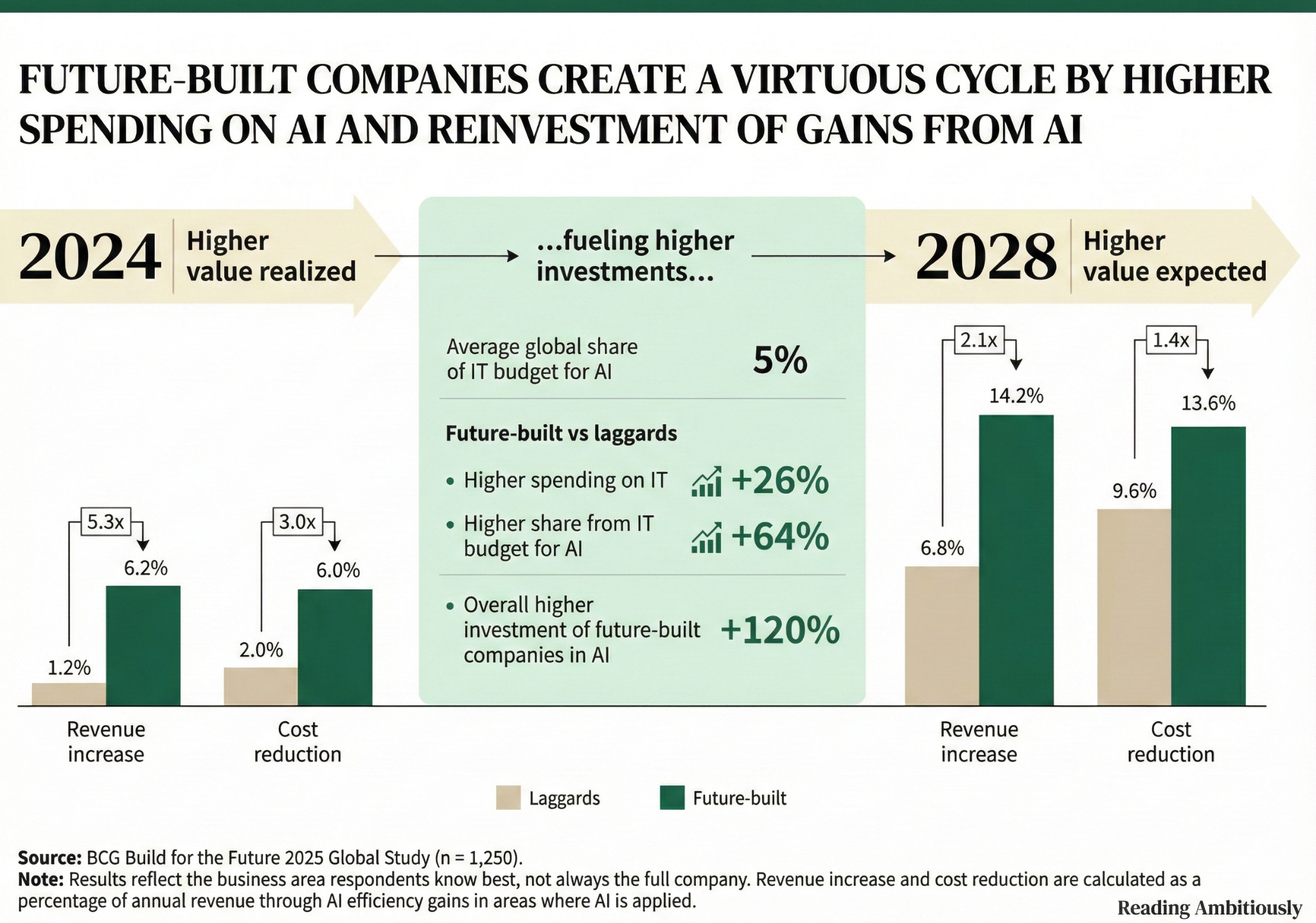
AI is creating a widening gap between companies that experiment and companies that meaningfully change how work gets done. The gap is not theoretical. A recent BCG study, “The Widening AI Value Gap,” found that early adopters are seeing more than five times the revenue growth and three times the cost reduction compared to their peers. The difference is not the model they chose or which vendor they prefer. It is whether they were capable of changing how their people work.
Most companies fall into one of three camps. They use OpenAI like they used Google in 2006, they bolt AI onto their products like a feature, or they reimagine work with AI at the core. The first group talks about AI. The second group plays with AI. The third group captures the value of AI.
Each year, Pantone names a “color of the year” to capture the mood of the moment for designers and brands. If we had to pick a leadership skill of the year for 2026, it would be change management. The next generation of AI native companies will not be defined by access to technology. Everyone will have access. The differentiator will be who can build a culture where employees reach for AI reflexively.
The challenge will be if your organization can translate ambition into Tuesday afternoon habits that compound over time. We believe it’s the difference between “we have AI” and “we work differently now.” We’re on the journey with you.

Best of the rest:
🤖 Confluent stock soars 29% as IBM announces $11 billion acquisition deal - IBM is paying $11 billion in cash for Confluent to own the real-time data streaming layer that feeds its AI stack, extending its HashiCorp and Apptio playbook and signaling accelerating consolidation in the enterprise data infrastructure market. - CNBC
🚀 Elon Musk’s SpaceX to raise over $25 billion in blockbuster 2026 IPO, source says - A trillion-dollar-plus SpaceX listing would not only bankroll Starlink and space-based data centers, it could also jump-start a new wave of late-stage tech IPOs after years of stagnation. - Reuters
🚫 DeepSeek is Using Banned Nvidia Chips in Race to Build Next Model — DeepSeek’s covert use of smuggled Nvidia Blackwell GPUs exposes how porous U.S. export controls really are, and how far China’s leading AI lab is willing to go to stay on the frontier of model performance. — The Information
🛰️ Constellation of models: the architecture powering Sierra’s agents — Sierra explains how it orchestrates 15+ frontier, open-source, and proprietary models into a modular “constellation” that delivers faster, more reliable, and on-brand agents that automatically improve as the model frontier advances — Sierra

Charts that caught my eye:
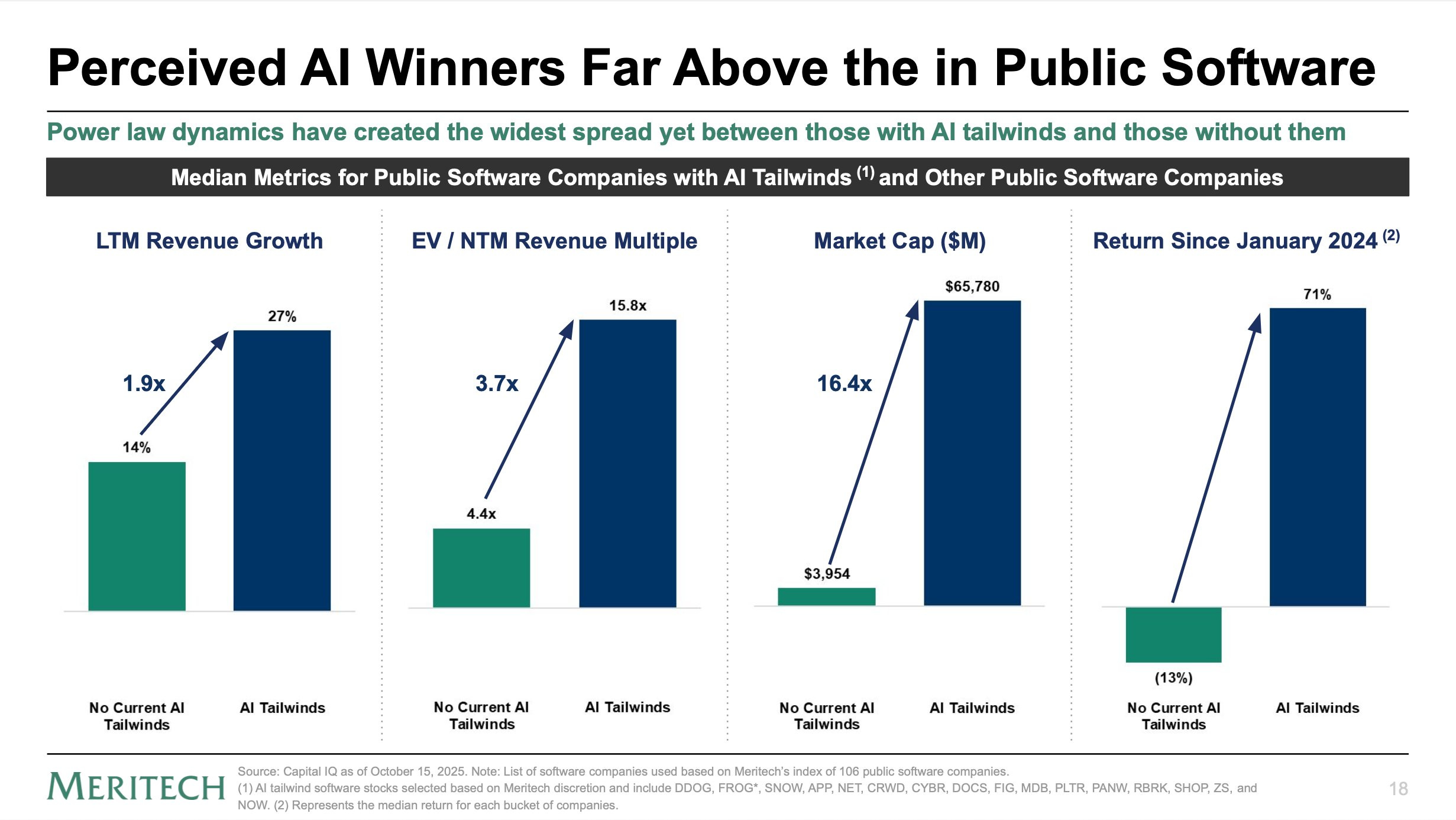
→ Why does it matter? According to the team at Meritech, public software, a $3T+ asset class, is bifurcating very quickly between companies with AI tailwinds and those without them.
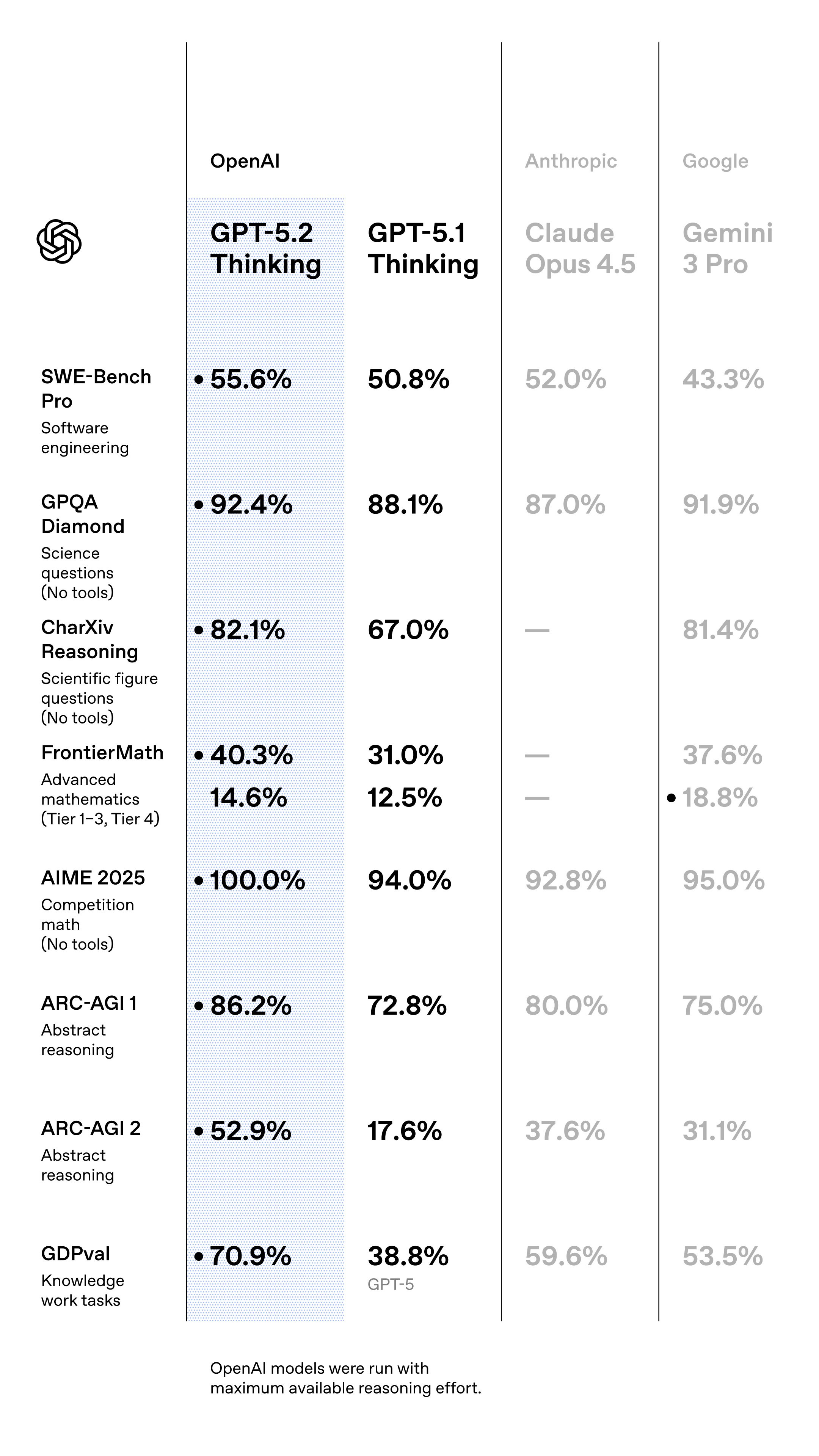
→ Why does it matter? Following “code red”, OpenAI released GPT 5.2 to hit back at Gemini 3. It’s a good model, Sam!
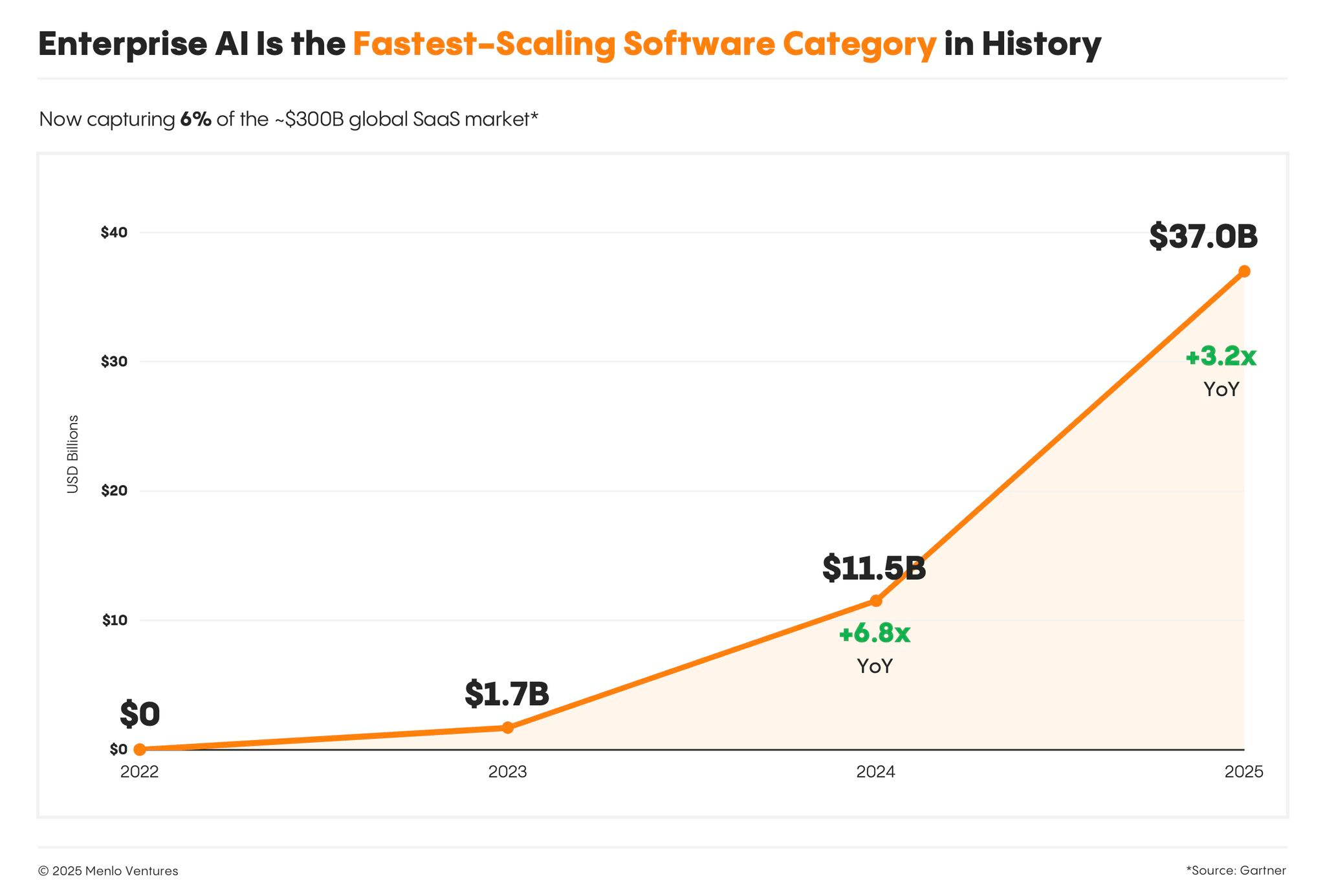
→ Why does it matter? 6% of the global SaaS market!

Tweets that stopped my scroll:

→ Why does it matter? The “architects” of AI.

→ Why does it matter? How does progress occur? Gradually, then suddenly! This thread is worth a read.

→ Why does it matter? Howard Marks is back with his latest memo titled “Is it a bubble?” TL;DR: Here's the point - no one can know. Act prudently !

→ Why does it matter? Meritech Capital produces some of the most insightful research on cloud software. For the first time, they are sharing their 2025 market update, which they usually reserve for investors, with everyone. Worth a watch.

Worth a watch or listen at 1x:
→ Why does it matter? Pat Grady and Alfred Lin recently took the helm as co-stewards of Sequoia Capital, one of Silicon Valley’s most storied venture firms. I liked hearing how they think about leading Sequoia into its next chapter on Jack Altman’s podcast.
→ Why does it matter? Gavin Baker is one of the most frequent guests on Invest Like the Best, right up there with Bill Gurley and Michael Mauboussin. In this episode he goes deep on AI, with a stunning command of the semiconductor manufacturing stack and the broader AI supply chain. If you want a clear, detailed view of how the AI ecosystem actually works, this wide ranging conversation with Patrick O’Shaughnessy is the one to listen to.

Quotes & eyewash:

→ Why does it matter? Don’t miss the opportunity to give AI Santa a call this year to see if you’re on the naughty or nice list.
“The key is to keep asking yourself the same question, again and again and again: this is your life—what do you want to pay attention to?”
Catherine Price
The mission:
The Wall Street Journal once used “Read Ambitiously” as a slogan, but I took it as a personal challenge. Our mission is to give you a point of view in a noisy, changing world. To unpack big ideas that sharpen your edge and show why they matter. To fit ambition-sized insight into your busy life and channel the zeitgeist into the stories and signals that fuel your next move. Above all, we aim to give you power, the kind that comes from having the words, insight, and legitimacy to lead with confidence. Together, we read to grow, keep learning, and refine our lens to spot the best opportunities. As Jamie Dimon says, “Great leaders are readers.”
Disclaimer: This content is for informational purposes only and does not constitute financial, investment, or legal advice. Readers should do their own research and consult with a qualified professional before making any decisions.