

The Wall Street Journal once used ‘Read Ambitiously’ as a slogan, but it became a challenge I took to heart. If that old slogan still speaks to you, this weekly curated newsletter is for you. Every week, I will summarize the most important and impactful headlines across technology, finance, AI and enterprise SaaS. Together, we can read with an intent to grow, always be learning, and refine our lens to spot the best opportunities. As Jamie Dimon says, “Great leaders are readers.”
Thanks to GenerativeAI and our friends at GoogleNotebookLM, you can enjoy this week’s Reading Ambitiously as a podcast entirely generated by AI. If you haven’t experienced this technology yet, definitely give this a try!

In the news:
Google says its new quantum chip indicates that multiple universes exist (TechCrunch)
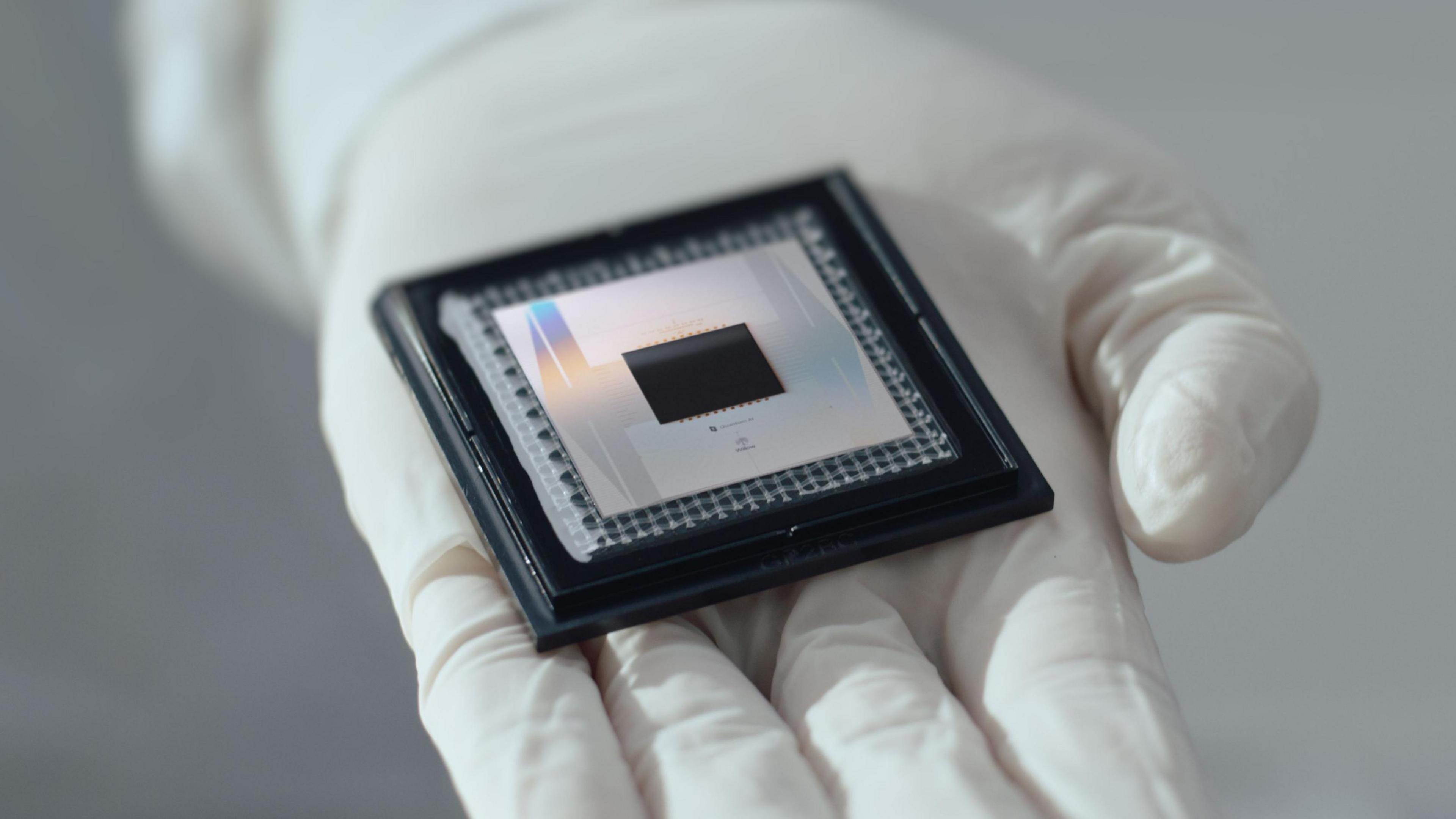
Why does it matter? Anytime there is evidence we're living in a multiverse, it matters. Earlier this week, Google announced details about its new quantum computing chip called “Willow”.
“Willow’s performance… is astonishing: It performed a computation in under five minutes that would take one of today’s fastest supercomputers 10²⁵ or 10 septillion years. If you want to write it out, it’s 10,000,000,000,000,000,000,000,000 years. This mind-boggling number exceeds known timescales in physics and vastly exceeds the age of the universe.
A breakthrough in Quantum Computing would change everything we know about modern computing. A classical computer keeps information in 64-bit groups called "words." These groups can exist in only one state at a time, either a “0” or a “1”. In a quantum world, instead of bits, there are qubits. Think of qubits like having multiple books of the same story where each book can be read in different ways at the same time, unlike regular books which tell one story at a time. This dramatically increases computational power because qubits can exist in multiple states at once, thanks to a quantum property called superposition. Imagine trying to read all possible versions of a book at once – that’s what qubits do with information.
That power would break most known limits in AI learning and crack encryption systems like Bitcoin’s SHA-256. Current encryption methods rely on the difficulty of certain mathematical problems, but a quantum computer could solve these much faster due to its ability to perform many calculations simultaneously. While concerning, we’re still a ways off. Cracking Bitcoin’s SHA-256 encryption would require millions of error-corrected qubits. Willow has only 105 qubits.
Go Deeper: Meet Willow, our state-of-the-art quantum chip
Meta to invest $10 billion for Louisiana data center (Reuters)

Why Does It Matter? Meta, led by Mark Zuckerberg is constructing a massive 4 million square foot, 2GW data center in Louisiana. Zuck announced this alongside the release of Llama 3.3 on Instagram earlier this week.
The big deal here is the energy and cost involved in training these AI models. Think of it like this: just like how you might need a lot of electricity to keep your house cool in summer, training a foundational AI model like OpenAI's GPT-4, Meta's Llama 3, or xAI's Grok 2 requires an enormous amount of computing power - and thus, energy. It's rumored that OpenAI spent over $100 million just to get GPT-4 up and running, while Google's bill for training Gemini Ultra might have been close to $200 million. That's a lot of money.
Now, let's talk about what Elon Musk's xAI is up to in Memphis, TN. Gavin Baker helped me wrap my head around this - xAI has linked over 100,000 NVIDIA GPUs together to train Grok 3. To put that into perspective, no one has ever used more than 32,000 GPUs for training a foundational model before. This is a monumental leap in computing power being throw at training a next-generation model.
In essence, these data centers are the digital factories of the AI age. The investment in these data centers underscores a race to not just innovate but to become the dominate platform for the paradigm shift to AI. For companies like Meta and xAI, these facilities are strategic investments in their future - a future where AI could transform everything.

Best of the rest:
📈 Apollo and Workday Join S&P 500 After Index Rebalancing - Both Apollo and Workday join the S&P 500. Bloomberg
🤖 Introducing ChatGPT Pro - OpenAI unveils ChatGPT Pro at $200 per month, designed for advanced-level research and professional-grade usage. OpenAI
🔓 OpenAI May Remove Restriction on Microsoft’s Access to AGI Models - OpenAI is reportedly considering removing a clause in its investment agreement with Microsoft that limits access to AGI models if achieved. Financial Times
🚀 SpaceX Valuation Soars to $350 Billion - A new stock sale priced at $185 per share values SpaceX at $350 billion, reaffirming its status as the world’s most valuable private start-up. Bloomberg
💰 ServiceTitan Prices IPO at $71, Above Expected Range - After a slow stretch for tech IPOs, ServiceTitan’s strong pricing signals renewed investor confidence. CNBC, ServiceTitan S-1 Breakdown (CloudedJudgement), ServiceTitan S-1 Breakdown (Meritech)

Charts that caught my eye:
114 companies created 43% of all exit value for VCs in the last decade (Daniel Bartus, LinkedIn)
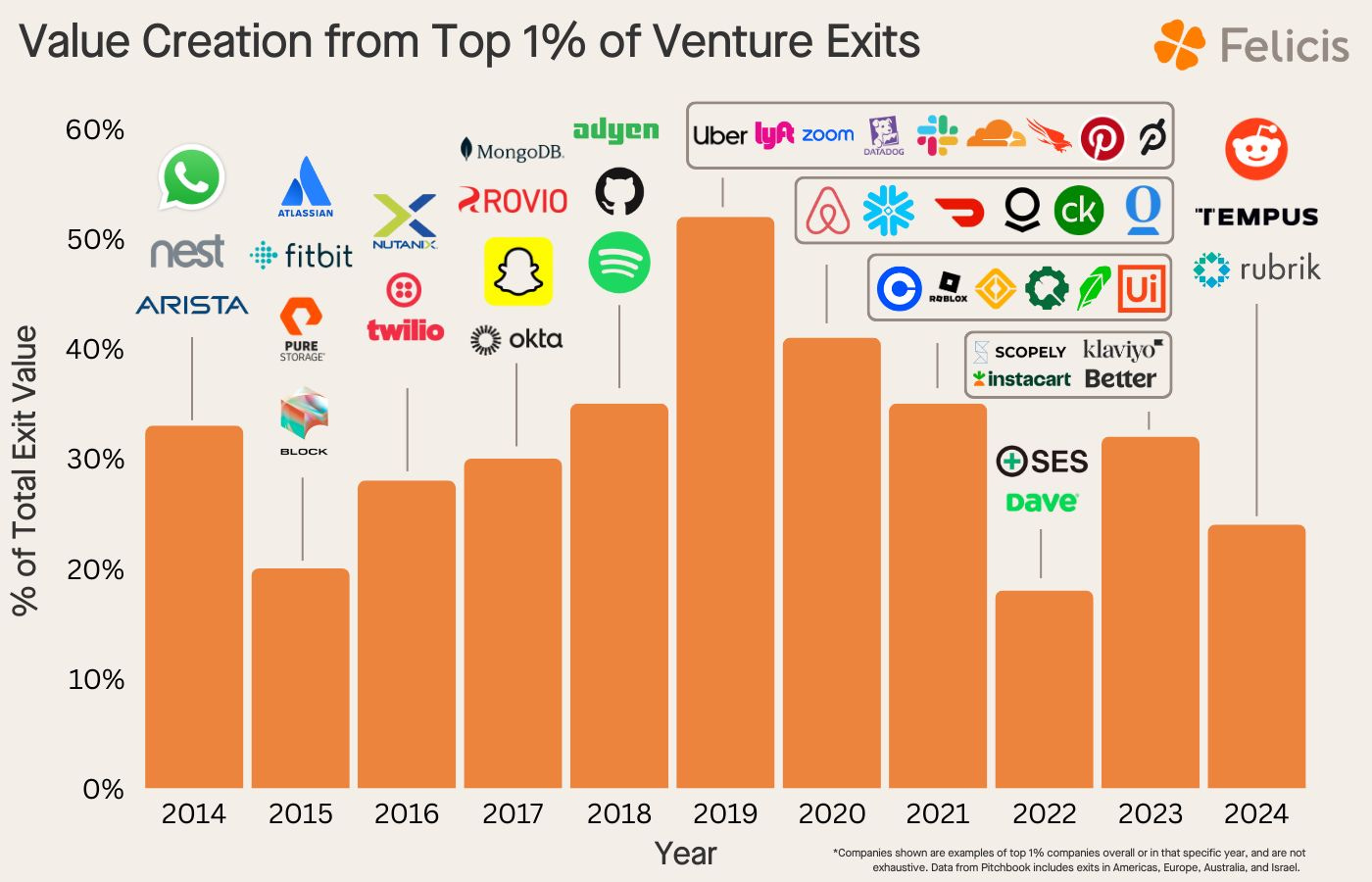
→ Why does it matter? Venture Capital is a power law game. A small number of investments yield disproportionately large returns, while the majority result in modest gains or losses. Be in the best companies as early as possible.
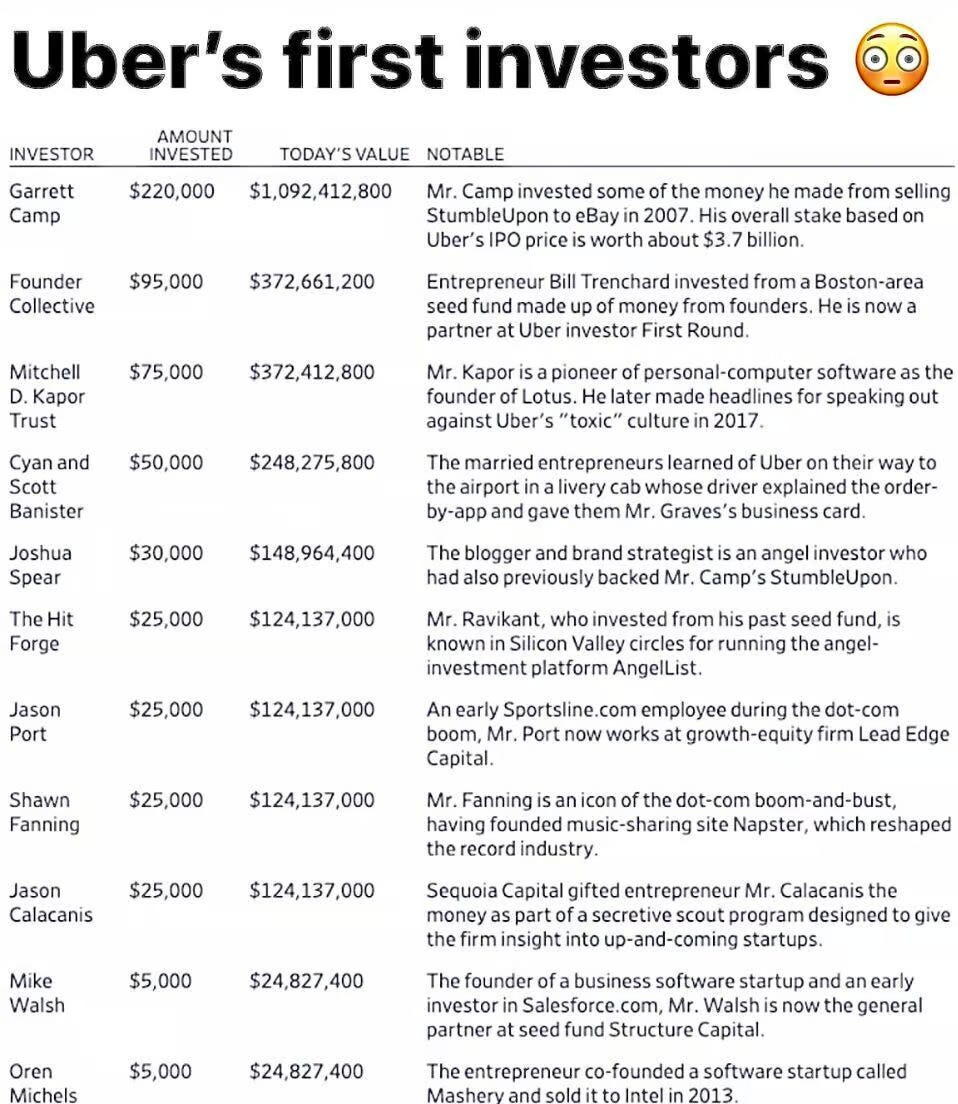
→ Why does it matter? Speaking of participating in the best investments as early as possible, if you had invested $25,000 in Uber, it would be worth $124,137,000 today. 🤯
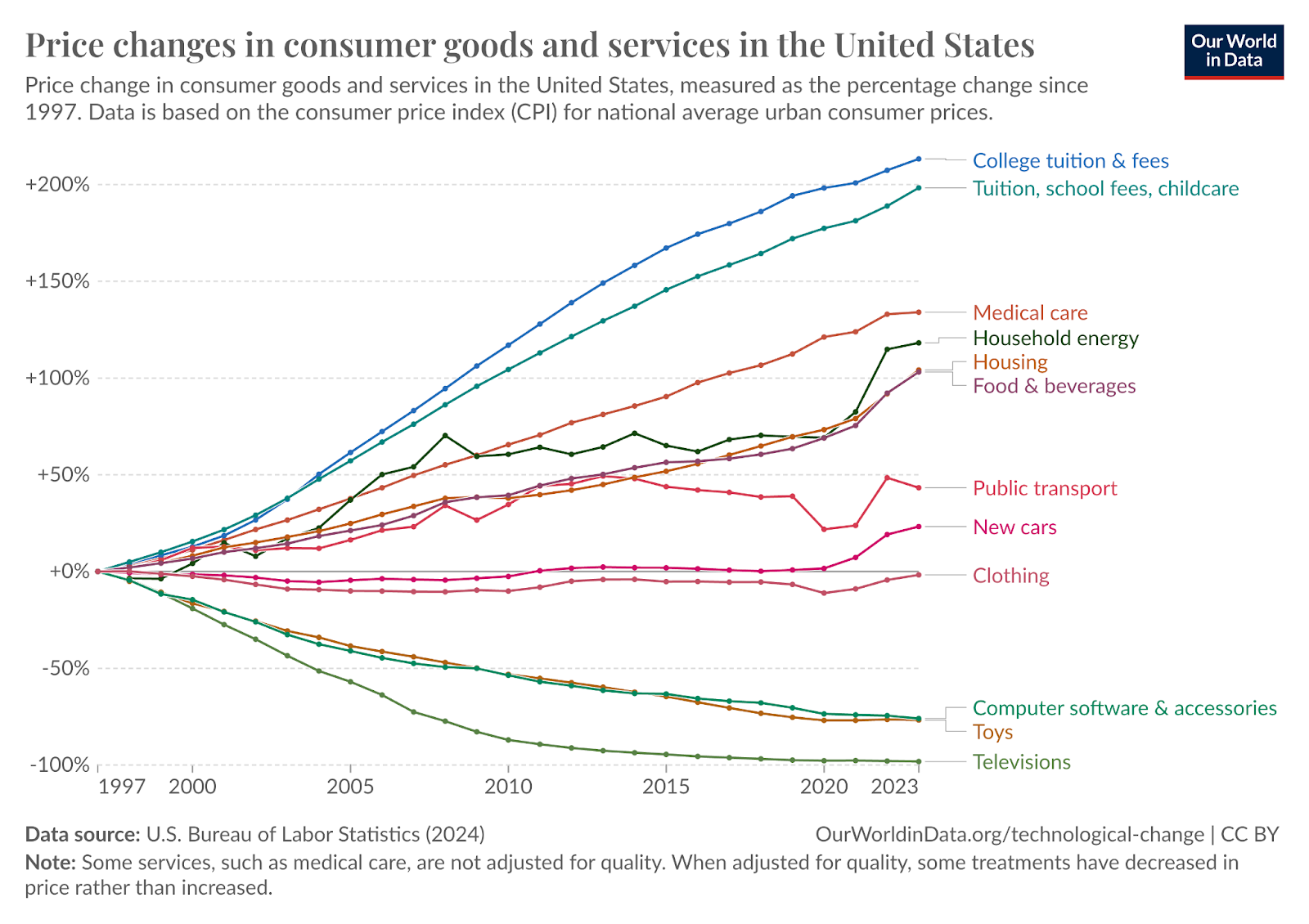
→ Why does it matter? Computer software and telecommunications have become significantly cheaper, while education and medical care have grown more expensive. Why? Service-based industries are notoriously hard to scale. However, in a ‘Service-as-Software’ world, the equation changes entirely.

Tweets that stopped my scroll:

→ Why does it matter? This is a great example of the difference between chatbots and AI agents. The agents do the work.

→ Why does it matter? An aphorism is a concise, memorable statement that expresses a general truth, principle, or observation about life. While the principle itself may have taken years of adversity to understand, a great aphorism can ensure that the lessons learned can be passed onto others.

→ Why does it matter? It’s all about the people!

Worth a watch or listen at 1x:
→ Why does it matter? Marc is all-in on AgentForce, Salesforce’s AI Agent platform. After 25 years since founding Salesforce, he calls this his most important focus yet.
→ Why does it matter? Few CEOs have mastered transformation like Satya Nadella at Microsoft. His insights on OpenAI, AI Agents, and advice for CEOs are a must-listen.

Quotes & eyewash:
“I think it's generally human nature to over-estimate risk and under-estimate opportunity. ... The risks are probably not as big as you perceive and the opportunities may be bigger than you perceive.” - Jeff Bezos
"Courage is what it takes to stand up and speak; courage is also what it takes to sit down and listen.” - Winston Churchill
“I don’t think it’s very complicated. I think it’s grit, persistence, tenacity, determination, never/refusing to give up, not tolerating low performers, insistence on team, very simple goals, and showing up for work every day—which, in the venture business, gives you a competitive advantage. A profound competitive advantage. - Michael Moritz”