

Enjoy this week’s Big Idea read by me:

The big idea: The browser was not the prize
Reading time: 7 minutes
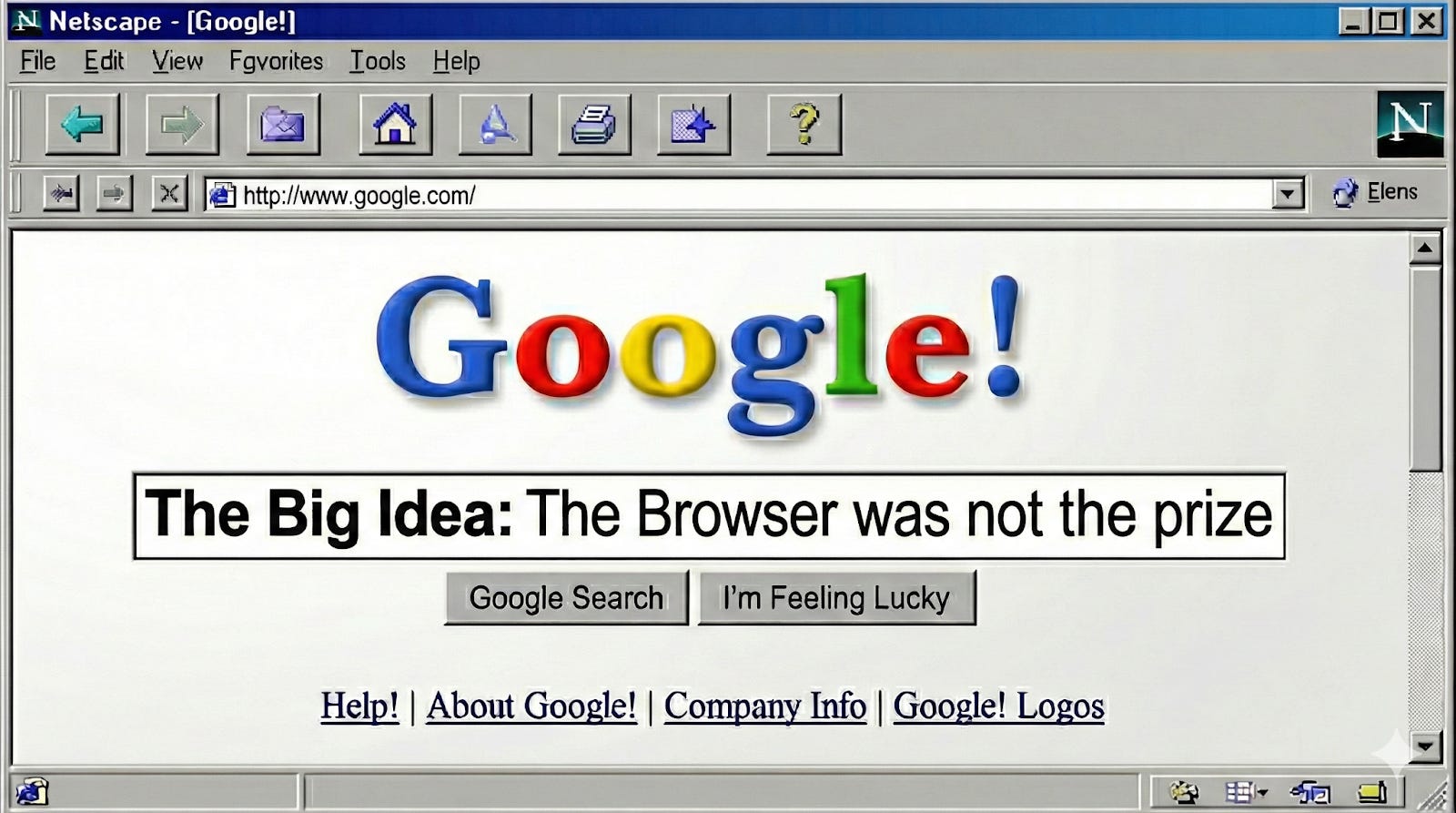

In 1994, Marc Andreessen and Jim Clark founded Mosaic Communications, later renamed Netscape. Their first product, Netscape Navigator, a browser, made the web accessible to everyone. A graphical interface turned the raw internet into something you could click and understand. It became part of dot-com mythology. The “Netscape moment” now refers to an inflection point and the arrival of a new era.
Netscape gave you a window into the World Wide Web as long as you knew where you wanted to go. You typed a domain, pressed return, and the browser took you there. However, if you didn’t know where you wanted to go, the browser couldn’t help you. That was the gap Larry Page and Sergey Brin noticed. The browser was not scarce. The ability to find information was. So, they built a search engine that could crawl and index the web, helping you discover it. And while you waited, they rented your attention to advertisers.
The browser introduced the internet to the world. Search captured the value.
From Netscape to ChatGPT and Gemini
For many people, the first time they used ChatGPT felt similar to the first time they used the internet. A tool that instantly changed how you understood what software could do.
When ChatGPT launched in November 2022, it introduced artificial intelligence to a mass audience in a way that felt simple and useful. It was a modern Netscape moment. A clear before and after. Over the last two years, the heroes of the AI story have been OpenAI and Nvidia. The launch of Gemini 3 is the moment Google steps fully back onto that stage.
Google was among the first to the modern era of AI. It acquired DeepMind in 2014 and published “Attention Is All You Need” in 2017, the paper that introduced the transformer architecture behind every large language model. Yet for all of this leadership, Google held back from training its models on the full breadth of the internet. Maybe the legal and reputational risks felt too high. Remember, the company was already under global scrutiny from European data privacy regulators and United States antitrust authorities.
OpenAI took a different approach. It trained aggressively on large swaths of the open web and moved fast to ship products. That decision helped it build a real lead, but it also lived in a legally gray area. You can see how risky that territory is by looking at Meta. In ongoing litigation, unsealed emails describe Meta researchers torrenting huge collections of pirated books to train their models, prompting one engineer to write that “torrenting from a corporate laptop doesn’t feel right.” For a company like Google, already under a global microscope, wading into that kind of legal and reputational mess was a very different calculation.
The release of ChatGPT made Google look behind, even though many of the foundational ideas in modern AI originated inside its own research groups. The perception worsened as Google’s early AI launches stumbled. Leadership declared a code red. Sergey Brin shifted into founder mode and returned to help push AI work forward.
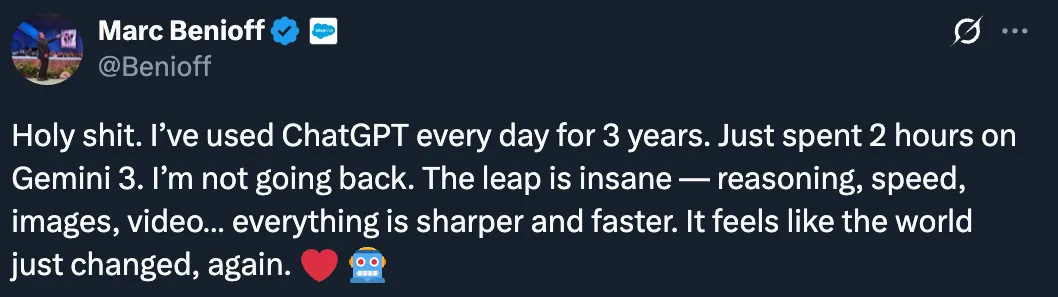
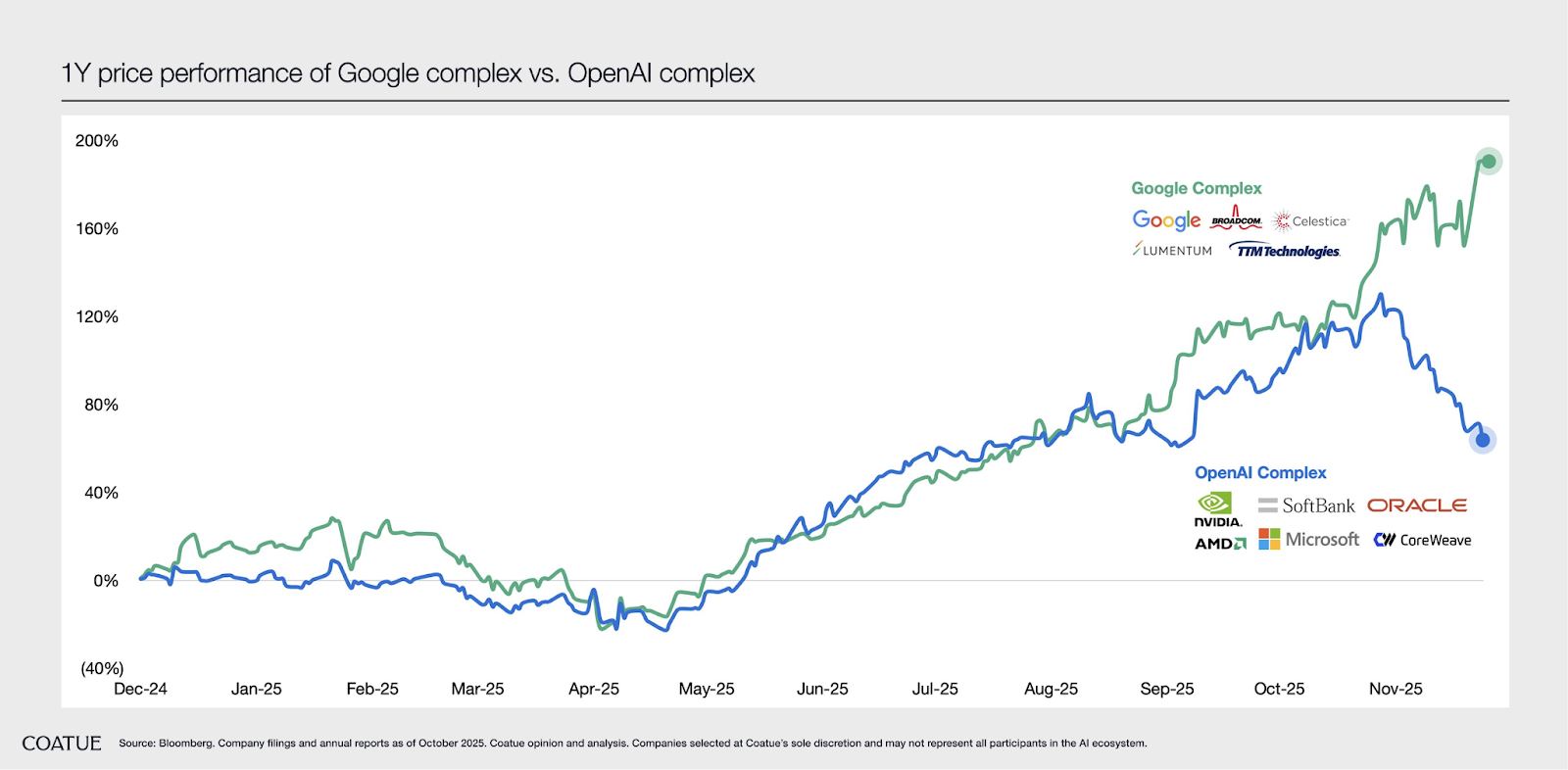
Two years later, we have Gemini 3. If you have not used it yet, you should. It represents a significant leap forward for Google, and it is now everywhere. It is sitting in Chrome. It is built into Google Docs, Gmail, YouTube, Maps, and practically every surface where Google can place it. In the 1990s, Microsoft did something similar when it bundled Internet Explorer into Windows and turned distribution into a weapon. Google is now running that same play, but with AI. The gap with OpenAI has narrowed, and in some cases it has closed. Sam Altman recently told employees to prepare for rough vibes and economic headwinds, a sign that OpenAI is no longer alone at the frontier.
The Browser Is Not The Prize This Time Either
Netscape introduced the world to the internet. Google built the system that organized it and captured the majority of the value. Will the same pattern emerge in AI? ChatGPT introduced the world to AI. The question now is whether the model itself is the scarce thing or whether it is only the window that exposes a much larger system underneath.
If the model is not the scarce thing, several candidates could play that role.
One possibility is compute. AI requires enormous amounts of power and specialized hardware. If Google’s TPUs and Nvidia’s GPUs become the true bottleneck, the companies that control capacity may determine how fast the field moves.
Another possibility is pre-training, an area where Gemini 3 made meaningful progress. Large models generalize because they ingest vast amounts of data and learn patterns that no single domain can provide. An advantage could come from enormous pre-training runs on high-quality data. The scarce resource becomes the data itself, the ability to clean and gather it, and the systems that can learn from it efficiently. OpenAI relied heavily on public web crawls. Google has been building structured and semi structured datasets for more than twenty years.
A third possibility sits closer to the user. The real value might come from an orchestration layer that routes intent across tools, agents, models, and applications. This layer would sit between people and their work and decide which model to invoke and which workflow to run. It would not look like a chat box. It would look more like an operating fabric for how knowledge moves through software.
Any one of these could become the equivalent of search in the AI era. None depend on a single chat interface, even one with eight hundred million monthly users. Habits at that scale are powerful, but they only become a moat if you can keep investing ahead of everyone else.
Why It Matters
I am not saying that Google will dominate AI. But it sure does look like they’re in this race in a big way. I am also not saying that OpenAI will share the fate of any company from the dot-com era. History rarely repeats itself so literally.
It is possible that large language models themselves will turn out to be the browser of this era. They introduce us to the technology. They create the inflection point. Yet, the system that captures the most value may not exist yet and may be located elsewhere.
So if LLMs are the browser, what is the search engine in this story? Which layer becomes the scarce one? Which system captures the value that the rest of the stack makes possible?
The answer is not obvious at least it is not to me. It may take years or decades to reveal itself. That uncertainty is part of what makes this moment interesting.
It is a privilege to have a front row seat to it. Stay ambitious.

Best of the rest:
📱 ‘We’re basically pushers’: Court filing alleges staff at social media giants compared their platforms to drugs - Newly unsealed evidence shows insiders at Meta, TikTok, Snap, and YouTube likening their own products to addictive drugs and downplaying harms to teens, raising the stakes for a massive wave of youth mental health lawsuits and regulation. - Politico
💸 Warren Buffett Was Always a Brand Guy - Craig Shapiro uses Buffett’s 1972 See’s Candy memo to show how enduring brands build emotional moats that compound trust, ritual, and affection far beyond what balance sheets can capture. - Collaborative Fund
🧠 The Last Human Edge - Henry Ellenbogen makes the case that in a world saturated with data and AI, durable alpha still comes from human judgment about people, patterns, and inflection points where businesses either compound for decades or quietly fall apart - Colossus
🏥 The Slow Death of Epic Systems – A sharp critique of Epic’s hospital software monopoly, arguing that a system built for billing and compliance cannot keep up with AI driven, real time medicine, which creates both risk for patients and a massive opening for next generation platforms. – Substack
🤖 Anthropic taps IPO lawyers as it races OpenAI to go public; Anthropic is sprinting toward a potential mega-IPO that will test whether public markets are ready to bankroll loss-making AI labs at $300bn-plus valuations; Financial Times

Charts that caught my eye:
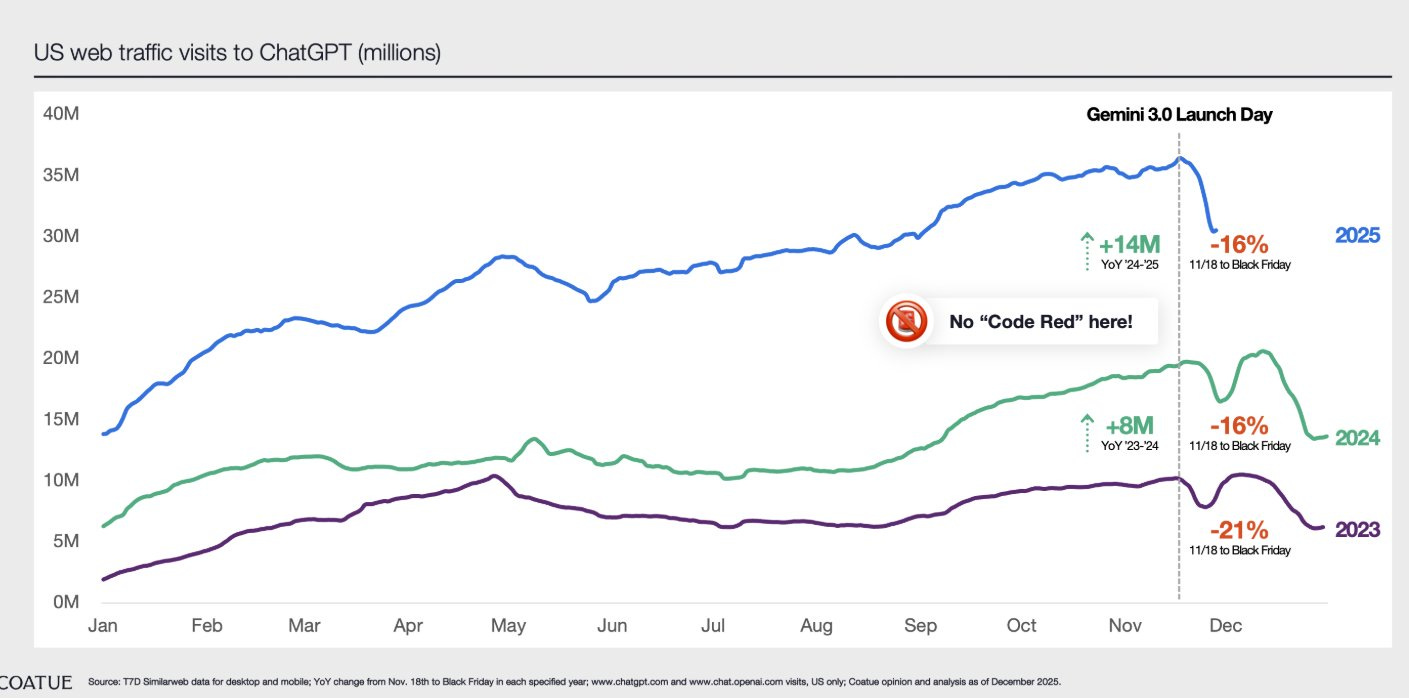
→ Why does it matter? The Wall Street Journal reported this week that Sam Altman declared a “code red” in an internal memo, refocusing OpenAI on improving ChatGPT and pausing other projects, including early work on advertising. The move is widely read as a response to Google’s Gemini 3 launch, even though Coatue’s usage data suggests OpenAI’s recent slowdown fits a familiar year end dip in GenAI activity.
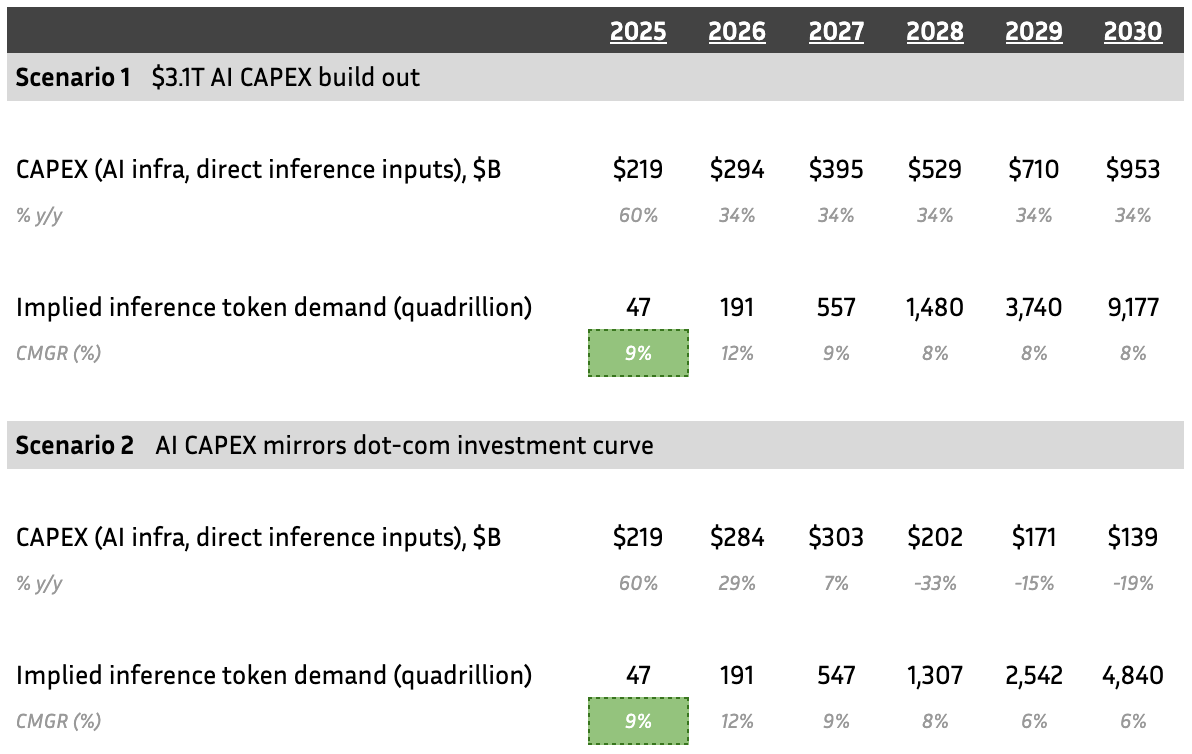
→ Why does it matter? Evan O’Donnell takes a fuzzy trillion-dollar capex story and pins it to one concrete variable, inference tokens that need to compound roughly 9–12 percent a month to justify today’s AI buildout. His scenarios, ranging from straight-line spend to a dot-com style boom and fade, still imply similar token curves, which means the real uncertainty is not whether money gets invested, but whether usage grows fast enough to meet it. This is a helpful directional scoreboard for operators and investors, providing a way to track in real-time whether AI infrastructure is becoming the next utility layer or just an overbuilt monument to optimism. Check it out 👉 here.
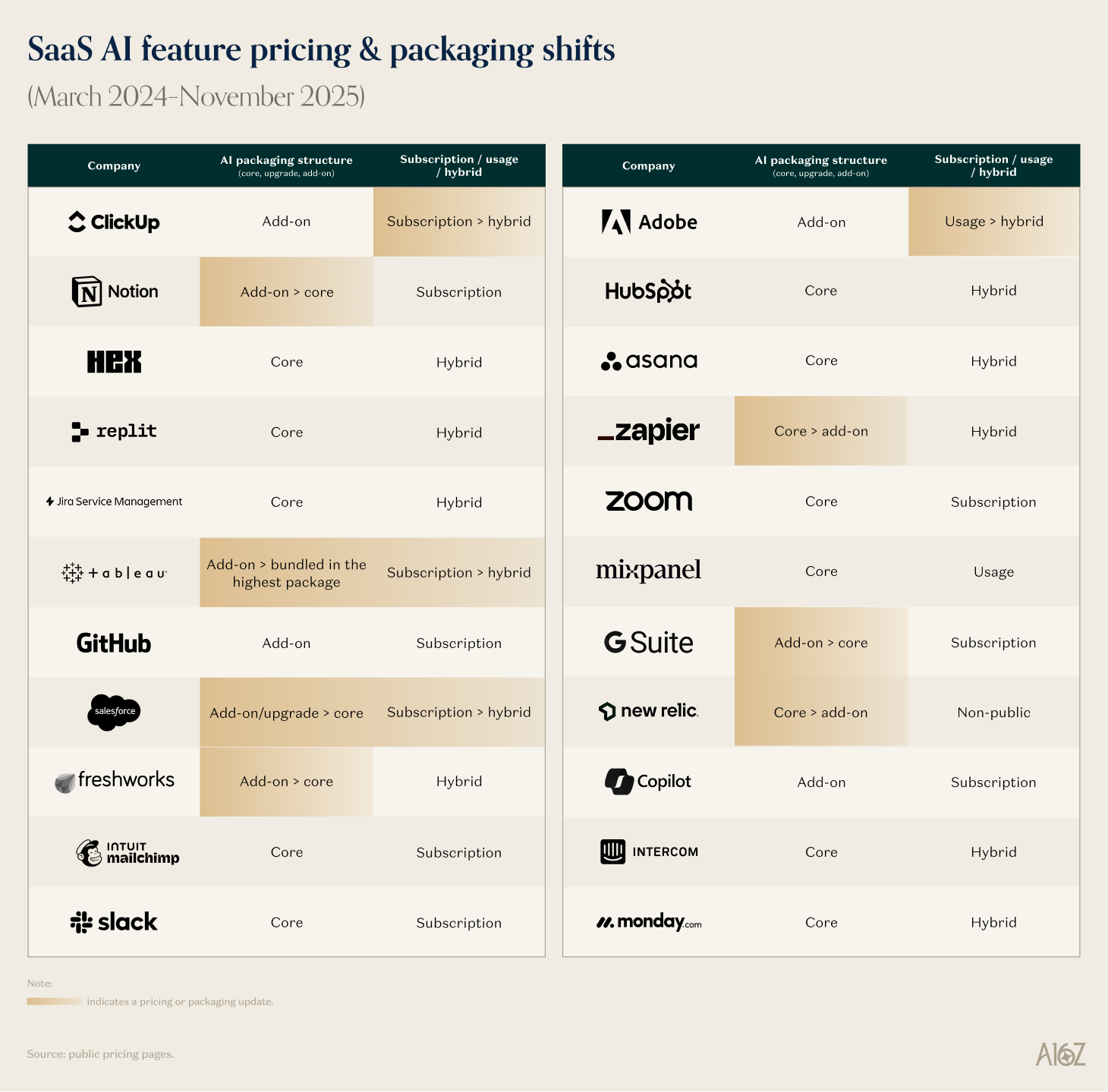
→ Why does it matter? a16z has a useful frame for the shifting AI pricing landscape. The big move: “add-on to core” now means folding a real bundle of AI features into your main product, with no separate AI line item on the bill.

→ Why does it matter? Merrill Lynch went poof not long after popularizing this clock, but I still use it as a simple way to remember which parts of the market sit closest to the real economy. It is a crude sketch of sensitivity: who benefits first when growth returns, who feasts in a boom, who gets hit hardest in a slowdown, and who survives when recession shows up. You do not need it for timing; you keep it around as a quiet reminder that every asset in a portfolio has a specific place in the cycle.
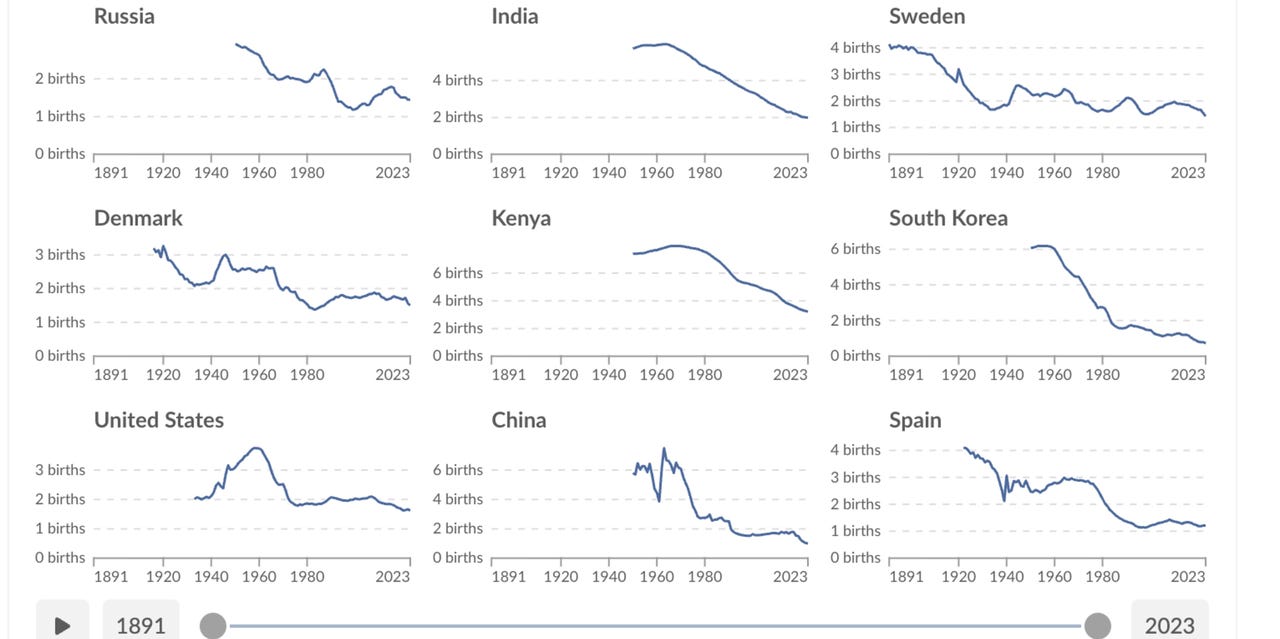
→ Why does it matter? This chart of declining global birthrates made its way around the internet this week, and Fred Wilson at USV frames the tension clearly: “If the population of the world is going to be declining, not growing, and if we are adopting cheap, and getting cheaper, energy at a very rapid pace, and if we have technology to make everyone massively more productive, what kind of world does that look like?”

Tweets that stopped my scroll:

→ Why does it matter? Druck with a reminder on the importance of conviction!

→ Why does it matter? This is what it looks like to embed it across your operating system and use distribution as a weapon, a clear nod to Microsoft’s 1990s Internet Explorer play.

Worth a watch or listen at 1x:
→ Why does it matter? Ilya Sutskever, OpenAI co-founder and the current CEO and co-founder of Safe Superintelligence Inc., talks to the AI podcaster Dwarkesh Patel about “moving from the age of scaling to the age of research.”
→ Why does it matter? Michael Burry, the investor immortalized in The Big Short, is back betting against the crowd. He has opened new short positions in Nvidia and Palantir, and walks through his thinking in a recent conversation with his longtime friend Michael Lewis
→ Why does it matter? Jeanne DeWitt Grosser has led world-class go to market teams at Stripe, Google, and now Vercel, where she is COO overseeing marketing, sales, customer success, revenue operations, and field engineering. She helped build Stripe’s early sales org from the ground up and now advises founders on treating GTM as a true strategic function. In this conversation, we unpack why GTM matters more in the AI era, how to earn the respect of product and engineering, and why most customers still buy to avoid pain rather than to chase upside.

Quotes & eyewash:
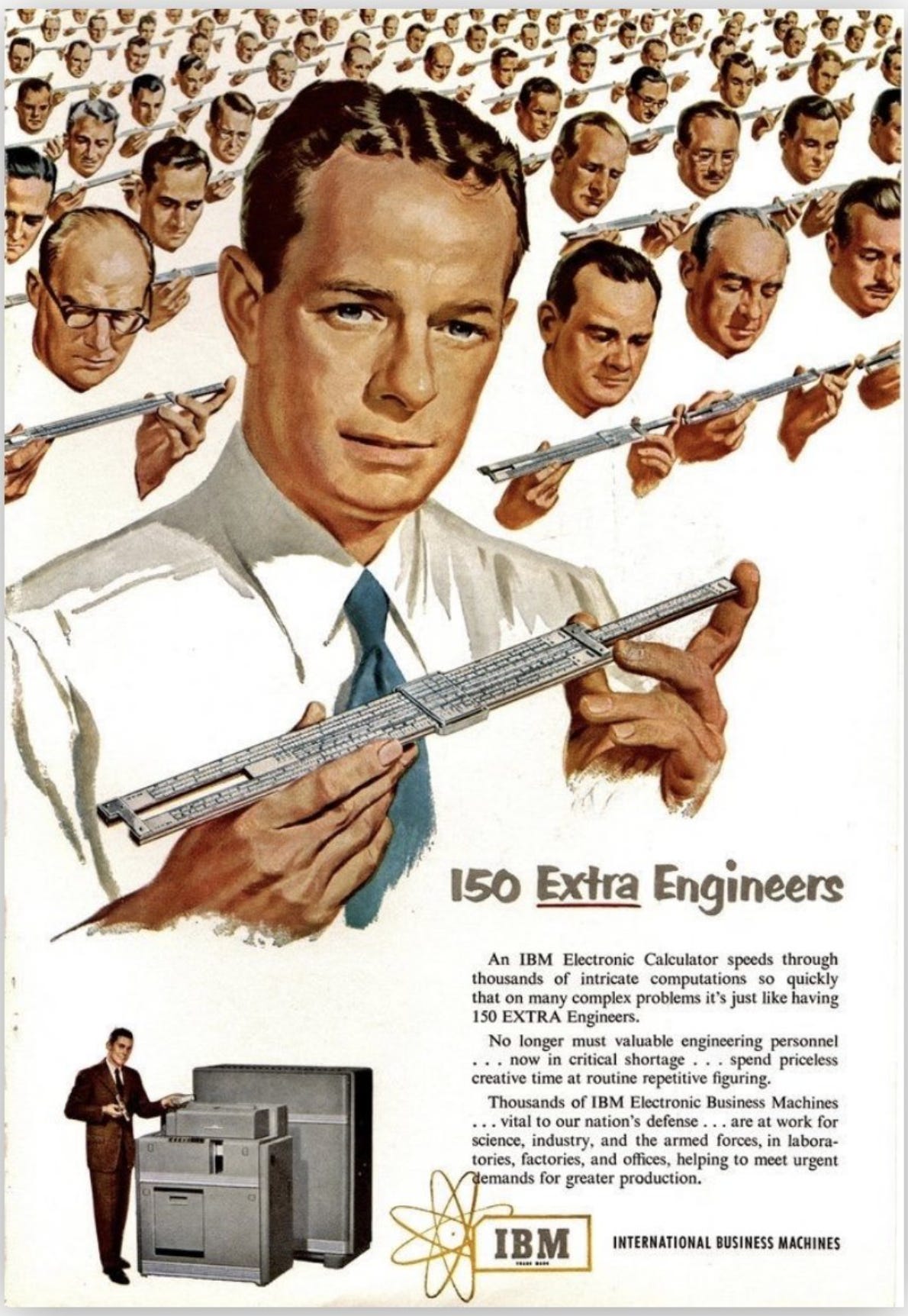
→ Why does it matter? “It’s just like having 150 extra engineers”.
The mission:
The Wall Street Journal once used “Read Ambitiously” as a slogan, but I took it as a personal challenge. Our mission is to give you a point of view in a noisy, changing world. To unpack big ideas that sharpen your edge and show why they matter. To fit ambition-sized insight into your busy life and channel the zeitgeist into the stories and signals that fuel your next move. Above all, we aim to give you power, the kind that comes from having the words, insight, and legitimacy to lead with confidence. Together, we read to grow, keep learning, and refine our lens to spot the best opportunities. As Jamie Dimon says, “Great leaders are readers.”
Disclaimer: This content is for informational purposes only and does not constitute financial, investment, or legal advice. Readers should do their own research and consult with a qualified professional before making any decisions.