

Enjoy this week’s Big Idea read by me:

The big idea: Building AmbitiousOS & AI Agents w/ Claude Code
Reading time: 7 minutes

Every Friday, Reading Ambitiously appears finished. What you don’t see is the system behind it, and how much work goes into it before a single sentence makes it into the final draft.
This edition is different.
I want to walk through how I’m actually using Claude and AI agents to build what I now think of as AmbitiousOS (the operating system behind this newsletter). Not conceptually, but practically, and in the same order I built it.
Why is this important? As a team of one, every minute I can get back to what I consider the most valuable part of what I do (giving you the power of these ideas, tastefully selecting what makes it in here, thinking, and creating) is time well spent. It’s time to get back what translates directly into more value for you. Let the robots do the rest.
Getting Set Up: Claude Code and Visual Context
On my desktop, I run Claude Code in the terminal and VS Code side by side.
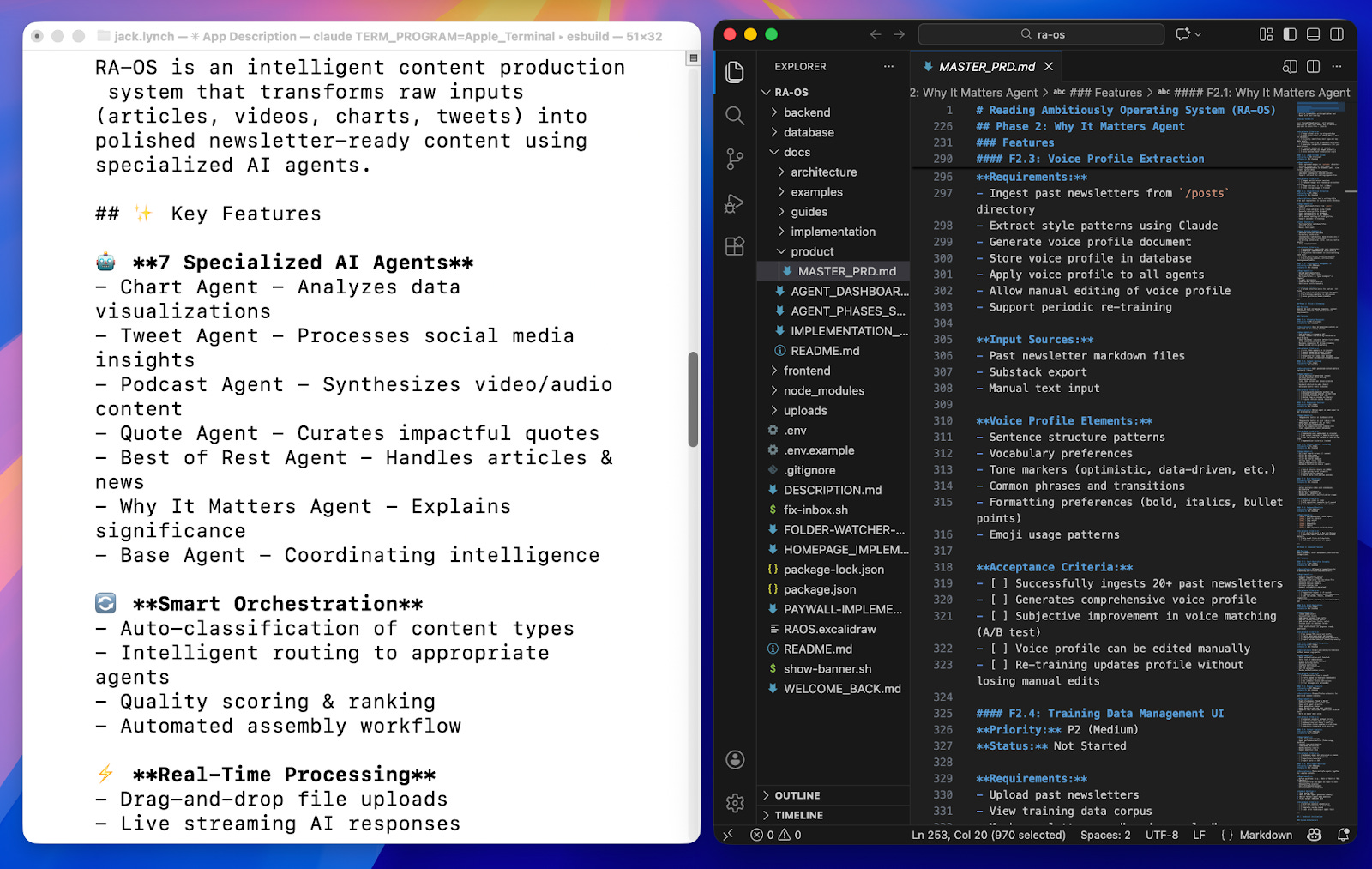
Claude can feel intimidating in a terminal window. VS Code makes the system legible. On the left, Claude understands the project. On the right, I can see the file structure as a real, assembled application.
As you become more comfortable with Claude, you may find yourself minimizing VS Code and “feeling the force,” as a close friend put it. Top engineers are now writing 100% of the code with Claude. VS Code is a nice stepping stone to getting there, so you can see the structure and have it help inform how you think about what you are asking the model to do.
Context Is King
Before writing any code, spend time on inputs.
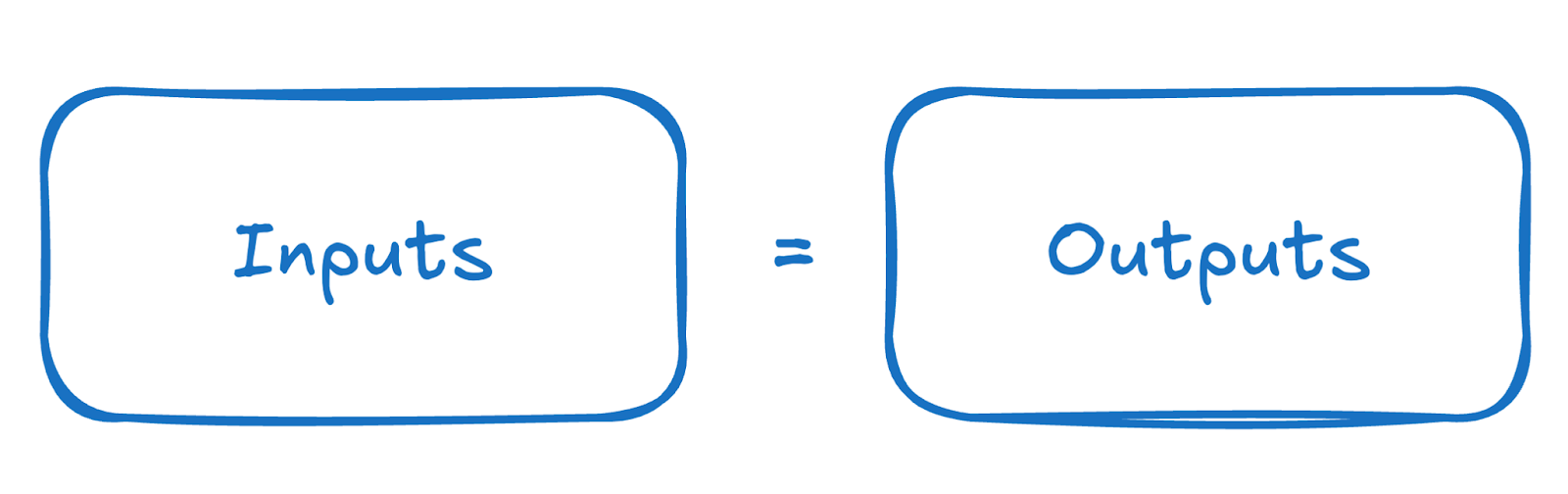
Claude loosely knows what a newsletter is, just as it loosely knows what a car is. That is not enough. If you want a system that works, you have to explain the features that make the thing the thing.

Feature one. Feature two. Feature three.
This is where planning mode matters. I use Claude’s planning workflow, not to generate code, but to think out loud with the model. PRD, spec-led design, and planning: they are all the same idea. Good inputs equal good outputs.
I often let Claude interview me. It asks follow-up questions until the ambiguity disappears: parallel or sequential processing, file limits, UX expectations, and failure cases.
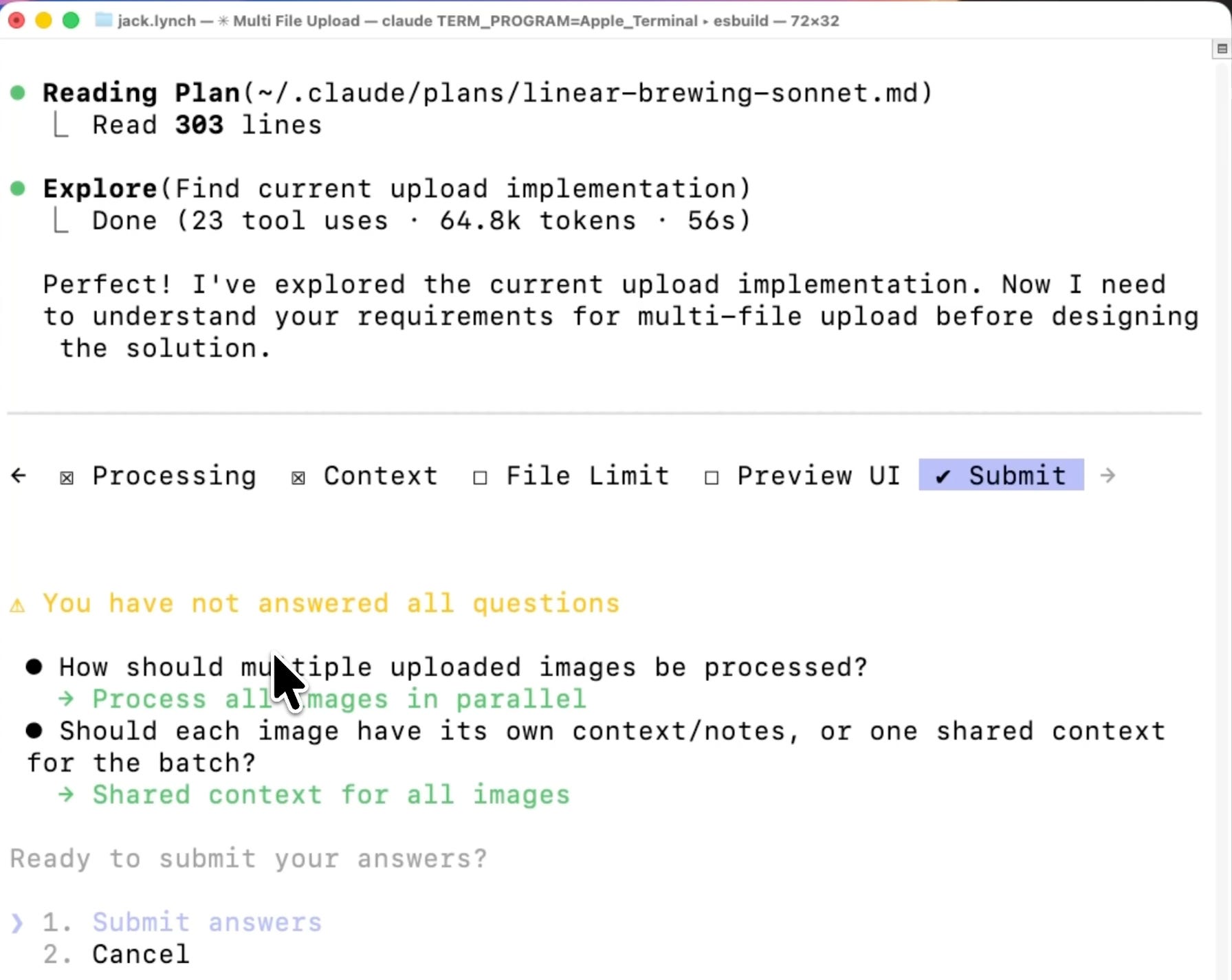
This stage takes time. Spend as much time as you can in planning. It always pays off.
System Design Is Not Optional
If you are not a software engineer, this part can feel uncomfortable.
It shouldn’t.
You are the architect now, whether you like it or not. AI does not remove the need for system design. It makes it explicit.
I’m basically the “Systems Architect” of Reading Ambitiously. It started as a simple internal post 2 years ago. Today, it includes video, charts, tweets, podcasts, and curated sections that some readers go to first. Each of those is a feature set with its own logic.
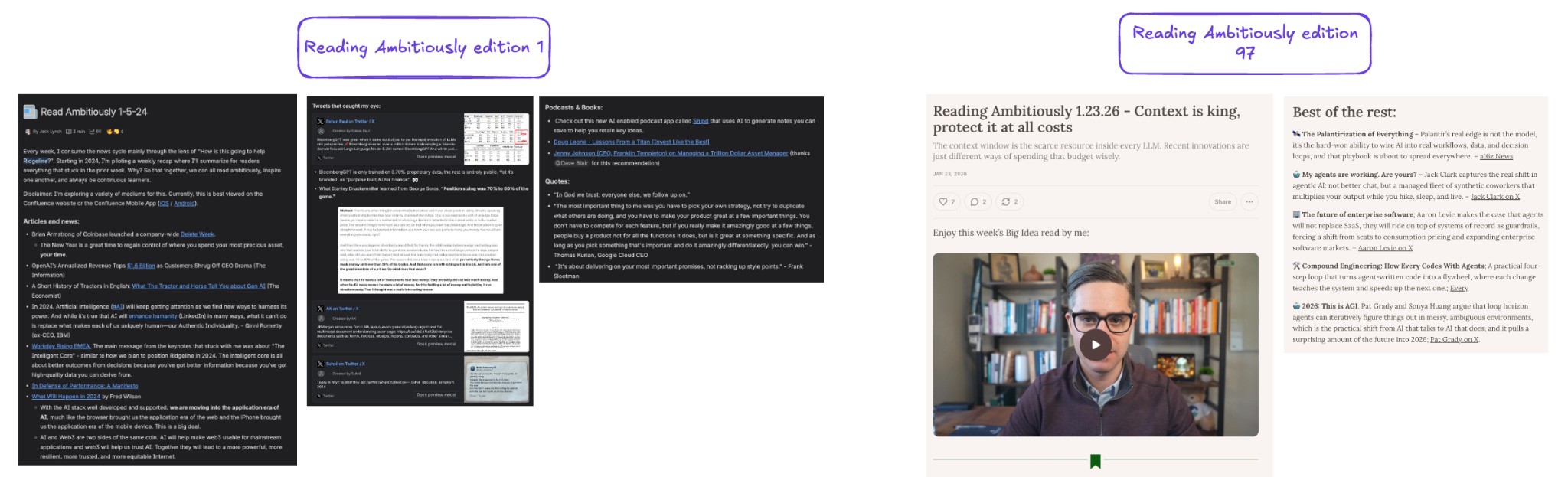
The system underneath had to evolve to support that complexity.
Understanding the primitives of what you are building is no longer a nice-to-have. It is the most important work.
Understanding the system drives design
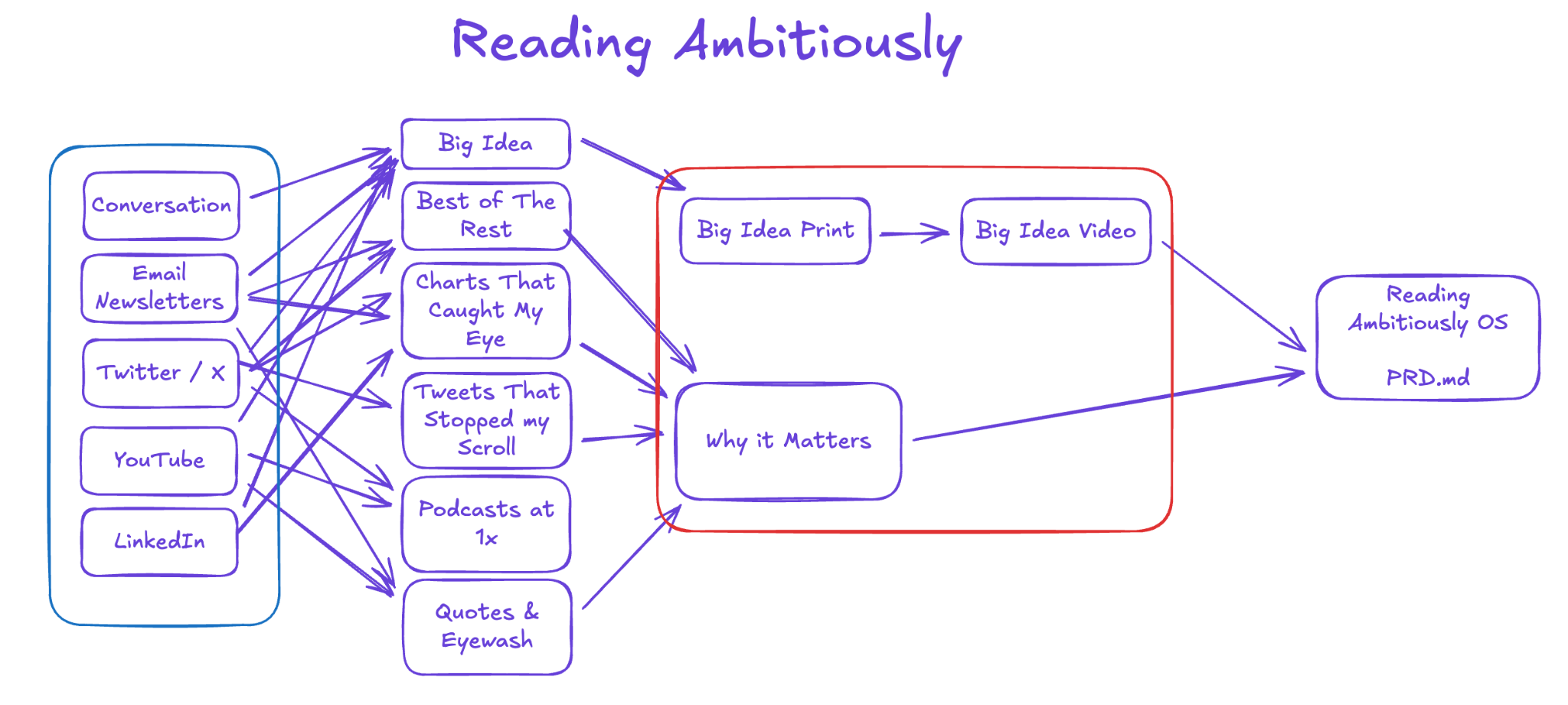
Before building anything, you have to fully understand the system. It helps to draw it out. From there, you can derive the product requirements document (PRD).
That PRD includes the vision, mission, audience, personas, architectural decisions, and the agents themselves. It is the instruction manual for the model. The current master_PRD for RA OS is 2,268 lines. 🤯.
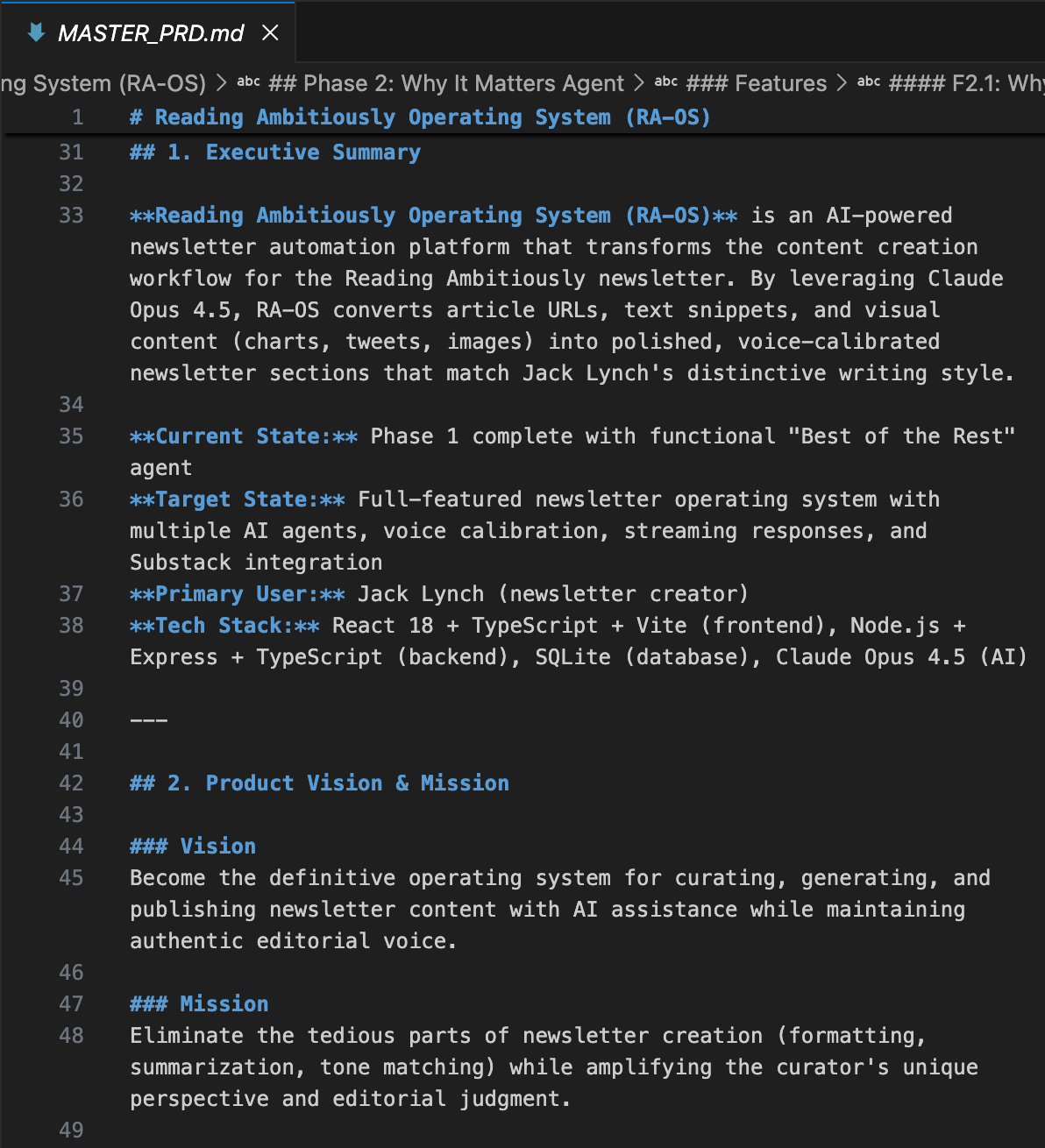
The more precise this document became, the better Claude’s output got. Not incrementally, but step-function better.
Version One: The Universal Inbox
The first system I built mirrored how I already worked.

A universal inbox. Content flowed in. I manually categorized it. Best of the Rest. Charts. Tweets. Podcasts. Each item could be processed by an agent to generate draft content.
It worked. It was UI-heavy. It was human-driven. It looked familiar.
Then I realized something obvious in hindsight, which reminded me of a favorite quote: “You’re always driving into the future in the rearview mirror.”
V1 looked a lot like what’s been possible pre-AI, not where we are today.
Let the Agents Do the Sorting
The AI was better at classification than I was.
So we built an auto-assembly system using an LLM with “vision,” so it can not only read text but also interpret images.

Now, content is classified first. Agents determine what something is, where it belongs, and how confident they are in their assessment. Then they process it and generate an initial “why it matters.”
This was the inflection point.
The more I built, the more agentic the system became. What started as folders became orchestration.
AmbitiousOS Today (really just a few hours later)
Today, when I log in, I do not see an inbox.
I see an update from my editor-in-chief telling me where the edition stands, what is missing, and where I should focus. I can talk to it. It coordinates the other agents in the background.
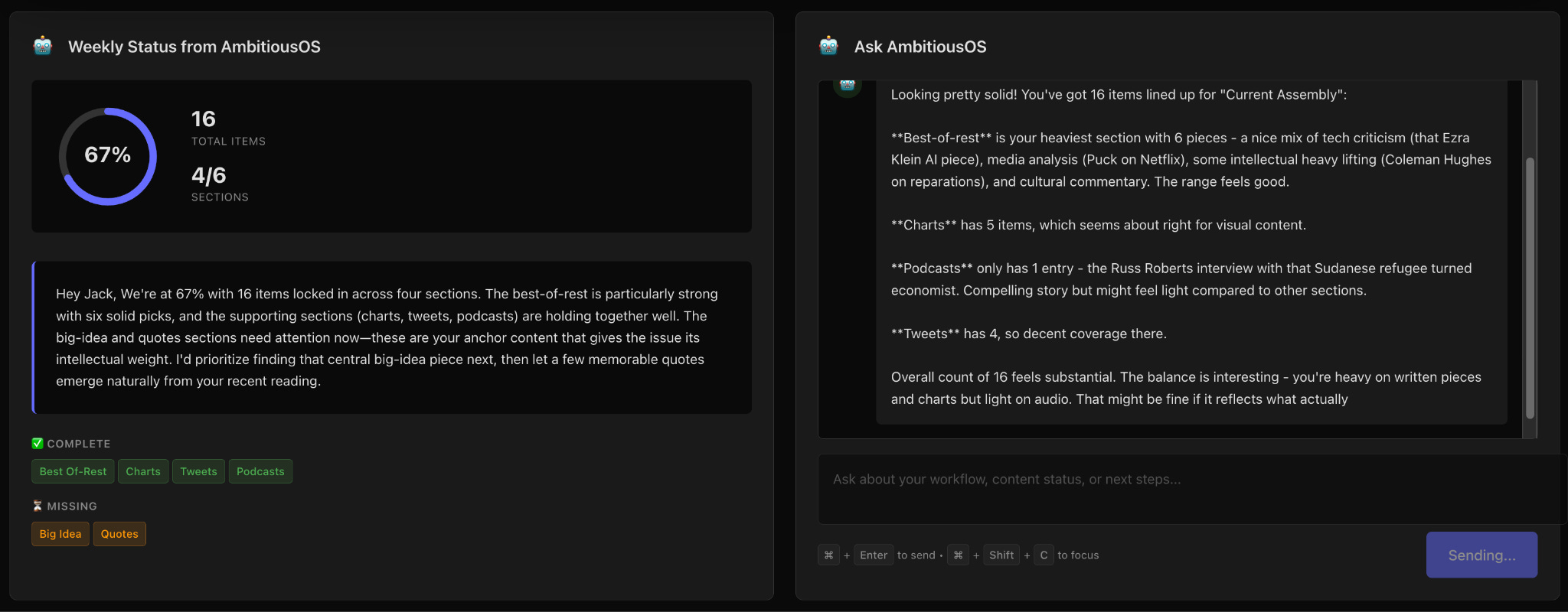
Each agent has narrow instructions and specific skills. Best of the Rest. Charts. Tweets. Podcasts. All orchestrated by the core system.
This will save hours every week.
What the System Does Not Do
AmbitiousOS does not decide what matters or why.
It does not replace taste. It does not judge how to explain why a certain piece of content matters. That’s my job!
What it does is remove the drudgery that competes with time for judgment. It protects my own context window, so I can spend my time on what matters most: explaining why something is important. So I can do what I love to do, give our readers the power!
That tradeoff is the entire point of most Agents you’re going to want to have.
Where This Is Headed
As one friend told me after seeing an early version, there may not be a UI at the end of this arc.
I think they are right.
The system started hierarchical, then became AI-driven, and now feels AI-native. That progression was not planned. It emerged.
Last year may have been the year of agents. This feels like the year of personal operating systems.
Software shaped around how you think, not how software has always worked.
This is just the beginning.

Best of the rest:
💾 Microsoft Flexes Custom Silicon – Maia 200 chip claims 3x performance over Amazon’s Trainium, will run GPT-5.2 and power Microsoft 365 Copilot at 30% better cost efficiency – The Verge
📊 The Man Who Almost Ran Berkshire – David Sokol was Buffett’s heir apparent until personal trades derailed everything. Now Greg Abel has the job Sokol lost. – WSJ
💰 Brex’s $5.15B Exit and the Hubris Tax – Capital One acquires Brex for less than half its peak valuation. A massive win by any normal standard, but a cautionary tale about raising at 100x+ revenue multiples. – X
🌅 Amodei’s “Technological Adolescence” Essay – Anthropic’s CEO lays out a battle plan for humanity’s most dangerous transition: the moment we hand near-infinite power to systems we barely understand – Dario Amodei
🎖️ Title Arbitrage – Palantir turned “solutions engineer” into “forward-deployed engineer” and changed how the role was valued. AI companies should do the same. – a16z

Charts that caught my eye:
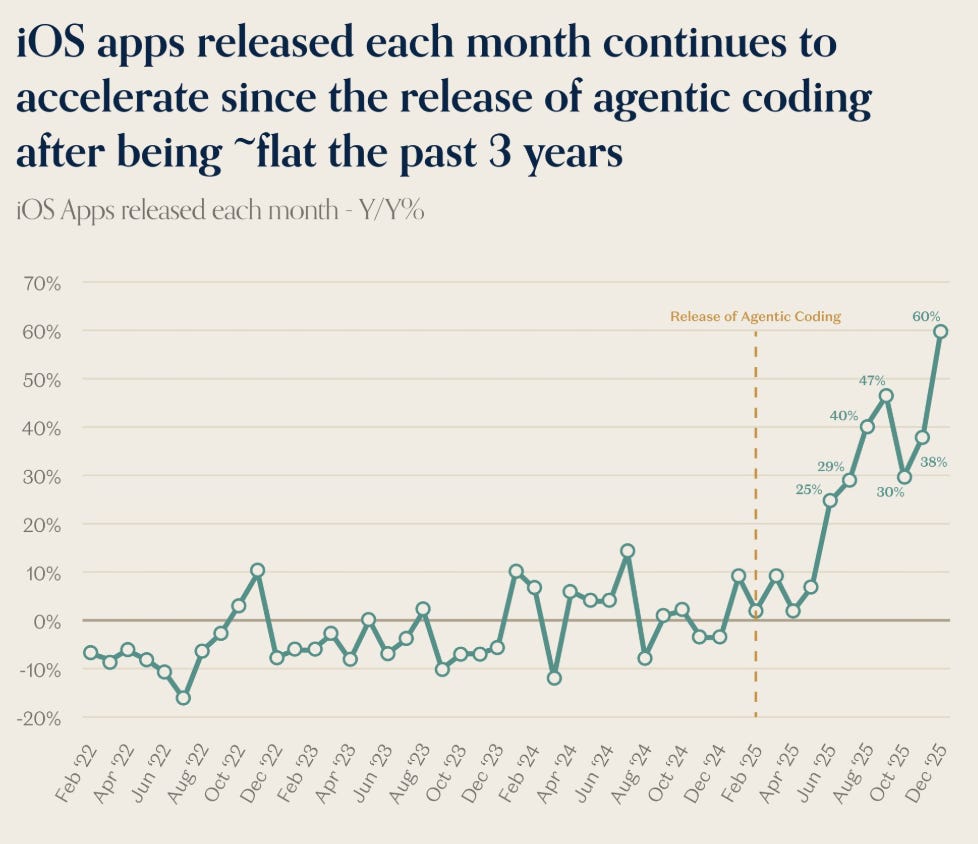
→ Why does it matter? After three flat years, iOS app releases are now running 60% higher YoY in December and 24% higher on a trailing twelve-month basis, a pattern that lines up well with the arrival of tools built for agentic coding!
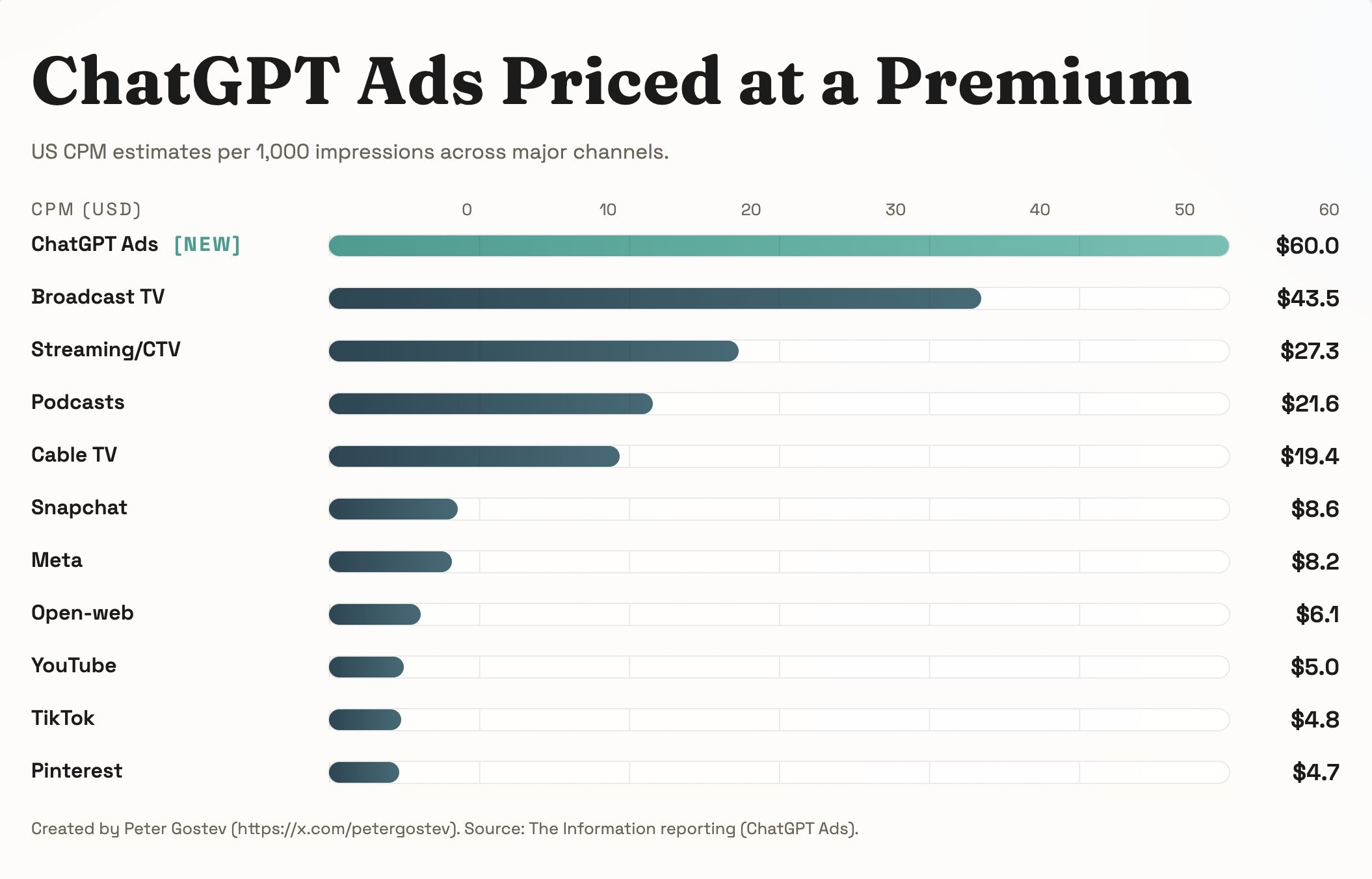
→ Why does it matter? OpenAI is betting that conversational AI commands a premium: at $60 CPM, ChatGPT ads cost 38% more than broadcast TV and 12x more than YouTube. That’s not a typo. OpenAI believes attention inside a chat interface is fundamentally different (and more valuable) than passive scrolling. The question is whether advertisers agree, or whether this pricing becomes the ceiling that forces OpenAI to build a real ads business from scratch.
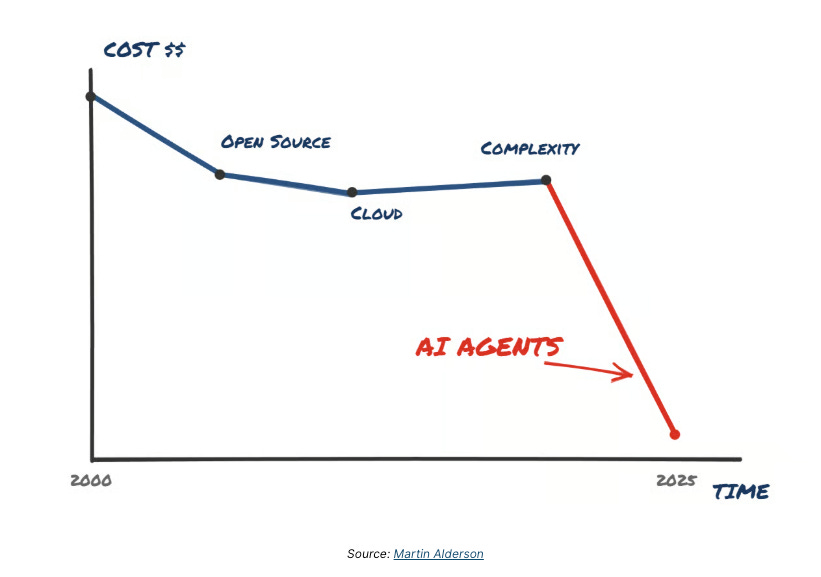
→ Why does it matter? Software costs followed a predictable pattern for 25 years: open source dropped the floor, cloud made it accessible, then complexity crept back in (more tools, more integrations, more headcount to manage it all). AI agents break that cycle entirely. They don’t just reduce costs. They collapse the labor component of software delivery. The companies that figure this out will operate at cost structures their competitors can’t match.

Tweets that stopped my scroll:
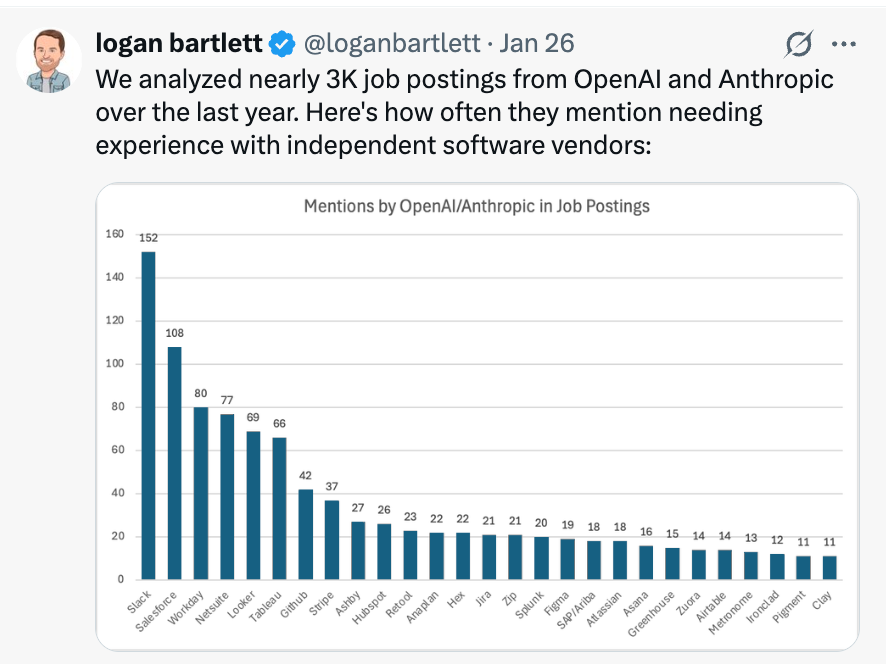
→ Why does it matter? This is a real-time map of enterprise software moats. When the two hottest AI companies are explicitly hiring for Salesforce, Workday, and NetSuite experience, they’re telling you which platforms have become so deeply embedded in how businesses operate that even frontier AI labs can’t ignore them. The long tail is equally revealing: 25+ different vendors mentioned means the modern enterprise stack is fragmented, specialized, and sticky.
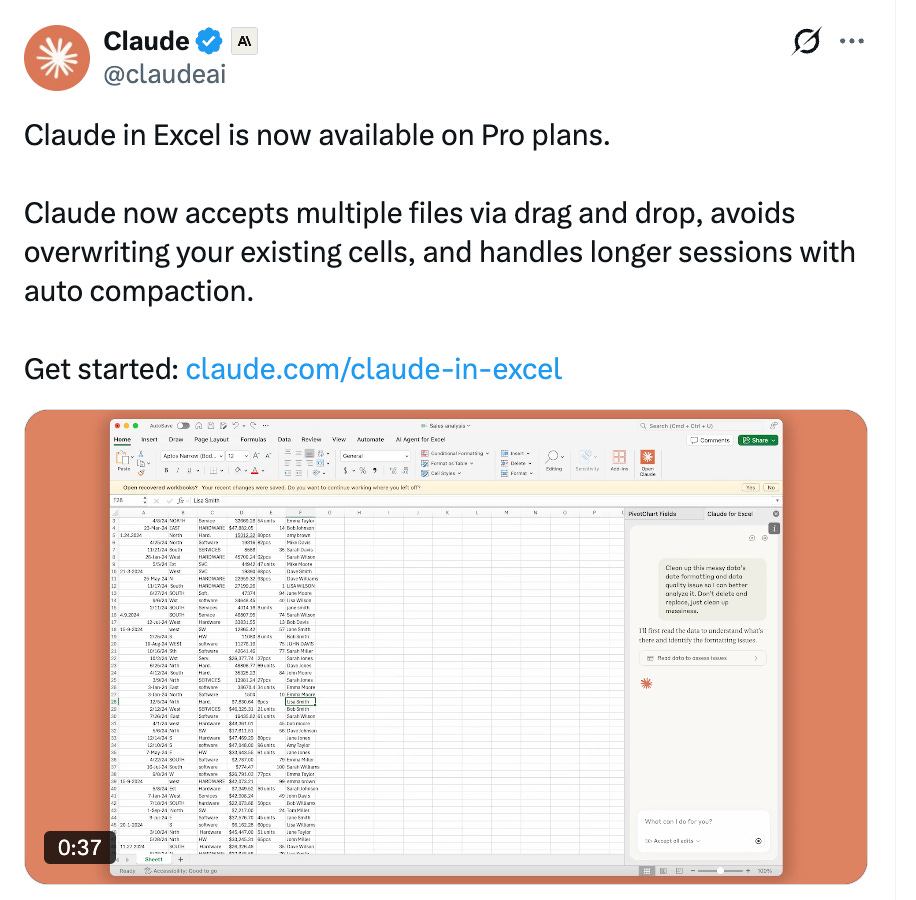
→ Why does it matter? Claude is now embedded directly where knowledge workers actually live: inside Excel. This is Anthropic’s enterprise play in action. Instead of asking users to copy data into a chatbot, they’re bringing the AI to the spreadsheet. This turns Claude from a “clever assistant” into a genuine co-pilot. Google has Gemini in Sheets. Microsoft has Copilot in Excel. Anthropic just made its move.
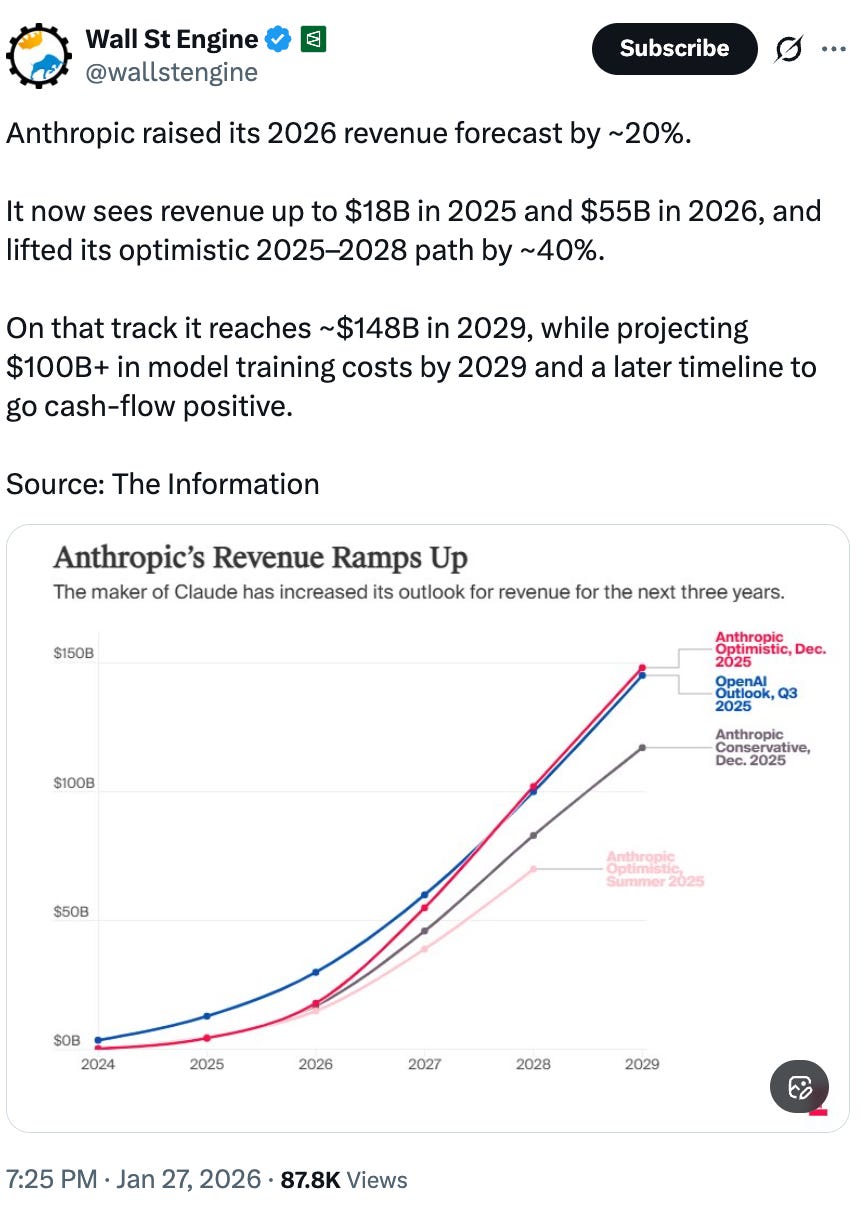
→ Why does it matter? Anthropic projects it could hit $148B in revenue by 2029 while spending $100B+ on model training before going cash-flow positive. For context, Google’s entire 2024 revenue was ~$350B. Anthropic is projecting nearly half that in five years. The AI race increasingly isn’t just about who builds the best model—it’s about who can sustain the spend long enough to reach profitability.

→ Why does it matter? This is emergent agent behavior in the wild. The AI wasn’t programmed to handle voice messages. It encountered an obstacle, found tools in the environment, and chained together a solution on its own. That’s not following instructions. That’s problem-solving. Feel the AGI. We’re watching the shift from “AI that does what you tell it” to “AI that figures out what needs doing.”

Worth a watch or listen at 1x:
→ Why does it matter? Honestly, with all the content from Davos/WEF over the past week, I’ve declared podcast bankruptcy. Here is a 15-minute set of timeless lessons on how to show up like some of the very best leaders. As I’ve heard Dave Duffield say, “You have two ears and one mouth, use them proportionately.”

Quotes & eyewash:
→ Why does it matter? How my friends who are real software engineers feel when I tell them about the application I just built with Claude.
The mission:
The Wall Street Journal once used “Read Ambitiously” as a slogan, but I took it as a personal challenge. Our mission is to give you a point of view in a noisy, changing world. To unpack big ideas that sharpen your edge and show why they matter. To fit ambition-sized insight into your busy life and channel the zeitgeist into the stories and signals that fuel your next move. Above all, we aim to give you power, the kind that comes from having the words, insight, and legitimacy to lead with confidence. Together, we read to grow, keep learning, and refine our lens to spot the best opportunities. As Jamie Dimon says, “Great leaders are readers.”
Disclaimer: This content is for informational purposes only and does not constitute financial, investment, or legal advice. Readers should do their own research and consult with a qualified professional before making any decisions.