

Enjoy this week’s Big Idea read by me:

The big idea: High-Agency teams win the AI era
Reading time: 5 minutes

In the agent era, the bottleneck is not intelligence. That will be abundant. The bottleneck is an orientation toward acting on it.
It’s a crisp January 9, 2026 morning. Company A and Company B sit down to map out the year ahead. They face the same market pressures, similar opportunities, and the same question on the table.
Can we leverage AI to achieve a real competitive advantage this year?
Both have the same frontier models from OpenAI, Anthropic, and Google. Both have committed real resources and budget. Both are aiming for meaningful wins.
Fast forward to the end of 2026. The outcomes have diverged sharply.
Company A treated agents like new co-workers, and they didn’t want to see their teammates fail. They selected a handful of key revenue-generating workflows, assigned a single owner to each, deployed them into production, and iterated quickly.
One example: business development. Agents monitored prospect account signals, automatically segmented markets, generated briefs for sales executives, and teed up the next best action. They provided the agents with data from Salesforce, ZoomInfo, Perplexity, and other sources. They also updated the agents’ instruction set and skills catalog every time they learned something new. Humans weren’t replaced. They gained leverage.
Company B treated agents like experiments. It launched pilot programs across functions, built impressive prototypes, and generated artifacts, decks, and internal excitement. But ownership stayed diffuse. Decisions waited for alignment. Nobody wanted to be the person who shipped the wrong thing into production. Each pilot ended with a debrief instead of a deployment. By year’s end, there was activity, but little achievement.
At Company B, AI was allowed to assist rather than be authoritative. It could draft, summarize, and suggest, but it could not own outcomes from end to end. It was a move to play it safe, and it kept progress slow. Work moved at the speed of human review.
What was the primary difference between Company A and Company B? It wasn’t the technology. For practical purposes, the AI tools available today (ChatGPT, Gemini, Claude, Grok) are increasingly interchangeable. What they provide, intelligence, is becoming abundant.
What differed was agency, the root word of AI agent.
An agent is, at its core, something that acts. My favorite definition of agency is the capacity to direct action, to choose an outcome, and move toward it without waiting for conditions to be perfect or blaming the circumstances. When agency is high, intelligence stops being merely impressive and starts becoming leverage.
LLMs are making intelligence abundant. The prize for high-agency teams that deploy it is leverage: a small team producing the output of a much larger one because the distance between intent and execution collapses.
That’s what Company A earns, and Company B does not.
Leverage emerges when software is empowered to act, not just suggest or summarize, and when humans transition from doing the work to overseeing the exceptions.
If you want the Company A outcome in 2026, start where the compounding begins: build a high-agency team, give them AI superpowers, and have them build the workflows that drive growth.
What it means to be high agency
Back to my favorite definition: getting what you want without waiting for conditions to be perfect or blaming the circumstances.
It’s easy to mistake high agency for a personality trait. It isn’t. It’s closer to an operating system, and in my view, one of the best predictors of success in hiring.
George Mack, who writes the High Agency blog, frames it as a blend of three skills: clear thinking, a bias for action, and a willingness to dissent when the default path is wrong.
High-agency teams start with outcomes and define “done” in plain English. Ambiguity is normal. When requirements are fuzzy, they don’t freeze. Being wrong is acceptable, the goal is to reduce uncertainty. They default to ownership. You can hear it in their language: “I will,” “we will,” “here’s the plan,” “here’s the deal.”
Now the uncomfortable part. Most organizations train the opposite. The good news is it can be fixed.
Low agency is often an incentive response, not a talent problem. If promotions go to the people who play it safe, if leaders punish a deployment that breaks something, if every decision requires a parade of approvals, if the safest move is to wait until consensus is reached, then waiting becomes rational.
Over time, a culture develops that appears thoughtful, aligned, and busy, while quietly bleeding momentum and creativity.
We all likely recognize our own environments in this story. If projects die through committee rather than failing fast in production, we are not looking at a motivation gap. We are looking at a system that rewards low agency.
Adjust the incentives and you can adjust the agency. A few suggestions:
Make ownership safe.
Give clear decision rights, with explicit thresholds and discretion.
Reward speed with accountability.
Treat failures as data, and focus on what was learned.
Acknowledge fear and reward good judgment. Encourage teams to trust their instincts.
This is the biggest difference between Company A and Company B. AI can act today, but it needs intent. A low-agency organization will use AI to generate artifacts and email summaries. A high-agency organization will use AI to own outcomes and create leverage.
The historical bottleneck was intelligence and technical skill. That is no longer the constraint. The constraint is willingness to act on intelligence that is now abundant.
Choose to be Company A
This is an easy story to tell, and a harder one to live.
But it’s worth saying plainly: technology isn’t the differentiator. The models are strong, the platforms feel interchangeable, and access is increasingly widespread. Thanks to AI, intelligence is becoming abundant.
Build for high agency. Ownership under uncertainty. The ability to pick an outcome, move toward it without waiting for conditions to be perfect or blaming the circumstances, and stay accountable when the work gets real.
Do that and you’ll earn the leverage that follows: a small team producing the output of a much larger one. Faster cycles from intent to execution. Work that used to require coordination across five different people handled in one directed loop, with humans focused on judgment, discernment, communication, trade-offs, and decision-making.
Company A did not win because it had better tools. It won because it built a high-agency team that learned how to use them.
Choose to be Company A.

Best of the rest:
📖 Companies Are Desperately Seeking ‘Storytellers’ , Corporate America is racing to hire narrative builders as earned media shrinks and AI-generated content floods the zone, forcing brands to own their voice, credibility, and human connection end to end. , The Wall Street Journal
🔮 What Will Happen In 2026 – Fred Wilson drops ten concrete predictions across AI, politics, venture, and markets that are easy to track through the year and useful for calibrating your own worldview. – AVC
🚀 Shipping at Inference-Speed – A visceral report on what software building looks like when you stop “writing code” and start running a factory of agents, with the real constraint shifting from keystrokes to model throughput, verification loops, and architectural taste. – Peter Steinberger
✨ Standing Out in 2026 – Lulu Cheng Meservey’s call is simple and sharp: in a world drowning in synthetic slop, the only durable edge is reality, real craft, real proof, real relationships, and real-world artifacts that compound into narrative trust over 6 to 18 months. – Lulu Cheng Meservey on X

Charts that caught my eye:
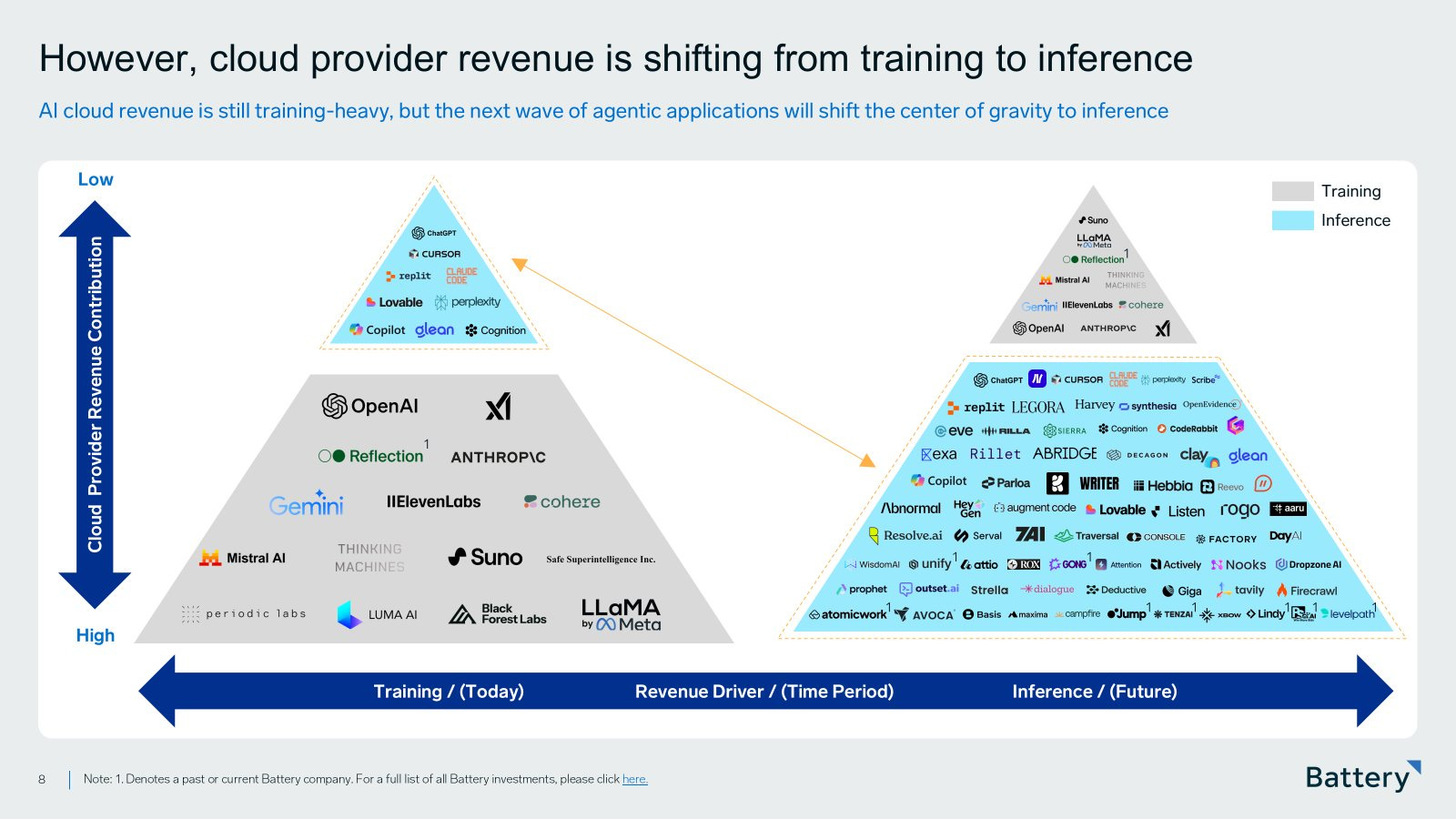
→ Why does it matter? Inference is the compute burned at runtime, after a model is trained; training creates the weights, inference is the ongoing cost that scales with usage. Reasoning models add a new lever: more test-time compute can improve output, so “thinking time” becomes a metered input. As agentic apps come online, most of the compute will be consumed at runtime, by systems that plan and execute workflows end-to-end.
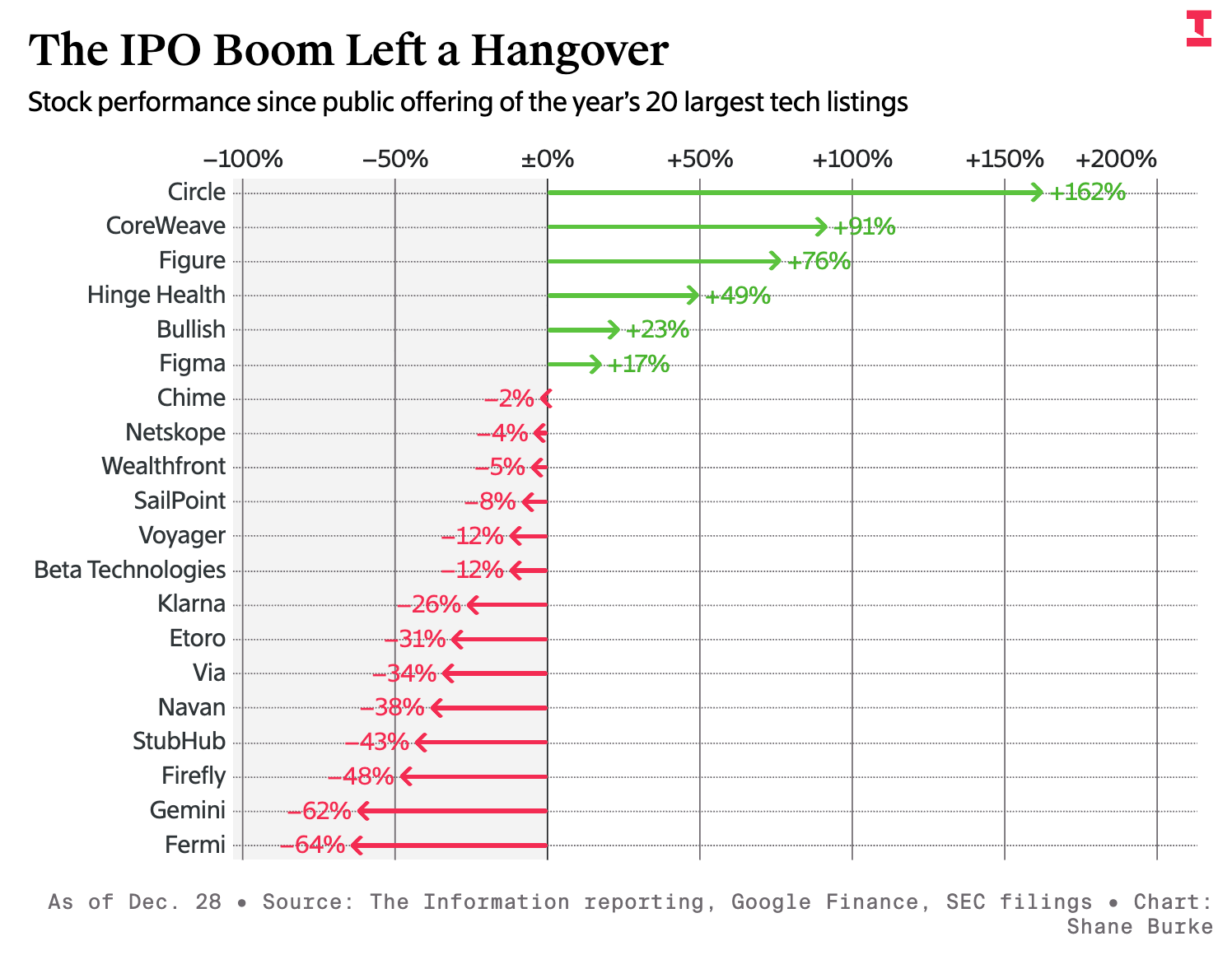
→ Why does it matter? The 2025 IPO class reads like a stress test of private-market narratives, particularly the belief that venture backing and brand recognition can offset durable cash flows once the lockups expire. Even the winners, Circle, CoreWeave, and Figma, demonstrated how challenging it is to maintain momentum when public investors are evaluating fundamentals.
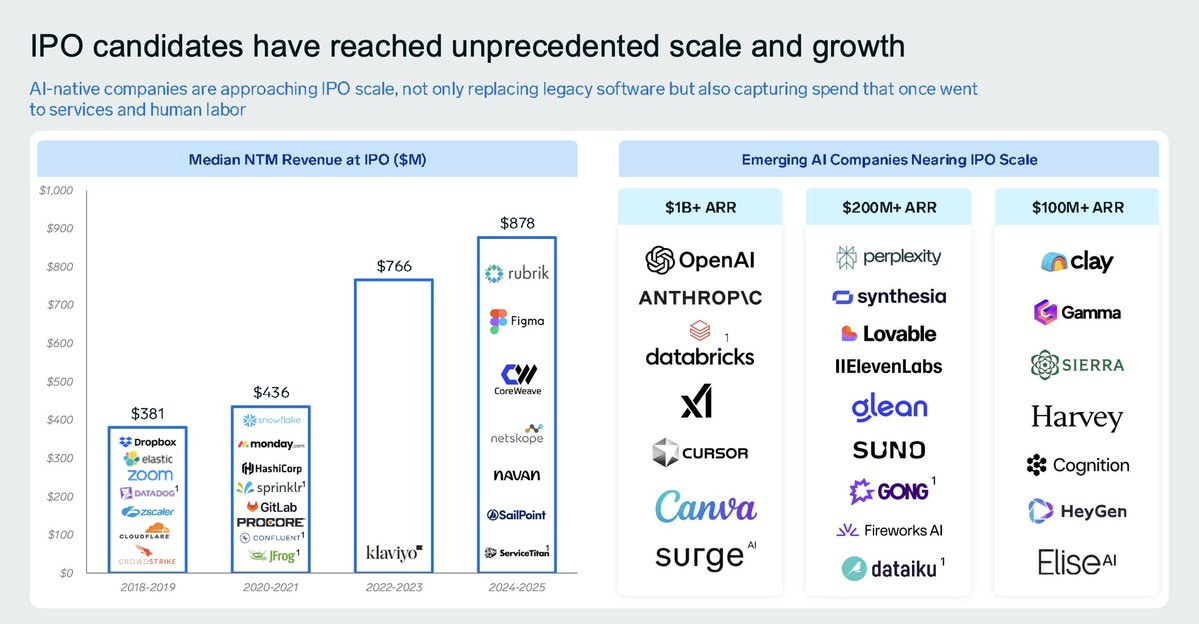
→ Why does it matter? Speaking of IPO, the window is open, and it could swing wide in 2026 if SpaceX leads the way!
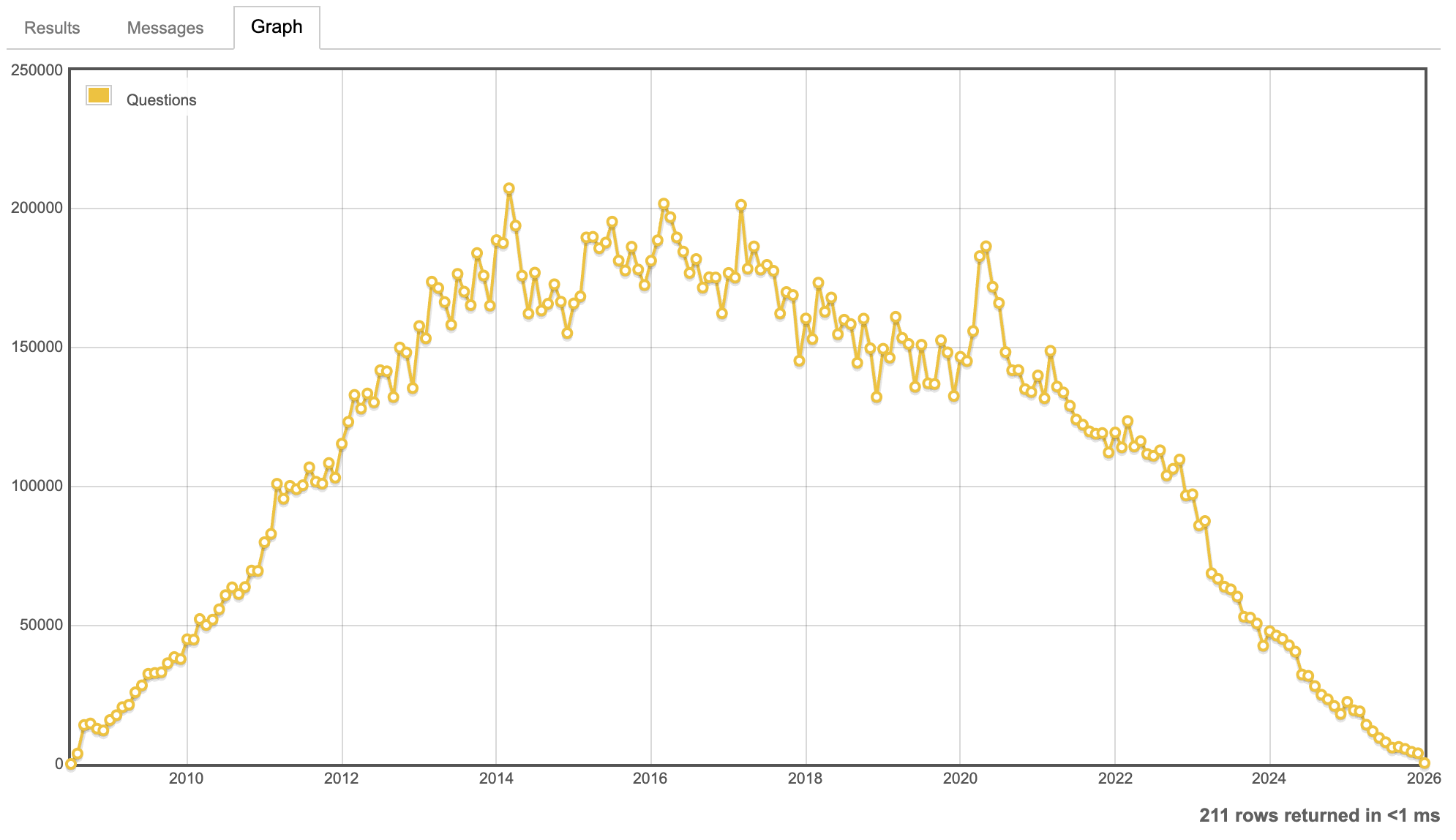
→ Why does it matter? Stack Overflow was the internet’s help desk for programmers, a public place to paste an error message and get a fix that stayed searchable for the next person. That loop snapped once developers could ask ChatGPT and coding assistants in private, and the volume of new questions has sunk to roughly where it was when Stack Overflow launched in 2009. Prosus paid $1.8B to acquire Stack Overflow in 2021, closing that summer, which in hindsight looks like selling the tollbooth right before traffic rerouted.
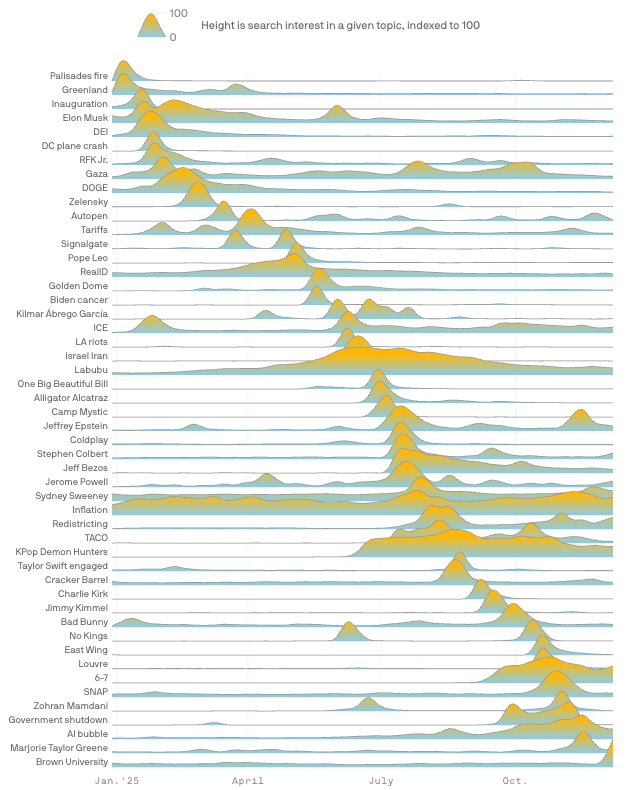
→ Why does it matter? The 2025 news cycle in one chart via Axios!

Tweets that stopped my scroll:

→ Why does it matter? The world of software development is changing fast. Rahul from Ramp captures well some of the changes they’re making on the engineering team. Impressive. Worth clicking through and reading the whole Tweet if you are on one of these teams!
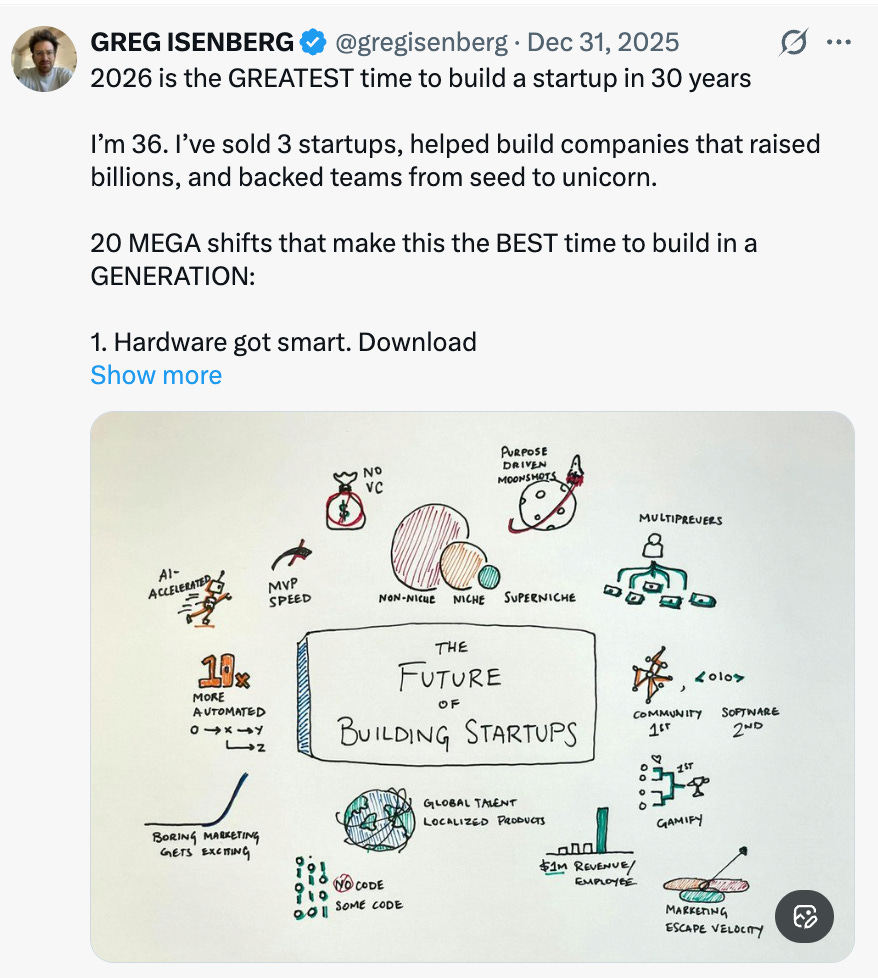
→ Why does it matter? It truly is a once-in-a-lifetime opportunity to build right now. Greg Isenberg captures a solid list of reasons why.

Worth a watch or listen at 1x:
→ Why does it matter? If you’re looking for a shot of intensity in the veins as we kick off 2026, look no further than this wide-ranging conversation with Matt MacInnis, CPO at Rippling. I admire Matt’s drive and ambition. I particularly like what he calls SPOTAK - people are generally Smart, Passionate, Optimistic, Tenacious, Adaptable, and Kind. If a candidate doesn’t click in a hiring process, chances are one of these traits is off.
→ Why does it matter? Make sure you’re in the right headspace before you fire this one up. It’s worth having real focus going in, especially if you’re feeling reflective as we kick off 2026. There are so many key insights in here. Including this mantra Dr. Brooks says every morning with his class at Harvard. “I am truly grateful for the pleasant things that will happen today. I am truly grateful for the troubles I face because my learnings and growth will come from those troubles. Bring them on”

Quotes & eyewash:
“My hunger is not for success, it is for excellence. When you attain excellence, success naturally follows.” - Coach Mike Krzyzewski
→ Why does it matter? 💯
“We are always driving into the future via the rearview window.” - Marshall McLuhan
→ Why does it matter? As Mr. Ford said, “If I had asked people what they wanted, they would have said faster horses.”
The mission:
The Wall Street Journal once used “Read Ambitiously” as a slogan, but I took it as a personal challenge. Our mission is to give you a point of view in a noisy, changing world. To unpack big ideas that sharpen your edge and show why they matter. To fit ambition-sized insight into your busy life and channel the zeitgeist into the stories and signals that fuel your next move. Above all, we aim to give you power, the kind that comes from having the words, insight, and legitimacy to lead with confidence. Together, we read to grow, keep learning, and refine our lens to spot the best opportunities. As Jamie Dimon says, “Great leaders are readers.”
Disclaimer: This content is for informational purposes only and does not constitute financial, investment, or legal advice. Readers should do their own research and consult with a qualified professional before making any decisions.