

Enjoy this week’s Big Idea read by me:

The big idea: You can just build things
Reading time: 4 minutes

The best marketing introduces a human truth.
Jeff Goodby, the advertising legend behind “got milk?,” spent a career arguing that the work starts with something real about people. That is why I like watching Super Bowl ads. When a 30-second slot can cost $8 million to $10 million, companies are forced to compress their worldview into the essentials.
OpenAI compressed theirs into six words: “You can just build things.”
They are claiming the world is more buildable. And they are exactly right.
The gap between idea and reality is compressing fast. Once you have your first “weekend with Claude,” (a couple of hours building software with AI) the feeling of awe snaps in. You stop thinking of software as a permissioned activity, something that requires the right resume, the right team, the right sprint plan. You start thinking of it as an extension of your best ideas.
The hard part is no longer getting to execution. It is choosing what deserves execution. And it’s a moment where the workforce begins to recognize this shift.
Because now that you can just build things, are you going to be the person who does? That is the real question.
A lever, not a ladder
Most productivity tools behave like levers. A lever multiplies force, but it does not distribute force. It rewards the person already applying pressure in the right direction.
AI will not replace workers in the terminator-style scenarios we see in cinema. But workers who use AI will replace workers who do not. Not because they are better people, but because their unit of output compounds.
We are already seeing it in software.
A project that used to require eight engineers and one product manager is now down to two engineers and one product manager. In some cases, it collapses into a single high-level agency person who can blend product judgment with enough engineering competence to ship, test, and iterate. Bret Taylor, founder and CEO at Sierra, said it well: “I think it’s very important to have a very loose attachment to the way we do our jobs.”
In practice, it means the old boundaries are dissolving. Designers are doing PM work. Engineers are doing design work. PMs and designers are coding.
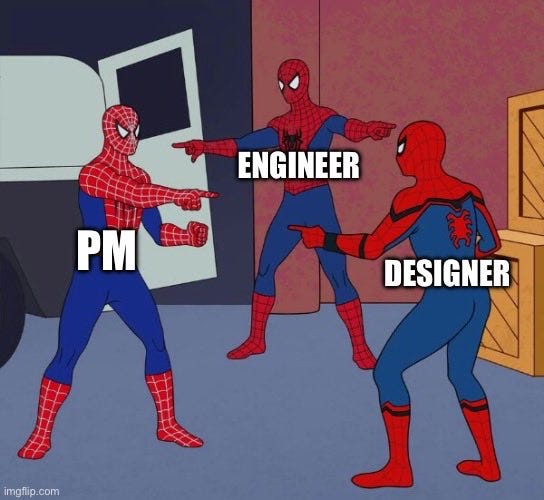
On one hand, that is empowering. The distance between idea and impact shrinks. Individuals get more agency. People who have spent years operating inside large machines can finally move more of the machine themselves.
On the other hand, it is dividing. Because the same compression that gives agency also squeezes the middle.
The K-shape workforce
It is starting to show up in the data.
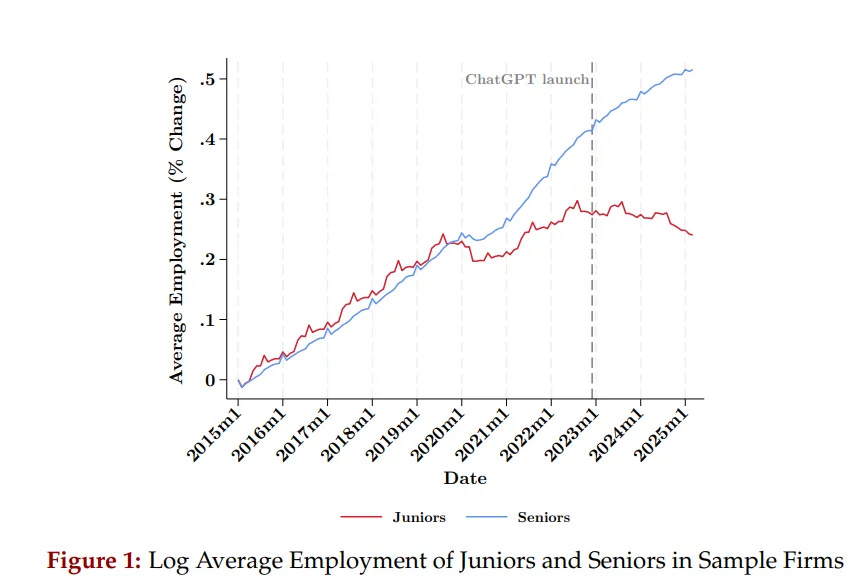
A Harvard working paper tracks seniority inside nearly 285,000 U.S. firms and asks a simple question: does GenAI adoption tilt employment away from junior roles and toward senior ones? Yes. But “junior vs. senior” is a confusing label. What the chart really shows is a shift away from execution-heavy work and toward judgment-heavy work once execution becomes cheaper.
Inside companies, that looks like a K-shaped distribution.
On one side are people who treat AI as a multiplier. They compress the loop: prototype, test, debug, ship. They do not just produce more, they learn faster. Over time, that compounds, because tight feedback loops are the closest thing business has to free money.
On the other side are roles built around the old scarcity: translation, coordination, status, and handoffs. Those roles rarely disappear overnight, but they erode. The work gets unbundled, then absorbed by end-to-end owners and their tooling. Even when a role survives, it often does so with less leverage, because the firm now has a credible alternative: fewer people with broader scope.
This is not a “no juniors” world. It is a “different juniors” world. The opportunity is to hire AI-native early-career builders and train them in the new way of working. Bret Taylor is doing exactly that at Sierra with APX, an early-career program modeled after the Google Associate PM program started by Marissa Mayer, designed to turn new grads into Agent Engineers and Agent Product Managers who can build and ship end-to-end.
In other words, the aggregate chart reads junior down, senior steady. But the red thread is simpler: as the gap between idea and execution narrows, companies hire fewer people to do narrow tasks and more people at every level who can decide and do.
Why it matters
When AI makes more of the “doing” abundant, value migrates upstream toward judgment, context, and people with high agency and a bias for action.
This is the part most companies will learn the hard way. If execution cost drops, winners do not stop building. They raise ambition. They pursue adjacent markets. They revisit legacy systems. They launch experiments that were previously uneconomical.
When firms can do more with the same number of people, they protect the scarce input. The scarce input is no longer engineering capacity and institutional knowledge. It’s judgment, the ability to choose the right thing, align people around it, and see it through.
That is why hiring shifts away from routine execution and toward high-agency, end-to-end owners. Not everyone will build, but the people who do will pull away, and org charts will follow.
A decade from now, the story will not be that AI took everyone’s job. It will be that AI changed what a job could include: fewer handoffs, more ownership, smaller teams, wider scopes.
Which pulls us back to the human truth OpenAI smuggled into six words: “You can just build things.”
But now that you can, are you going to be the person who does?

Best of the rest:
🚨 Something Big Is Happening – Matt Shumer compares where we are now to February 2020: the moment before everything changed. – X
⚔️ Peacetime CEO vs. Wartime CEO – Ben Horowitz’s classic framework on why the skills that build empires don’t save them. Growth mode and survival mode require completely different leadership DNA. – Andreessen Horowitz
💰 Alphabet Sells 100-Year Bonds to Fund AI – Google’s parent drew 7x oversubscription on a £750 million century bond. Investors are betting big that AI dominance pays off across multiple generations. – Bloomberg
💻 Your Software Has Become a Backseat Driver – Modern apps have shifted from tools you operate to channels that operate on you. One reasonable step at a time, we normalized constant interruption. – Mike Swanson’s Blog

Charts that caught my eye:
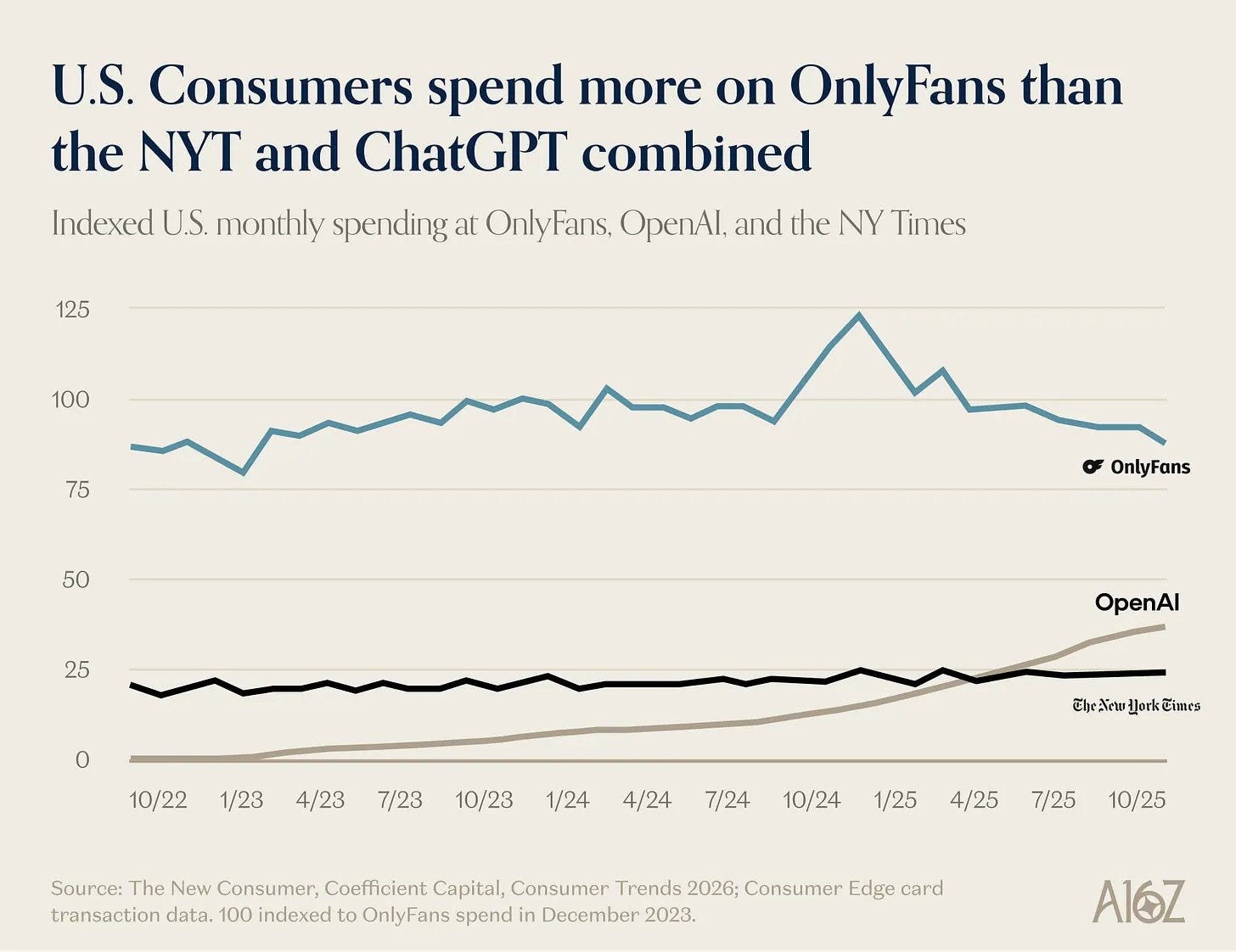
→ Why does it matter? OnlyFans has become one of the most durable consumer subscription businesses in tech history, now generating roughly 4x the consumer spend of OpenAI and NYT combined.
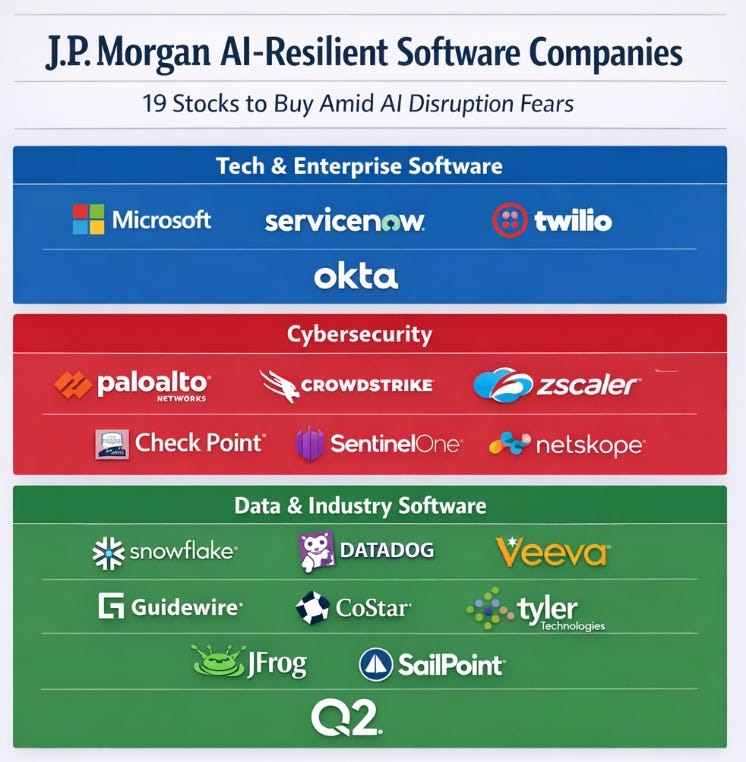
→ Why does it matter? J.P. Morgan just published its 19 AI-resilient software stocks after the SaaS crash, and the thesis is clear: companies with deep workflow integration, proprietary data moats, and security-critical positioning are the ones AI will augment rather than replace.

Tweets that stopped my scroll:
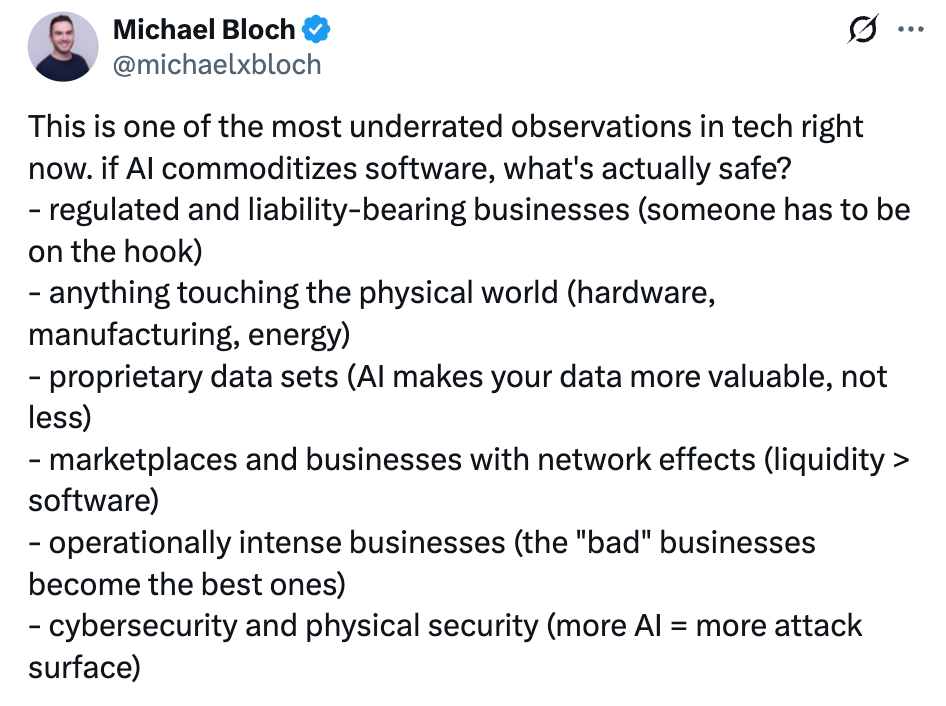
→ Why does it matter? This is the right framework for thinking about AI disruption. When software becomes cheap and abundant, the moats that matter are the ones AI can’t replicate: regulatory complexity, physical constraints, proprietary data, network effects, and operational excellence. The “bad” businesses (messy, people-intensive, hard to scale) suddenly look like the “safe” businesses.

→ Why does it matter? This is the logistics of modern media dominance in one image. NBC isn’t just covering two of the biggest events in sports: they’re treating the Super Bowl and Winter Olympics as a single, continuous broadcast operation. Two Bombardier Global 7500s (roughly $150K+ in charter costs) to move talent 6,000 miles overnight. That’s the cost of being everywhere at once. It’s also a reminder that “live” sports remain the last defensible moat in television. You can’t time-shift the Super Bowl. You can’t skip the opening ceremony. And NBC is betting that having Mike Tirico’s face on both events, back-to-back, is worth the private jet fuel.

→ Why does it matter? Ferrari partnering with Jony Ive signals something bigger than a luxury EV launch: it’s a bet that the next generation of high-end vehicles will compete on software and interface design as much as horsepower. The man who made aluminum feel like a status symbol is now shaping what it feels like to sit in a $400k electric car. That’s Ferrari acknowledging the cockpit is becoming the product.
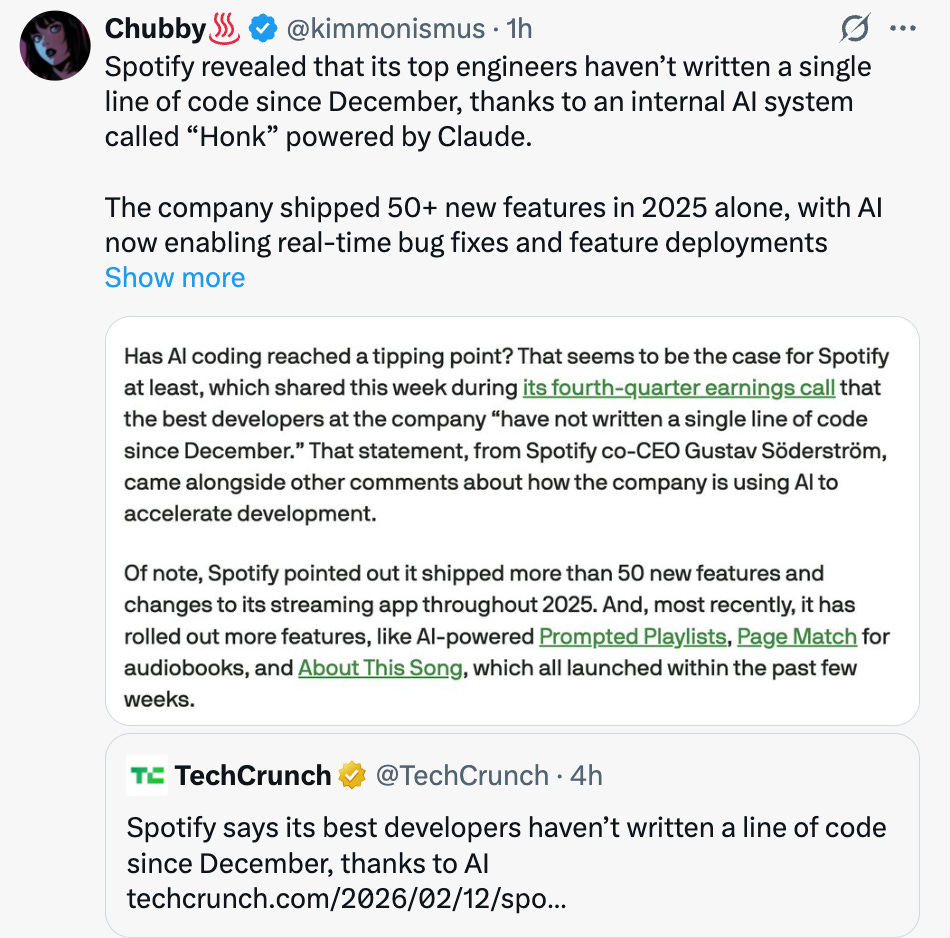
→ Why does it matter? This is the clearest signal yet that we’ve crossed a threshold. Spotify’s best engineers aren’t writing code anymore: they’re directing AI systems that write code for them. The company shipped 50+ features in 2025 while their top talent focused entirely on architecture, review, and strategy. If Spotify (not exactly a bleeding-edge AI lab) is already there, the rest of the industry is about 18 months behind at most.

→ Why does it matter? An AI model to emulate human behavior and simulate the world we live in. A flight sim for humans.

→ Why does it matter? Sam Blond was CRO at Brex during its hypergrowth phase, so when he launches an AI sales platform, it’s worth paying attention. Monaco is betting that the traditional SDR model (hire bodies, run playbooks, grind through lists) is about to get automated away. If Monaco delivers, it compresses the go-to-market timeline for early-stage startups from “hire your first sales rep” to “configure your AI sales engine.”

Worth a watch or listen at 1x:

→ Why does it matter? We had a blast representing Ridgeline at WSJ’s Invest Live last week! Fun to share the Ridgeline story and where we’re planning to take the industry.
→ Why does it matter? Dwarkesh and John get Elon to connect dots he rarely connects publicly: Starlink’s bandwidth economics, Tesla’s energy storage buildout, xAI’s compute demands, and Optimus manufacturing. The thesis here is that these aren’t separate companies. They’re a vertically integrated system designed to solve the same bottleneck (power, data, physical labor) from multiple angles. At 2x you’ll miss the moments where Elon pauses to think through constraints in real time.

→ Why does it matter? Friend of Reading Ambitiously, Scott McNealy joined CNBC earlier this week to talk all things AI and share his perspective on the moment. Having lived and led Sun through the dot-com in a big way, Scott’s accrued wisdom is always insightful.

Quotes & eyewash:

→ Why does it matter? One of the most amazing shots of live TV ever captured!
The mission:
The Wall Street Journal once used “Read Ambitiously” as a slogan, but I took it as a personal challenge. Our mission is to give you a point of view in a noisy, changing world. To unpack big ideas that sharpen your edge and show why they matter. To fit ambition-sized insight into your busy life and channel the zeitgeist into the stories and signals that fuel your next move. Above all, we aim to give you power, the kind that comes from having the words, insight, and legitimacy to lead with confidence. Together, we read to grow, keep learning, and refine our lens to spot the best opportunities. As Jamie Dimon says, “Great leaders are readers.”
Disclaimer: This content is for informational purposes only and does not constitute financial, investment, or legal advice. Readers should do their own research and consult with a qualified professional before making any decisions.