

Enjoy this week’s Big Idea read by me:

The big idea: Building AmbitiousOS v2 + Total Recall & Memory + AI Agents w/ Claude Code
Reading time: 8 minutes

On Friday night, I pulled a stack of journals off the shelf.
Throughout my career, I have taken many notes. Spiral notebooks. Hardbound journals. iPad note-taking apps. Evernote. The notebook I took everywhere in the first 200 days of Ridgeline. Every person we met. Their advice. Our goals.
Reading Ambitiously is an extension of that habit. One hundred and one editions of how technology, markets, and ambition are evolving. In many ways, it is my public journal.
And on Friday night, I had an idea.
What if subscribers could talk to it? Not search it. Talk to it. What is Reading Ambitiously? Could it become a part of their team?
In about 30 minutes, Claude and I had a plan. We built it, and we’re going to make it available to you.
Memory
Memory is a funny thing. The human brain is extraordinary at pattern recognition and terrible at retrieval.
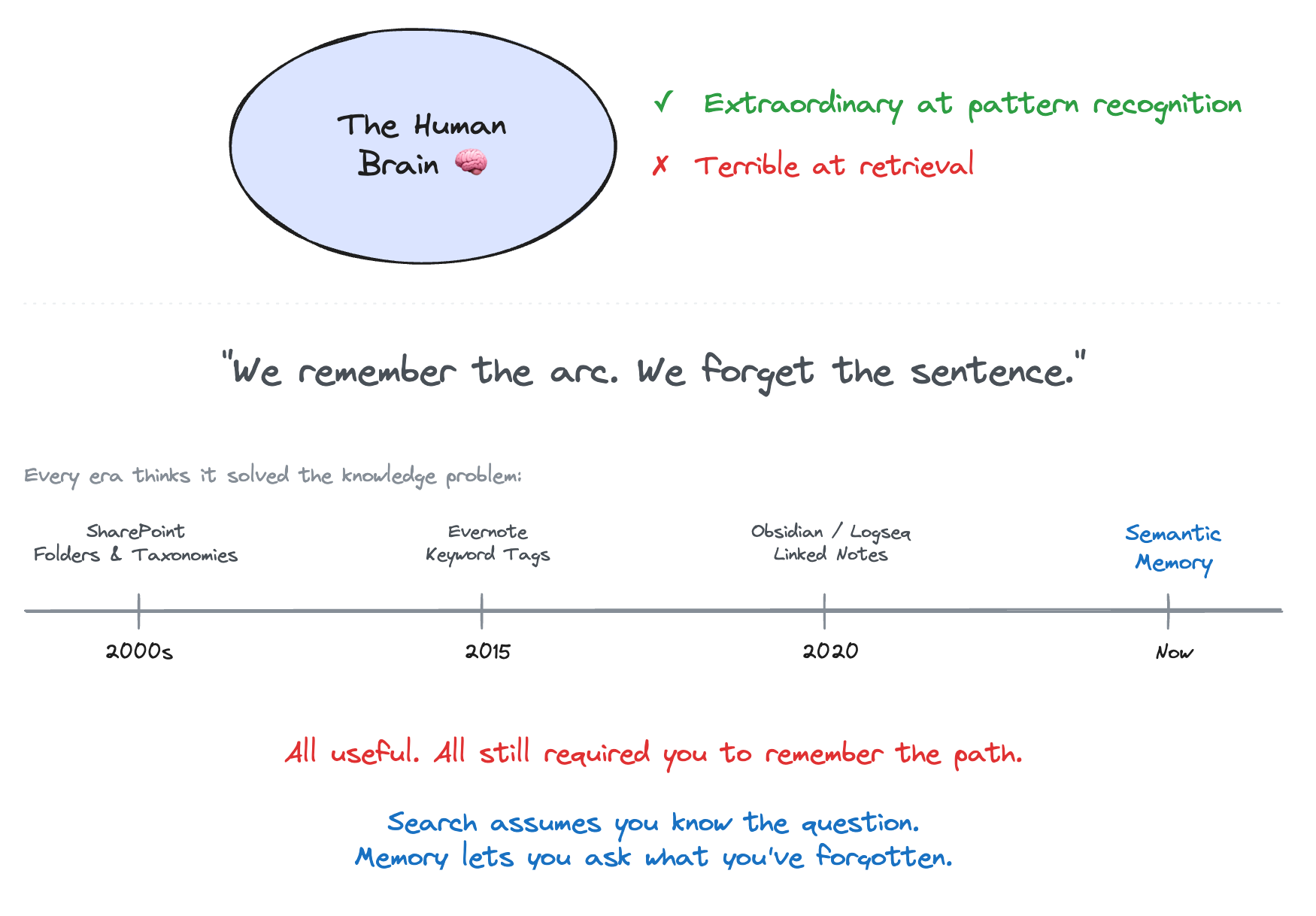
Every technology era believes it has solved the knowledge problem. In the early 2000s, we built document management systems. Taxonomies. Keyword indexing. Then came the “second brain” movement.
All useful. All still dependent on one thing: you had to remember the path. And spend a lot of time gardening to keep it clean.
Search assumes you know what you are looking for. Memory allows you to ask what you have forgotten.
The latter of which AI is very good at.
From Newsletters to AmbitiousOS v2
There are tools that claim to do this (Glean, Notion AI, various “chat with your docs” products). I have tried a few. They feel heavy. You do not quite understand what they are retrieving or why. Plus, I wanted to do this to understand what’s going on technically here.
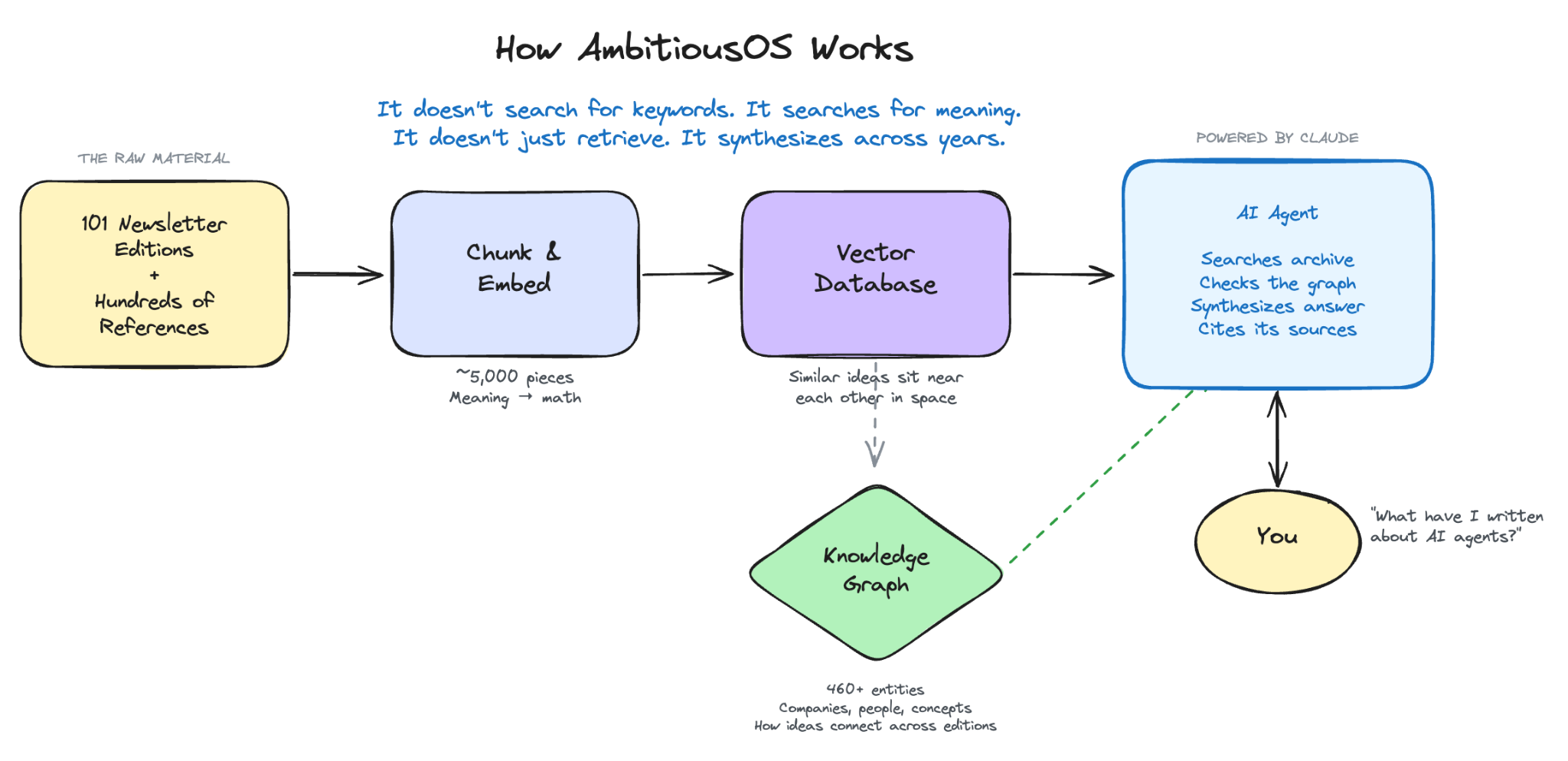
The first step was building a vector database. If you are new to that term, think of it as a way to store meaning instead of keywords. Each paragraph becomes a mathematical representation (an embedding) that captures its semantic shape. Similar ideas sit near each other in that space, even if the words are completely different.
Every edition of Reading Ambitiously was pulled from Substack. Not easily, I should add. But we wrote code to fetch the full archive, then chunked each edition into smaller sections: roughly 300 to 900 tokens at a time, preserving headings so the structure remained intact. Each chunk was embedded and stored with metadata (title, date, tags, entity references).
In our first load, we went with all editions available on Substack, which is 59. About 5,000 chunks. Indexed and stored.
From there, we layered on more intelligence and tooling:
A retrieval system that searches by meaning.
A temporality layer that detects when you are asking how your thinking has evolved, and sorts results chronologically.
A knowledge graph that maps 460 entities (companies, people, concepts, frameworks) and how they connect across editions. Claude read every piece of content, extracted the entities, and built the graph automatically.
An AI agent that does not just search once and respond. It decides which tools to use, searches the archive multiple times, checks the knowledge graph for connections, and synthesizes everything into a grounded answer with citations.
Persistent memory so the system does not reset every session.
If I’ve lost you in the technical weeds, I’m sorry! This is technical. But what mattered was what happened next.
The Moment It Clicked
I asked a simple question: “Tell me every time I’ve mentioned AI pricing.”
The system did not just return quotes. It synthesized across years. It cited the original editions. It highlighted the first mention and recent usage. It showed how the framing shifted. In the UI, I could see the agent working: “Ambitiously thinking...” with a timeline of each step (searching the archive, looking up entities, finding connections) leading up to the answer.
A few seconds. Doing this manually across 100+ editions would have been an afternoon.
“I have a meeting about AI agent pricing tomorrow. Refresh my thinking: what have I written, what frameworks apply, and what is my current position?”
It pulled relevant chunks from the archive, cross-referenced the knowledge graph, and gave me talking points. Not generic AI-generated ones.
Then I asked one more: “How has the thinking on enterprise SaaS moats evolved over time?”
It detected the temporal nature of the question, sorted everything chronologically, and showed me how my position developed. Early editions versus recent ones. Where I changed my mind. Where I doubled down.
It felt less like a search and more like total recall. Search finds a file. Memory has a conversation with your own thinking.
Near-Perfect Memory, With Limits
Software is moving from tools you open to systems that respond to intent. This is the personal version of that shift. You do not open a folder. You ask. And because the corpus is yours, because the embeddings are legible, because you can see exactly which editions it pulled and why, you understand how it works. Feels like magic, but it’s AI!
The implication is this: near-perfect memory will belong to those who choose to document.
If you want leverage over your own thinking five years from now, you need to give your future self a corpus. Journals. Investment memos. Product specs. Friday notes. The format matters less than the habit. Write it down.
The model is not the asset.
The archive is.
We’re launching in private beta today. The plan is to make AmbitiousOS generally available to Reading Ambitiously subscribers next week. If you’re interested, please reach out.

Best of the rest:
🤖 Introducing Agentic Wallets: Give Your Agents the Power of Autonomy - Coinbase is productizing the missing piece for real agent autonomy, wallets with built-in skills, spending guardrails, and the x402 rails so agents can pay, trade, and operate without waiting on humans. - Coinbase Developer Platform
🔋 The AI Productivity Paradox – An engineer who builds AI agent infrastructure shipped more code than ever last quarter. He was also more exhausted than ever. The two facts are connected. – Siddhant Khare
🐝 Anthropic’s Talent Density Is NFL-Level – Steve Yegge talked to 40 Anthropic employees and came away convinced they’re building a “hive mind” for software development. Harder to get hired there than making the NFL. – Medium

Charts that caught my eye:
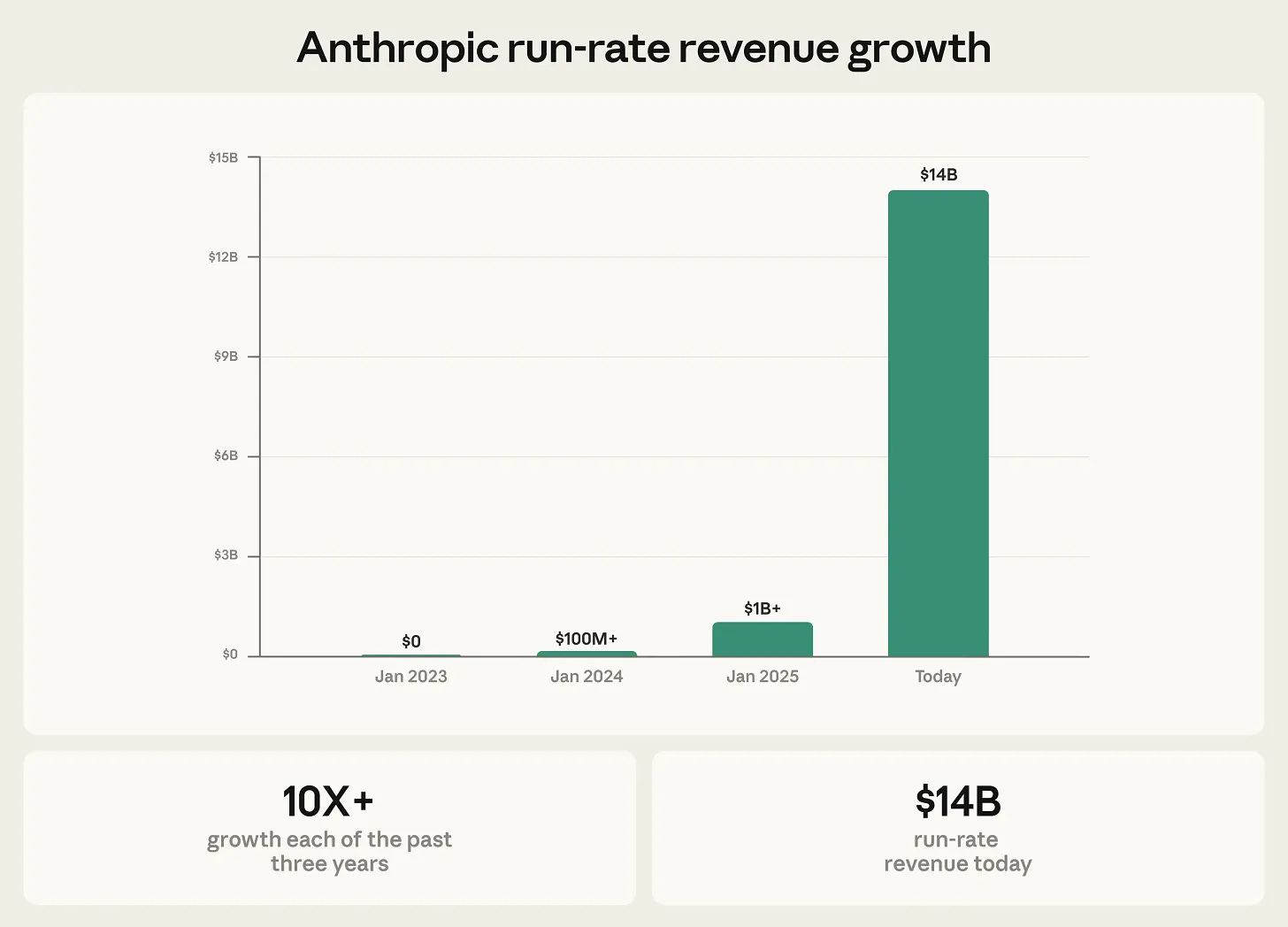
→ Why does it matter? This is the fastest revenue ramp in enterprise software history. Going from $0 to $14B in annualized revenue in roughly two years, with 10x-plus growth each year, puts Anthropic in rare company. For context: it took Salesforce ~20 years to hit $14B in annual revenue.
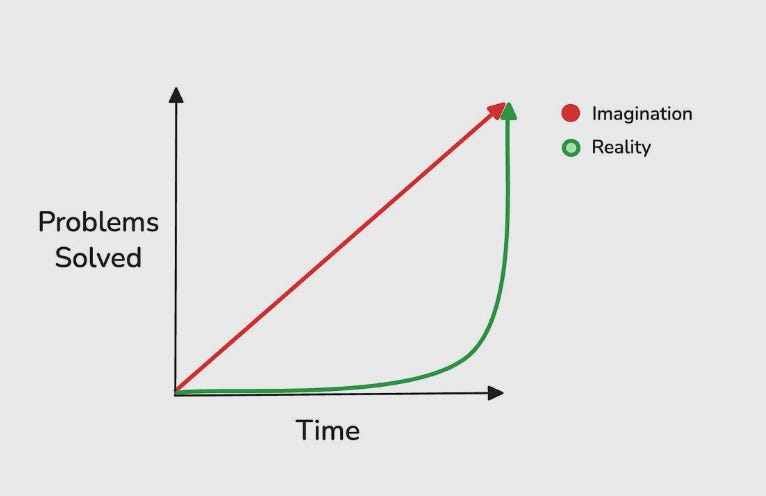
→ Why does it matter? How many years did it take for human beings to create fire, build shelter, and hunt with spears? About 2.2 million years. We tend to think humanity progressed like the red line, but it actually looked more like the green line. The gap between those lines is where most organizations lose patience and quit. The ones who stay in the game during that flat period? They’re positioned at the elbow when everything compounds at once.
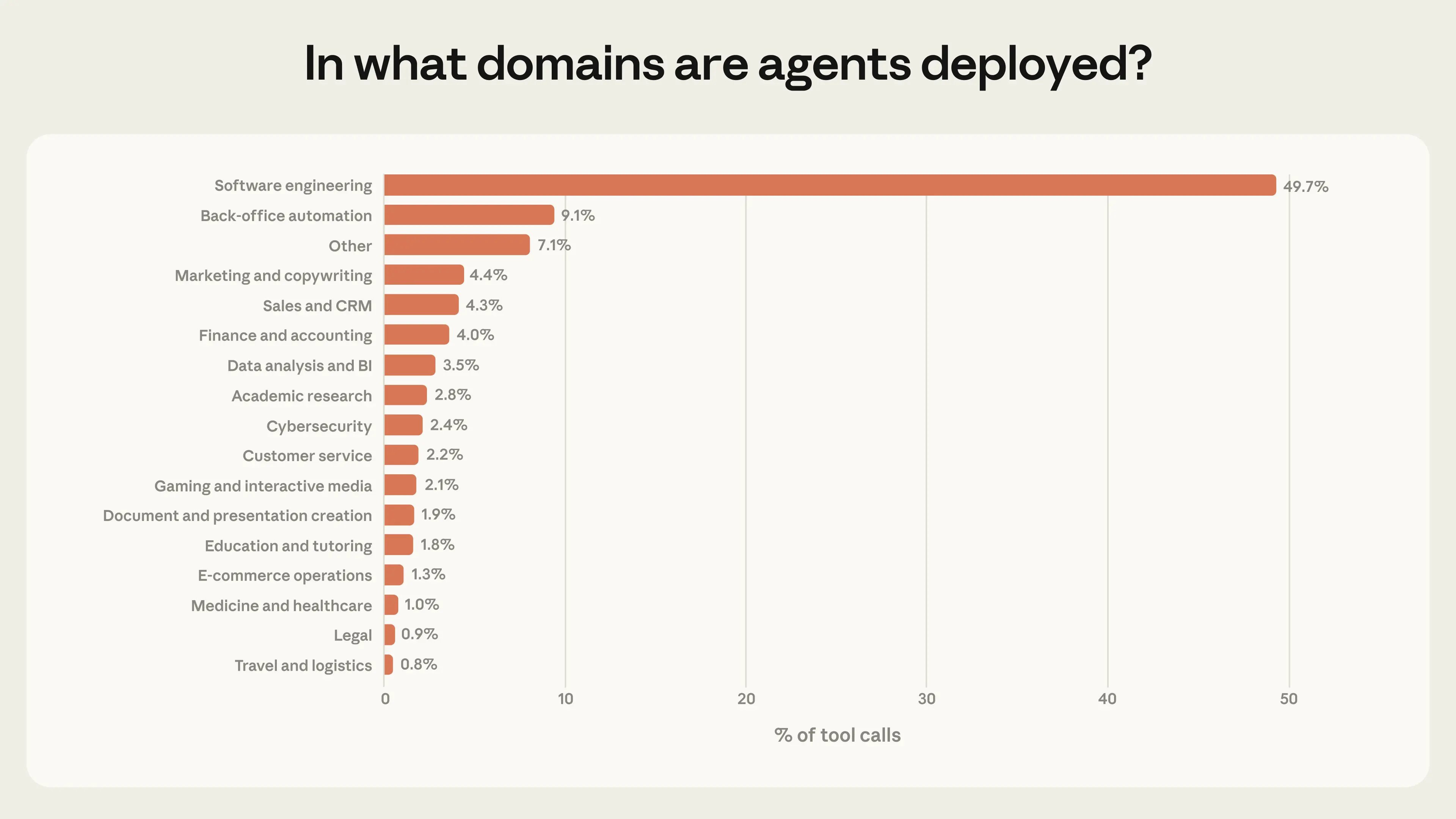
→ Why does it matter? New research from Anthropic on how Agents are being deployed, how much autonomy people are granting, and where they’re deployed. The full study can be found here.

Tweets that stopped my scroll:

→ Why does it matter? I’m sure this has hit most of your feeds by now. Sam Altman and Dario Amodei refusing to hold hands is priceless.

→ Why does it matter? This is an entirely AI-generated 3.5-minute movie. Wow.

→ Why does it matter? Many readers are setting up Claude Code as their Chief of Staff. If last year was the year of AI Agents, perhaps this year is that of Personal Operating Systems. Check out this short video for some great inspiration.

Worth a watch or listen at 1x:
→ Why does it matter? Dario Amodei doesn’t do many long-form interviews. When he does, he’s remarkably precise with language. This conversation covers the end of the scaling exponential, what “a country of geniuses in a data center” actually means for labor markets, and Anthropic’s positioning against OpenAI. The insight density is high. Amodei’s careful phrasing reveals as much as his answers. You’ll want to catch the pauses.

→ Why does it matter? Great to be with Marley Kayden to talk all things AI for Asset & Wealth managers, as well as what we’re seeing in the overall software market! Thank you for having Ridgeline on the show!
→ Why does it matter? Bret Taylor is the founder and CEO of Sierra, an AI agent company transforming customer service. Bret is one of the brightest minds on AI-native company building.
→ Why does it matter? Boris Cherny built Claude Code as a simple terminal-based prototype just a year ago, and it has already begun reshaping how software is built and how knowledge work is done. The details are the point: Claude Code’s growth to 4% of public GitHub commits, daily active users doubling last month, and the counterintuitive product principles behind it. When Boris says coding is “solved,” the claim is really about where work is moving next, from writing lines to directing systems.

Quotes & eyewash:

→ Why does it matter? Very excited for Bill Gurley’s first book, Runnin’ Down a Dream. It comes out next week!
The mission:
The Wall Street Journal once used “Read Ambitiously” as a slogan, but I took it as a personal challenge. Our mission is to give you a point of view in a noisy, changing world. To unpack big ideas that sharpen your edge and show why they matter. To fit ambition-sized insight into your busy life and channel the zeitgeist into the stories and signals that fuel your next move. Above all, we aim to give you power, the kind that comes from having the words, insight, and legitimacy to lead with confidence. Together, we read to grow, keep learning, and refine our lens to spot the best opportunities. As Jamie Dimon says, “Great leaders are readers.”
Disclaimer: This content is for informational purposes only and does not constitute financial, investment, or legal advice. Readers should do their own research and consult with a qualified professional before making any decisions.
YES!!!