

Enjoy this week’s Reading Ambitiously as a podcast entirely generated by AI.
The big idea: model context protocols

This week, I’m obsessed with Model Context Protocols (MCP), an innovation from Anthropic that enables AI to seamlessly integrate with popular software like Slack, Google Drive, and Microsoft Word. It sounds technical, but stick with me—Anthropic is playing three-dimensional chess here, and this move positions them strongly to dominate the application layer. Let’s unpack why this matters.
Imagine AI agents as your new digital workforce. To be effective—uploading files, pinging colleagues on Slack, or editing documents—they need smooth access to the same tools your team uses daily. Traditionally, this integration required painstaking custom coding through APIs for each and every application. Tedious, right?
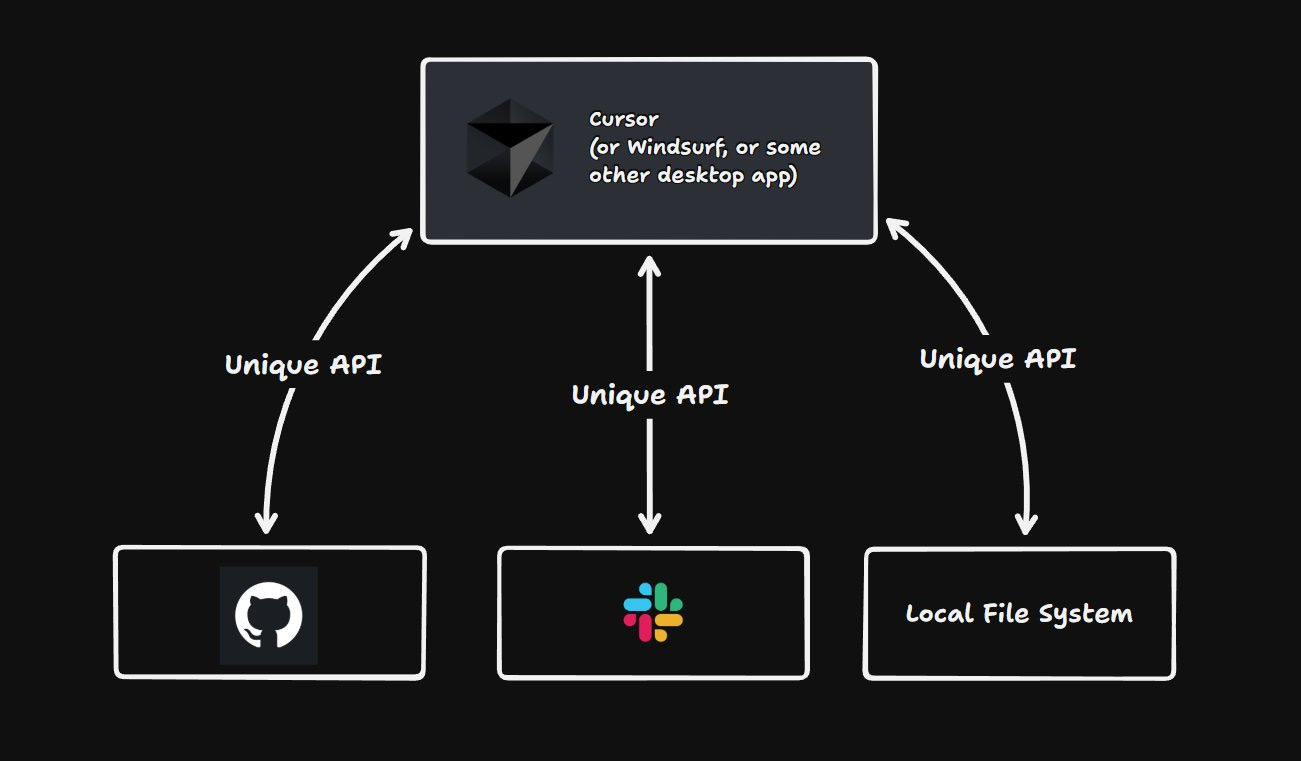
Enter MCP: a universal protocol enabling AI to instantly plug into numerous applications, from Slack and Google Drive to GitHub and even Weather.com. Think of it as a translator, effortlessly facilitating interactions between AI and software tools with just a one-time setup.
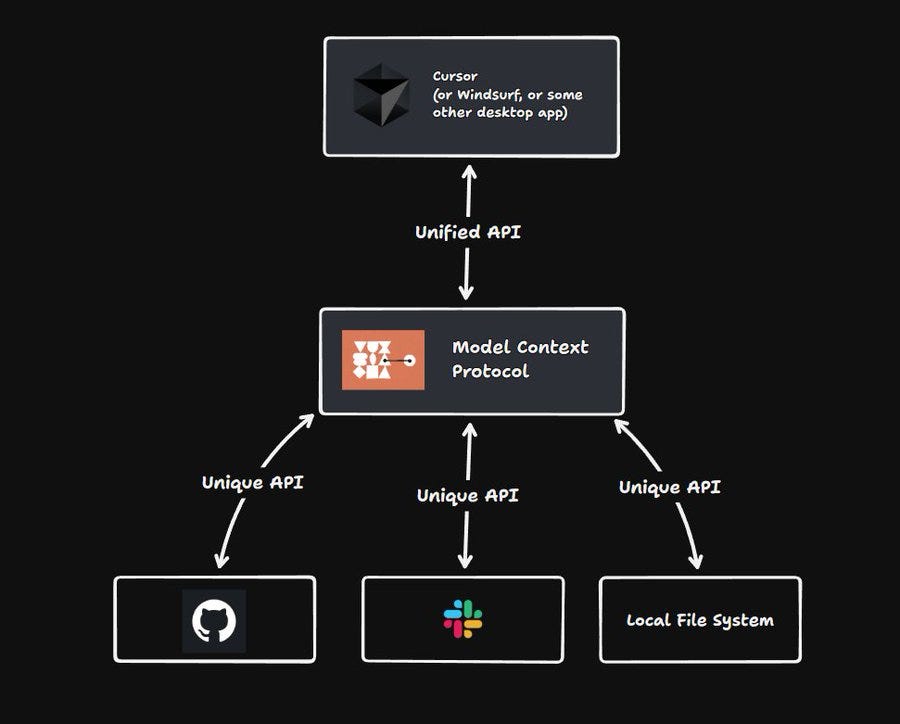
The twist? Anthropic made MCP open source. Developers are already capitalizing on it, swiftly creating pre-built integrations connecting AI to popular apps like Notion and Snowflake.
Why would Anthropic give this tech away for free? It maybe strategic genius. Consider the internet’s early days—without TCP/IP or HTTP, AOL and Mosaic (first internet browser) wouldn't have emerged. Applications drive infrastructure, not vice versa. As the team at Union Square Ventures (USV) argues in their paper "The Myth of the Infrastructure Phase":
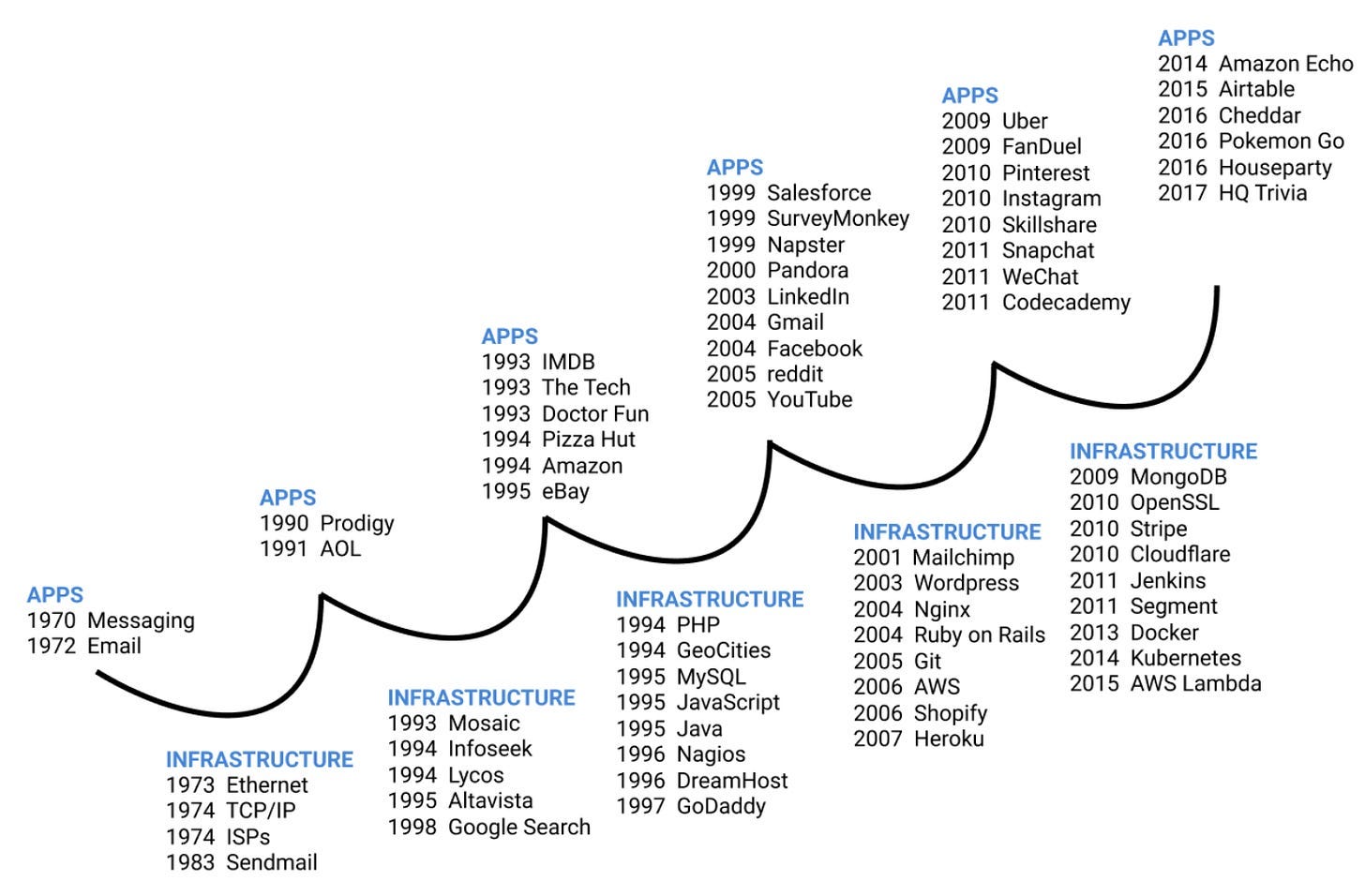
When we talk to founders who are building infrastructure, we keep hearing that the biggest challenge for them is to get developers to build apps on top. Now if we are really in an infrastructure phase, why would that be?
Our hypothesis is that this is not actually how things play out. We are not in an infrastructure phase, but rather in another turn of the apps-infrastructure cycle. And in fact, the history of new technologies shows that apps beget infrastructure, not the other way around. It’s not that first we build all the infrastructure, and once we have the infrastructure we need, we begin to build apps. It’s exactly the opposite.
Anthropic understands this. By open-sourcing MCP, they're giving developers an invaluable, flexible foundation to rapidly build AI-driven applications. Contrast this with OpenAI’s recent AgentSDK—effective, yes, but largely locking developers into their ecosystem. Anthropic’s approach empowers developers, increasing their platform’s attractiveness, and positioning them to capture substantial enterprise and startup market share.
Why it matters: MCP might initially seem like technical jargon, but it’s actually a key protocol for a new wave of AI-powered applications. Agents capable of automating complex, multi-step workflows are about to become significantly easier to build. Anthropic is betting on a future where their AI models power these applications, earning developer goodwill—and potentially dominating market share—along the way. They just have to give aspects of the infrastructure that make it possible away for free. Three-dimensional chess, indeed.

Best of the rest:
🏛️ Palantir’s Response to the White House OSTP on Developing an AI Action Plan - Palantir outlines its recommendations to the White House Office of Science and Technology Policy (OSTP) on shaping a national AI strategy. - Palantir Blog
⚖️ Lawsuit Alleges $12B "Unicorn" Deel Engaged in Corporate Espionage - Rippling accuses Deel of orchestrating a long-running trade-secret theft and corporate espionage campaign.
Rippling Blog
🤖 Unbundling the BPO: How AI Will Disrupt Outsourced Work - AI is set to transform the business process outsourcing (BPO) industry by automating tasks traditionally handled by outsourced workers. - a16z
💳 Fintech Giant Klarna Files for U.S. IPO - Klarna, the buy-now-pay-later giant, has officially filed for a U.S. IPO, marking a major milestone in the fintech industry. - Axios
💰 Gimme Credit by Howard Marks - Legendary investor Howard Marks shares his latest insights on credit markets, risk, and investment opportunities. - Oaktree Capital
🔐 Google to Acquire Cloud Security Startup Wiz for $32 Billion - Google makes a major cybersecurity play with its $32 billion acquisition of Wiz, one of the largest cloud security deals ever. - CNBC

Charts that caught my eye:
Redpoint Market Update - March 2025 (Redpoint Ventures)
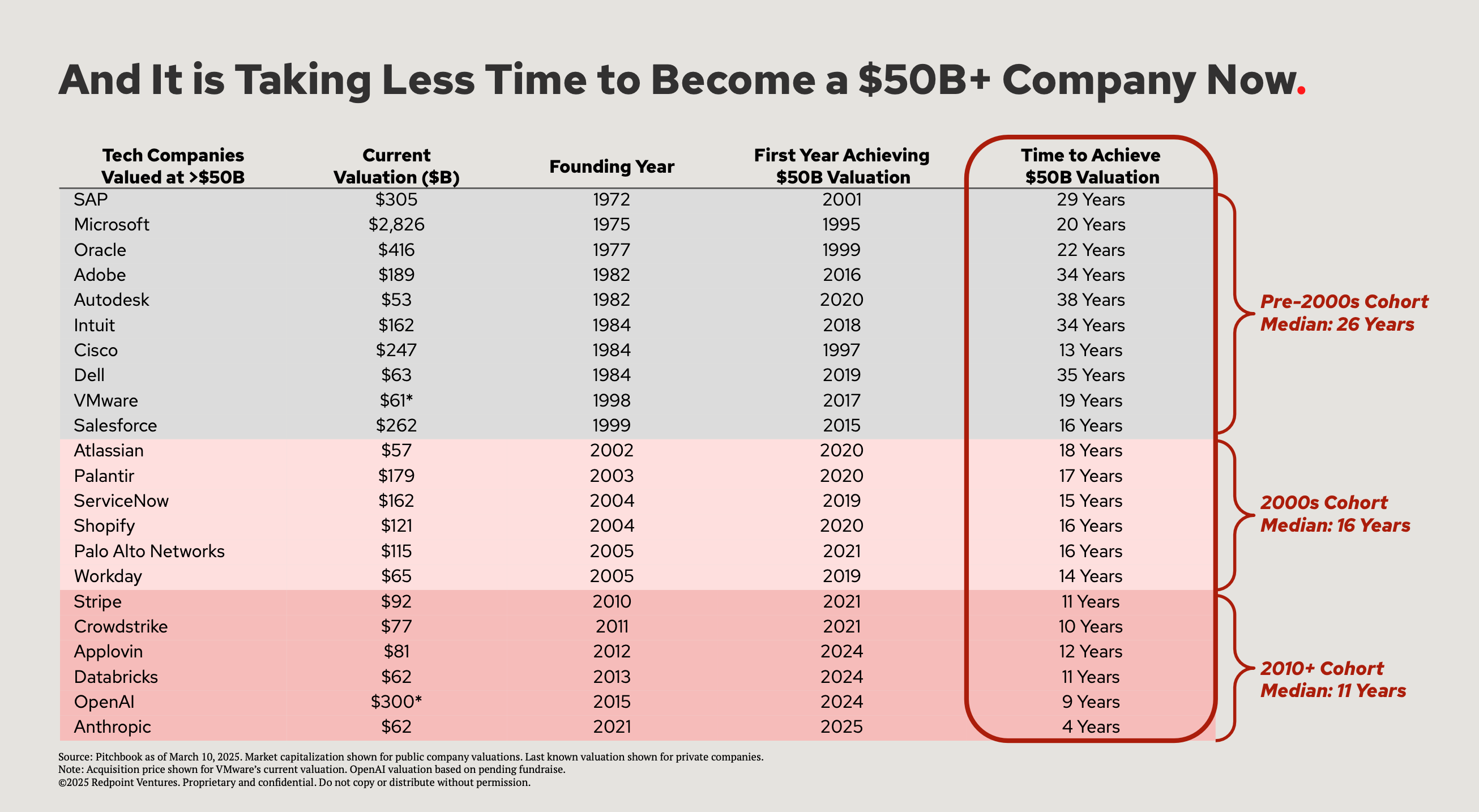
→ Why does it matter? The Redpoint Market Update (linked above) is a must-read if you want a clear snapshot of where public and private enterprise tech markets stand today. One chart stood out: the biggest winners are reaching $50B+ valuations faster than ever.

Tweets that stopped my scroll:

→ Why does it matter? Earlier this week it was announced Google is acquiring Cybersecurity startup Wiz for $32B! This deal is Google’s largest acquisition ever, surpassing its previous record of $12.5 billion for Motorola Mobility in 2012. It’s also the biggest exit in Israeli tech history, topping Mobileye’s $15 billion sale to Intel in 2017!

→ Why does it matter? Cursor is the fastest company to reach $100M ARR—without spending a single dollar on marketing!

Worth a watch or listen at 1x:
→ Why does it matter? Emergence Capital has picked some real winners over the years, including Salesforce.com, Zoom, and Veeva. They also have put out some great thought leadership on their investment philosophy and the big picture, including one of my favorite pieces about Specialized Software Will Win in the Age of Generative AI - this is worth a listen.
→ Why does it matter? Jensen Huang’s NVIDIA keynote had Super Bowl like energy. The hype was real—there was even a pre-game show hosted by the podcast team at Acquired. Demand for hotel rooms skyrocketed over $2500 per night, and Huang didn’t disappoint. He unveiled major upgrades to NVIDIA’s Blackwell GPU lineup, a landmark partnership with General Motors, and a bold strategy to address the soaring demand for AI inference compute.
“Software is eating the world, but AI is going to eat software." — Jensen Huang, Nvidia CEO

Quotes & eyewash:
→ Why does it matter? AI is set to revolutionize education. Synthesis, a next-gen math tutor, personalizes lessons to each student’s skill level and uses gamification to make learning more engaging. Check out this demo—it’s remarkable.

→ Why does it matter? For those of us in Chicago, seeing the beauty of Augusta means one thing—spring is finally on its way.
The mission:
The Wall Street Journal once used ‘Read Ambitiously’ as a slogan, but it became a challenge I took to heart. If that old slogan still speaks to you, this weekly curated newsletter is for you. Every week, I will summarize the most important and impactful headlines across technology, finance, AI and enterprise SaaS. Together, we can read with an intent to grow, always be learning, and refine our lens to spot the best opportunities. As Jamie Dimon says, “Great leaders are readers.”