

Enjoy this week’s Reading Ambitiously as a podcast entirely generated by AI.

In the news:
The Deep Research problem (Benedict Evans)
→ Why does it matter? Picture this: you’re late for a meeting, stuck in traffic, and an AI hands you hours worth of research on every attendee—in minutes. That’s the pitch for OpenAI’s Deep Research, now also available with xAI’s Grok. At launch, someone quipped, “This is when you feel the AGI.” Artificial General Intelligence—AI with human-like reasoning and adaptability—seems tantalizingly close. But here’s the catch: even with OpenAI, Grok, and Meta (who reportedly stole heaps of data) trained on nearly all internet data, results are mixed, often chalked full of errors.
Deep Research is a game-changer in theory: a personal AI churning out professional-grade reports on any topic, fast. For busy leaders like our readers, it’s a lifeline—until you dig into the fine print. Benedict Evans notes in his latest piece: these tools lack access to the world’s richest datasets. They scrape the web, lean on unreliable sources, and stumble over precision. The result? Reports that dazzle but demand fact-checking. AI excels at patterns, not pinpoint accuracy. Without exclusive, high-quality data, it can leave users second-guessing.
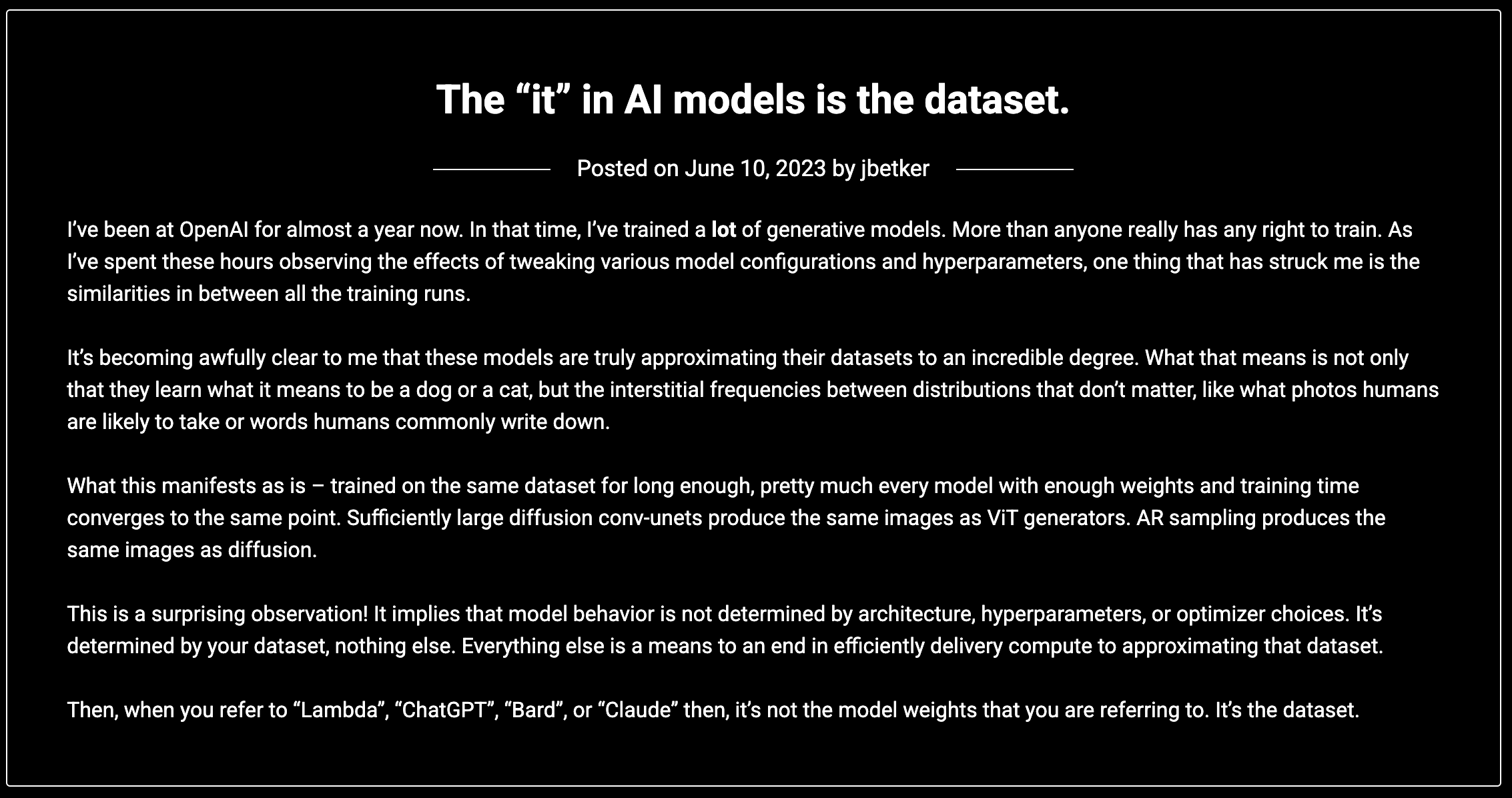
Rewind to 2023. An OpenAI engineer posted: “The ‘it’ in AI models is the dataset.” Translation? Model performance will plateau—data (and application, like we talked about last week) is the differentiator. A great AI strategy hinges on a great data strategy.
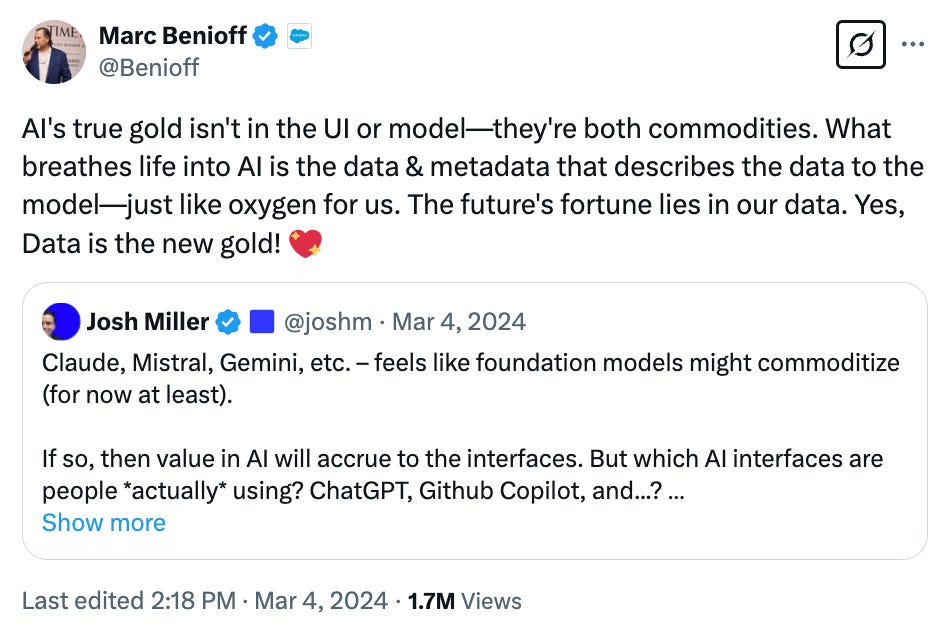
Marc Benioff calls it “data gravity”—systems with the best datasets pull ahead. Tesla proves it. Every car feeds its neural networks with driving data—cameras, sensors, behavior—unless you opt out. That’s why Tesla’s full self-driving tech leads. It’s also why I keep returning to Google Gemini: YouTube’s treasure trove gives it an edge. (Marc, I’d tweak your tweet—UI/UX is proving just as critical as data in AI-native products.)
Data isn’t just volume—it’s context. The real magic lies in metadata—data about the data. That’s what turns raw info into insight. The most valuable AI doesn’t just automate. It informs, it creates intelligence.
The next wave of AI isn’t just about who builds and trains the Start of the Art (SOTA) model. It’s about who owns the best data and pairs it with tools like Deep Research to create unbeatable products. For ambitious readers, that’s the signal: control the data, build the winning application, win the game.

Best of the rest:
💰 OpenAI Reportedly Plans to Charge Up to $20,000/Month for Specialized AI ‘Agents’ - OpenAI is exploring high-priced, specialized AI agents tailored for businesses willing to pay a premium for advanced capabilities. - TechCrunch
📊 All the Data! Reporting & Analytics, and the Coming Battle for Data Gravity - How AI, analytics, and reporting are shaping the future of data dominance. - Tidemark
💸 Another ‘Near Miss’: Citigroup Mistakenly Credited a Customer Account with $81 Trillion - A routine transfer turned into a massive blunder as Citigroup mistakenly credited $81 trillion instead of $280, raising fresh concerns over its operational controls. - CNBC
💳 Peter Thiel-Backed Fintech Ramp Nearly Doubles Valuation to $13B - US payments start-up Ramp completes a share sale, boosting its valuation as customer spending rebounds. - Financial Times
📈 Scoop: General Catalyst Is Considering an IPO - The venture capital giant is exploring a public listing, a rare move for a VC firm. - Axios
🌐 AI.com Is for Sale—Asking Price? $100 Million - Veteran domain broker Larry Fischer is looking to sell AI.com for a record-breaking price, hoping to attract buyers like OpenAI. - The Information
📜 2024 Shareholder Letter by Warren Buffett - Berkshire Hathaway’s annual letter, where Warren Buffett shares insights on investing, business, and the economy. - Read the Letter

Charts that caught my eye:
Stripe’s Annual Letter 2024 (Stripe.com)
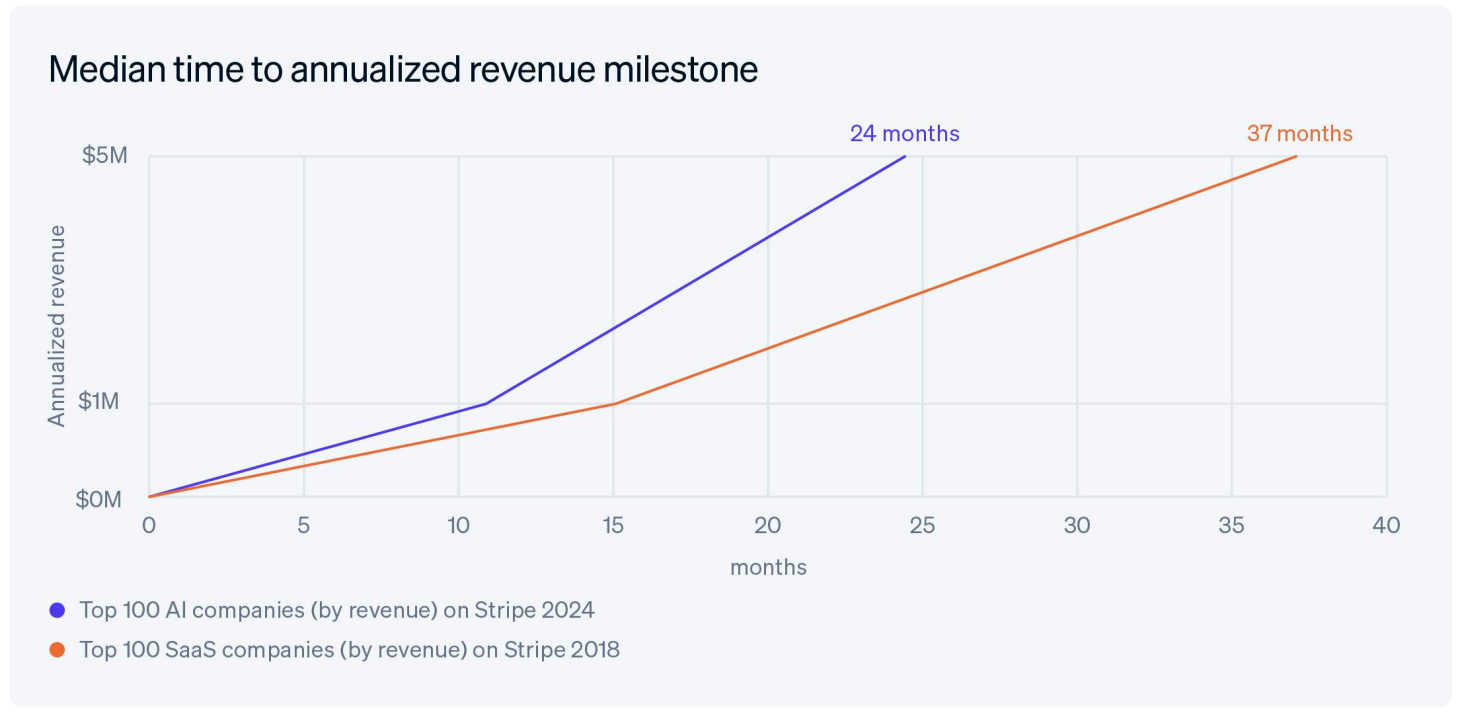
→ Why does it matter? First of all, from the letter: “Businesses on Stripe generated $1.4 trillion in total payment volume in 2024, up 38% from the prior year, and reaching a scale equivalent to around 1.3% of global GDP.” 🤯
However, this chart caught my eye. AI-native companies are scaling faster than their SaaS predecessors, hitting $5M annualized revenue in 24 months versus 37 months for 2018 SaaS firms—a clear sign of a new growth paradigm.

Tweets that stopped my scroll:

→ Why does it matter? Zuck has always wanted Meta to be a platform company. This AI shift is his shot. What better way to engage small and medium businesses than with an AI-driven frontend inside Meta’s products—Instagram, Facebook, WhatsApp? Talk about rich and unique datasets!

→ Why does it matter? Perhaps you heard last year that Klarna was turning off Salesforce and Workday. Here's the follow-up to that story!

→ Why does it matter? Talk about a killer use case for AI. Doctors' offices will never be the same. Definitely a demo worth checking out from Satya and the Microsoft team.

Worth a watch or listen at 1x:
→ Why does it matter? Chris is the Founder and CEO of Granola.ai, the AI Assistant built for back-to-back meetings. What stands out about Granola is two things: its small team and its user experience. This product couldn’t exist without AI. Granola isn’t just using AI—it’s redefining UI/UX in ways we’ve never seen before. The way it generates meeting notes feels like having a personal assistant in the room. It’s seamless, intuitive, and, frankly, a bit magical. Magic enabled by AI. This is a design pattern worth paying attention to.
→ Why does it matter? Fascinating to hear about current Bridgewater CEO talk about the $2B hedge fund they launched last year where the primary investment decision maker is machine learning and artificial intelligence.

Quotes & eyewash:
Ask for no, don’t ask for yes by Dan Moore.
I think it is important to have a bias for action. Like anything else, this is something you can make a habit of. Moving forward allows you to make progress. I don’t know about you, but I’ve frozen up in the past not knowing what the right path was for me. Moving forward, even the smallest possible step, helped break that stasis.
One habit I like is to ask for no, not yes. Note that this is based on my experience at small companies (< 200 employees) where a lot of my experience has been. I’m not sure how it’d work in a big company, non-profit, or government.
When you have something you want to do and that you feel is in scope for your position, but you want a bit of reassurance or to let the boss know what you are up to, it’s common to reach out and ask them for permission. Don’t. Don’t ask for a yes. Instead, offer a chance to say no, but with a deadline.
Let’s see how this works.
Suppose I want to set up a new GitHub action that I feel will really improve the quality of our software. This isn’t whimsy, I’ve done some research and tested it locally. I may have even asked a former colleague how they used this GitHub action.
But I’m not quite sure. I want to let my boss know that I’ll be modifying the repository.
I could say “hey, boss, can we install action X? It’ll help with the XYZ problems we’ve been having.”
If you have a busy boss (and most people do), this is going to require a bit of work on their part to say “yes”.
They’ll want to review the XYZ problem, think about how X will solve it and maybe do some thinking or prioritization about how this fits in with other work. Or maybe they’ll want you to share what you know. It may fall off their plate. You will probably have to remind them a few times to get around to saying “yes”. It might be a more pressing issue for you
Now, let’s take the alternative approach.”Hey, boss, I am going to install action X, which should solve the XYZ problems we’ve been having. Will take care of this on Monday unless I hear differently from you.”
Do you see the change in tone?
You are saying (without being explicit) that you “got it” and are going to handle this issue. The boss can still weigh in if they want to, but they don’t have to. If they forget about it or other issues pop up, you still proceed. This lets you keep moving forward and solving problems while keeping the boss informed and allowing them to add their two cents if it is important enough.
You can also use this approach with a group of people.
By the way, the deadline is critical too. Which would you respond to more quickly, if it was Jan 15, all other things being equal and assuming a response was needed?
“I’m going to do task X.”
“I’m going to do task X on Jan 17.”
“I’m going to do task X on Feb 15.”
I would respond to the second one, which has a deadline in the near future. I think that is the way most folks work.
Again, pursue this approach for problems you feel are in the scope of your role but that you want to inform the boss about. It’s great when you want to offer a chance for feedback, but you are confident enough in the course of action that you don’t need feedback.
The mission:
The Wall Street Journal once used ‘Read Ambitiously’ as a slogan, but it became a challenge I took to heart. If that old slogan still speaks to you, this weekly curated newsletter is for you. Every week, I will summarize the most important and impactful headlines across technology, finance, AI and enterprise SaaS. Together, we can read with an intent to grow, always be learning, and refine our lens to spot the best opportunities. As Jamie Dimon says, “Great leaders are readers.”
Great note about the quality and uniqueness of data within datasets. Very interesting to see Meta leaning into this with their own stack.