


Enjoy this week’s Big Idea read by me:

The big idea: Trust is the rate limiter on risk transfer
Reading time: 3 minutes

By the simplest definition, business is the exchange of risk. That’s it.
For that exchange to take place, the most essential ingredient is trust.
The world is adopting AI at a speed we rarely see in technology. And I am optimistic. This is a new operating system.
At the same time, human nature has its own operating system, older than markets and older than modern institutions. One of its core jobs is deciding when reliance is safe.
With AI, we can rapidly go from idea to artifact.
Still, business isn’t the exchange of artifacts. It’s the transfer of risk. When a buyer chooses you, they’re not only buying your product, they’re choosing who they can rely on when the stakes are real.
Maybe that sounds obvious or trite. And you’re saying “duh, Jack”. I think it’s easier said than done.
Evidence
There is an explosion of new companies, and news every day about how fast they’re growing. Speed is impressive, and velocity is important. But can trust be established at the same pace, especially when the risk being handed over is meaningful and priced accordingly?
I’ve worked for two companies in my career: IBM and Ridgeline. Both were shaped by founders who understood this deeply, Thomas Watson and Dave Duffield. IBM is one of only a handful of companies in the “century” club. Dave is one of a small number of founders to have built multiple companies that went public and entered the S&P 500.
Amongst many things, I think they both understood that technology is important, but it’s rarely the deciding factor on its own.
Imagine for a second if you gave peak-era IBM sales teams today’s AI copilots, agents, and automation tools. They’d sign customers up. They’d probably crush sales targets. But the deeper advantage wouldn’t be the tools. It would be the culture and the way customers learned to rely on IBM over time.
Lately, I keep thinking about that point as the x-factor in company building.
Trust Engine
My first year on the job at IBM was spent in training programs designed to teach employees how to show up as an IBMer. At the first official meeting I ever attended with Dave Duffield about what would become Ridgeline, core values were the first order of business.
Buffett and Munger seemed to understand this too. If you read their letters carefully, the “people” part is foundational to their investment thesis.
So what do we do about it?
The takeaway for me is not “slow down.” It’s “build the trust engine as deliberately as you build the product.” Put the same care into culture and people as you put into the shiny objects, especially right now when so many of us are trying to figure out AI.
When I say “trust engine,” I mean a set of core values, practices, and culture that make you consistently reliable.
Because the decision to hand over risk won’t be made on demos and feature comparisons alone. It’s made on pattern recognition. Who has shown up consistently? Who has history? Who understands the domain beyond the slide?
That’s what I mean by trust turning into something personal, almost emotional, in business relationships.
Rate Limiter
AI makes it a better time than ever to launch a new product or start a company. You can build faster, iterate faster, and learn faster.
But the thing you’re really asking a customer for is still the same. You’re asking them to trust you enough to underwrite risk with you.
That’s why trust is the rate limiter on risk transfer. You can accelerate the build cycle and generate evidence sooner. Reliance still takes time, and it still gets earned the old-fashioned way: by doing what you say you’re going to do.
And that’s my personal favorite definition of the word trust.

Best of the rest:
💼 OpenAI Selects Law Firms Cooley, Wachtell for IPO Prep – The company has taken its first concrete step toward a potential public listing that could rank among the largest in history, signaling that the AI leader may soon test public markets at a pivotal moment for the industry. – The Information
🤖 Meta acquired Moltbook, the AI agent social network that went viral because of fake posts — Meta just bought one of the internet’s strangest experiments in AI-generated social activity, signaling that even chaotic, synthetic engagement can be strategic when you are racing to define the future of online interaction. – TechCrunch
🗣️ The stranger secret: how to talk to anyone – and why you should — In an age of headphones, phantom phone use, and social caution, this piece argues that small, low-stakes conversations with strangers are not awkward relics but essential practice for rebuilding our social muscles and civic trust. – The Guardian

Charts that caught my eye:
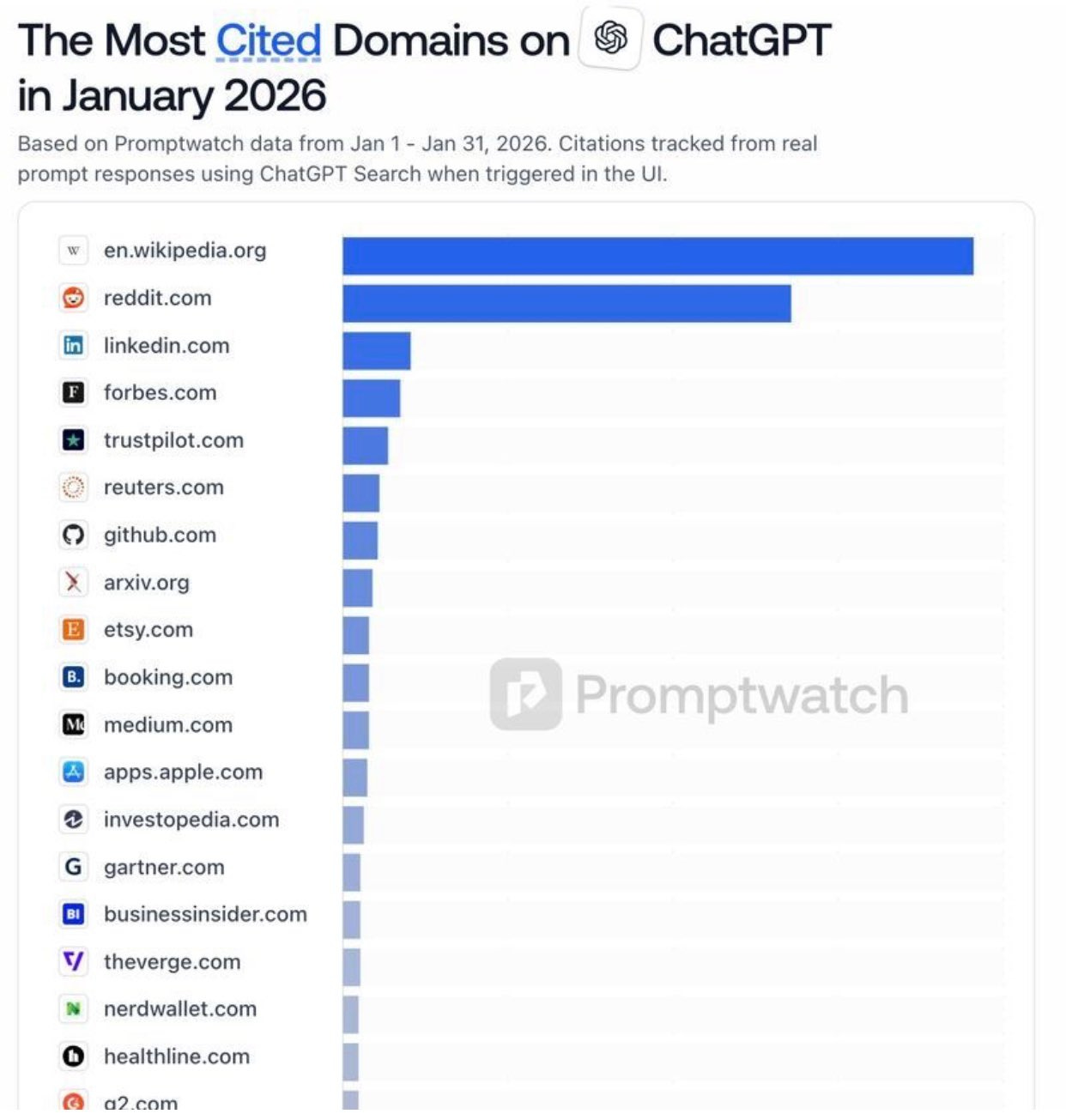
→ Why does it matter? Curious what websites ChatGPT is visiting to help source its response?

Tweets that stopped my scroll:

→ Why does it matter? This feels like the future user experience of how we’ll use computers. Bravo, Perplexity!

→ Why does it matter? This is a crazy story, and it’s the second time I’ve heard about an incredible entrepreneur asking someone they wanted to hire, “Where are you?” and then immediately going to see them. There’s a great story in Elon’s biography about him doing the exact same thing. It makes you think. Is there anyone in your life you need to go see right now?

→ Why does it matter? An example of a skill called cost-estimate that I really like. An easy one for anyone to replicate. And a great way to convey the ROI on investing in these tools.

→ Why does it matter? This was one of the most discussed tweets on the internet this week, and it captures an important idea: recursive learning. A human writes the strategy document. An agent runs experiments autonomously. A clear metric determines what stays and what goes. Then the loop runs again and again, compounding while you sleep.

→ Why does it matter? I cannot wait for Claude to nail generating graphics and animations. It’s a tough use case for AI right now. Everybody is trying to get AI to generate slides. There isn’t really a clear leader. This is progress.

Worth a watch or listen at 1x:
→ Why does it matter? To me, Coatue is saying this is a regime change, and they are investing as if it were. They do not assume the Magnificent 7 will remain the Magnificent 7; they keep their own roster, the “Fantastic 40,” a curated list of companies they believe can lead in an AI-driven world. That mindset, in their opinion, makes the SaaS repricing feel inevitable.
→ Why does it matter? What I take from this conversation is a very practical theory of where agents actually work. Code repos are unusually agent-friendly, they are text-heavy, versioned, and full of built-in feedback like tests, which is why coding agents have sprinted ahead while most “knowledge work” still feels squishier. Taylor’s “harness” idea is the missing layer, turn a workflow into something repo-like with documentation, rules, tools, and even a blunt memory system, sometimes as simple as a directory of markdown files.

Quotes & eyewash:

→ Why does it matter? Connect Claude Code to your Apple Vision Pro. Now we’re talking.
The mission:
The Wall Street Journal once used “Read Ambitiously” as a slogan, but I took it as a personal challenge. Our mission is to give you a point of view in a noisy, changing world. To unpack big ideas that sharpen your edge and show why they matter. To fit ambition-sized insight into your busy life and channel the zeitgeist into the stories and signals that fuel your next move. Above all, we aim to give you power, the kind that comes from having the words, insight, and legitimacy to lead with confidence. Together, we read to grow, keep learning, and refine our lens to spot the best opportunities. As Jamie Dimon says, “Great leaders are readers.”
Disclaimer: This content is for informational purposes only and does not constitute financial, investment, or legal advice. Readers should do their own research and consult with a qualified professional before making any decisions.