


Programming note: No issue next Friday. Reading Ambitiously returns April 10.

The big idea: The Stall
Reading time: 6 minutes

The first time I smoked a pork shoulder, the first few hours made me feel smarter than I was.
I bought the meat, got the cooker steady at 225, inserted the fancy digital probe, and watched the internal temperature rise on schedule. For a while, it all felt wonderfully mechanical. Heat goes in, number goes up, dinner gets closer. I cut the lawn. I started imagining the finish before I had earned the right to.
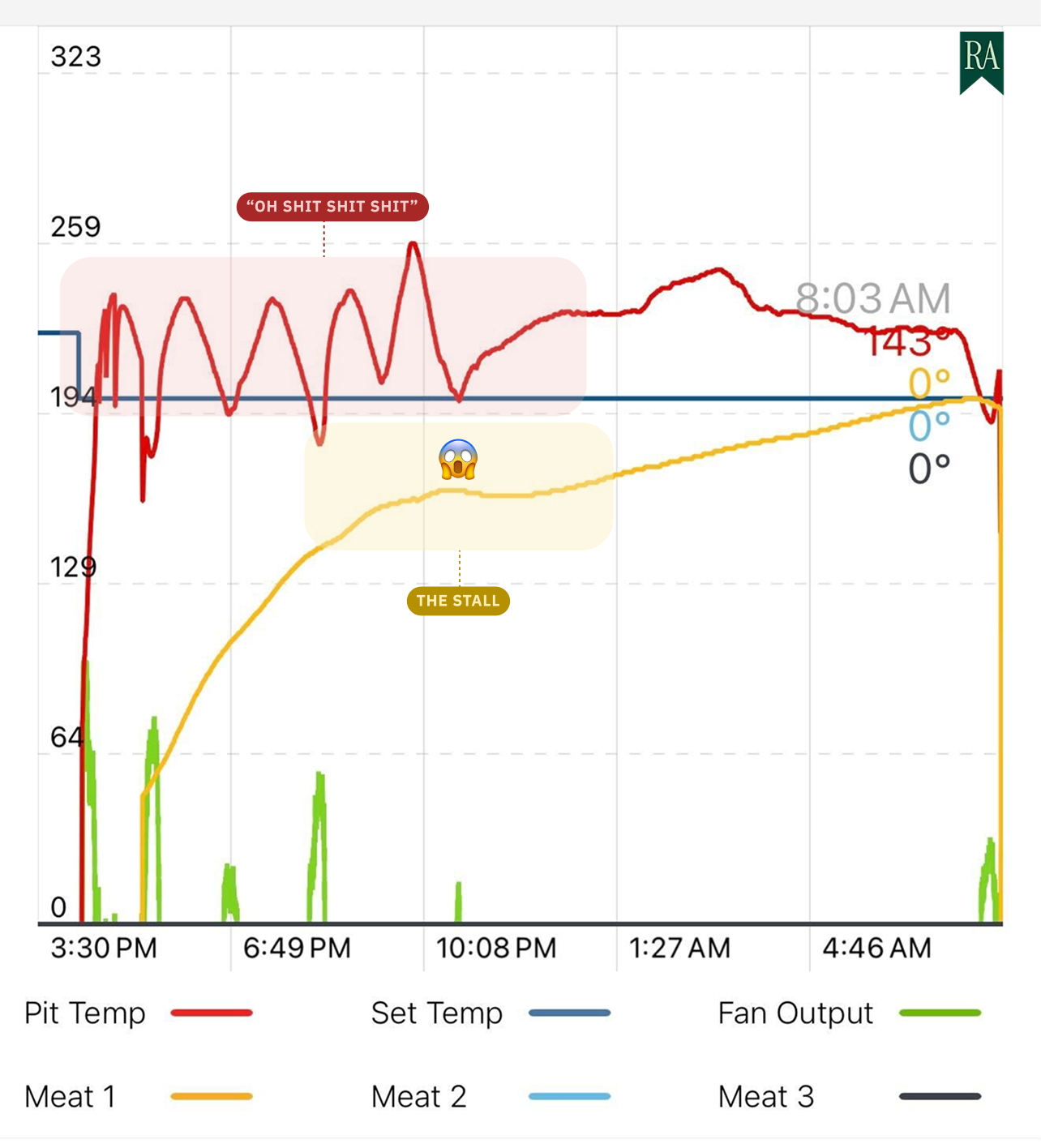
Then the temperature stopped climbing.
Not slowed. Stopped.
It sat there for what felt like an absurd amount of time. Then it barely moved. At one point, I was convinced it had gone backward. I checked the batteries in the thermometer. I tapped the smoker gauge like that might somehow help. Meanwhile, guests were arriving, and the meat was still nowhere near where it needed to be. That is when panic sets in.
Pitmasters have a name for this moment: the stall. It unnerves backyard cooks because the line had been moving so obediently, until suddenly it wasn’t.
That is what makes the stall so unsettling. You did the setup right. You followed the process. The early feedback looked good. Then the signal vanishes, and your confidence goes with it.
What the Stall Really Is
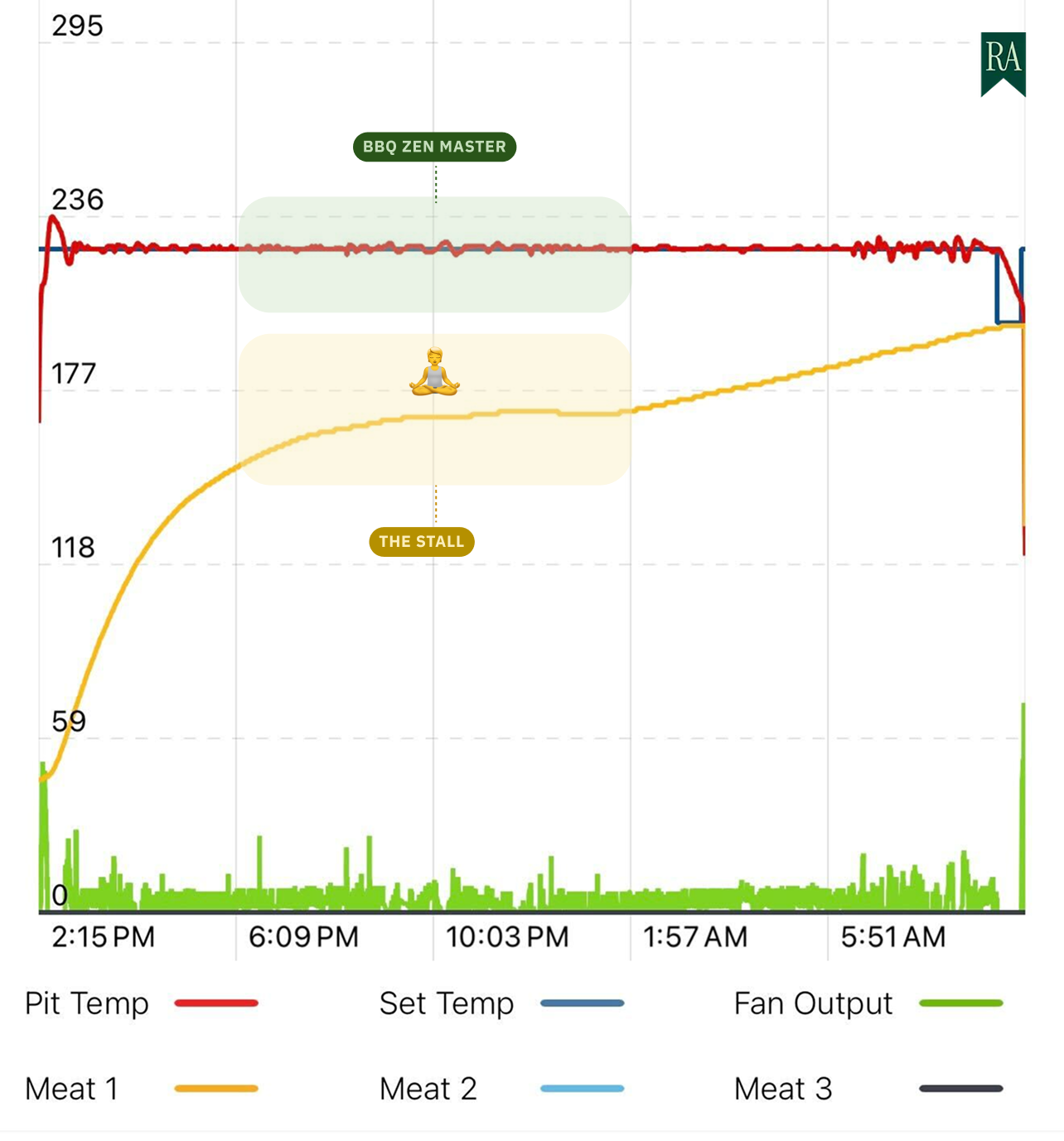
The explanation, at least in barbecue, is simple. As moisture evaporates, it can cool the meat almost as quickly as the smoker heats it. From the outside, it looks like nothing is happening. Underneath, a great deal still is.
The stall is not just a barbecue phenomenon. It is a recurring feature of life and progress. It shows up almost everywhere that the work is real.
Anyone who has lifted weights for more than a few months knows the feeling. Early on, progress is generous. The bar moves. The numbers go up. Effort feels neatly rewarded. Then the curve flattens. The same lift that used to move cleanly starts to feel heavy and stubborn. If you are impatient, you do what the nervous pitmaster does. You force it. You add weight too quickly, let your form erode, and turn a plateau into an injury.
The same pattern shows up in sports, learning, writing, and work. At the beginning of any worthwhile pursuit, improvement is visible enough to keep your confidence high. Then the gains become harder to see. The work continues, but the proof arrives less often and less neatly.
When Progress Goes Quiet
Most plateaus are not dangerous in themselves. What is dangerous is how we interpret them. We mistake a pause in feedback for a failure in process. We assume something is broken because something is no longer obvious, and because we assume something is broken, we start making emotional decisions. In barbecue, that means cranking the heat.
In lifting, it means chasing load rather than technique. In the workplace, it means abandoning a sound process because results are arriving more slowly than your patience would prefer.
The stall is rarely just about progress. It is about psychology. We depend on visible signs that our effort is paying off. When those signs disappear, even temporarily, our judgment gets noisy. The stall asks for continued effort without immediate reassurance.
Systems Over Goals
That is one reason I have become increasingly drawn to the idea of systems over goals.
Goals matter. They give shape to ambition. They tell you what you are aiming at. But goals are often least useful in the middle, and the middle is where most of life is lived. The middle is where the scale stalls. The draft gets worse before it gets better. The business has a quarter that feels flatter than the last three. The visible progress that made the process feel rewarding goes quiet.
A goal is an outcome. A system is a repeatable way of operating. It is the set of behaviors, constraints, and rhythms that still make sense on the days when the scoreboard is silent. Goals tell you where you want to go. Systems tell you what to do this week, especially when the mood shifts against you.
Goals can make you stare at the gap. Systems return your attention to the process. Goals ask, am I there yet. Systems ask, did I run the right play today.
That is why systems matter most in the stall.
When progress is obvious, almost any plan feels motivating. When progress becomes non-obvious, psychology takes over. People improvise. They abandon routines that were working. They reach for intensity when what they needed was consistency. They confuse urgency with wisdom.
What a Good System Does
A good system protects against that. It gives you something sturdier than mood.
It shifts your attention from lagging outcomes to leading behaviors. It lowers the odds that one bad day turns into a broken week. Most importantly, it tells you what to do when the signal disappears. A system does not require you to be heroic every day. It gives you a repeatable way to keep running the play while the deeper work catches up.
That will vary by person and by pursuit. The details are personal. The principle is not. A good system reduces the number of decisions you have to make when you are discouraged.
The better question is not just what outcome do I want. It is what process can I trust when the outcome is not yet visible. Put differently, what kind of operating system will keep me steady when my instincts start telling me to overcorrect.
Your Operating System
This is also where AI starts to feel genuinely useful to me. Most people still approach it as a search tool, a writing tool, or a source of quick answers. It can do all of that. But one of its more practical uses may be helping people build a better system for themselves.
Used well, AI can help you define the inputs that matter, track them, notice patterns across your weeks, and review what is working without having to reconstruct the story from memory after a frustrating day. It can serve as an accountability partner, a thought partner, and a low-friction layer for personal change.
That does not mean outsourcing judgment or borrowing someone else’s routine off the internet. It means more people now have access to an always-on partner that can help them build something highly personal, not a generic productivity system, but their system, shaped around their rhythms, blind spots, and the specific ways they tend to lose the plot when they hit a stall.
One of the best ways to learn how to use AI may be to point it first at the oldest management problem you have: yourself.
Proof Later
With grilling season upon us, I’m thinking about that first cook.
At the time, the stall felt like evidence that I had lost control of the cook. In reality, it was evidence that I did not yet understand the process. The meat was not broken. The thermometer was not lying. The work had simply moved somewhere I could not easily see.
A lot of life is like that.
The hardest moments are often not the beginning, when uncertainty is expected, or the end, when the result is visible. They are the long middles, when effort is still required, but reassurance has gone missing. That is when people start making emotional decisions. That is when they crank the heat.
The stall has made me steadier in those moments, less eager to mistake silence for failure. It has reminded me that some of the most important forms of progress do not announce themselves in real time. Less eager to crank the heat. Consistency first. Proof later.

Best of the rest:
🤖 More! More! More! Tech Workers Max Out Their A.I. Use. - “Tokenmaxxing” shows how fast AI has shifted from productivity tool to workplace status marker, and why spiraling usage costs may be the next hidden tax of the enterprise AI boom. - The New York Times
💼 OpenAI sweetens private equity pitch amid enterprise turf war with Anthropic - This is the clearest sign yet that the AI leaders are not just selling models, they are building distribution machines to lock up the enterprise before the market settles. - Reuters
🌎 Larry Fink’s 2026 Annual Chairman’s Letter to Investors - Fink’s core argument is bigger than BlackRock, namely that if capital markets are driving more growth and AI is set to concentrate even more wealth, broader ownership, private market access, and tokenized investing start to look less like product innovation and more like economic necessity. - BlackRock
🏢 Productive Individuals Don’t Make Productive Firms - George Sivulka makes the right point at the right moment, namely that AI gains do not compound at the company level until workflows, incentives, and systems are redesigned around the technology instead of simply layered on top of old ways of working. - X
🤖 TurboQuant: Redefining AI efficiency with extreme compression — Google’s latest compression work matters because it points to a future where long-context AI and vector search get dramatically cheaper and faster, without the usual accuracy tradeoffs. — Google Research

Charts that caught my eye:
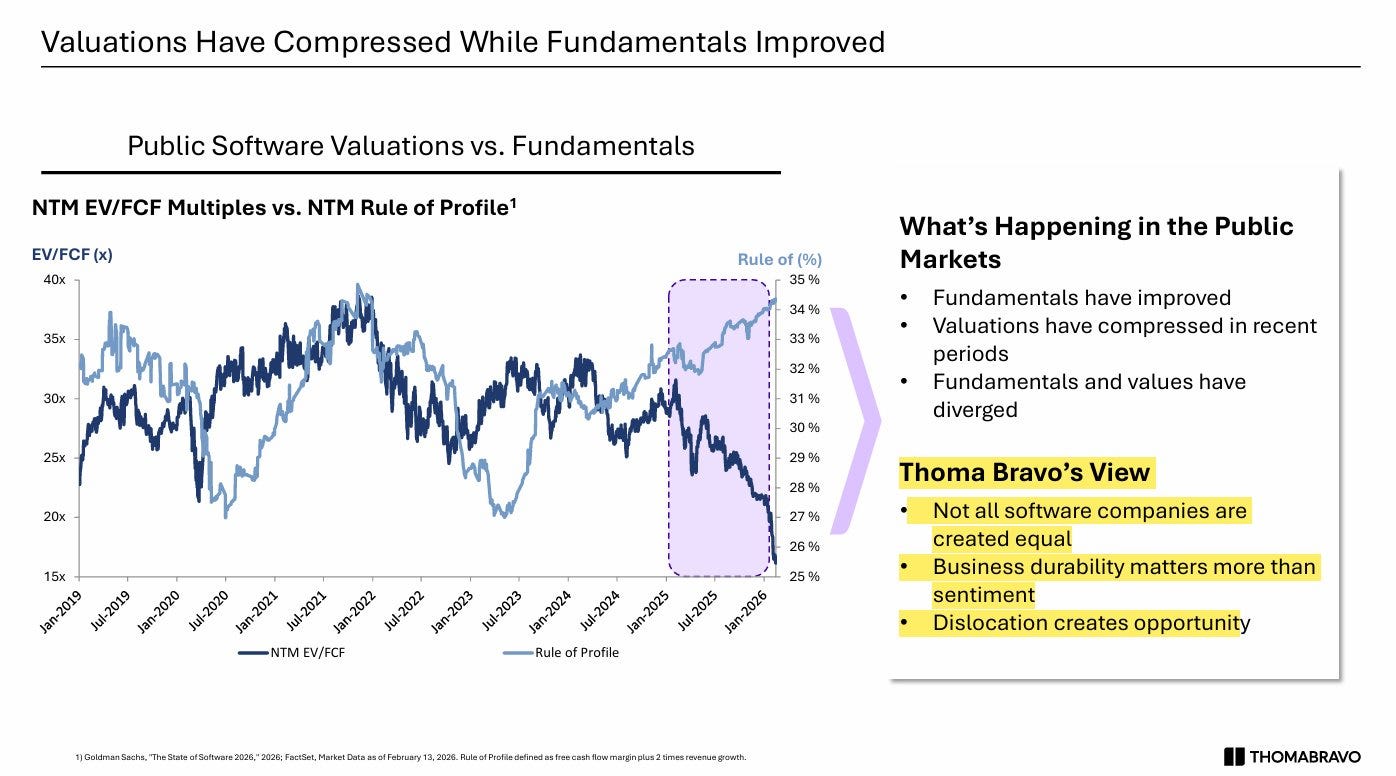
→ Why does it matter? Thoma Bravo is one of the most sophisticated software investors on the planet, and their thesis here is precise: public markets are pricing software companies on sentiment, not fundamentals. The chart shows the Rule of 40 profile (a measure of real business quality combining growth and profitability) climbing steadily toward 35% even as EV/FCF multiples compress sharply, a divergence that only happens when fear is doing the pricing, not math. The crowd sells the category, the disciplined buyer buys the company. Not all software businesses will recover equally, but the ones with durable unit economics and sticky revenue are trading at a discount that history suggests will not last.
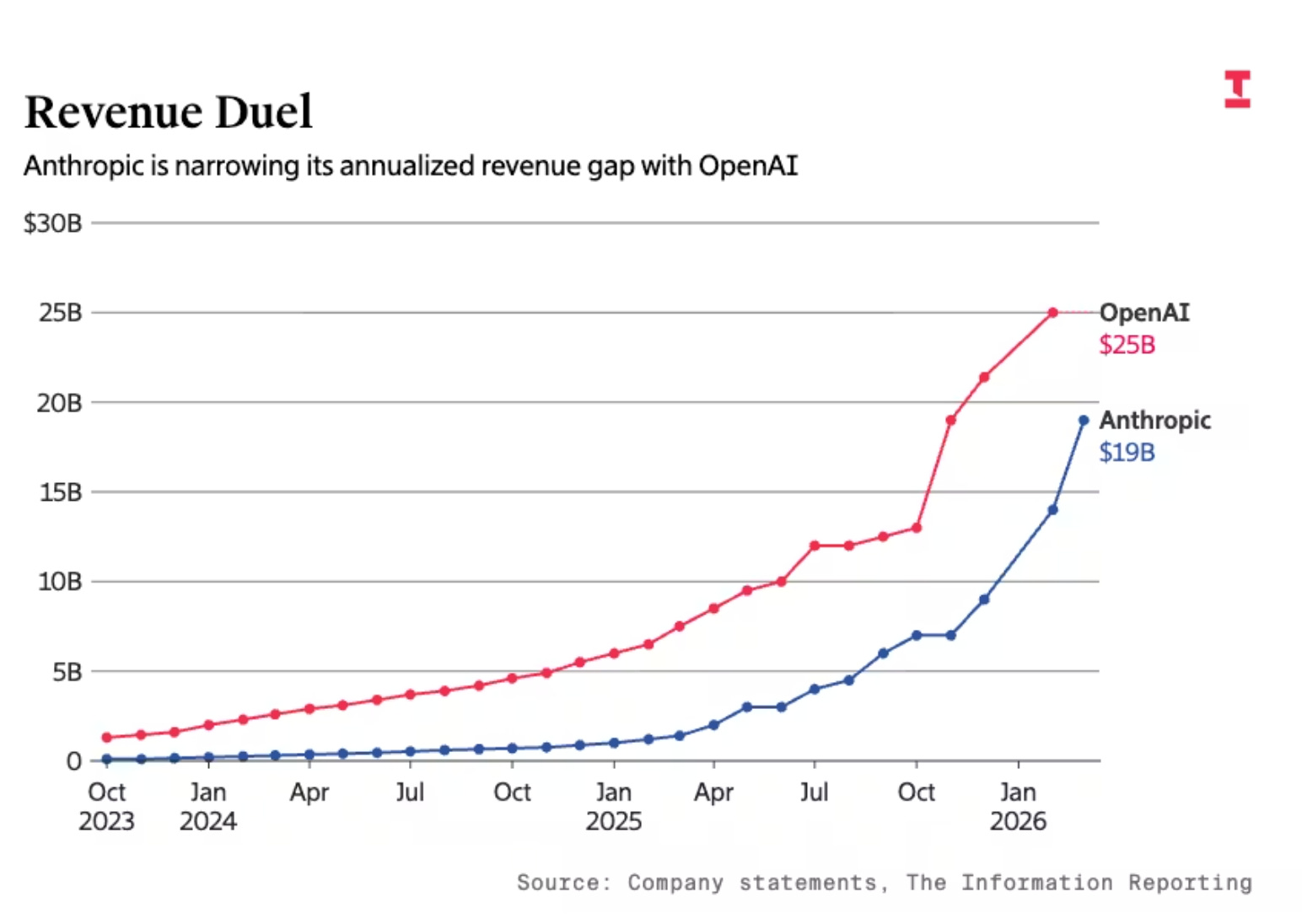
→ Why does it matter? The revenue gap between OpenAI and Anthropic appears to be $6B. It may actually be much larger. Anthropic counts gross hyperscaler revenue before paying out its AWS revenue share, while OpenAI reports net revenue after paying Microsoft Azure. Strip out the accounting difference, and Anthropic's $19B annualized figure shrinks materially. If both companies pursue an IPO this year, the SEC is unlikely to let that comparison stand, and the chart you think you are reading today will look very different once the numbers are restated on a common basis.
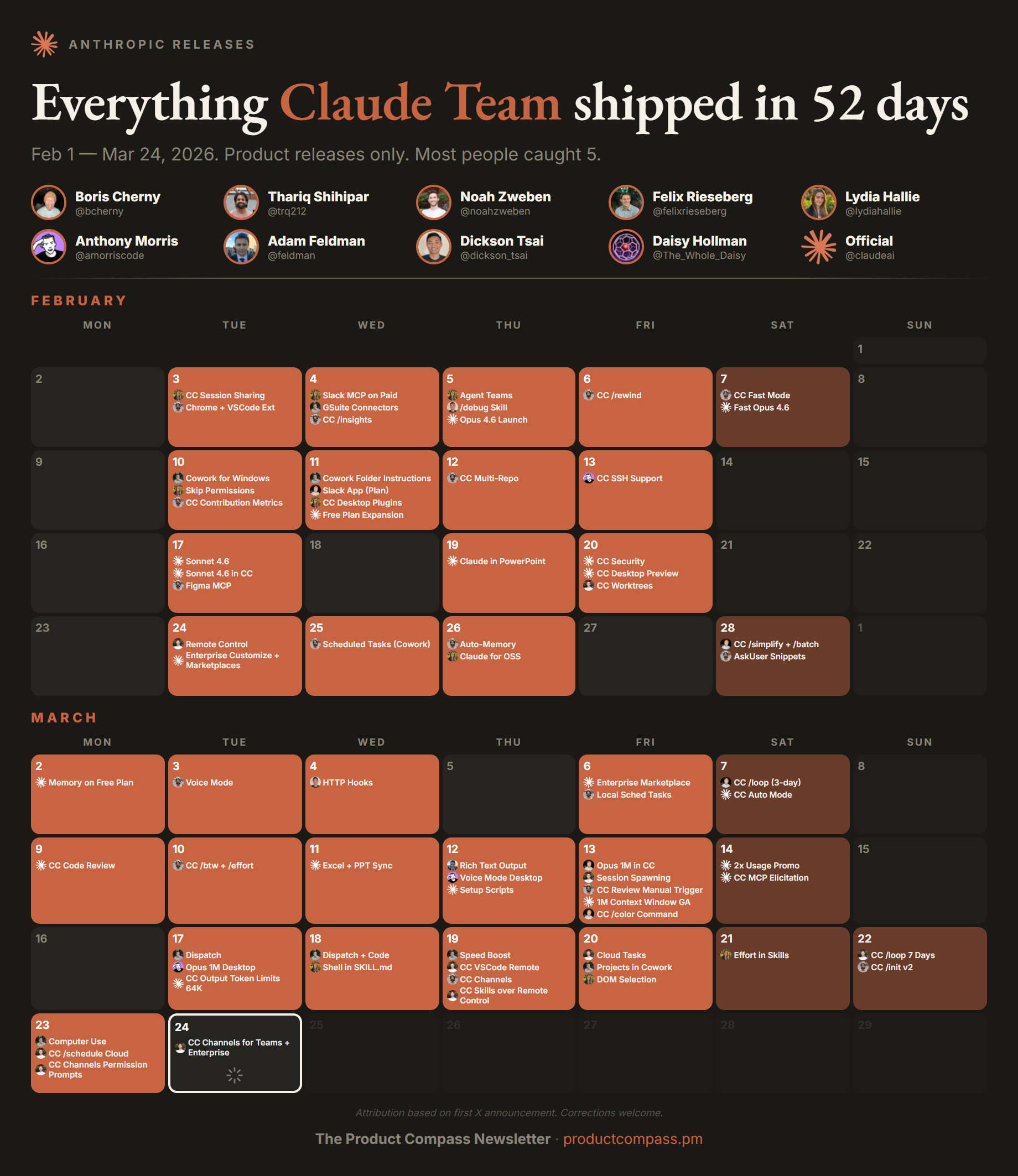
→ Why does it matter? Anthropic shipped over 100 product releases in 52 days, averaging roughly two per day, and most users caught only five of them. The pace of AI product development has moved so far ahead of human attention that even power users are operating with an incomplete picture of what the tools can already do.

Tweets that stopped my scroll:

→ Why does it matter? Sierra just shipped Ghostwriter. An agent that builds agents, removing the bottleneck of needing specialized AI talent to deploy customer-facing intelligence. If a platform can now handle voice, chat, multilingual support, and system integrations in one shot, the barrier between "we're exploring AI" and "we have AI in production" collapses.

→ Why does it matter? Guillermo Rauch is the Founder & CEO of Vercel. And his company has quickly become a favorite of AI builders. SORs are highly defensible. UIs not so much. Agents with CLIs and skills. API access. Feels like the future.

→ Why does it matter? Researchers just demonstrated that anonymity online is functionally dead. LLMs can now cross-reference pseudonymous posts against real identity profiles at scale, moving from less than 0.1% to 54% match rates on HackerNews to LinkedIn. Yikes.

Worth a watch or listen at 1x:
→ Why does it matter? Jensen Huang is the most important CEO in technology right now, and this three-hour conversation with Lex Fridman is the closest thing to a masterclass on what it takes to build the infrastructure for a civilizational shift. He covers AGI, scaling laws, the future of coding, data centers in space, and China with the kind of clarity and conviction.
→ Why does it matter? Andrej Karpathy is one of the clearest thinkers in AI, and this conversation with Sarah Guo covers the territory most people are still catching up to: agents that loop, self-improve, and run experiments without a human in the seat. He introduces the idea of the "loopy era," where AI systems don't just execute tasks but iterate on their own outputs, which changes everything about how you build, supervise, and trust them. If you want the mental model for where software development goes next, Andrej has it for you.
→ Why does it matter? Jensen Huang sits down with the All-In crew and goes deep on the inference explosion, physical AI, and what it actually means to run the world's most valuable company during the biggest platform shift in a generation. Jensen thinks deeply about how to put words to some of these big ideas shaping the AI era, and I find those framings so helpful.

Quotes & eyewash:
→ Why does it matter? Shoutout @rtwlz! The ultimate way to get pumped up before a meeting.
→ Why does it matter? I’m ready for it!
The mission:
The Wall Street Journal once used “Read Ambitiously” as a slogan, but I took it as a personal challenge. Our mission is to give you a point of view in a noisy, changing world. To unpack big ideas that sharpen your edge and show why they matter. To fit ambition-sized insight into your busy life and channel the zeitgeist into the stories and signals that fuel your next move. Above all, we aim to give you power, the kind that comes from having the words, insight, and legitimacy to lead with confidence. Together, we read to grow, keep learning, and refine our lens to spot the best opportunities. As Jamie Dimon says, “Great leaders are readers.”
Disclaimer: This content is for informational purposes only and does not constitute financial, investment, or legal advice. Readers should do their own research and consult with a qualified professional before making any decisions.