

Enjoy this week’s Reading Ambitiously as a podcast entirely generated by AI.

The big idea: stablecoins - the dollar’s quiet software upgrade

Tariffs dominated the headlines this week. Everyone focused on who trades with whom—and at what cost.
Everyone was asking about trade policy. I couldn’t stop thinking about trade infrastructure. When tariffs shift up or down, is there some enterprise dashboard where a policymaker cranks a knob to "37%" like they're tweaking a thermostat?
Of course not. But if money is the bloodstream of global trade, then it's time we asked: What powers the pipes?
Then I read Dom Cooke’s profile of Matt Huang in the Colossus Review—and the spark lit.
By the way, the Colossus Review is, in my opinion, what new media looks like. Thoughtful, long-form, and razor-sharp. Welcome to the club.
For the past century, banks haven’t just been institutions—they’ve been infrastructure. They moved money, cleared currencies, and captured yield from the friction they managed. The last part is very important. It’s the bank's technology that powers global trade – until now.
Enter stablecoins.
Think of them as digital dollars that live on the internet. Unlike traditional money, which travels through bank networks and clearinghouses, stablecoins move instantly, without middlemen. They reroute the rails—not just speeding up transactions, but reshaping how money flows entirely.
A glimpse of the future—now
A developer in Lagos earns $500 labeling data for an AI model. He gets paid in stablecoins. The money arrives in minutes, not days. No wire fees. No frozen accounts. Overnight, it starts earning yield—no bank involved.
That's not a hypothetical. It's happening today.
Stablecoins aren’t speculative. They’re useful. Programmable. Instant. Invisible. Quietly reshaping the financial plumbing of the internet.
Stablecoins aren’t challenging the dollar. They're modernizing it—providing a software upgrade for the internet age.
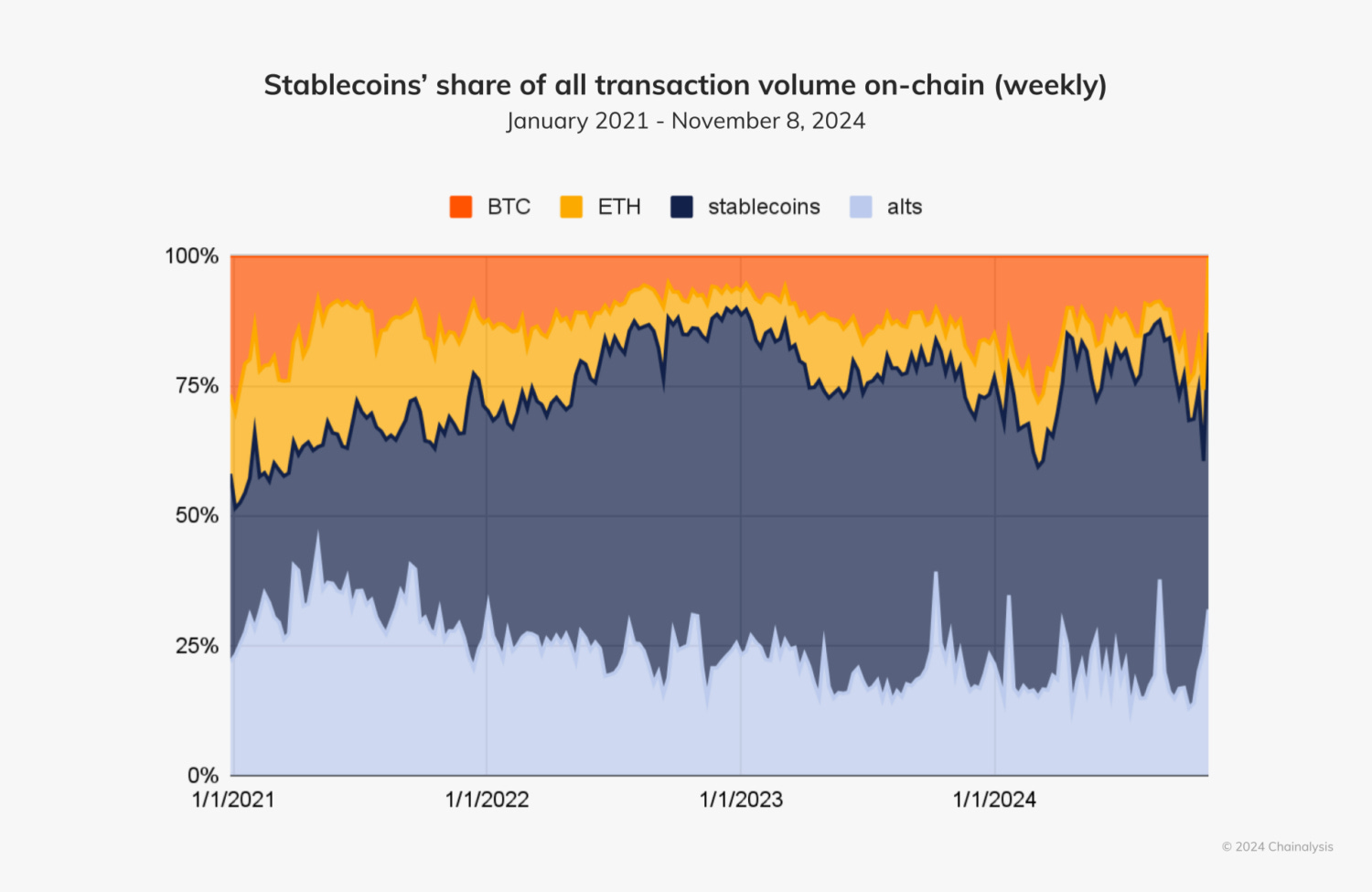
We often discuss crypto through the lens of speculation: prices, volatility, meme coins, boom and bust. But zoom out, and stablecoins stand out as one of crypto's breakout applications. Not NFTs. Not DeFi. Not Layer 2s. Stablecoins.
In 2024, stablecoins processed $5.6 trillion in payments—nearly half of Visa’s $13.2 trillion. Let that sink in.
Changing the infrastructure of global trade
While the global economy debates trade policy, the technology powering global trade is quietly undergoing transformation.
Banks make money on yield spreads—parking deposits in short-term Treasuries earning 5%, returning a fraction to depositors, and pocketing the rest. That margin underpinned global banking for decades.
Digital dollars don’t just move faster; they redistribute yield.
Tokenized dollars held in smart contracts bypass banks entirely. The yield returns directly to users.
It reminds me of my favorite Bezosism:
“Your margin is my opportunity.” — Jeff Bezos
Amazon famously used software to steal the margin from big-box retailers like Sears. We now call that e-commerce.
In stablecoin land, that margin is the bank's current yield—and the opportunity is global. Digital dollars do to banking what Amazon did to retail: digitize the core, collapse the intermediaries, and return value to the end user.
Since Bretton Woods in 1944, the U.S. dollar has anchored global commerce. Yet, while the dollar remained dominant, the underlying infrastructure—banks, correspondent networks, clearing systems—lagged behind.
Stablecoins aren’t replacing the dollar. They're upgrading it – with software.
Circle’s S-1: a stablecoin IPO
If anyone doubted stablecoins’ mainstream arrival, Circle just ended that debate. The issuer of USDC filed to go public last week—backed by real users, real revenue, real infrastructure.
Since launching in 2018, USDC powered over $25 trillion in on-chain transactions. More than $500 billion minted, $460 billion redeemed—every redemption matched one-to-one with dollars. Circle reports millions of end-users, thousands of developers, and hundreds of companies integrating USDC across commerce, treasury, payments, and fintech infrastructure.
And the business model is thriving. Revenue and reserve income jumped from $15 million in 2020 to $1.7 billion in 2024, with net income at $156 million and liquidity exceeding $1 billion at year-end.
Circle isn’t betting on a hypothetical use case—they’re betting on a new financial foundation of which they plan to play a big role in.
The new backend of money
Stablecoins may be crypto’s most crucial financial primitive. They feel inevitable. Useful. Boring. Transformative.
But they’re not merely a crypto success story.
Stablecoins provide the dollar with a new digital chassis. They're dissolving old financial borders. They’re placing yield directly back into user hands.
This isn't just a product trend. It's a protocol quietly rewriting the rules of money.
The dollar isn’t going away as the world's reserve currency. It’s just moving on-chain.

Best of the rest:
💾 Bill Gates Reflects on the Original Microsoft Source Code - Bill Gates shares a look back at the early days of Microsoft, including the original source code that helped spark a software revolution. - Gates Notes
🦙 The Llama 4 Herd: The Beginning of a New Era of Natively Multimodal AI Innovation - Meta introduces Llama 4, marking a leap forward in natively multimodal AI with new capabilities in vision, language, and reasoning. - Meta AI
🧠 Everything Is Sales - Whether you realize it or not, you’re always selling—your ideas, your value, your perspective. Embrace it. - Nikunj Kothari

Charts that caught my eye:
Beyond vibe checks: A PM’s complete guide to evals (lenny’s newsletter)
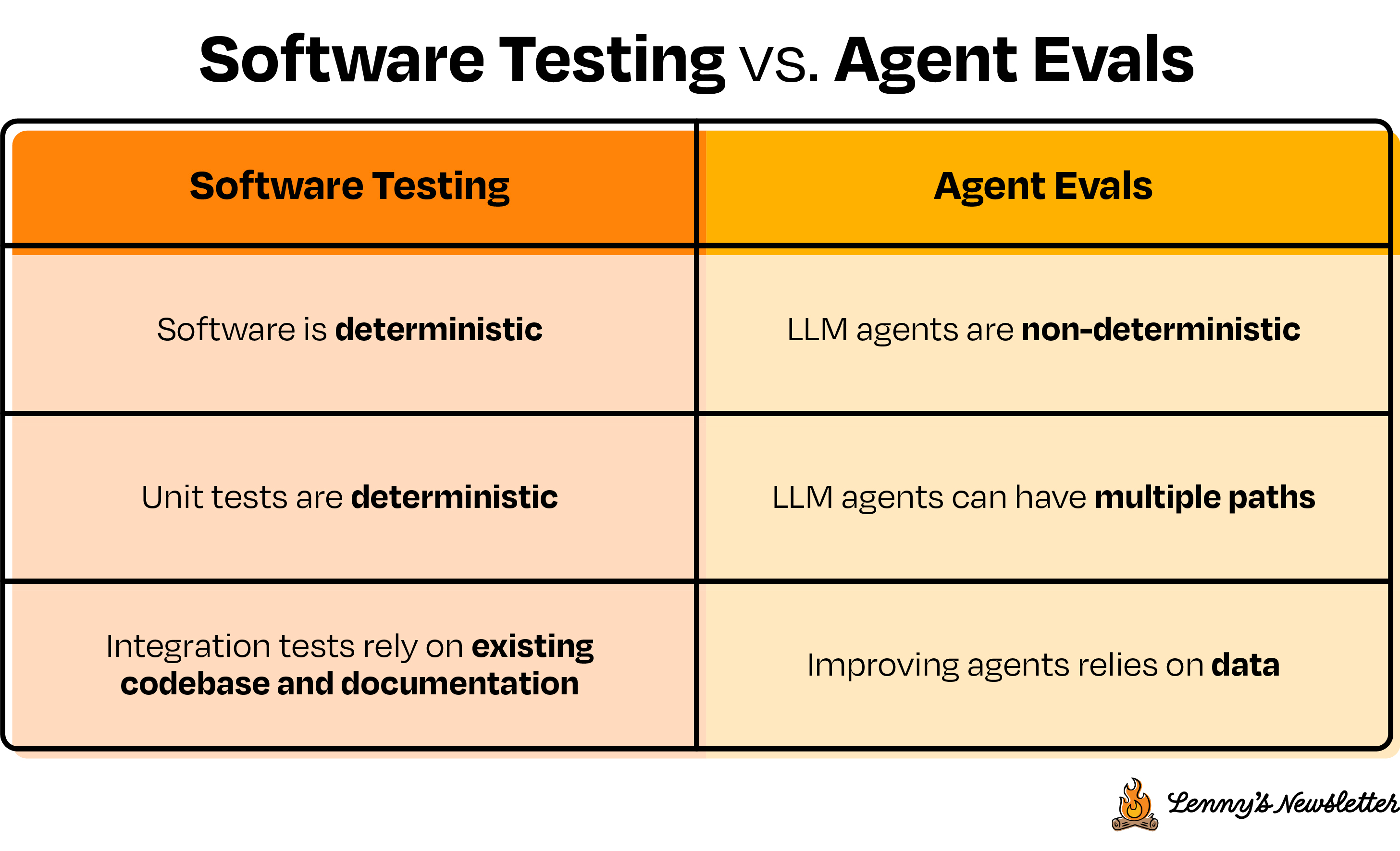
→ Why does it matter? Evaluations—“evals”—are structured tests used to measure how well an AI system performs specific tasks. Think of them like unit tests for AI, except the outputs can be fuzzy, subjective, and hard to benchmark. Testing AI is fundamentally harder than testing traditional software. In software, you can write clear, binary tests (“Did it pass or fail?”). But with AI, results are often probabilistic, nuanced, and context-dependent. That’s why learning how to design good evals is becoming one of the most important—and underappreciated—skills in building reliable AI products.
📐 The Rule of 40 Explained (App Economy Insights)
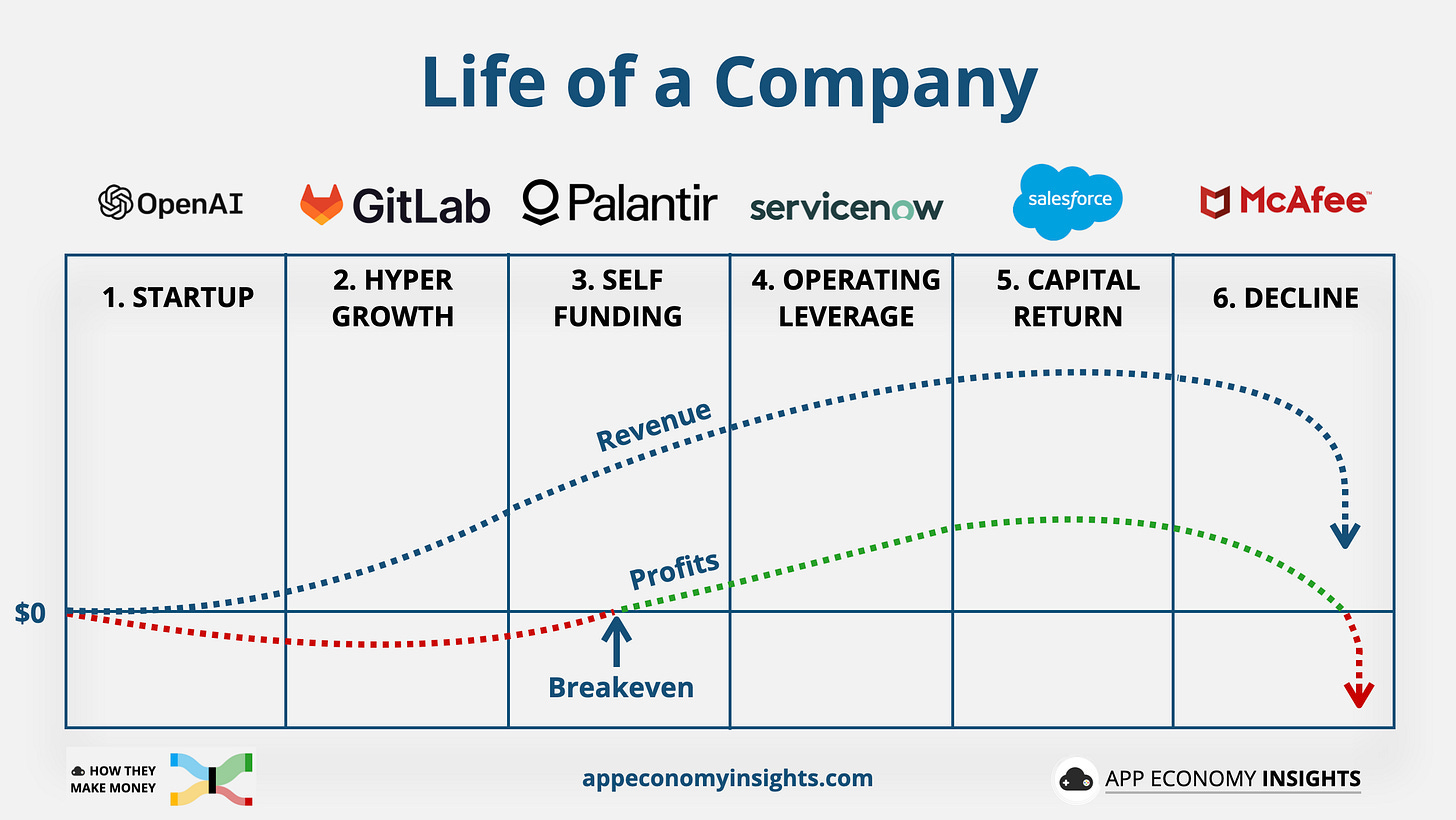
→ Why does it matter? The Rule of 40 helps investors understand if a company is growing fast and efficiently enough to justify the risk. But its value depends on where the company is in its journey. This chart nails that idea. A startup burning cash in hypergrowth? Expected. A mature business doing the same? That’s a red flag. The key isn’t just the Rule of 40 score—it’s what phase the company is in, and whether it’s pulling the right lever.

Tweets that stopped my scroll:

→ Why does it matter? Shopify CEO Tobi Lütke just made AI a company-wide expectation. In a memo to employees, he encouraged teams to explore how AI could solve problems—before hiring people to do the same work. That might sound small, but it’s a big shift in mindset: AI-first, not people-first. This is part of a larger trend. Leaders are starting to see AI as a way to increase output per person, not just automate tasks. Shopify, for example, has grown revenue ~25% annually for a decade—while keeping headcount lean. Tobi’s bet? Tools like AI-powered translation and code refactoring can help them scale 10–100x without linear hiring.

→ Why does it matter? 50 years ago, Bill Gates started Microsoft with a vision to put a computer on every desk. Today, he’s being interviewed—and roasted—by one. As Gates once said: “We always overestimate what we can do in a year and underestimate what we can do in ten.” Just look at what they’ve built in five decades. From MS-DOS to copilots with a sense of humor. Absolutely wild.

Worth a watch or listen at 1x:
→ Why does it matter? Ovitz's career is a masterclass in high-stakes dealmaking, strategic positioning, and the dynamics of influence – essential skills for leaders today. My personal favorite Ovitz story? When he helped Palantir close J.P. Morgan — he tells that story in this interview starting at minute 10.
→ Why does it matter? Pedro Franceschi (Founder & CEO, Brex) tells us what it really means to realign culture with long-term value creation. For anyone playing the long game, there are a ton of great lessons in here.

Quotes & eyewash:
Jamie Dimon’s 20 Commandments of Management - Adapted from his 2024 JPMorgan Chase Shareholder Letter
Jamie Dimon has led JPMorgan Chase for nearly two decades, overseeing $3.9 trillion in assets and building a $700 billion company. In his 2024 shareholder letter, he dropped a masterclass in management—hard-won lessons from 50 years in the trenches.
Here are his 20 rules every leader should steal:
Complacency kills. Arrogance, bureaucracy, and BS destroy companies from within. Hunt them down relentlessly.
Do more with less. Can you run your team with fewer people and more impact? That’s leadership.
Speed wins. Slow speed kills. Move fast, stay sharp. Companies that wait, die.
Know your numbers. Budget, P&L, allocations—understand them cold. You can't manage what you don't measure.
Benchmark against the best. Don’t compare yourself to the industry average. That includes the losers.
Good expenses > bad revenue. Don’t cut investments that drive long-term growth. Cut waste, not muscle.
P&Ls can lie. Look deeper—by customer, by unit, by channel. Truth lives in the details.
Question allocations. They hide massive inefficiencies. Fix them or you’re just propping up the past.
Kill bureaucracy. Every. Single. Day. It slows innovation, kills morale, and suffocates speed.
Controls matter. Stress test everything. Check assumptions. New products are where risk hides.
Never outsource leadership. You can’t delegate culture. If you’re not coaching, you’re not leading.
Beware spreadsheet logic. Not everything fits in a model. Use common sense. Especially on branch closures.
Steal good ideas. Learn from Chick-fil-A. Alibaba. Ping An. Innovation has no borders.
Fire bad clients. If they disrespect your people, they’re gone. Culture over cash.
Test > plan. Iterate. Learn. Move. Most innovation dies under analysis paralysis.
Hit the road. Talk to customers. Visit competitors. Great CEOs don’t hide behind dashboards.
Tell the truth. Internally and externally. Spinning numbers spins your people too.
Celebrate people. Recognition fuels morale. Watch Ted Lasso. Say thank you—loudly and often.
Make work fun. You spend most of your life doing it. Enjoy the ride, or change the vehicle.
Ask this weekly: “If I were king or queen for a day, what would I change?” Then go do it.
The mission:
The Wall Street Journal once used ‘Read Ambitiously’ as a slogan, but it became a challenge I took to heart. If that old slogan still speaks to you, this weekly curated newsletter is for you. Every week, I will summarize the most important and impactful headlines across technology, finance, AI and enterprise SaaS. Together, we can read with an intent to grow, always be learning, and refine our lens to spot the best opportunities. As Jamie Dimon says, “Great leaders are readers.”