



The big idea: Always-On Intelligence
Reading time: 7 minutes

Knowledge work carries a hidden tax.
You read an article on Tuesday. By Thursday, it connects to a board conversation, a product decision, or a pattern you are seeing with customers. You know you saved it. Highlighted it. Maybe even sent it to yourself.
And when you need it, you cannot find it.
Most knowledge workers do not suffer from a lack of information. They suffer from a lack of usable memory. The article sits bookmarked in your browser. The notes live in multiple apps. The meeting transcript hides in a folder you forgot about. You earned the insight. But it is scattered across tabs, tools, and your own imperfect recall.
The Second Brain Became a Second Job
We built a whole category of software to solve this. Note-taking apps. Read-it-later tools. Systems for what people started calling a second brain.
I bought the vision. I also bought the tools. I have tried almost all of them.
For me, most of them turned organizing all of this into a second job.
Every new input became another small task. Save it. Name it. Tag it. Link it. Revisit it. Clean it up before the structure gets messy. The tool that was supposed to reduce cognitive load started competing for it.
That is why so many of these systems do not reach their potential. The idea was right. The upkeep was brutal.
Bush Saw the Problem Early
In 1945, Vannevar Bush published As We May Think and described the Memex: a personal system that could store a lifetime of records and let a user move through them by association instead of strict hierarchy. He understood something that still feels true today: the mind does not think in folders. It moves through trails.
Bush could imagine the library. He could not staff it.
Who updates the links when new information arrives? Who decides what belongs together? Who keeps the system current as the archive grows?
For decades, the answer was simple: you did.
AmbitiousOS Changed My Mind
Earlier this year, with the help of Claude Code, I started building AmbitiousOS on top of the full Reading Ambitiously archive. More than 50 subscribers use it today through voice and text. At first, I thought I was building a smarter interface to a body of work.
I now think we’re building a preview of something bigger.
In version one, AmbitiousOS could search the archive, retrieve passages, and answer questions across the corpus.
Version two changed my mind.
Now Claude maintains a living wiki on top of the source material. The original newsletters remain the source of truth. New inputs update pages on companies, people, and concepts. The system adds links, flags contradictions, and writes the changes back into the knowledge base.
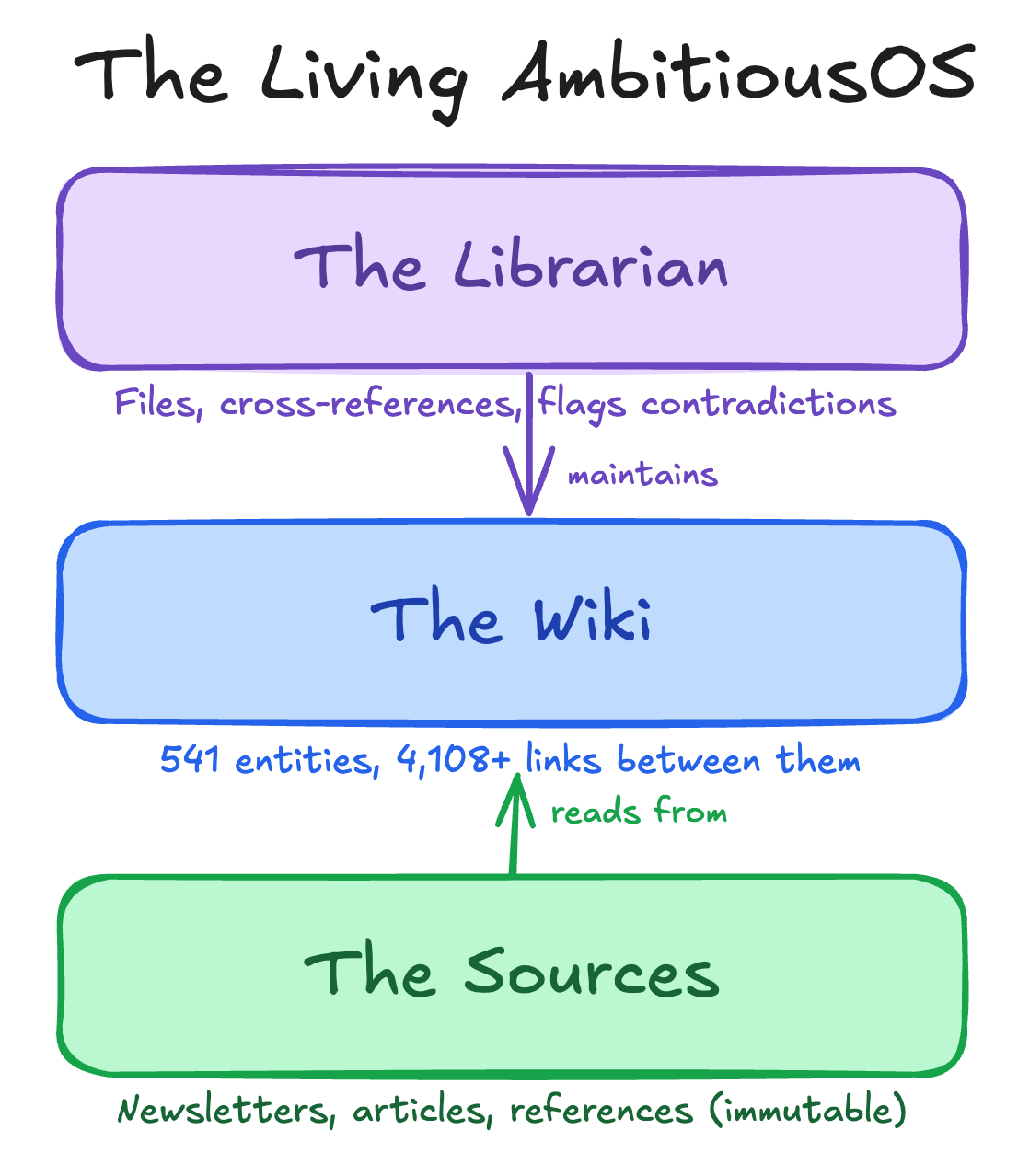
The opportunity is an always-on executive assistant with a working knowledge of your world. One that understands your reading, your meetings, your notes, your documents, your decisions, and the threads that connect them. One that feels like you hired your own librarian to build a private Library of Alexandria around your work.
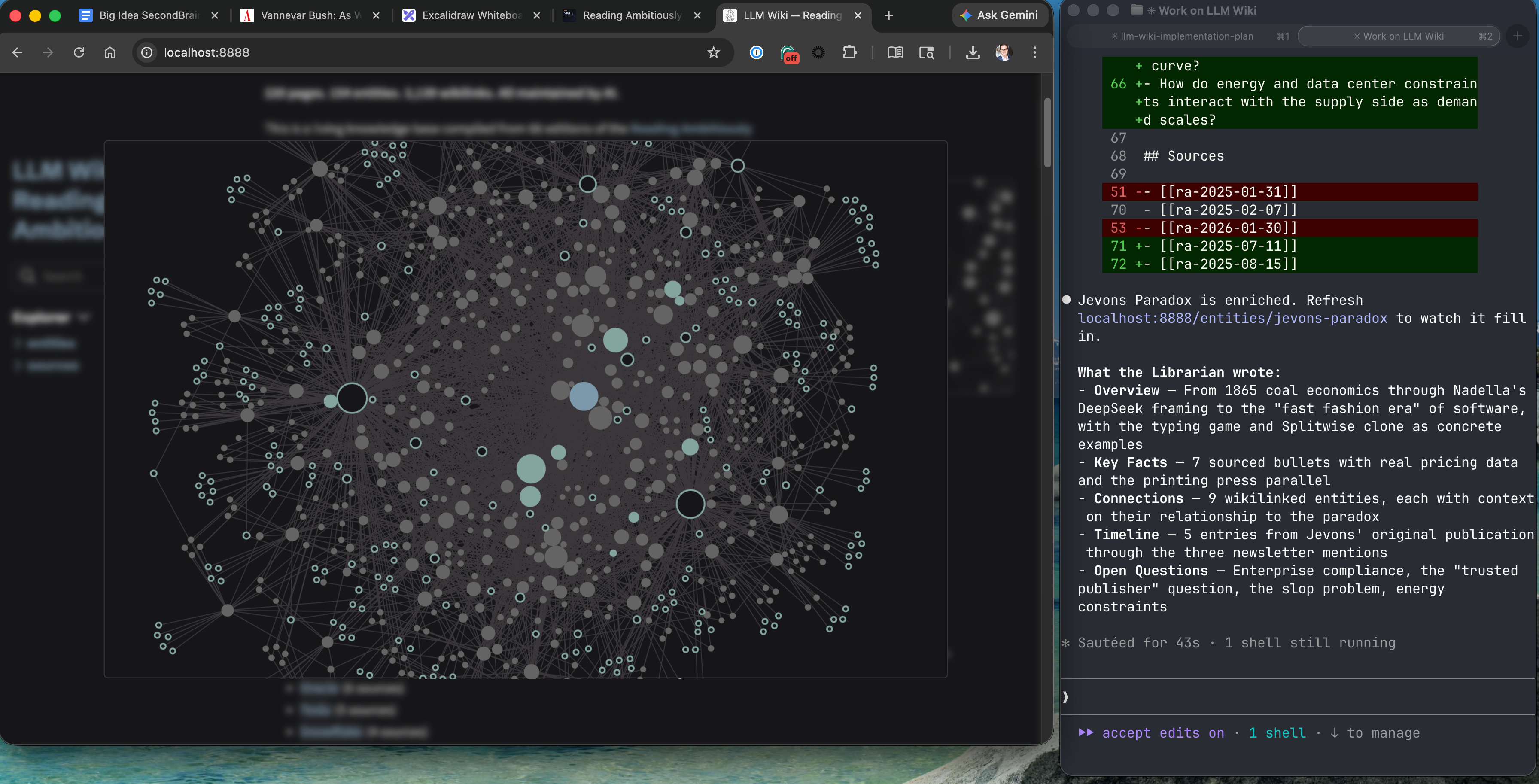
Right now, I still trigger AmbitiousOS by hand. I drop in an article and tell Claude to ingest it. It reads, files, and updates the system in seconds.
Now remove the trigger.
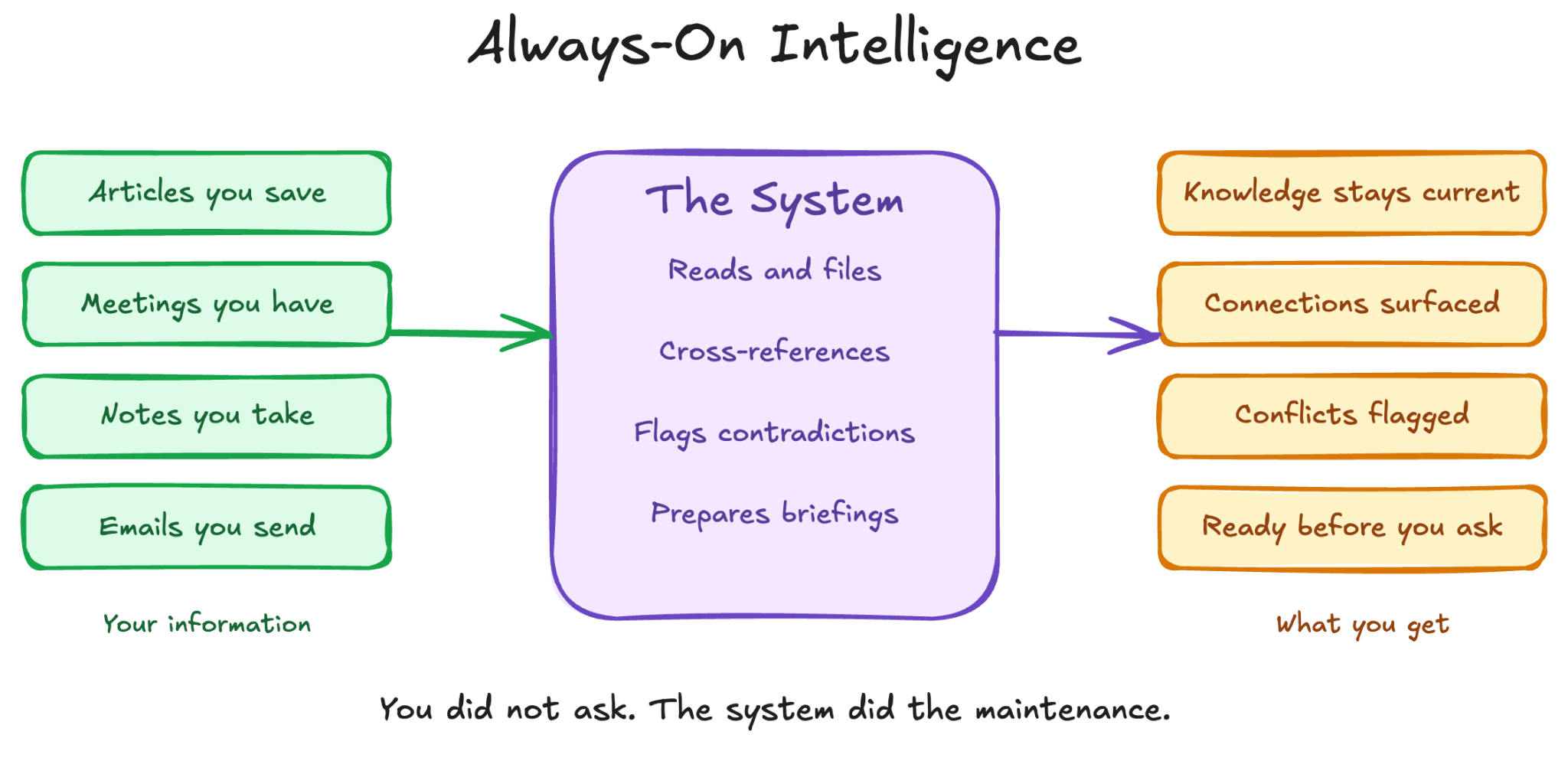
Imagine waking up and the system has already processed the three articles you saved the night before. It tied one to a company you track, another to a theme you have been writing about, and a third to a decision you made last quarter. It noticed that one of them conflicts with an assumption sitting in your notes, and it flagged the issue before your next meeting. It connected these concepts in a recent email you sent.
You did not ask the question. The system did the maintenance, then proactively alerted you.
The Harness Is Becoming the Product
OpenClaw is the clearest open-source version of that idea. A self-hosted gateway that connects apps and chat surfaces to an always-available assistant, with sessions, memory, tools, multi-agent routing, background work, and scheduled jobs. It feels like you gave AI a real operating environment instead of a single prompt box.
Anthropic is building the closed-source version of the same vision in Claude Cowork. Anthropic describes Cowork as a system for autonomous knowledge work that runs on desktop, works across local files and applications, and returns a finished deliverable. It is built around outcomes, not one-time prompts.
Two versions of the same idea. In my view, this could become the iPhone-caliber product of the AI era.
The model still matters.
But the product value is moving into the harness around it: memory, background maintenance, access to the tools where work lives, and skills that turn context into action.
The Missing Layer in Knowledge Work
Knowledge work still runs on the same loop: gather, make sense, retrieve, decide.
We built good tools for gathering. We built decent tools for retrieval. We never built a system that kept the knowledge layer current on its own.
Now we can.
That matters because the cost of broken memory compounds. You lose time. You miss context. You redo research. You walk into meetings with fragments instead of continuity. Over time, your own accumulated knowledge starts to feel less like an asset and more like a pile.
The products that matter next will keep context warm, maintain your knowledge base in the background, and prepare work before you ask. They will return something closer to a deliverable than a response.
Bush imagined the library in 1945. The missing piece was upkeep.
The web gave us infinite information. Search gave us retrieval. These new harnesses point to the missing layer: persistent intelligence that keeps your accumulated knowledge alive while you work.
I started AmbitiousOS by trying to build a smarter interface to a newsletter archive.
I came away with a stronger conviction about where this market is heading.
You do not need more information.
You need an always on intelligent assistant that remembers what you know and gets to work before you ask. And with AI, it’s now possible.

Best of the rest:
💸 Clouded Judgment Per Token Pricing – Jamin Ball makes the clearest case yet that in AI, pricing is becoming strategy itself, because the winners will be the companies that turn falling inference costs into value-based token and credit models before everyone else does. – Clouded Judgement
⏳ Some Things Just Take Time – Armin Ronacher makes the case that in an AI age obsessed with speed, the real moats are still trust, craftsmanship, and the long, unglamorous work of sticking with something long enough for it to matter. – Armin Ronacher
🤖 OpenAI CEO and CFO Diverge on IPO Timing – The real story is not just IPO timing, but whether OpenAI can outrun the financial strain of a $600 billion compute buildout before public markets start demanding discipline. – The Information
🐢 Thoughts on slowing the f*ck down – A sharp corrective to AI coding hype, this argues that speed without judgment produces brittle software, runaway complexity, and teams that stop understanding the systems they ship. – Mario Zechner
🚀 SpaceX Is Said to Target More Than $2 Trillion Valuation in IPO – This matters because a $2 trillion target would make SpaceX’s debut the biggest IPO ever, and force public markets to underwrite one of the most ambitious growth stories in modern corporate history. – Bloomberg

Charts that caught my eye:
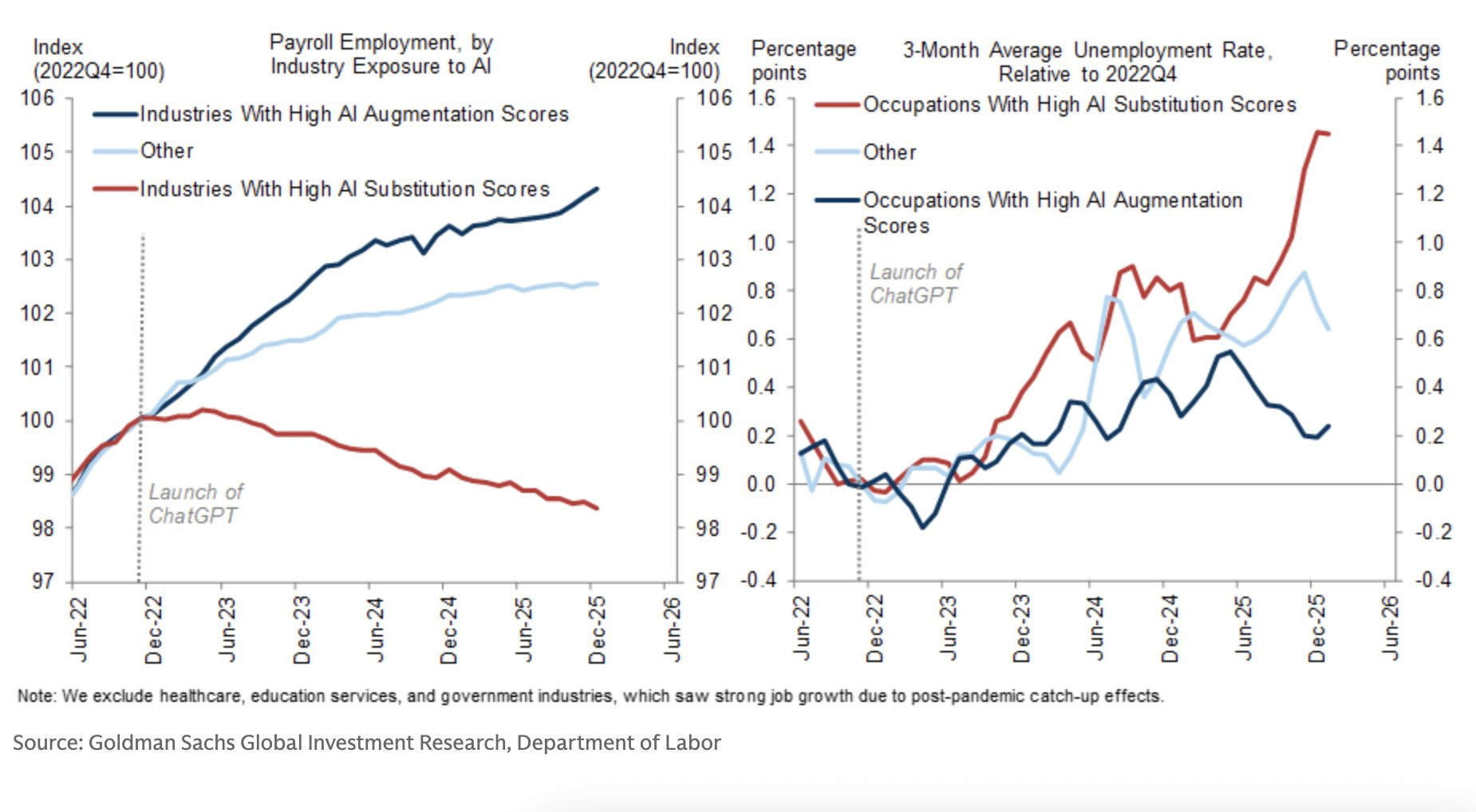
→ Why does it matter? Goldman Sachs found that industries where AI augments workers are adding jobs, while those where AI substitutes for workers are shedding jobs. The unemployment rate for high-substitution occupations is already up more than 1.4 percentage points from its 2022 baseline. The workers feeling the most pressure appear to be entry-level ones, suggesting the rungs at the bottom of the career ladder may be getting harder to find.
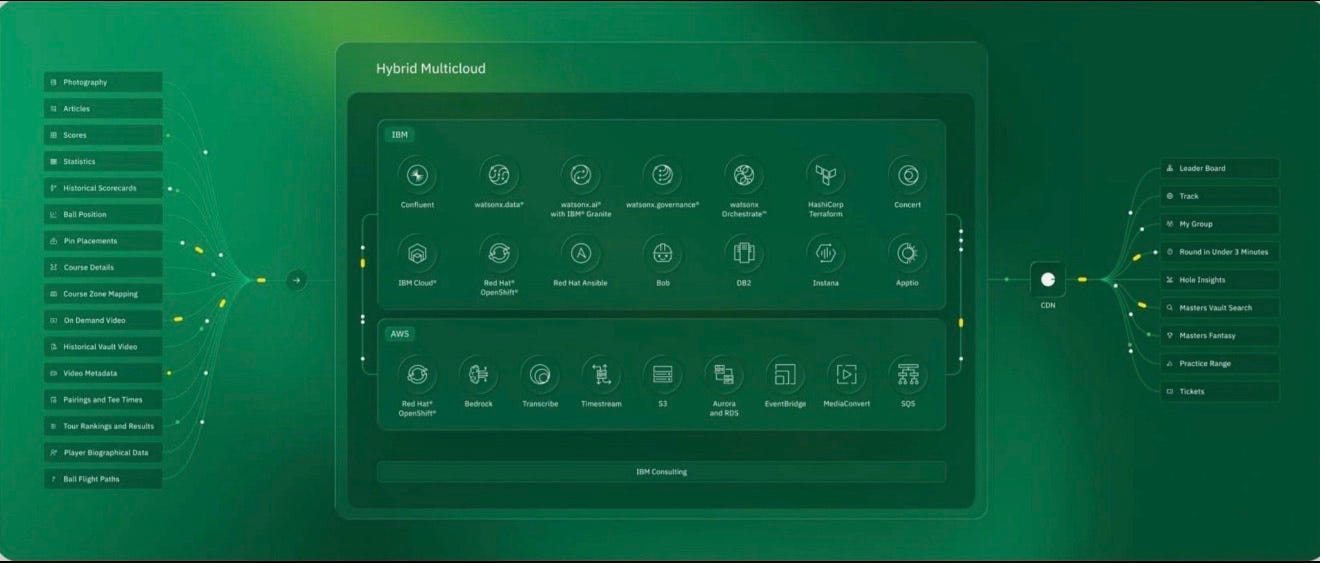
→ Why does it matter? The architecture behind one of the most popular apps in live sports: The Masters!
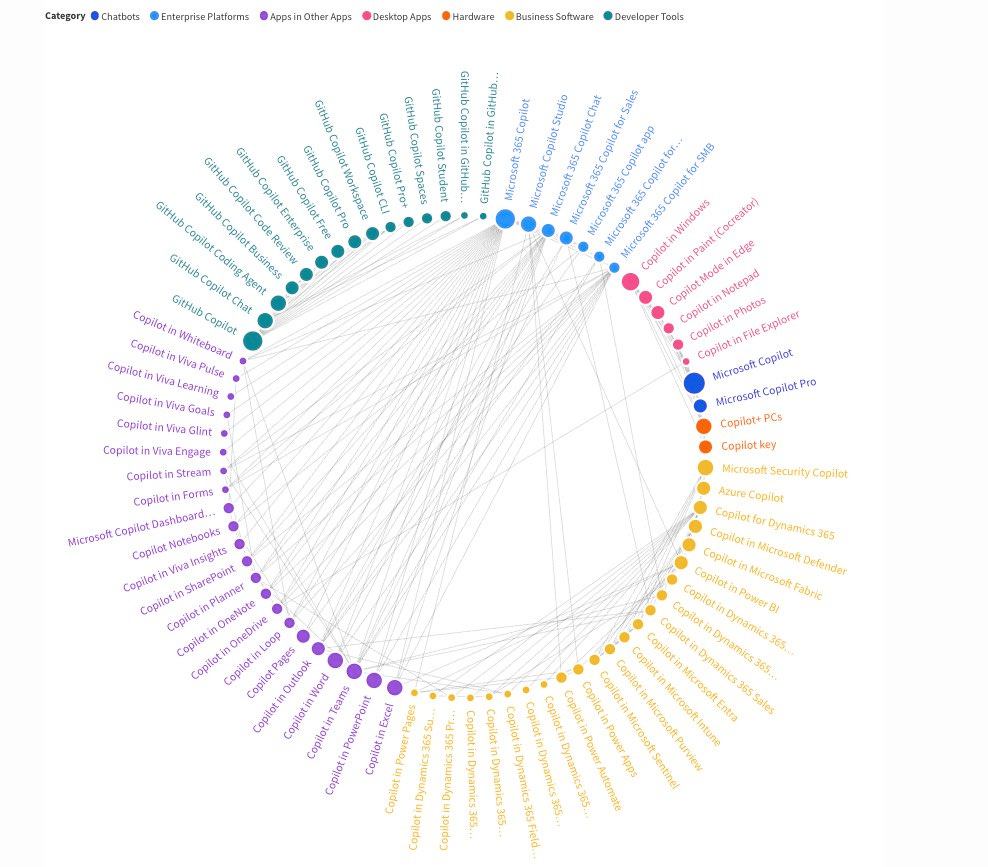
→ Why does it matter? Hat tip to Tey Bannerman for surfacing this one. Microsoft has branded somewhere around 78 separate products “Copilot,” and the chart makes the sprawl hard to ignore: Copilots inside Copilots, Copilots for other Copilots, and a dedicated hardware key on your keyboard to summon them. Will the real copilot please stand up?!
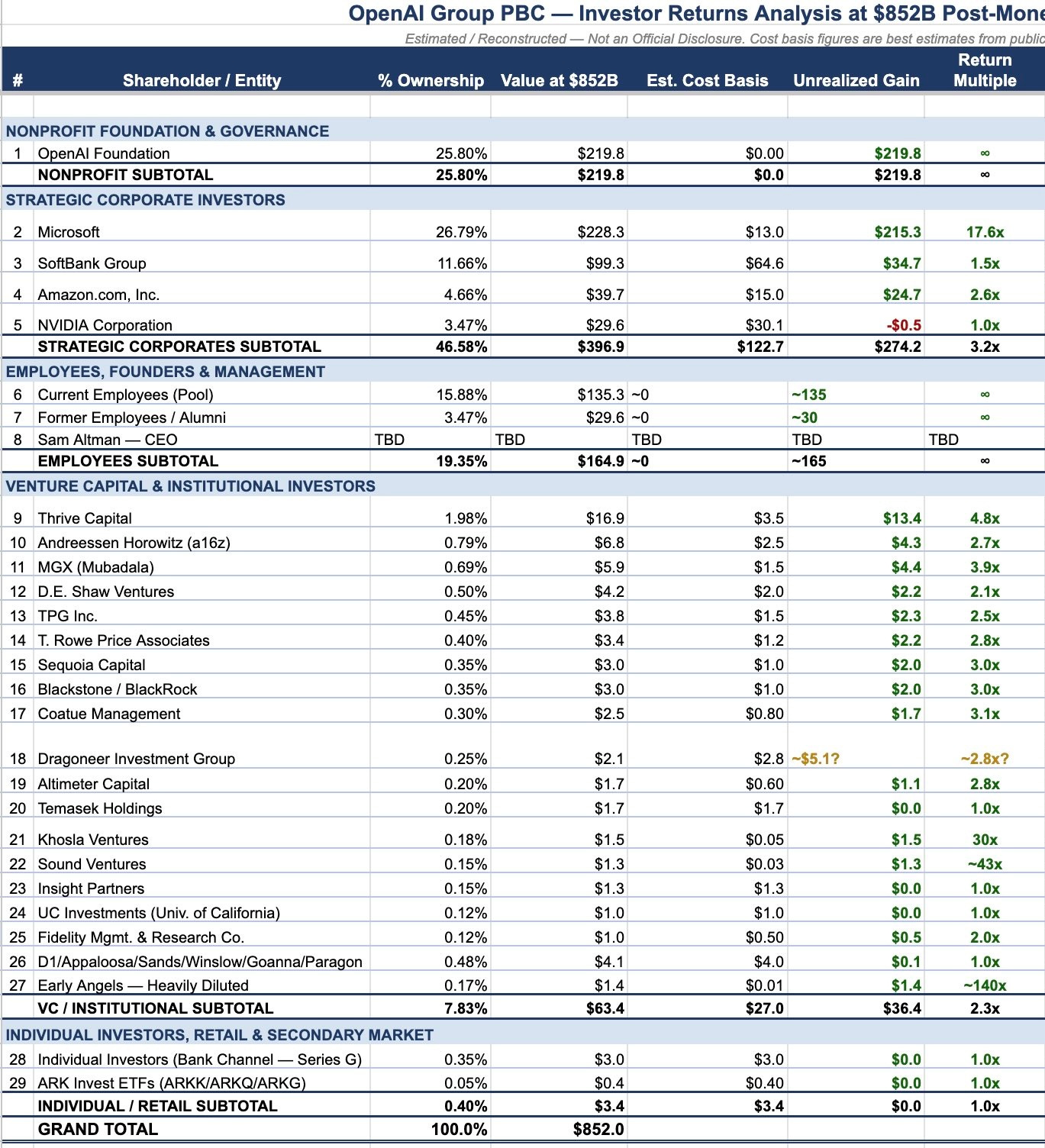
→ Why does it matter? This is the leaked OpenAI cap table (I have no idea if it is fake news). If it's real, it tells a few stories at once. Microsoft’s $13 billion bet is now worth 17.6x, making Satya Nadella’s 2019 call one of the greatest capital allocations of the modern era. The nonprofit foundation is sitting on $220 billion in gains from a $0 cost basis, which is the most unusual wealth creation in corporate history. NVIDIA, despite being the backbone of everything OpenAI builds, is currently underwater on their position. And then there is Ashton Kutcher, who turned $30 million into $1.3 billion in under three years, a 43x return that most professional investors will never see in a lifetime. If this company IPOs at $1 trillion or more, every number on this table increases by 30%, and the nonprofit’s gains become a governance story unlike anything we have seen before.

Tweets that stopped my scroll:

→ Why does it matter? A frontier-class multimodal model, built from the same research that powers Google Gemini 3, is now running entirely on a phone at 40 tokens per second. This could jeopardize cloud-based AI inference. On-device models at this speed and capability level suggest that privacy, latency, and cost constraints that once required a server farm could someday be available locally on the device in your pocket.
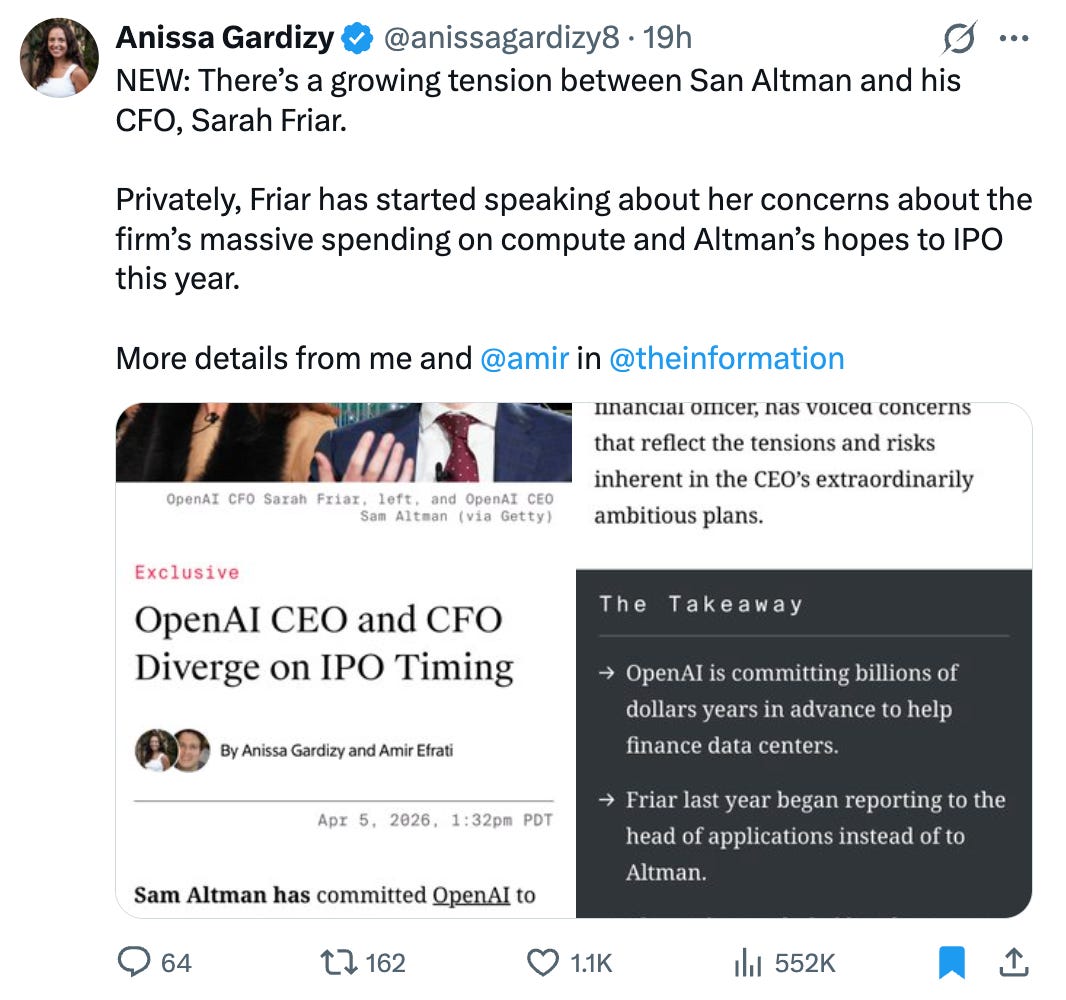
→ Why does it matter? The CFO of the world's most valuable AI company is privately raising concerns about spending and IPO timing, and she no longer reports directly to the CEO. Worth watching this relationship closely.

→ Why does it matter? Tony Fadell raises a question worth sitting with: when product management and product marketing operate as separate functions, does the story stay close enough to the product? There is no single right answer to how you organize these roles. But his point is worth understanding. The person who defines what gets built and the person who decides how it gets explained need to be in constant contact, ideally the same person. Greg Joswiak’s superpower at Apple wasn’t marketing genius in isolation. It was empathy deep enough to become the customer, which kept the message and the product aligned.

→ Why does it matter? A year ago, the big question was whether enterprise AI revenue would materialize. Well, here it is. Anthropic added $11B in annualized revenue in a single month. When your million-dollar customer count doubles in under two months, that’s worth paying attention to!

Worth a watch or listen at 1x:
→ Why does it matter? Brad Lightcap is OpenAI’s COO. He covers how OpenAI thinks about the transition from tools to agents, what enterprise adoption actually looks like at scale, and where the real bottlenecks are. Worth a listen!

Quotes & eyewash:
“If you don’t build your dream, someone else will hire you to help them build theirs.” - Dhirubhai Ambani, Founder, Reliance Industries
→ Why does it matter? Are you climbing the right hill?
The mission:
The Wall Street Journal once used “Read Ambitiously” as a slogan, but I took it as a personal challenge. Our mission is to give you a point of view in a noisy, changing world. To unpack big ideas that sharpen your edge and show why they matter. To fit ambition-sized insight into your busy life and channel the zeitgeist into the stories and signals that fuel your next move. Above all, we aim to give you power, the kind that comes from having the words, insight, and legitimacy to lead with confidence. Together, we read to grow, keep learning, and refine our lens to spot the best opportunities. As Jamie Dimon says, “Great leaders are readers.”
Disclaimer: This content is for informational purposes only and does not constitute financial, investment, or legal advice. Readers should do their own research and consult with a qualified professional before making any decisions.