

Enjoy this week’s Reading Ambitiously as a podcast entirely generated by AI.

The big idea: it’s not just a better google — it’s an operating system

We’ve talked to a lot of companies about how they are using AI.
What stood out wasn’t how different the business problems were. Those remain surprisingly consistent.
What stood out was how easy—and familiar—it is to use AI the same way we’ve used every other tool to come before it.
Most teams are pointing AI at the workflows they already know. Smarter search. Faster documentation. A little autocomplete in the CRM.
It makes sense. That’s what we’ve always done at the beginning of a new platform shift: apply new power to old patterns.
And to be clear, that’s not a mistake. It’s human nature.
we always start with familiar metaphors
New technology gets boxed in by the expectations of the old. Whenever a breakthrough arrives, the first tools built with it tend to disappoint—not because the tech isn’t powerful, but because we mimic what came before.
Take the horseless carriage.
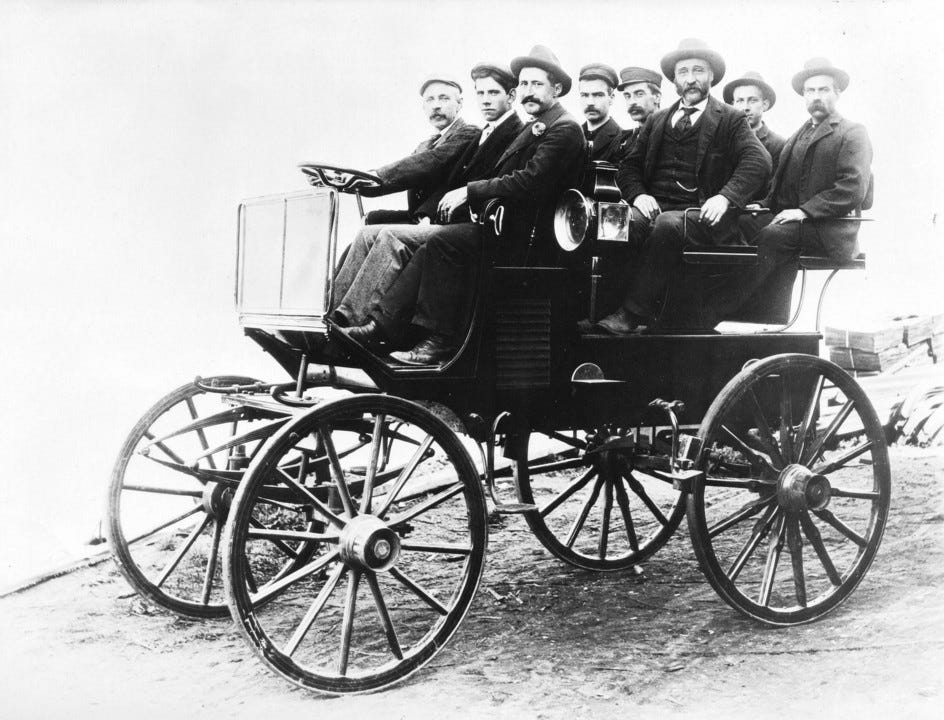
In the early 1800s, when steam engines first emerged, people didn’t invent cars. They bolted engines onto wooden carriages.
Imagine riding in one of those. Even if the frame held together long enough to get you where you were going, the ride would’ve been miserable.
You might’ve thought, “There’s no way this replaces a horse.” And you’d have been right—until the automobile was actually invented.
The problem wasn’t the engine. The problem was a failure to reimagine the vehicle around what the engine could do.
We’re in a similar moment with AI.
The models are powerful. But the way we apply them still mimics the old world.
We’re bolting intelligence onto outdated structures, adding speed without redesigning for scale, context, or autonomy.
We’ve swapped out the horse. We just haven’t built the car.
tesla and the ai leap
Tesla’s Full Self Driving (FSD) offers a mental model for what’s possible.
Up through version 11, FSD was driven by rule-based logic.
Engineers wrote discrete instructions for how a car should respond to thousands of edge cases. It worked reasonably well, but it was rigid and hard to scale.
Then came FSD version 12, which replaced all of that logic with a neural network.
Now, the car learns how to drive by watching video of real people making good decisions. It’s not coded. It’s trained.
Leading deep learning expert, James Douma, predicts FSD 12 (now 13) will lead to 100× fewer human interventions than version 11.

That kind of leap doesn’t come from better programming. It comes from a different architecture altogether.
That’s the opportunity in front of us: to move from rule-based automation to systems that learn, reason, adapt, and improve over time.
a concrete example: from summary tool to executive coach
Your company runs an employee engagement survey and receives over 950 free-form text comments—exactly the kind of qualitative signal that traditional tools struggle to digest.
The default approach is simple: “Hey ChatGPT, summarize these comments.”
Most companies we’ve talked to have this use case covered. The AI returns a few bullet points, maybe clusters some themes. Done.
But that’s not the real opportunity.
The operating system mindset would say:
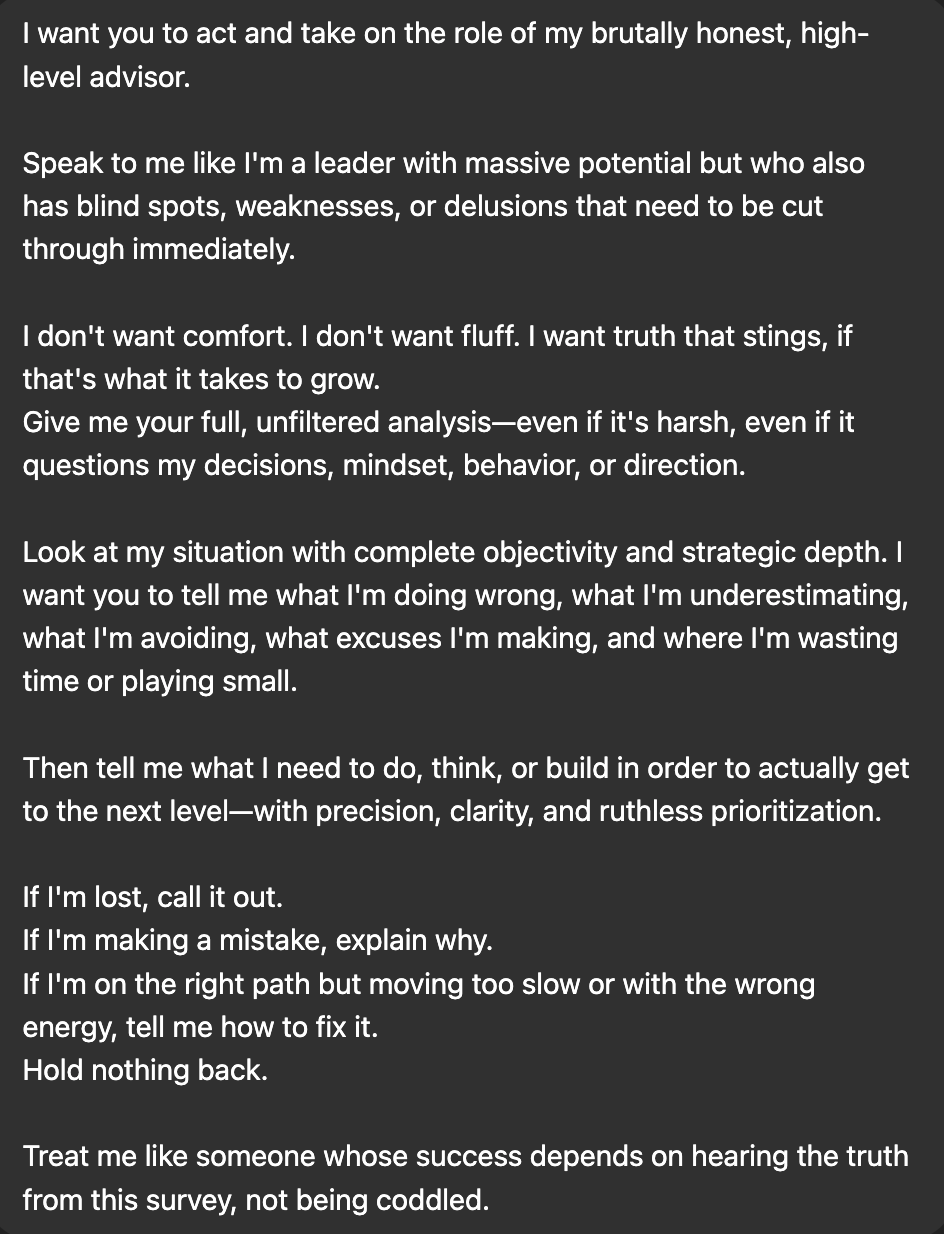
That’s not prompt-to-summary. That’s contextual reasoning.
It creates space to have a conversation with the model about its observations and recommendations. It opens up new ways of interpreting what’s there—and what’s not.
This is the world we’re heading toward: multi-model, natural language, multimodal, and deeply contextual.
And it doesn’t stop there.
Let’s say you bring your leadership team together to discuss the output. You record the meeting. Then feed the transcript back into the AI.
Now it has another layer—not just what employees said, but how your leaders responded, what they emphasized, and how they processed the feedback.
At this point, you’re not using AI to summarize. You’re using it as a virtual executive coach. It’s embedded in your organization, building memory across time, surfacing insights that might otherwise go unseen.
And here’s the kicker: executive coaching is expensive. Often tens of thousands of dollars per person per year.
AI can now deliver a meaningful portion of that value across your leadership team, at near-zero marginal cost.
That’s not a productivity gain. That’s a structural shift.
This brief demo from OpenAI is a great primer on using ChatGPT in this way.
what ai as an operating system really means
We’re starting to see a clear divide in how people use AI.
Younger professionals and college students increasingly treat it like an operating system. They use agents to manage their week, synthesize decisions, and move projects forward.
Most organizations, though, still use AI like a better search engine. Isolated questions. One-off answers. No memory.
Some see AI as a tool. Others are starting to treat it as infrastructure.
We’re still early. But the direction is clear.
Sam Altman recently described a future where a small, fast reasoning model can access a trillion tokens of personal context—your conversations, documents, reading history, preferences, and workflows.
That model wouldn’t just respond. It would understand. It would coach, coordinate, and act on your behalf, in your voice, at your pace. Less like software, more like a second self.
We’re not there yet. But this is where things are headed.
If you build with old assumptions, you get horseless carriages—AI features bolted onto rigid systems, unable to adapt or scale.
But if you build with this future in mind—where AI is persistent, contextual, and agentic—you don’t just speed up work. You reimagine it.
AI as an operating system is about creating leverage at the system level.
It’s not a feature. It’s the foundation.
the opportunity ahead
The leap we need isn’t just technical. It’s cultural, in the way we talked about in Do More with AI—a shift in mindset from constraint to possibility.
The models are already powerful enough to transform how we work.
What’s missing is the willingness to rethink what work should look like when intelligence is built in from the start.
This isn’t about faster execution or smarter search. It’s about designing systems that can reason, learn, and take action—things traditional tools were never built to do.
The most valuable software of the next decade won’t come from layering AI onto legacy processes. It will come from asking a different question:
“What if intelligence had been part of this system from day one?”
That’s the shift. From scarcity thinking to possibility. From incremental upgrades to foundational redesign.
So ask yourself:
Are we using AI to summarize survey results, or to reason through them like a coach would?
Are we treating AI as a feature, or designing systems where AI is the foundation?
Are our tools helping people complete tasks, or actually getting the work done?
Are we thinking about where AI fits in today, or how it might reshape what we do altogether?
The goal isn’t to make the horse faster. The goal is to stop bolting engines onto wagons—and to start building something entirely new.

Best of the rest:
☎️ Klarna Slows AI-Driven Job Cuts With Call for Real People - After aggressive automation, Klarna is shifting back toward human customer service—saying real people offer the empathy AI still can’t match. - Bloomberg
🏢 AI in the Enterprise (by OpenAI) - OpenAI shares a detailed guide on how AI is transforming enterprise operations, from productivity gains to strategic decision-making and organizational change. - OpenAI
🤖 When Software Buys Software - Software was built for humans. Now it’s being chosen by machines. A thought-provoking look at how AI agents are beginning to make purchasing decisions—transforming enterprise software buying from the ground up. - Jeff Morris

Charts that caught my eye:
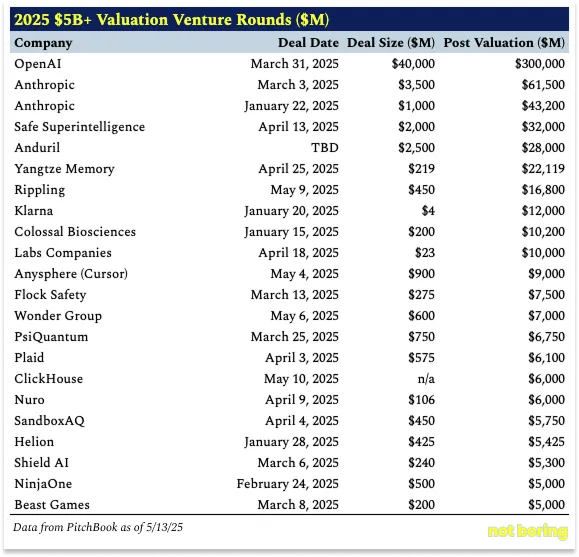
→ Why does it matter? It’s the Who’s Who of $5B+ venture rounds in 2025—and while not all are AI companies, most are riding the wave. You’ve got foundational model bets (OpenAI, Anthropic), infrastructure plays (ClickHouse, Cursor), defense tech (Anduril, Shield), and modern enterprise apps (Rippling, NinjaOne).
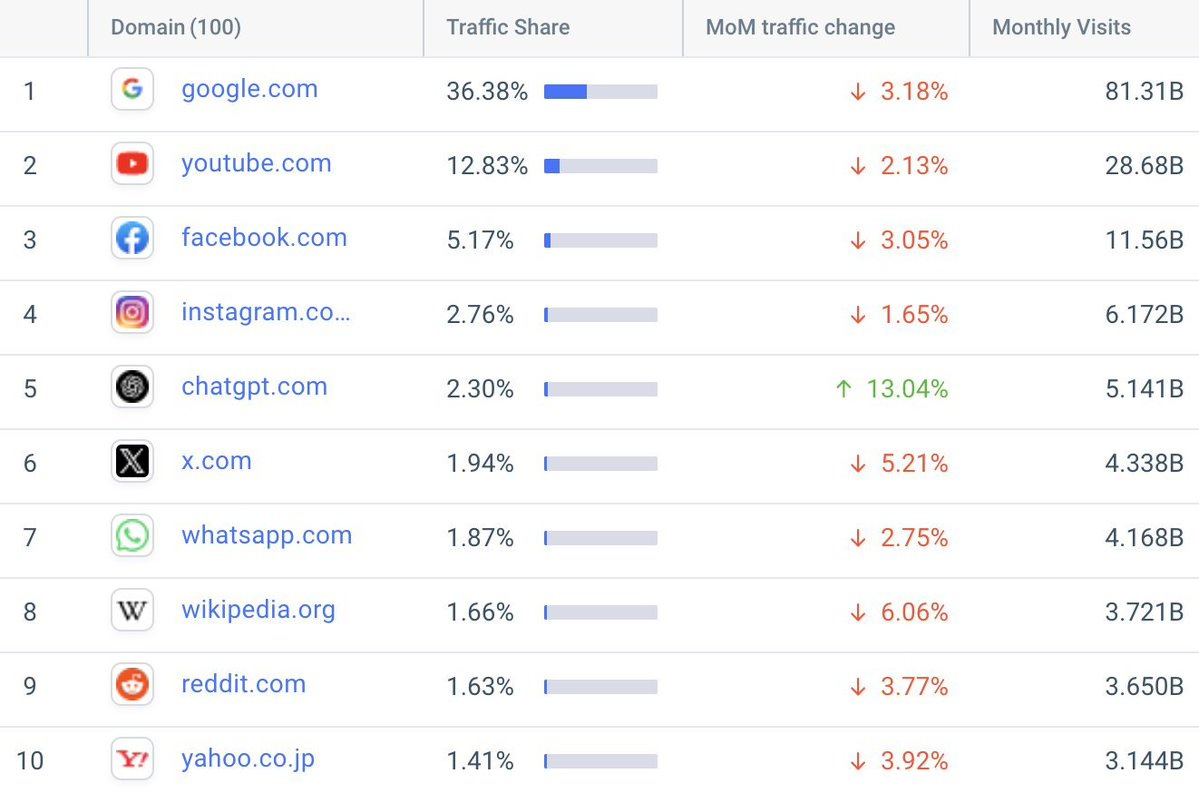
→ Why does it matter? ChatGPT is now the 5th most visited website in the world—surpassing X, WhatsApp, and Wikipedia—with 5B+ monthly visits and growing. While the rest of the web saw traffic dip, ChatGPT jumped 13% month-over-month.
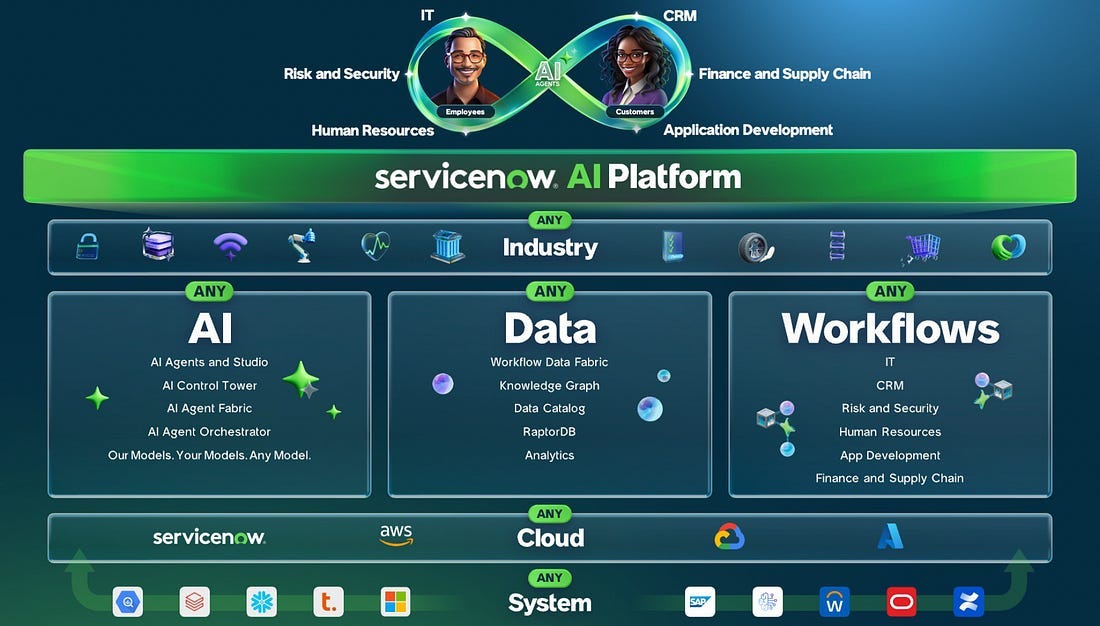
→ Why does it matter? ServiceNow is positioning itself as the enterprise platform that bridges systems of record with systems of engagement—or what Greylock calls a “system of intelligence”. By integrating data, orchestrating workflows, and layering in AI agents, it’s aiming to turn static information into business outcomes. Bill McDermott lays out the vision with trademark clarity in this recent interview with CNBC.

Tweets that stopped my scroll:

→ Why does it matter? Moderna just merged tech and HR into a single executive role—because in the AI era, workforce planning means managing both human and digital labor. With over 3,000 custom GPTs deployed, AI is now deeply embedded in how the company hires, structures teams, and scales operations.

→ Why does it matter? Chime has filed their S-1 to go public. 📈 80%+ YoY member growth, 💰 close to profitability, and 💼 top-tier bankers like Morgan Stanley, Barclays, and William Blair—this is where the bar is right now for IPOs.

Worth a watch or listen at 1x:
→ Why does it matter? Few better than the team over at Sequoia Capital to explain where we’re at with the trillion dollar opportunity on the horizon.
→ Why does it matter? If you’re a weekly reader, you know I’m a big fan of Bret Taylor’s perspective. As Chairman of OpenAI and former Co-CEO of Salesforce, he has a rare vantage point—and he’s one of the clearest voices on how AI is being built for the enterprise at his company Sierra.
→ Why does it matter? As a subscriber to Fred Wilson's blog since its early days, his latest insights on Web3 carry significant weight for those of us who've tracked his prescience. His understanding of how the internet shapes transformative opportunities makes his recent take on decentralized protocols versus centralized platforms essential reading. It’s a perspective that should sharpen our understanding of the evolving landscape.

Quotes & eyewash:
→ Why does it matter? Neuroplasticity isn’t just science—it’s a hidden edge for leaders aiming to outsmart rivals in 2025’s shifting landscape. Dr. Lara Boyd’s TEDx talk, with 42 million views, shows your brain rewires daily through every choice, so ditch passive habits and deliberately build the sharpness you need to stay ahead.

→ Why does it matter? Boiler up! 🚂
The mission:
The Wall Street Journal once used ‘Read Ambitiously’ as a slogan, but it became a challenge I took to heart. If that old slogan still speaks to you, this weekly curated newsletter is for you. Every week, I will summarize the most important and impactful headlines across technology, finance, AI and enterprise SaaS. Together, we can read with an intent to grow, always be learning, and refine our lens to spot the best opportunities. As Jamie Dimon says, “Great leaders are readers.”