



The big idea: America turns 250. It almost ended in Brooklyn.
Reading time: 5 minutes

This is my last Reading Ambitiously before America celebrates its 250th birthday.
From this distance, the American story can feel inevitable. A revolution, a republic, a superpower. We compress two and a half centuries into a clean arc and forget how fragile the beginning really was.
A few weeks after the Declaration of Independence, the whole experiment nearly collapsed.
David McCullough tells the story in 1776. Washington’s army had been badly beaten in Brooklyn. The British had him trapped with the East River at his back. The rebellion was still more idea than reality, and the idea was in danger. There was no guarantee the army would survive the summer, let alone that the country would survive the next two and a half centuries.
The British had the superior army and the momentum. Washington had a battered force, a narrow window, and one possible way out: across the river to Manhattan. Even that depended on the weather. If the wind shifted, British warships could move into the East River and close the trap. Washington’s army would have nowhere to go.
But the wind held.
As night fell, Washington made his move. Boats crossed back and forth in the dark, carrying men, horses, artillery, and supplies across the river. A heavy fog settled over Brooklyn and concealed the retreat. By morning, the British looked across the East River and realized the Americans were gone. The Continental Army had escaped, and the Revolution had survived.
Two hundred and fifty years later, we call that history. At the time, it was a near miss.
We tend to clean up the past when we tell it backward. We turn uncertainty into destiny. We draw straight lines through events that were anything but straight to the people living through them. We say the Revolution led to the Republic, the Republic endured, and the United States became the most powerful economic engine in human history.
All true. It also almost ended in Brooklyn.
Living through history is different from reading it afterward. People make decisions with incomplete information. Leaders carry doubt they cannot show. Good luck and good judgment become tangled together. The line between survival and collapse can be thinner than anyone wants to admit.
Life works this way, too. A chance meeting becomes a marriage. A job you almost did not take becomes the place where your life’s work begins. A child is born, and the world divides into before and after. These moments rarely announce themselves as turning points. Most of the time, they arrive disguised as ordinary days. Only later do we understand what changed.
America at 250
America is turning 250 at a strange moment. Technology is moving faster than institutions can absorb it. AI is changing the shape of work before most companies have figured out how to use it well. Markets are concentrated. Politics are polarized. Trust is low. The global order feels less stable than it did a decade ago. The future feels unusually hard to read.
When the future gets hard to read, fear fills the empty space.
The decline narrative has a certain appeal because it gives anxiety a plot. It takes every bad headline, every institutional failure, every political dysfunction, and every technological disruption, then arranges them into a story with a clear destination.
That story shows up in almost every major technological era. The new thing is too powerful. Institutions are too weak. Incumbents are too entrenched. Jobs will disappear. This generation will be the one that finally loses control of the machine.
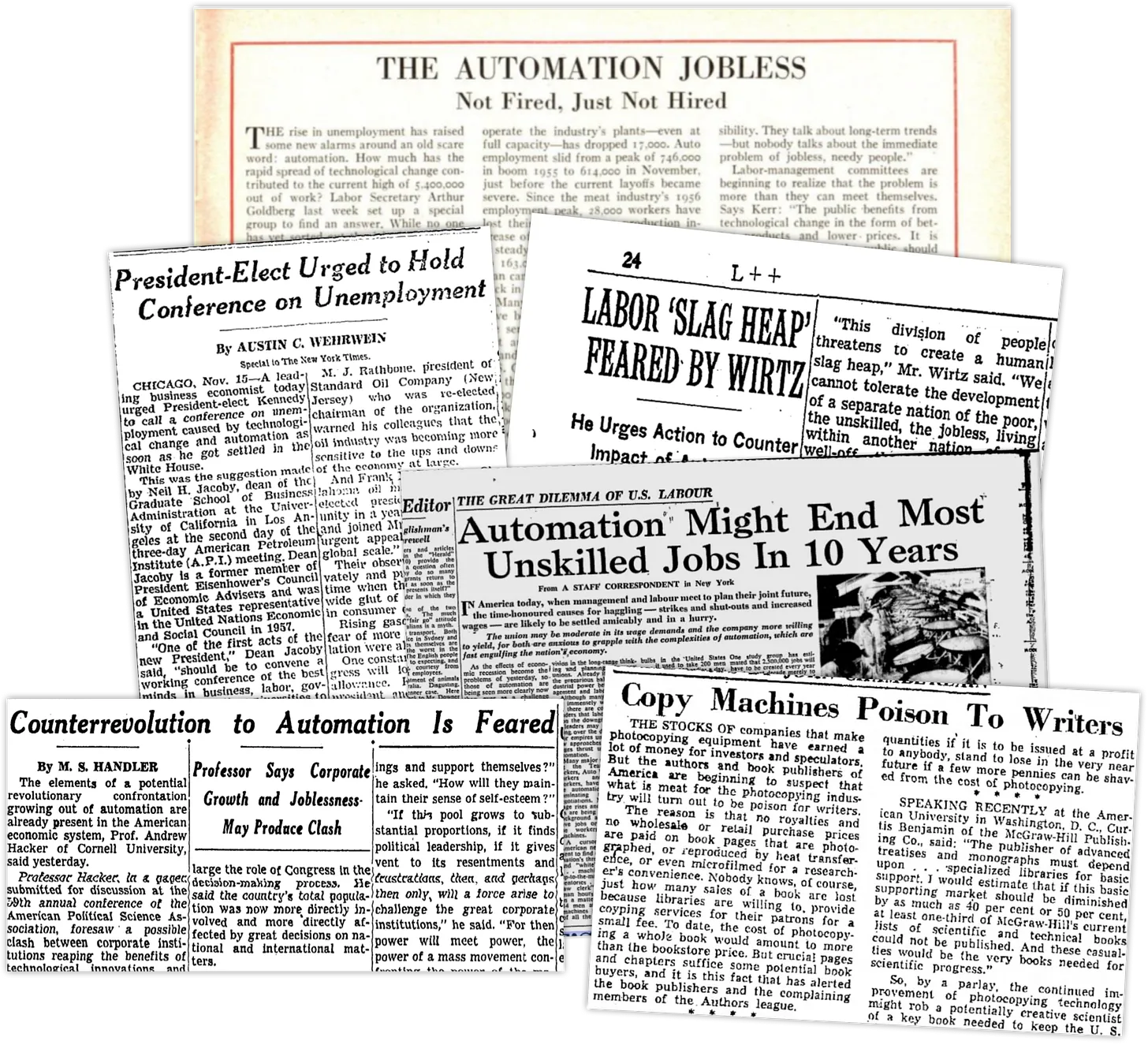
The printing press threatened existing authority. The steam engine upended labor. Electricity remade the factory. The mainframe changed the enterprise. The PC challenged the mainframe. The internet rewired distribution. Now the world’s information is available 24/7 in our pockets.
AI is forcing the next question: what happens when software stops waiting for us to push buttons and starts pushing the buttons for us?
That is a serious question. AI will disrupt. It will expose weak business models, institutions, and strategies. It will create winners and losers. It will move faster than many people want, and probably slower than the loudest people predict.
The mistake is treating the first pain of a transition as the final verdict on it.
New technologies break old patterns before the new ones are fully visible. The future arrives unevenly. People experience the disruption before they experience the abundance. That is why turning points feel so unstable. The old world has begun to break, but the new one has not yet become useful enough to feel inevitable.
This is where history helps. It does not give us a script, but it can give us a pattern.
Each era looks different on the surface. Underneath, the same arguments keep coming back: centralized vs. decentralized, open vs. closed, regulation vs. innovation, fear vs. adoption. Every cycle has its dominant players. Every cycle has its skeptics. Every cycle has people who insist the incumbents are unbeatable and people who insist the whole thing is a bubble.
Every cycle also produces a period where the technology is visible, awkward, expensive, and overhyped before it becomes useful, embedded, and eventually ordinary.
The most powerful technologies eventually disappear into the background. Most of us did not wake up this morning and thank electricity. It is just on. AI will likely follow a similar path. It will move from spectacle to infrastructure, and from the thing everyone talks about to the thing everyone uses.
The path is messy at the moment as we approach the turning point. It often comes with speculation, monopoly power, inequality, political stress, institutional lag, and a general feeling that the economy has become detached from common sense.
The people who do well in these periods usually do not have perfect foresight. They keep building when the story is unresolved. They learn the new tools. They are curious. They adapt their organizations. They protect what matters and let go of what no longer works. They resist the temptation to confuse uncertainty with helplessness.
And they choose optimism over fear.
Across centuries, mankind has a remarkable track record of turning tools into capacity. We invent, then we adapt. We lower costs. We expand access. We use new capabilities to do work that previously seemed impossible, expensive, or reserved for the few.
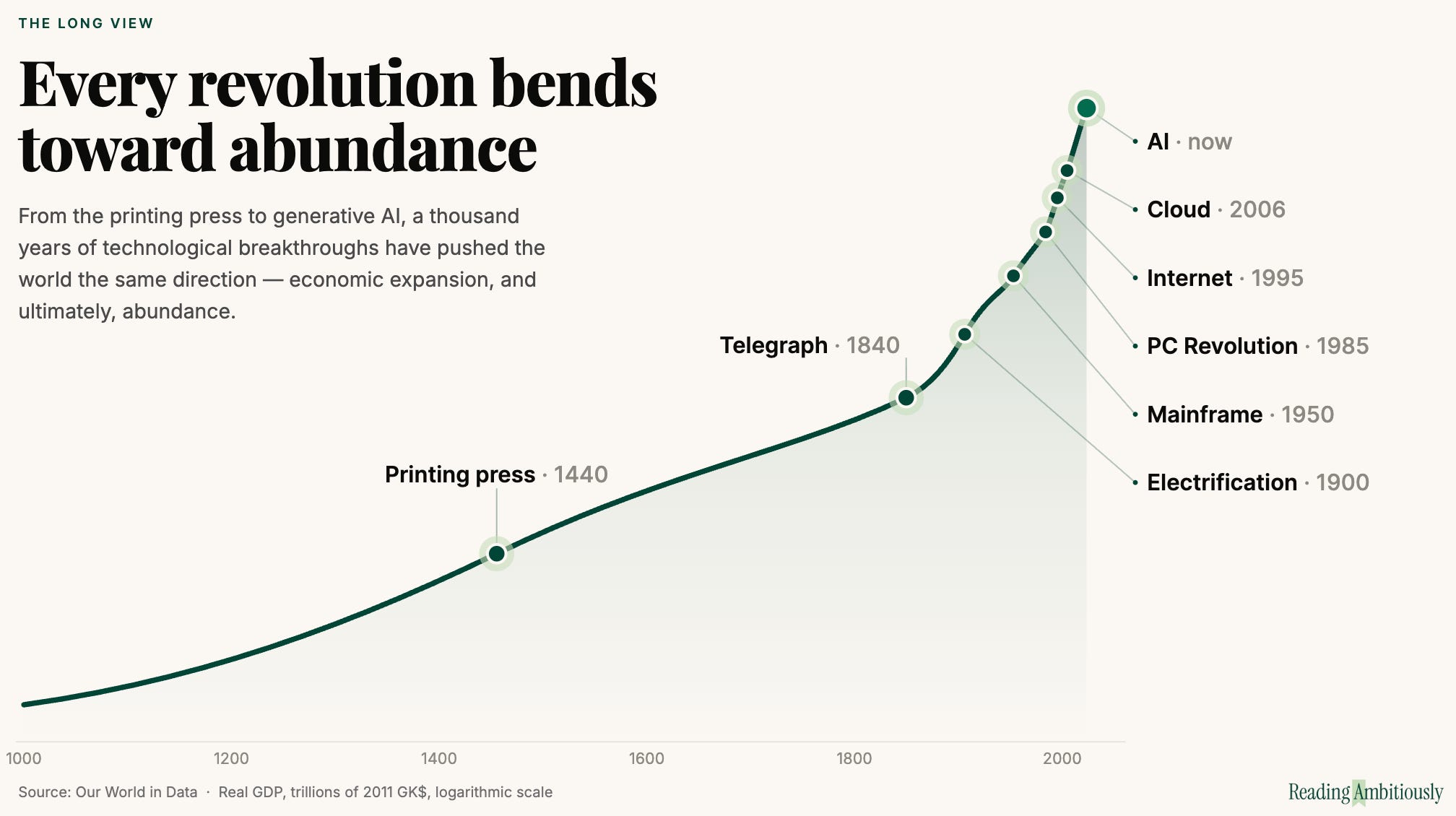
That record is imperfect and full of painful transitions. But it is still the record. Again and again, human ingenuity has taken the raw material of disruption and turned it into progress.
The American story itself follows that pattern. It has never been a straight line. It has been a long argument between fear and possibility, failure and renewal, contradiction and progress. Again and again, the country has required reinvention from people who could not know the ending, but chose to act anyway.
That is the posture I invite you to carry into this next era.
We do not know exactly what AI will do to work. We do not know how institutions will respond. We do not know which companies will matter in ten years. We do not know what the next chapter of the American story will look like.
Still, all of us, not just Americans, have agency to live our ideals. We can build. We can learn. We can reskill. We can invest in people. We can make the new thing useful. We can preserve what deserves to endure while finding the courage to change what no longer works.
History is shaped by the people living inside the uncertainty. It is shaped by the people who keep rowing in the fog, who move before the outcome is obvious, who carry the idea forward long enough for it to become real.
Washington did not know how the story would end when he crossed the East River. He only knew the army had to survive the night. That is often how progress works. The grand historical arc depends on people making the next right move before they have the comfort of knowing how it all turns out.
Maybe years from now, people will look back at this strange, anxious, accelerated period and say the next era was being born in plain sight. They will make it cleaner than it felt. They will draw the line backward and give the story a shape none of us can see yet.
But we are the ones living in the fragile part, before the fog lifts, while the future is still being made. The work is to keep moving before the story makes sense. To learn the new tools and use them for good. To build what we couldn’t before. To carry the idea forward long enough for it to become real. And to be optimistic that it will.
History hangs by a thread.
And sometimes, the wind holds just long enough for the courageous ones to act.
Happy birthday, America.
I’ll see you on July 10th.
Stay ambitious.

Best of the rest:
🔁 The AI world is getting ‘loopy’ – Agentic AI is moving from one-off prompts to always-on feedback loops, where agents monitor, improve, and prompt other agents, a powerful shift that could make AI more useful and much more expensive. – TechCrunch
💰 How to Earn a Billion Dollars – Paul Graham makes the founder’s case that extreme startup wealth is less about extraction than exponential growth, created by building something users love in a market big enough to compound. – Paul Graham
📚 Has AI Already Killed How-To Nonfiction? Sales Trends, My Personal Data, and What It Might Mean for the Future – Tim Ferriss uses his own collapsing book sales to make a blunt case that prescriptive nonfiction is becoming raw material for chatbots, while voice, sequencing, and transformation may be the last durable moats. – The Blog of Author Tim Ferriss
🏗️ Owning vs. Renting Intelligence — Lin Qiao argues that AI companies shouldn’t just rent frontier model APIs, they need to turn their own data, workflows, and domain expertise into proprietary intelligence they actually control. — Lin Qiao on X
🌶️ OpenAI unveils its first custom chip, built by Broadcom – OpenAI unveiled Jalapeño, its first custom inference chip, built with Broadcom and designed to lower the cost of running its AI models as the company doubles down on its own infrastructure to reduce its dependence on Nvidia GPUs. – TechCrunch

Charts that caught my eye:
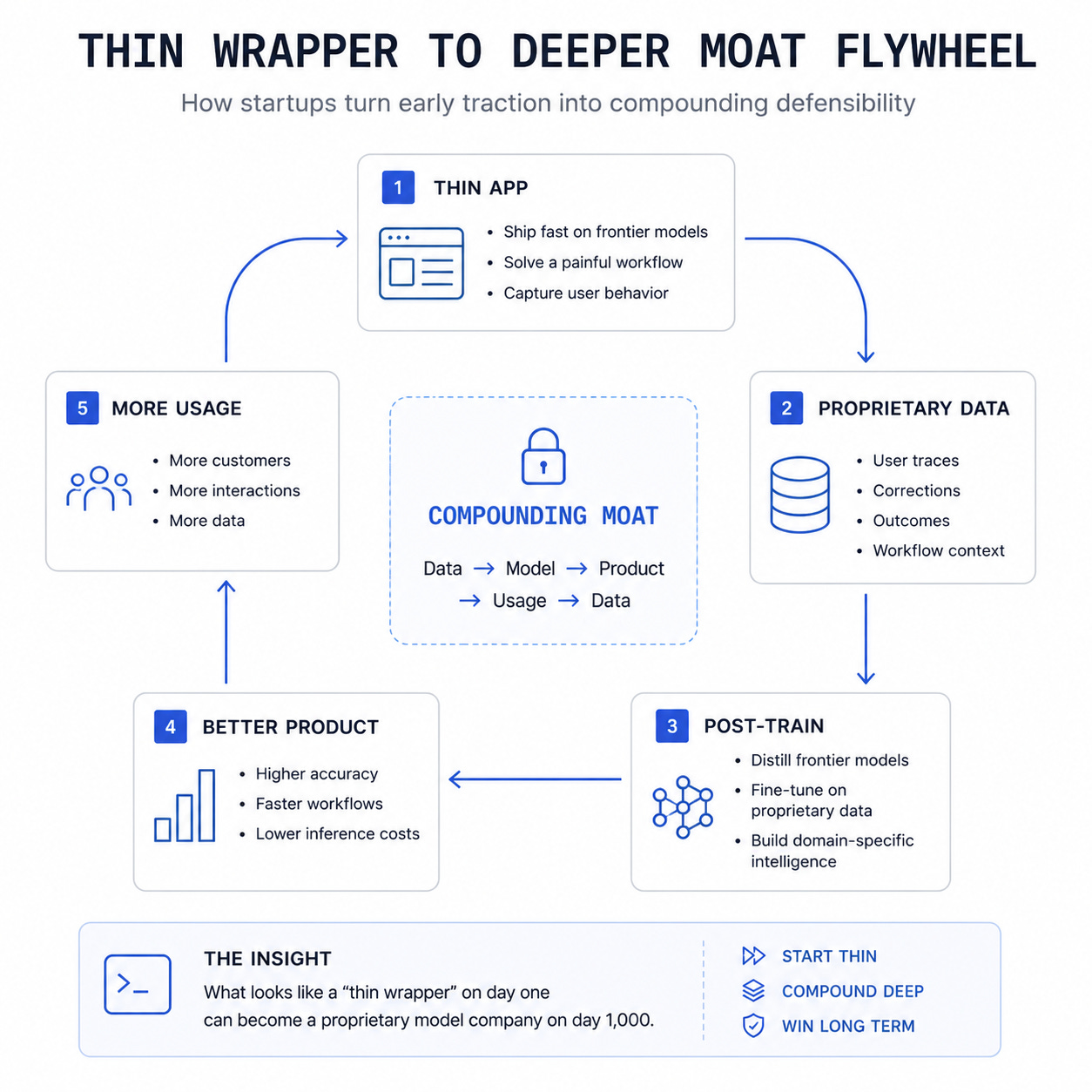
→ Why does it matter? People often describe AI applications as “thin wrappers” around the model. The concern is easy to understand: if the model does most of the work, the product layer can look thin, and thin products rarely build deep moats. Maybe. But accurate output takes more than a prompt box and an API call. The model needs the right context, workflow, permissions, integrations, evaluation loop, and domain-specific definition of “good.” The moat may not come from the model itself. It may come from everything required to make the model useful, reliable, and trusted in production.
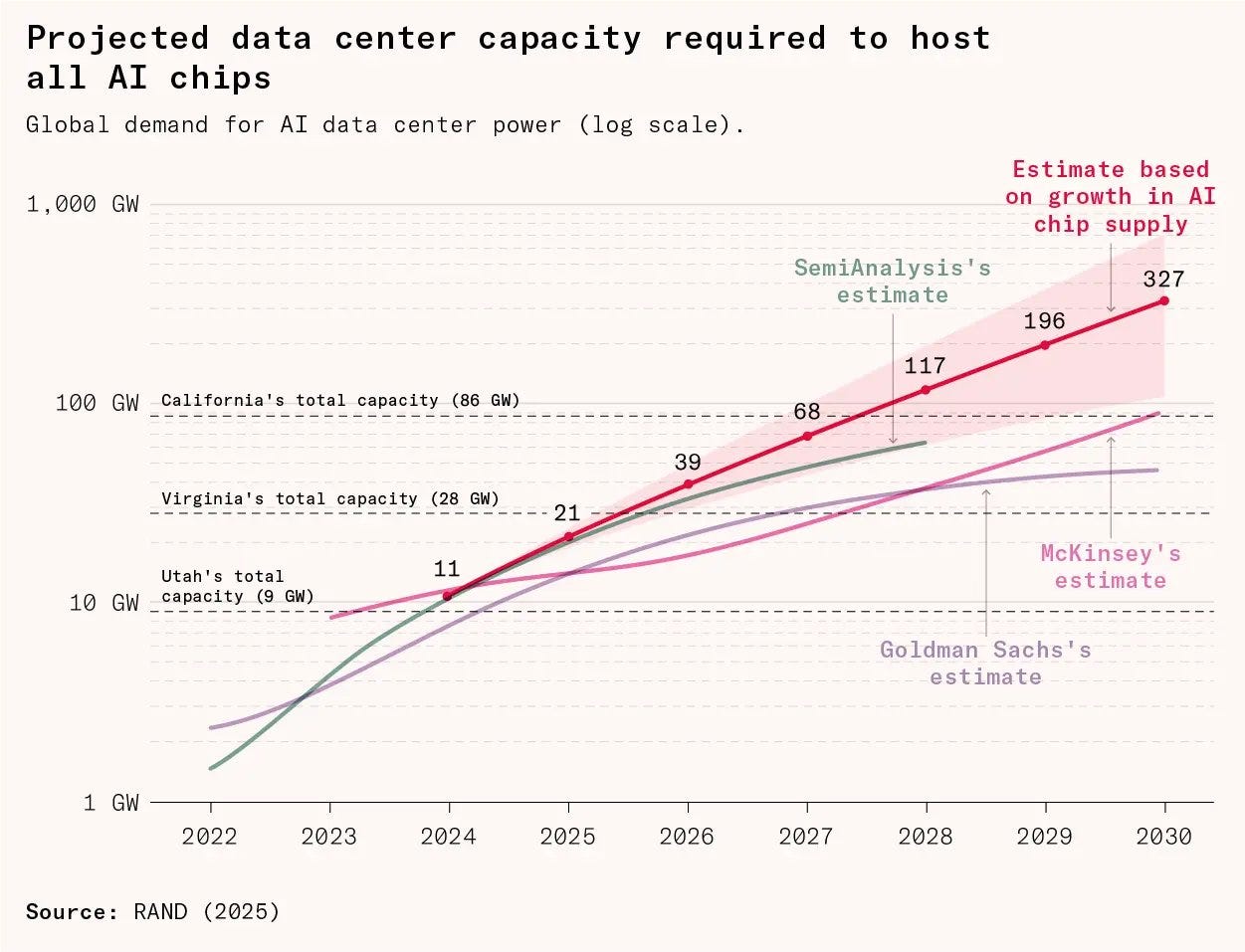
→ Why does it matter? Either we need a lot more data centers, or AI needs to get much more efficient at using the compute we already have.
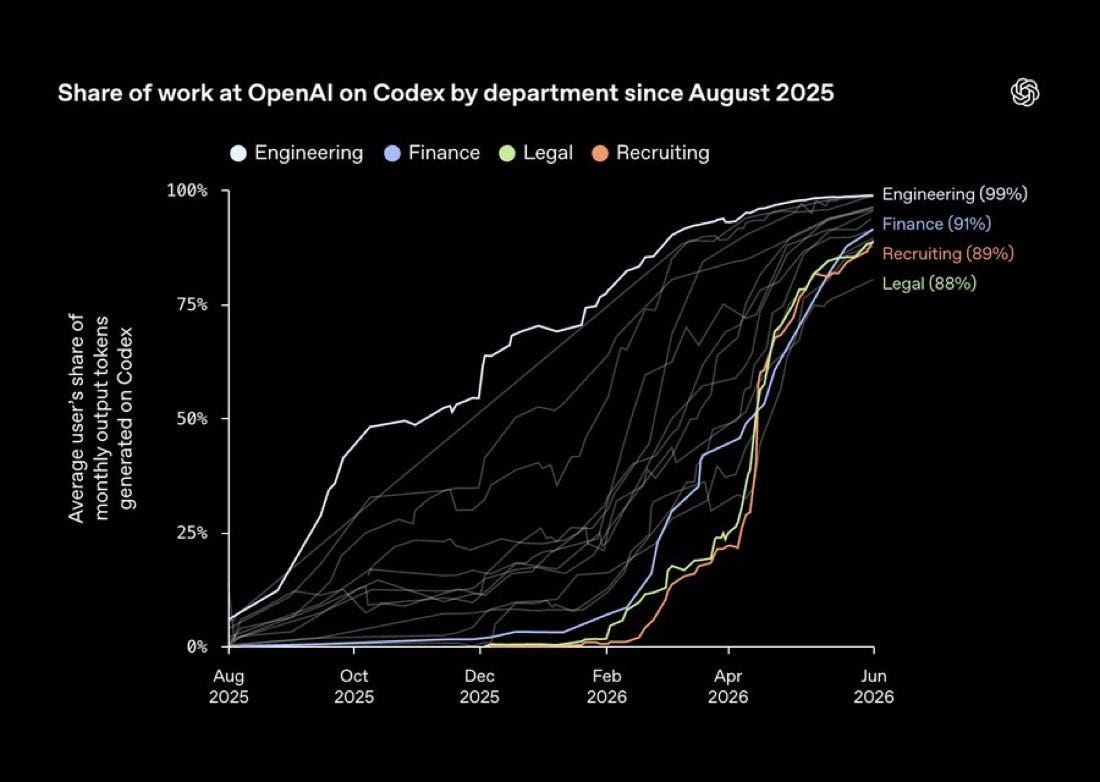
→ Why does it matter? Some interesting reporting from OpenAI on how Codex is spreading beyond software engineering. Coding was the first killer use case, but the usage pattern is broadening: Legal, Finance, and Recruiting accounted for the majority of Codex usage around April 2026, and non-developer usage has grown faster than developer usage among individual, organizational, and internal OpenAI users. The next wave of agentic work may start with code, but it will not stay there.

Tweets that stopped my scroll:

→ Why does it matter? Now you can tag Claude directly inside Slack and bring AI into the work already happening. It can read the conversation, use the context, remember your instructions, and take action with the data it can access. It starts to feel less like a tool you open and more like another person helping the team.

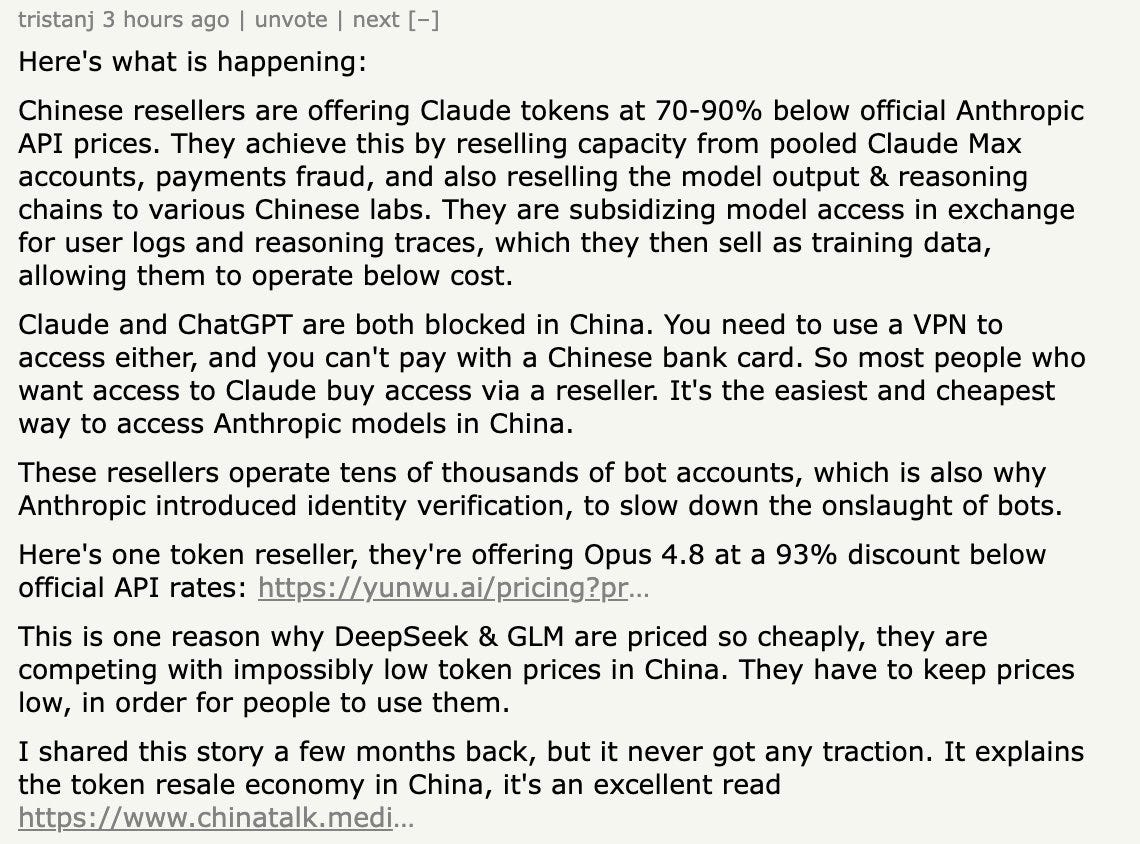
→ Why does it matter? I remember visiting Beijing about ten years ago and stumbling across a street vendor selling software. At the time, IBM had a multi-billion-dollar software business, and one of its middleware products could sell for millions of dollars per year. The vendor had a hard drive with the source code for $30. Different technology, same story: American companies spend years and billions building valuable software, and China finds ways to copy it. More here. 👇
Worth a watch or listen at 1x:
→ Why does it matter? "To me, a model is like the database market." - Satya Nadella. Applied Computer is helping companies do that. We’re seeing early attempts with Cursor Composer and Harvey. How many models should there be? Companies should be able to embed their proprietary knowledge inside models they control.
→ Why does it matter? Nikesh Arora is the Chairman and CEO of Palo Alto Networks. Tons in here on AI inside the enterprise, including Mythos as an accelerant in cybersecurity, falling token costs, memory as the moat, and why AI in cyber creates a different set of stakes than consumer AI.

Quotes & eyewash:
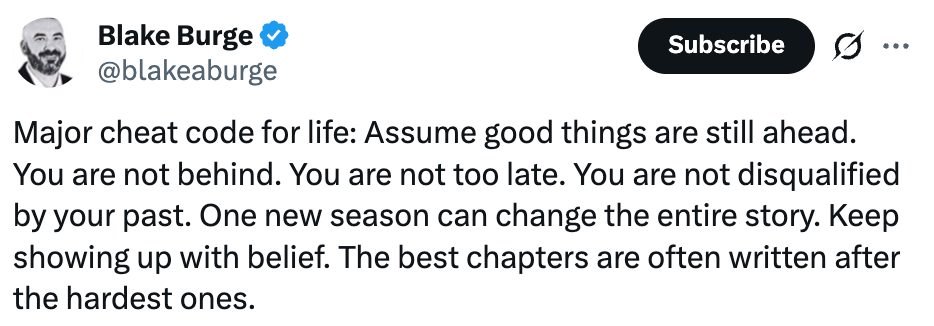
→ Why does it matter? The journey is the reward!
The mission:
The Wall Street Journal once used “Read Ambitiously” as a slogan, but I took it as a personal challenge. Our mission is to give you a point of view in a noisy, changing world. To unpack big ideas that sharpen your edge and show why they matter. To fit ambition-sized insight into your busy life and channel the zeitgeist into the stories and signals that fuel your next move. Above all, we aim to give you power, the kind that comes from having the words, insight, and legitimacy to lead with confidence. Together, we read to grow, keep learning, and refine our lens to spot the best opportunities. As Jamie Dimon says, “Great leaders are readers.”
Disclaimer: This content is for informational purposes only and does not constitute financial, investment, or legal advice. Readers should do their own research and consult with a qualified professional before making any decisions.
This is a fantastic historical perspective! We have been schooled to over explain and over plan. While the 2 are very important we forget the power of chaos. Many mistakingly equate chaos with disorder. Life emerged thanks to chaos whereby small deviations or events get amplified to change the course of history, like the fog over the east river, or the clouds over the english channel during the siege of Dunkirk.
One of the most powerful inventions of biology is it gave the means of production to all organisms no matter the size or cell count. This created many niches of innovation that resulted in explosions of biodiversity. I think advances in technology are doing just the same. The open source movement made software accessible to many, the web opened up distribution, and AI in unleashing creation. What is unique about today's AI revolution is that it removed the technical barriers to entry. Almost any one can build software products, make movies, write novels, etc. without having the technical skills to do either. So the next time there is a crisis or opportunity, and it happens to be on a "cloudy day", someone, somewhere will build something that will change the course of history.