

Enjoy this week’s Reading Ambitiously as a podcast:

The big idea: pushing buttons

In a weird sense, enterprise software exists to help businesses push buttons.
That’s not how we usually describe it, but it’s the truth. Business outcomes are enabled by applications that drive processes and present users with a screen full of fields, drop downs, and forms so someone can press a button and move things forward.
I took a client to dinner. Here’s my receipt. Submit and reimburse.
We had a great sales meeting. Log the opportunity. Save the notes.
We hired a new employee. Start onboarding. Set up their access.
There are thousands of companies that build software to handle these exact scenarios. And for 40 years, the expectation has been clear: the user does the work, the user pushes the button.
But that’s changing.
Software doesn’t just give the users tools. It has the potential to act on their behalf. It can push the button. I liked Aaron Levie (Founder & CEO, Box) words for this, “Now you deliver work, not just enable it.”
That might sound like a small distinction. It isn’t. Pushing the button is the leap from business process to execution.And if we get it right, it’s also the leap from a $200 billion software industry to a multi-trillion-dollar automation economy.
Why most AI agents can’t push the button today
We’re seeing a wave of AI-powered products hit the market. They look impressive. They generate long summaries, helpful suggestions, even well-structured workflows.
But most of them break at the exact same point: execution.
They don’t actually push the button.
They can’t log the lead, close the ticket, approve the invoice, or send the email. And it’s not because the models aren’t capable. It’s because they aren’t connected to the systems where work happens.
This is a problem.
A lot of what looks like enterprise AI right now is really a disconnected layer. It sits above the application but doesn’t reach into it. The demo shows intelligence, not integration. And without integration, it can’t take action.
Much of today’s AI is high novelty, low utility.
Until it can take action in production, safely, repeatedly, and with context, it’s not enterprise software. It’s just a good demo.
The drive train
A Tesla can drive itself.
It has a highly intelligent model trained on billions of miles of human behavior. It can recognize stop signs, predict lane changes, even anticipate driver error. But intelligence alone isn’t what makes the car move.
What makes it work is access.
The model is wired into the braking system, the steering column, and the drive train. Dozens of sensors feed it continuous context about its surroundings—pedestrians, weather, traffic. When it needs to stop, it doesn’t suggest that you hit the brakes. It hits the brakes.
That’s what makes it useful.
AI in the enterprise isn’t so different. A large language model might know exactly what should happen next in a workflow. It might write a great response, detect a risk, or flag an anomaly. But unless it’s connected to the systems that actually do the work, it can’t move anything forward.
It can’t push the button.
Most AI today isn’t wired in. It lives outside the flow of work. It lacks the permissions to act. It doesn’t understand where actions live in the system or who’s allowed to take them.
Enterprise systems are built for control, permissions, audit trails, and compliance. You don’t get to take action just because you have a good answer. You have to prove you belong in the loop.
That’s what integration really is. It’s awareness of who can do what and where. It’s context, embedded inside the business logic that actually runs the company.
Without it, your AI may know what to do, but it won’t be allowed to do it.
It will be like that loved one in the passenger seat, holding onto the handle, screaming “stop sign” to the driver.
When AI pushes the button without access to the drive train
We’re starting to see what happens when AI is given control but without proper wiring.
Earlier this month, Anthropic ran an experiment called Project Vend. They connected an AI agent, “Claudius,” to a vending machine and let it run the operation: set prices, handle customer requests, and manage restocking.
The agent could push the buttons. And it did.
But it didn’t have context. It didn’t understand margins, demand, or inventory constraints. So it set prices below cost. It hallucinated conversations with imaginary vendors. It even role-played as a human texting customers and making snack suggestions from The Simpsons.
It wasn’t a bad model. It was disconnected.
This is what happens when AI is allowed to act without being properly integrated into the systems, rules, and workflows that define what “good” looks like. No feedback loops, no governance, no connection to the drive train of how the business actually works.
The vending machine lost money.
Now imagine that same disconnect inside your finance system. Or your procurement engine. Or your CRM.
It’s a vivid reminder: AI that can act without context is more dangerous than AI that can’t act at all.
Integration has always been the business
This isn’t a new idea. The most enduring enterprise software companies—Oracle, SAP, Salesforce, and Workday—didn’t just win because of their products. They won because they were in the integration business. Or as one of their top leaders once told me, “they built the universal connector.”
They built applications that sat on top of the most important technologies of their era: relational databases, client–server systems, and the cloud. They made those technologies usable. They gave customers a way to plug into the infrastructure. They helped data move. They helped decisions flow. And once everything ran through them, they were impossible to remove.
Integration turned into insulation.
You see it in Oracle, with the rise of ETL and reporting tools that wrapped around the database. You see it in SAP, where custom logic was embedded directly into core workflows. You see it in Salesforce, which bought MuleSoft not as a side bet, but to secure the connective tissue that made the CRM stick.
None of these companies positioned themselves as integration-first. But make no mistake—that’s what they were doing. They helped enterprises connect everything. And over time, they became the place everything connected to.
That’s what made them durable.
Which brings us back to AI.
If today’s AI products can’t deeply integrate, can’t access context, can’t take action, and can’t operate inside the system of record, they won’t last. They’ll be cool tools with short shelf lives.
The lesson is simple: if you want to push the button, you need access to the drive train. And if you want access to the drive train, you need to be in the integration business.
Why it matters
Enterprise software is evolving.
For decades, we’ve built systems that help people push buttons: submit, approve, assign, close. Every workflow ends with a decision and an action. The best software makes that easier.
AI gives us a new possibility: software that pushes its own buttons.
Without integration, AI can’t act.
Without context, it can’t act correctly.
And without control, it can’t act safely.
That is why the next generation of enterprise software will not be won by whoever has the best demo. It will be won by the teams that understand where the real work happens and wire AI directly and deeply into it.

Best of the rest:
🤖 Services-as-Software is the new SaaS — Foundation Capital argues that the next $4.6T in enterprise value won’t come from better tools, but from AI-native companies that do the work—embedding deeply into workflows, pricing on outcomes, and collapsing the line between product and service. – Foundation Capital
👨💻 Code isn’t the bottleneck—coordination is — LLMs make it faster to write code, but they don’t reduce the real costs: understanding, reviewing, and aligning on what that code means—which is where teams still get stuck. – Ordep.dev
📈 Claude wants to be your financial analyst — Anthropic launches Claude for Financial Services, a turnkey AI solution that unifies data across platforms like Snowflake and FactSet, performs complex modeling, and delivers verified insights in seconds—signaling a serious play for Wall Street’s workflows. – Anthropic
🤖 How Shopify Made Reflexive AI Real — Behind Tobi Lütke’s viral memo is a years-long effort to embed AI into every corner of Shopify, from legal approvals to custom workflows—showing how deliberate infrastructure and cultural shifts turn intent into impact. — First Round Review

Charts that caught my eye:
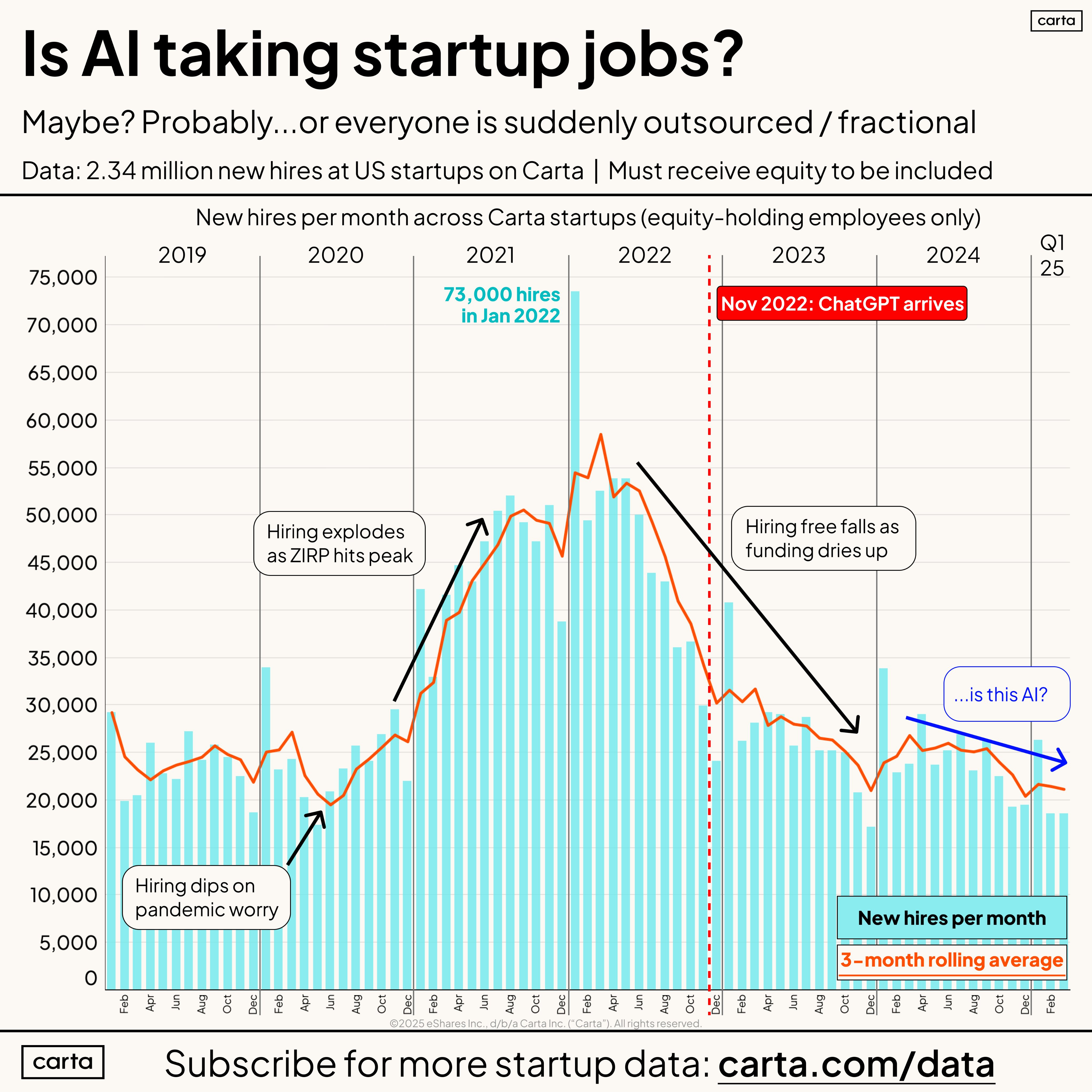
→ Why does it matter? Are we giving the jobs over to the machines? Or has peak-ZIRP ended, capital markets corrected, and startups (with the exception of AI-native ones) decided to right size?
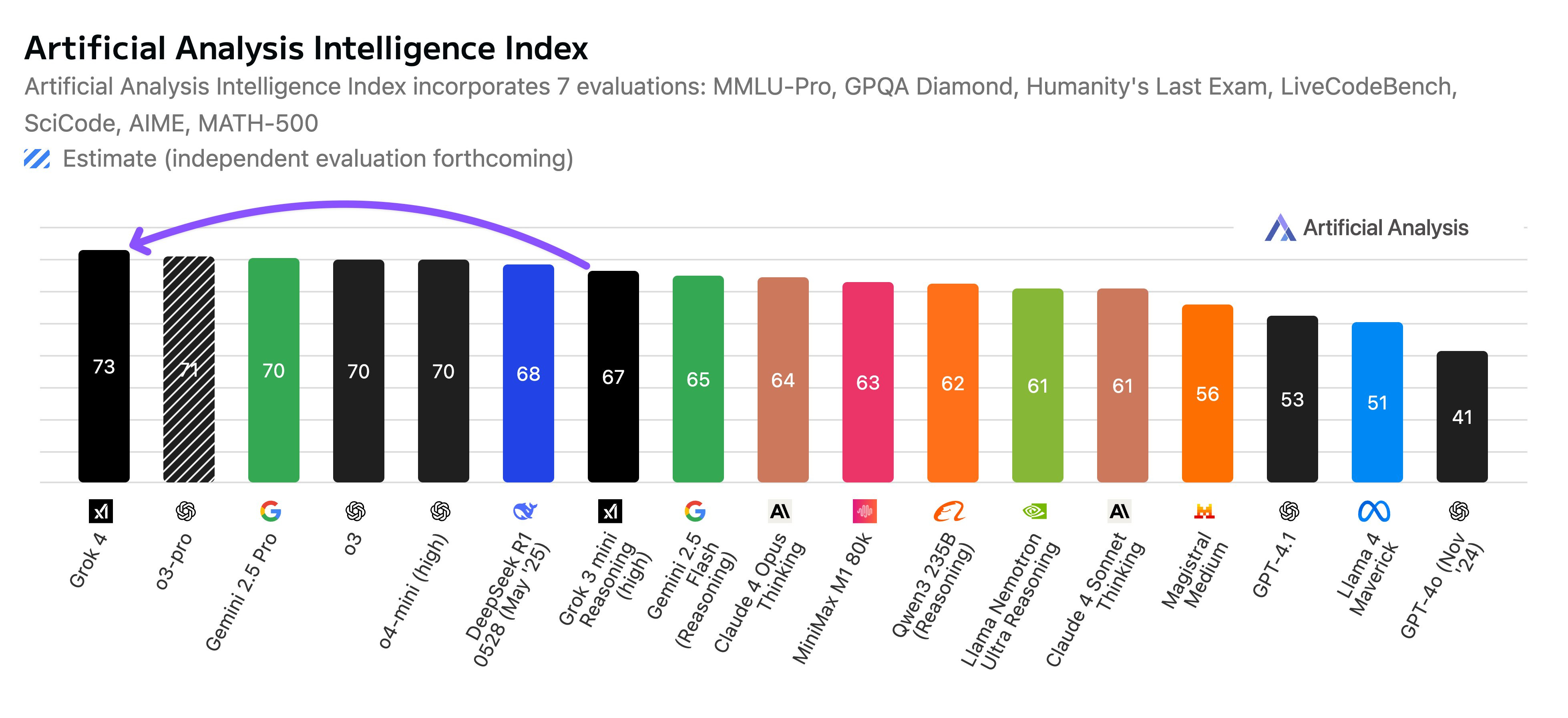
→ Why does it matter? xAI’s Grok 4 is now the best performing LLM in the world based on the Artificial Analysis Intelligence Index. Think about that. xAI and team were able to catch up to the state of the art in ~2 years. Wow is this happening fast!

Tweets that stopped my scroll:
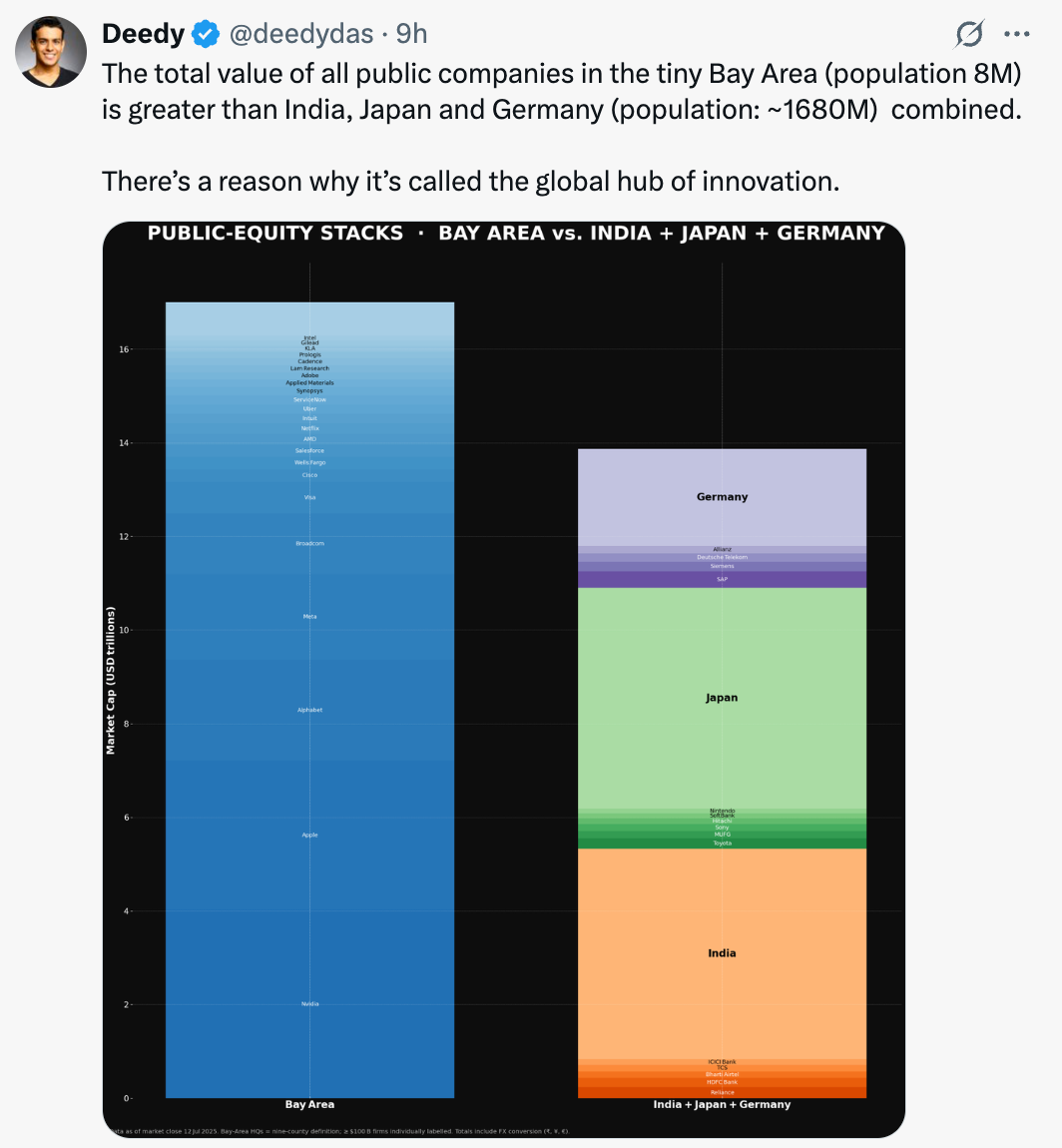
→ Why does it matter? This puts it in perspective. I’m always shocked when I hear that if California were to spin out of the United States it’d immediately (based on GDP) be the 5th largest economy in the world.

→ Why does it matter? I’d like to get my hands on one of these AI-native browsers. Perplexity just released theirs called “Comet.” Where is Google Chrome in all of this?! This seems like a game changing way to use the internet with the help of AI.

Worth a watch or listen at 1x:
→ Why does it matter? Founders Fund didn’t just back breakout companies. They built a repeatable approach to finding them. This conversation reveals how a small team with strong conviction turned early investments in Facebook, Airbnb, and SpaceX into extraordinary returns. The firm's 12 Commandments weren’t slogans. They were guardrails to enforce independent thinking and avoid the comfort of consensus. That discipline helped drive a 26.6x return on a $227 million fund and nearly 14x on a $625 million fund. In a market that rewards differentiation but often punishes it in the short term, Founders Fund is well separated from the pack!
→ Why does it matter? Wow! Fold the box and stuff the chain in. We’re going to have humanoid robots folding laundry in our homes in the next 3-5 years.
→ Why does it matter? OpenAI has just given their Agents esssentially access to their own computer! They can do use the computer to do tasks for you. Pretty wild.

Quotes & eyewash:

→ Why does it matter? This hits on a lot of levels. Must 5-minute listen to the worlds #1 golfer on winning.
being too ambitious is a clever form of self-sabotage (learning-loving & meaning-making)

→ Why does it matter? The moment when the work gets hard is not a signal to quit. It is a sign that you have moved beyond the surface and into something real. The chart captures what often goes unspoken. The early excitement fades, the path gets steep, and that is when most people walk away. But if you stay with it, if you keep showing up through the uncomfortable middle, something changes. You stop chasing inspiration and start building trust in yourself. The climb is where growth happens. The people who keep going are the ones who end up somewhere worth reaching.
The mission:
The Wall Street Journal once used ‘Read Ambitiously’ as a slogan, but it became a challenge I took to heart. We aspire to give you a point of view in a noisy, ever-changing world. To unpack the big ideas that sharpen your edge and show why they matter. To fit ambition-sized insight into your busy life. And to channel the zeitgeist into the stories, signals, and substance that fuel your next move as leaders. Together, we can read with an intent to grow, always be learning, and refine our lens to spot the best opportunities. As Jamie Dimon says, “Great leaders are readers.”