



The big idea: Context, Control, Cost & Choice
Reading time: 8 minutes

I do not have a precise way to measure overall AI adoption. But based on a deeply unscientific study of my own conversations, many companies are in a similar place. “Can we use ChatGPT at work?” The answer is increasingly “yes,” though for many that has meant Microsoft Copilot, a first wave of vendor AI features turned on in a limited way, and coding tools such as Claude Code or Cursor in pockets of engineering.
Some companies have not yet touched AI. Others were born AI-native and use it reflexively. Most enterprises I speak with are somewhere in the middle: they have achieved initial access.
People are using the tools, building intuition, and hitting their first “aha” moments. Now comes the next chapter: moving from experimentation into deployment.
And deployment requires more than a model. It requires an application layer. We have written a lot this year about the emerging AI application architecture. The model is only one part of it.
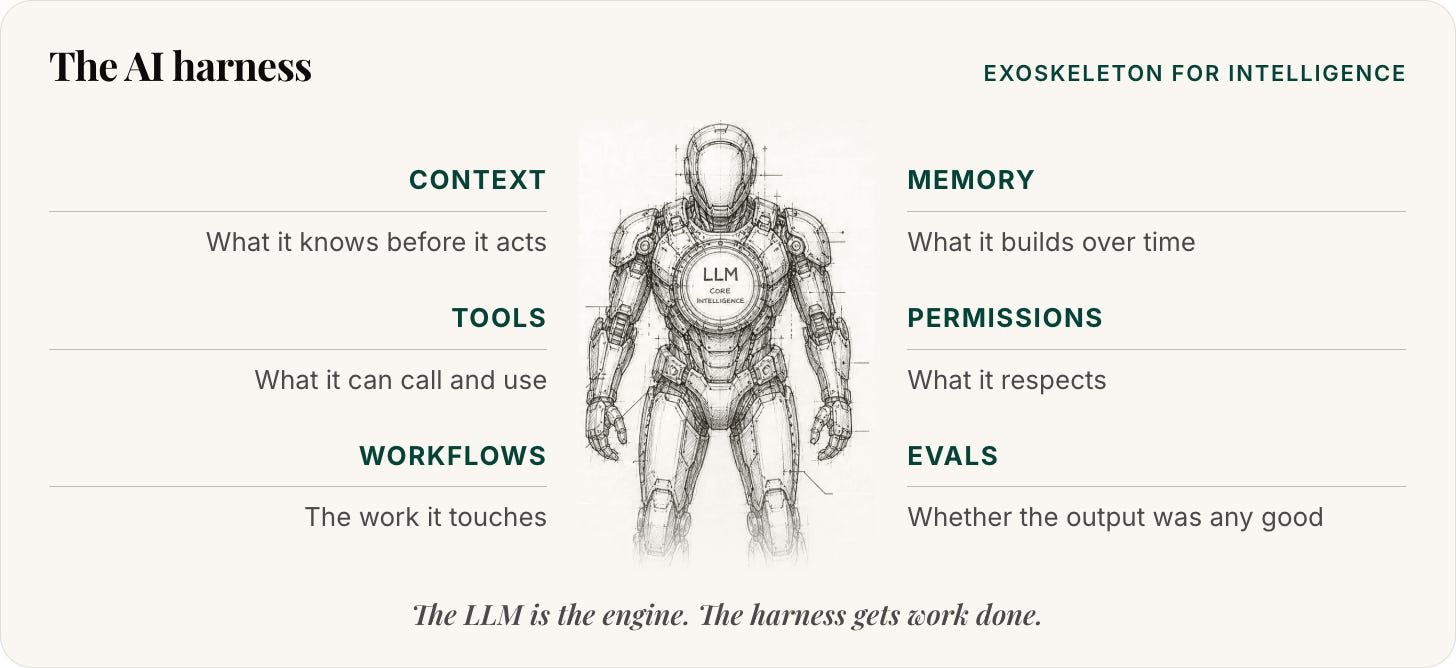
Traditional software waits for us to click the buttons. This new software can click its own: it reasons across systems, takes action, learns from outcomes, and will eventually help run parts of the enterprise.
Now the questions get bigger. “Which tool should we use?” gives way to “How does this system learn from our business, and who owns what it learns?”
AI creates a new loop between people and digital systems.

That loop can become a new source of advantage. But only if the company can govern it, afford it, and own it across models and vendors.
Leaders need a framework for those choices.
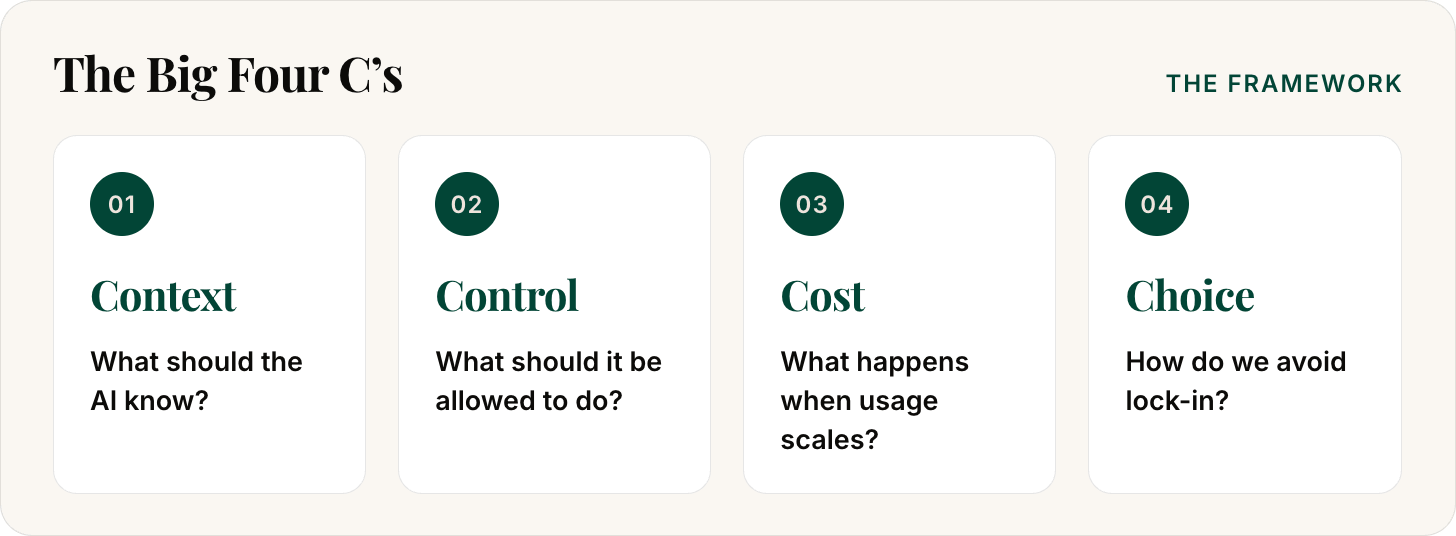
Context: What should the AI know?
The models are getting pretty smart, especially on general knowledge. The business is another matter.
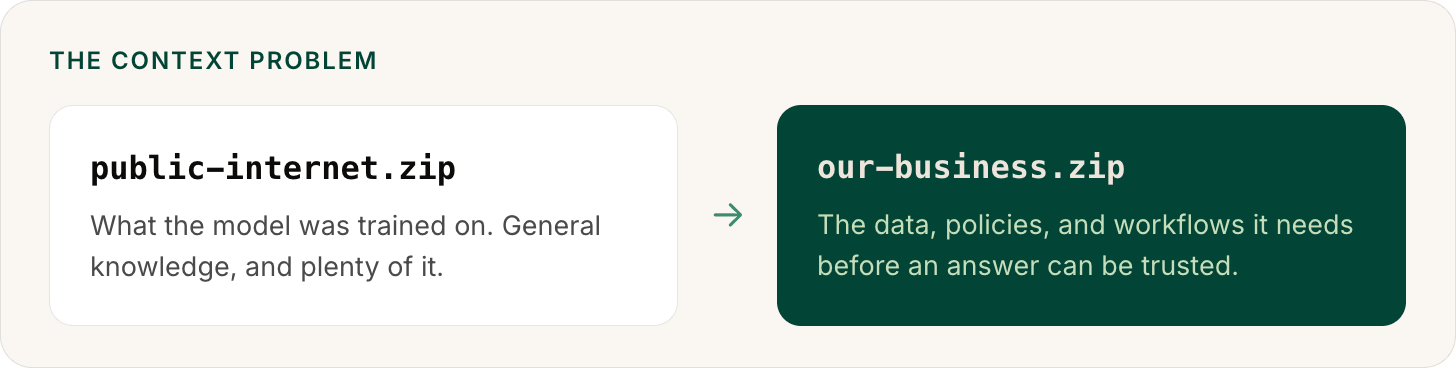
What information does the AI need to do useful work inside the business? Which data matters? Which systems should it pull from?
Many AI projects sit here today. The data lives in different systems. The process depends on tribal knowledge. The output is only useful if it reflects the company's specific facts and rules. That will take work.
Harvey is a good example. In a recent interview, CEO Winston Weinberg said the company has more than 200 lawyers on staff. Only a small portion are doing traditional legal work. Many are helping build product, support go-to-market, and translate legal expertise into the system itself.
Putting a lawyer costume on a general model does not get us legal AI. Harvey has to build around it: legal workflows, task-specific datasets, evals, and human expertise that reflects how lawyers actually work. The context is the product.
The learning loop begins here, too. The work is turning domain knowledge and past outcomes into something the system can use. Not once. Continuously.
Control: What should the AI be allowed to do?
Once the model has context, the next question is control. What should it be allowed to see? Who is accountable when the system takes action?
A chatbot that drafts an email is one thing. An AI system that reads customer data, updates records, generates recommendations, triggers workflows, or touches regulated information is another.
Control is also about ownership. Suppose the application layer contains the logic of how our business works, then it is more than plumbing. It may contain some of the most valuable knowledge in the company: how we serve customers, build product, manage risk, and make money. The means of production. And it cannot be treated casually.
This is the risk at the application layer. The frontier labs need to move closer to the work to capture more value. Enterprises need them closer to the work to generate more value. Both are true. But the closer AI gets to the work, the more important it becomes to know who controls the context, the workflow, and the learning. Use case matters here. Are we automating an internal operational task, or putting AI closer to how the business creates alpha? Those decisions require different levels of control.
Anthropic has already launched applications in multiple areas, including coding, life sciences, design, and legal. The frontier labs know that value will not live only in the model layer. It will move upward into the applications where real work gets done. But the best training data for those domains is not sitting neatly on the public internet. It is inside the leading companies in those fields. That is where the tension begins.
Every company wants better AI. But no serious company wants to hand over the knowledge that makes it valuable without understanding who owns the learning that comes back.
Tim Ferriss recently published the run rates for his own catalog.
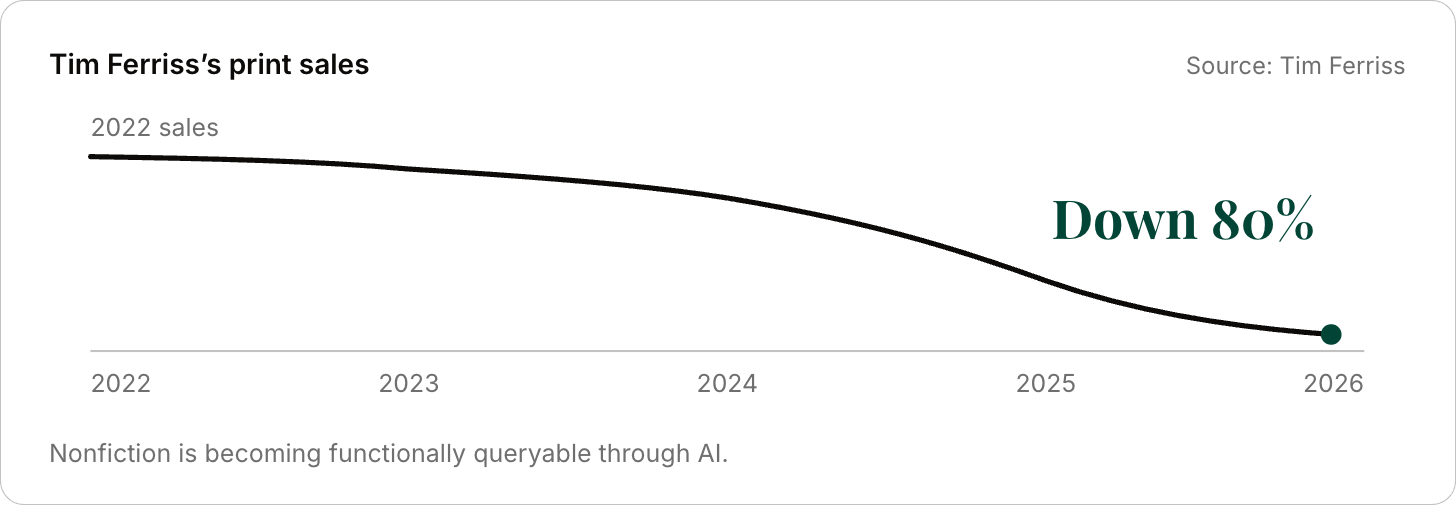
There are caveats, of course. But the broader point is hard to ignore. If AI can absorb and repackage the knowledge of individual creators, enterprises will ask whether the same thing can happen to them. They will not tolerate it. Especially if the knowledge being absorbed is part of how they generate economic value.
The reward for getting control right is trust. And trust is what lets AI work where the stakes are highest.
Cost: What happens when usage scales?
Software buyers are used to paying for seats. AI introduces a different cost structure. The more context we give the model, and the more work it performs, the more tokens it consumes. And as AI begins searching across systems, calling tools, and repeating tasks, usage can compound quickly.
Understanding what different kinds of work cost will become critical. Which tasks deserve the best model? Which can run on a cheaper one? When should the system stop so that the cost of the answer does not exceed the value of the output?
Not every task needs frontier intelligence. We would not use Anthropic Fable to parse a basic PDF. Near-identical output can be achieved at 0.2% of the cost. At current rates, parsing a basic three-page PDF with Anthropic’s Fable would cost roughly 12 cents. That sounds trivial until we scale it.
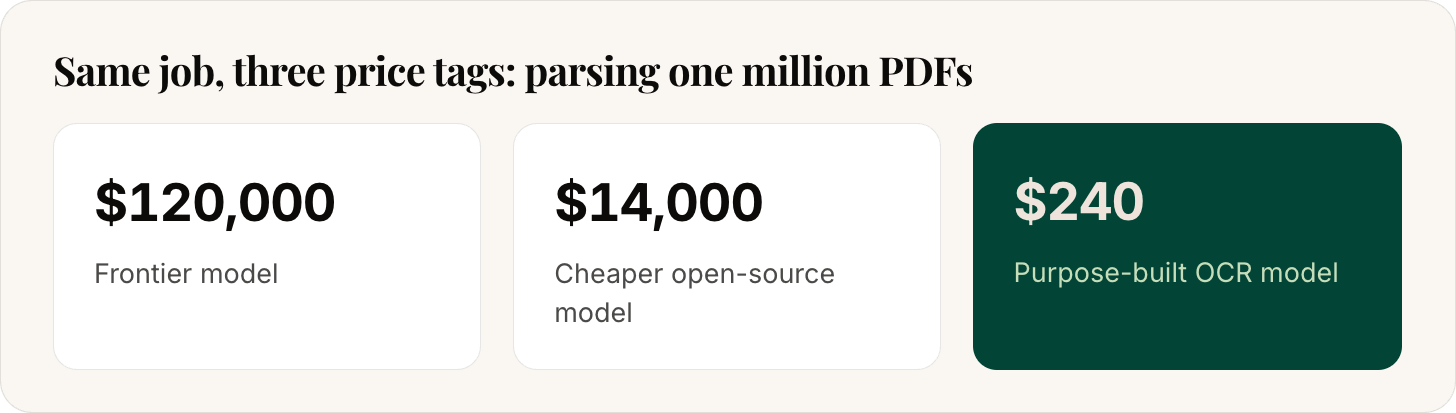
That is the “wow” buried inside token pricing. The expensive model may be brilliant. But if the job is reading and structuring a PDF, we may be using a Ferrari to deliver the mail.
Enterprises will need help routing the right tasks to the right models at the best price. Depending on the job, the models could be cloud-based or local, open or closed, large or small. A whole industry will spring up around routing, observability, and spend management.
Cost will not stop enterprise AI. But unmanaged cost will shape how quickly it moves from experiment to deployment.
Choice: How do we avoid lock-in?
We have built our learning loop. Now comes the next question. If a better model ships tomorrow, can the company retain what it has learned and adopt it without having to rebuild from scratch? If the vendor changes direction, can the business keep moving?
This will depend a lot on the situation. But let’s assume it matters. Let’s assume AI is touching the company’s means of production.
If our AI system gets smarter over time but all of that learning lives elsewhere, we have not built an asset. We have rented one. Getting stuck with a vendor is the familiar version of lock-in. The version that matters is the one where the vendor owns the learning loop.
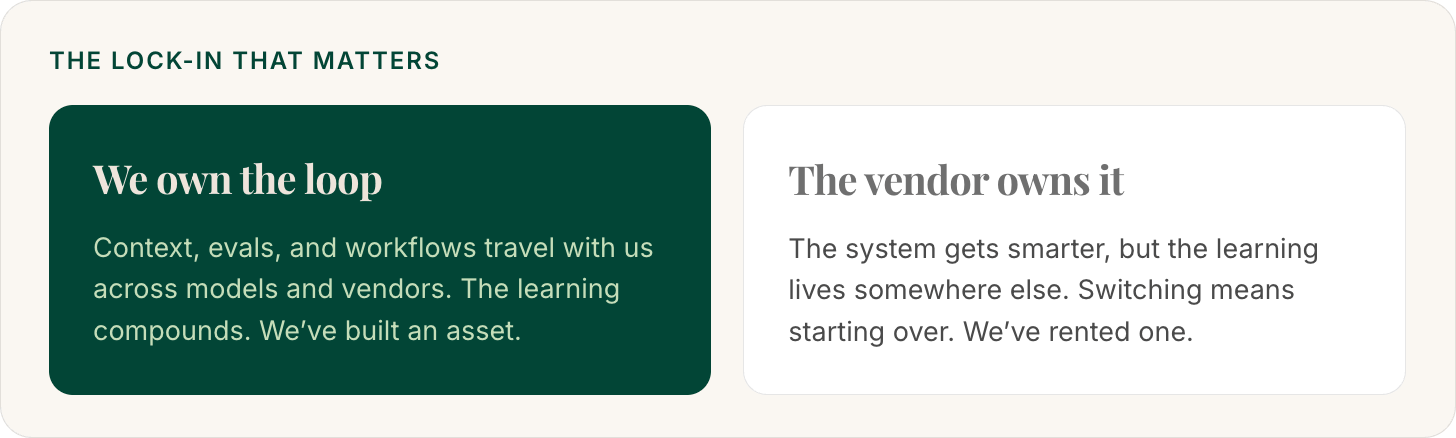
A world where a small number of model providers absorb the expertise of every company in every industry will not be a stable equilibrium. Companies need AI systems that amplify their people, capture their learning, and compound their institutional knowledge over time.
The open source conversation will get louder. Few companies should run their own models, and open and closed will coexist; they probably need to. The point is leverage: model choice, and the ability to preserve the context, evals, and workflows that make the system valuable in the first place.
When a paradigm shift emerges, the best platforms enable more value on top than they capture inside. That was true in personal computing: Microsoft captured enormous value, but a far larger software business grew up around the platform. That is the balance we should want in AI: frontier models keep improving, while every company can build, differentiate, and create value on top of them.
Why it matters
Now it is time to deploy. The application architecture is emerging. The economics are becoming better understood. Many enterprises are ready to move from prototype to production and start building their learning loops.
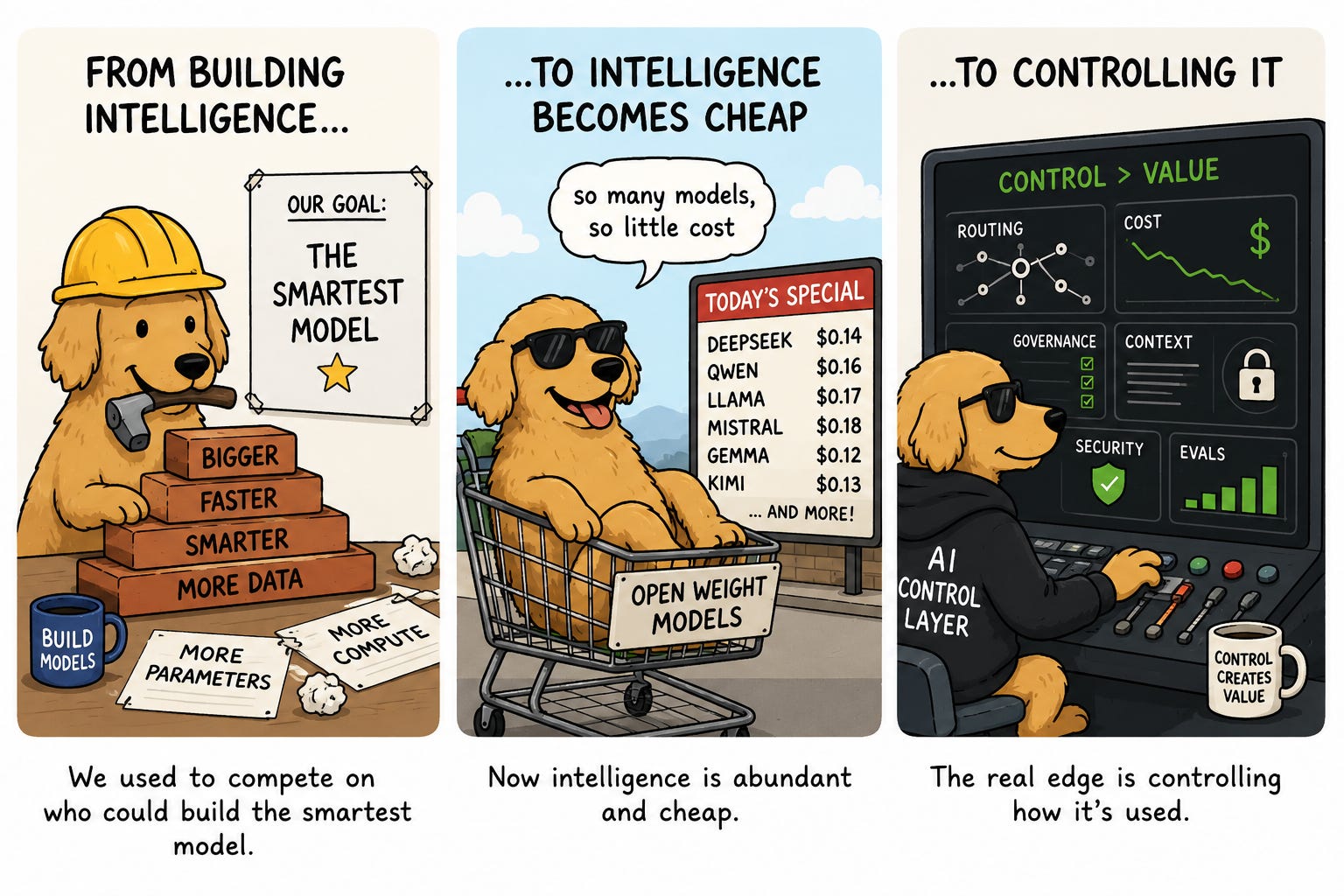
It is a moment to make some important decisions. The next phase of enterprise AI will be defined less by who has the best model and more by which companies can provide AI with the right context, maintain control, manage costs, and preserve choice.

Best of the rest:
🤝 OpenAI proposes handing Trump administration 5% stake – OpenAI’s floated public-ownership plan shows how the politics of AI are shifting from safety and regulation to who gets to capture the economic upside of frontier models. – Financial Times
🎨 Defining Taste – Mitchell Hashimoto argues that as AI makes production abundant, taste becomes the scarcer advantage: the human ability to know what is worth making before everyone else starts copying it. – Mitchell Hashimoto on X
🧶 Brunello Cucinelli — Om Malik’s interview with the “king of cashmere” is really a meditation on humanistic capitalism, arguing that dignity, craftsmanship, restraint, and long-term thinking can be business principles, not branding copy. — Om Malik
🗣️ Introducing GPT-Live – OpenAI’s new full-duplex voice model makes ChatGPT feel less like turn-taking software and more like a real conversational interface, with natural back-and-forth, better listening, and deeper reasoning delegated in the background. – OpenAI

Charts that caught my eye:
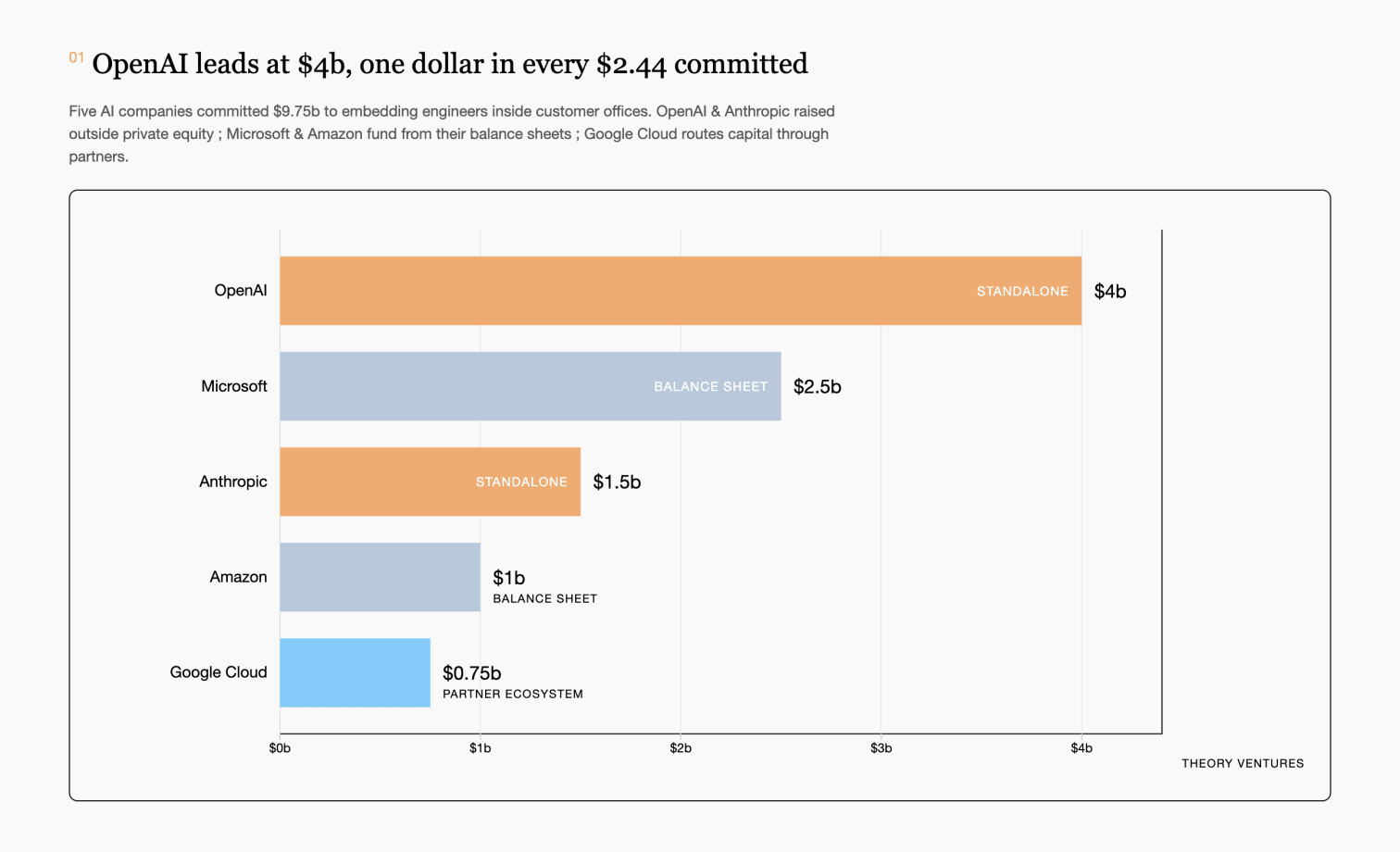
→ Why does it matter? The frontier labs are learning a timeless lesson: the technology does not deploy itself. Somebody has to sit with the customer and help them use it. This will put competitive pressure on existing systems integrators such as Deloitte, Accenture & PWC.
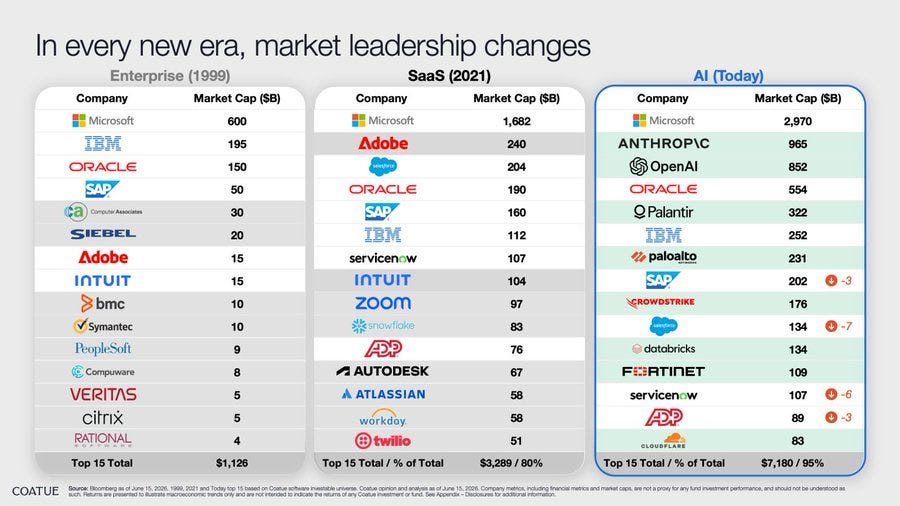
→ Why does it matter? Platform shifts can reshuffle the deck. We also see, for the first time, that some of the world's largest companies are still private.
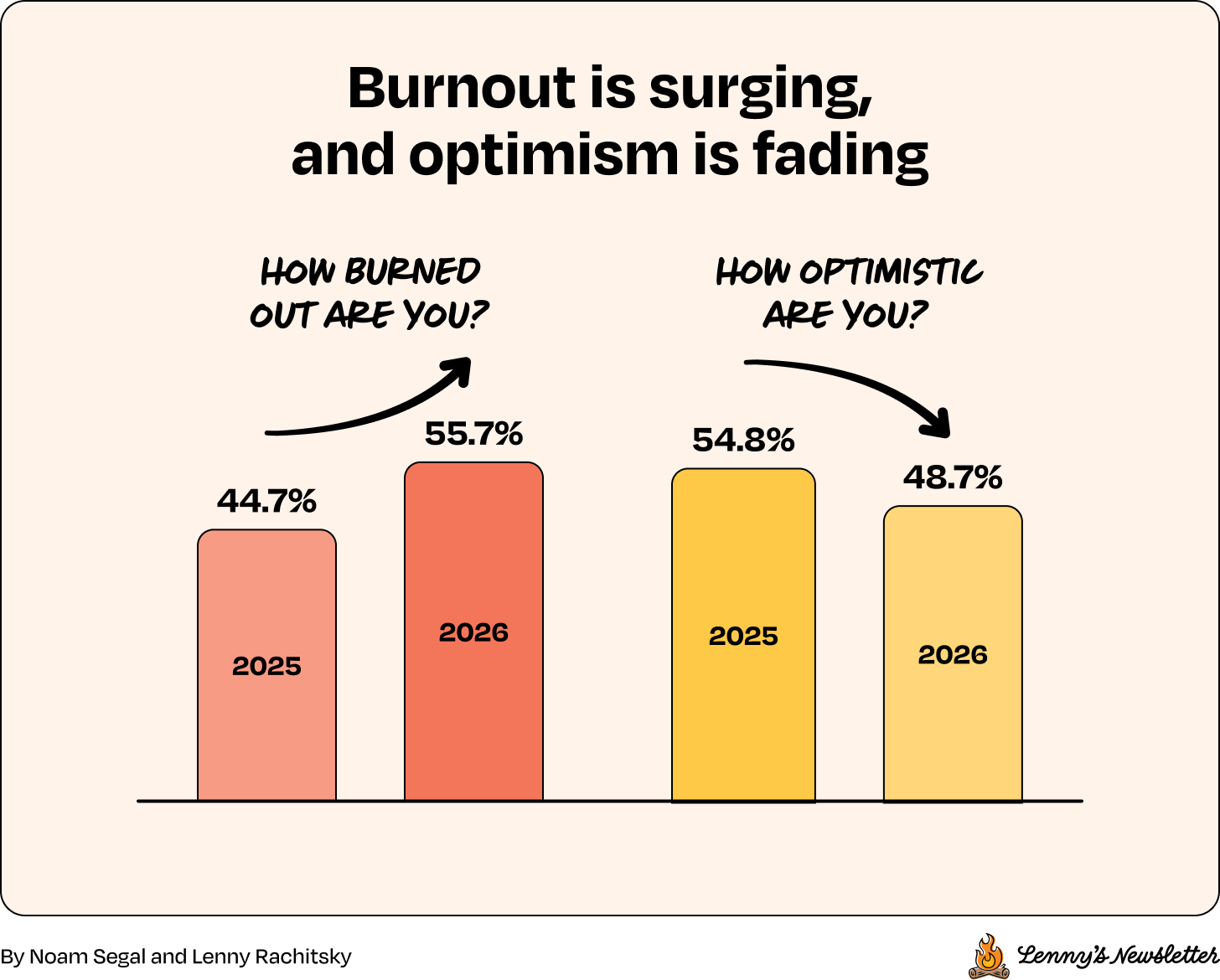
→ Why does it matter? Those who feel destabilized by AI are feeling the least optimistic and the most burned out.
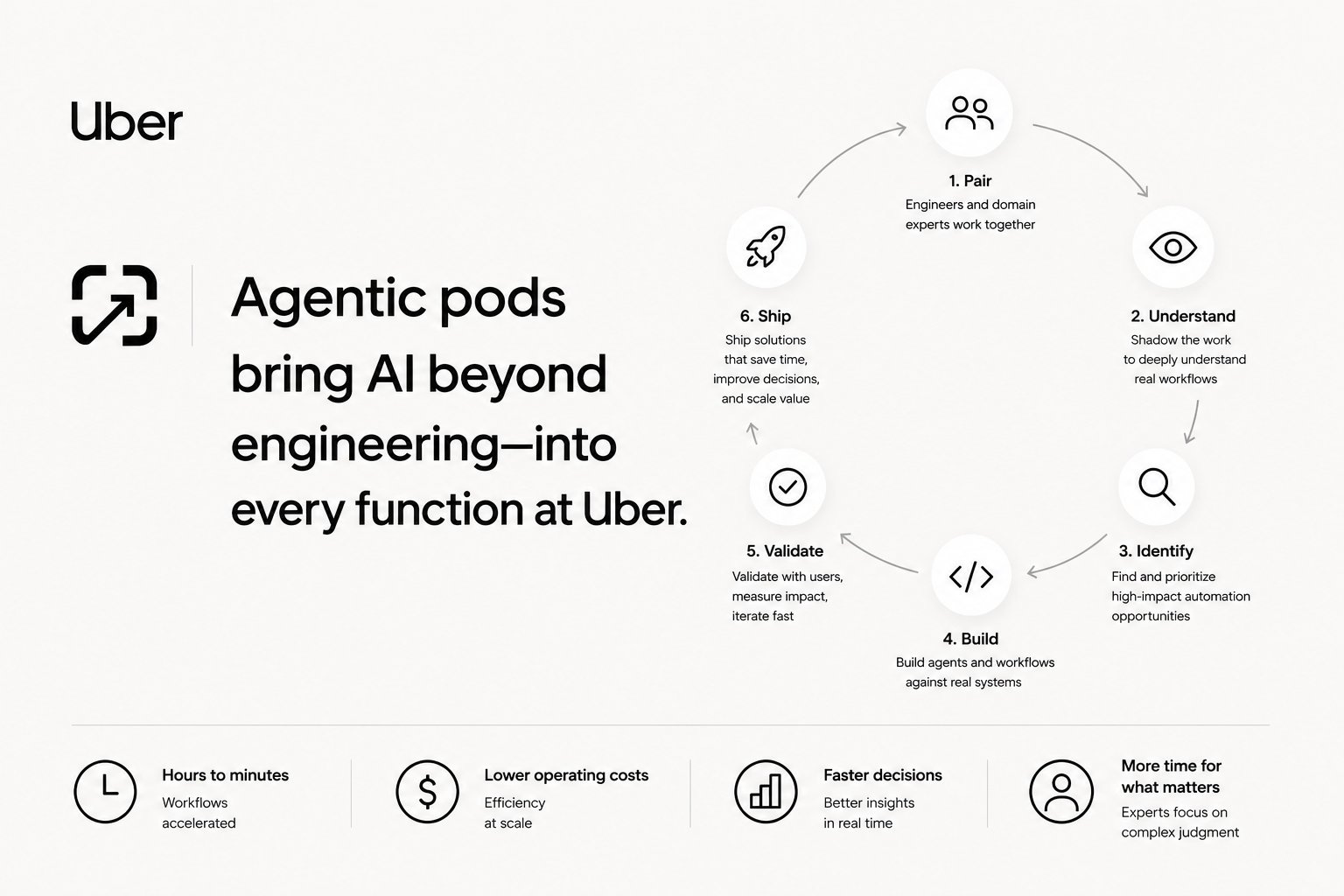
→ Why does it matter? Uber has essentially built out their own FDE team. We saw this earlier this year with Stripe too. A trend to watch.
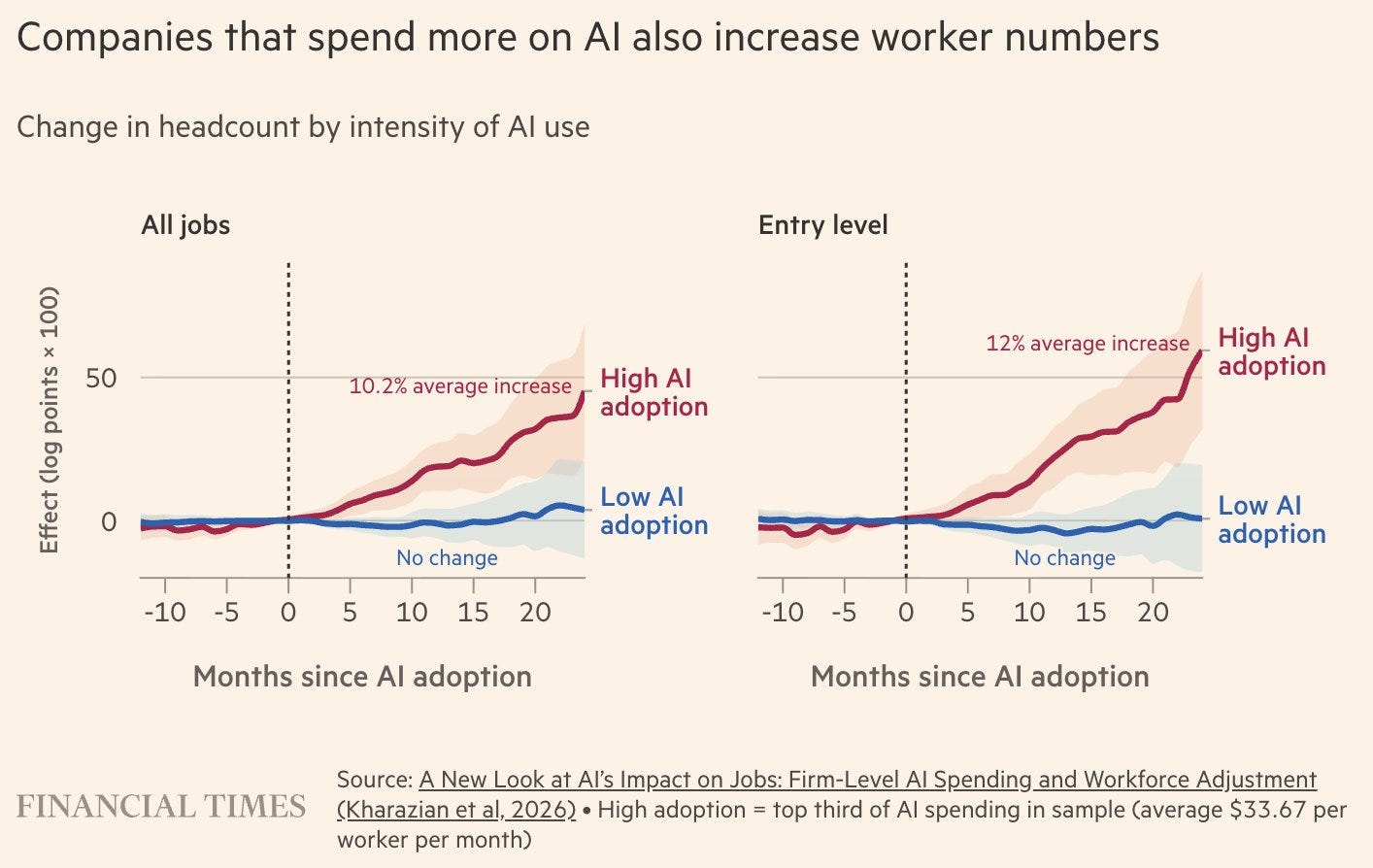
→ Why does it matter? Interesting data from FT here to say that enterprises that use AI are actually creating jobs, not reducing them.

Tweets that stopped my scroll:

→ Why does it matter? Sometimes the future is obvious years before the technology is ready.

→ Why does it matter? Consumer apps learned what we did. Enterprise AI gets powerful when it learns why we decided.

→ Why does it matter? Rent the intelligence, own the context.

→ Why does it matter? Hello, OpenAI’s response to Claude Cowork!
Worth a watch or listen at 1x:
→ Why does it matter? This is a pretty wild short about “J-space,” which Anthropic discovered is how the model “thinks”.
→ Why does it matter? Some great best practices for overall AI adoption here with Anthropic and DoorDash. DoorDash has rolled Claude Code out to every employee.
→ Why does it matter? Better tools can raise our ceiling, but they do not remove the human part. The work still comes back to confidence, attention, and the reps we do when nobody is watching.
→ Why does it matter? Ross thinks AI will call other AI the way software calls servers. If he is right, it’s all about speed! David Senra is on top of his game.

Quotes & eyewash:

→ Why does it matter? Google is undefeated in storytelling!
The mission:
The Wall Street Journal once used “Read Ambitiously” as a slogan, but I took it as a personal challenge. Our mission is to give you a point of view in a noisy, changing world. To unpack big ideas that sharpen your edge and show why they matter. To fit ambition-sized insight into your busy life and channel the zeitgeist into the stories and signals that fuel your next move. Above all, we aim to give you power, the kind that comes from having the words, insight, and legitimacy to lead with confidence. Together, we read to grow, keep learning, and refine our lens to spot the best opportunities. As Jamie Dimon says, “Great leaders are readers.”
Disclaimer: This content is for informational purposes only and does not constitute financial, investment, or legal advice. Readers should do their own research and consult with a qualified professional before making any decisions.
Not this issue but, a month or so ago, you mentioned using AI to find out who to write to and write a letter to your local government about an issue. I wanted to let you know that , remembering that, I just this week did the same thing, with quite good results. Thanks for that idea.