



The big idea: The Finished Product
Reading time: 7 minutes

In 1962, Ross Perot was a 32-year-old salesman at IBM, the world’s most powerful technology company.
He was so good that IBM considered shrinking his territory. Perot offered to take a lower commission rate to keep it. That year, he hit his annual quota in 19 days.
But selling the machines had shown him what IBM was missing. Companies were spending enormous sums to lease mainframes they struggled to use. They still needed someone to write the software, install the system, train their people, and keep everything running. Perot said his customers wanted a “finished product.”
He pitched IBM on providing it. IBM passed.
Perot had a line I love: “Life is never more fun than when you’re the underdog competing against the giants.”
IBM had just volunteered to be the giant.
Perot borrowed $1,000 from his wife Margot’s teaching savings to start Electronic Data Systems. He made 77 sales calls before securing his first customer. EDS grew into one of the era’s largest technology services companies by helping customers deploy technology and realize its value. The gap between technology and business results became Perot’s market.
Fifty-seven years later, several years into my life as an entrepreneur, I began noticing the same pattern. We would set a plan based on the best information we had. The plan moved in a straight line. The work did not.
Sometimes we arrived faster than expected. Sometimes slower. Often, progress was happening before it became visible. New things are simply hard to forecast. Early plans are made before the team has learned what the work will require.
I drew a picture to make sense of it. I called it the Graph of Misaligned Expectations.
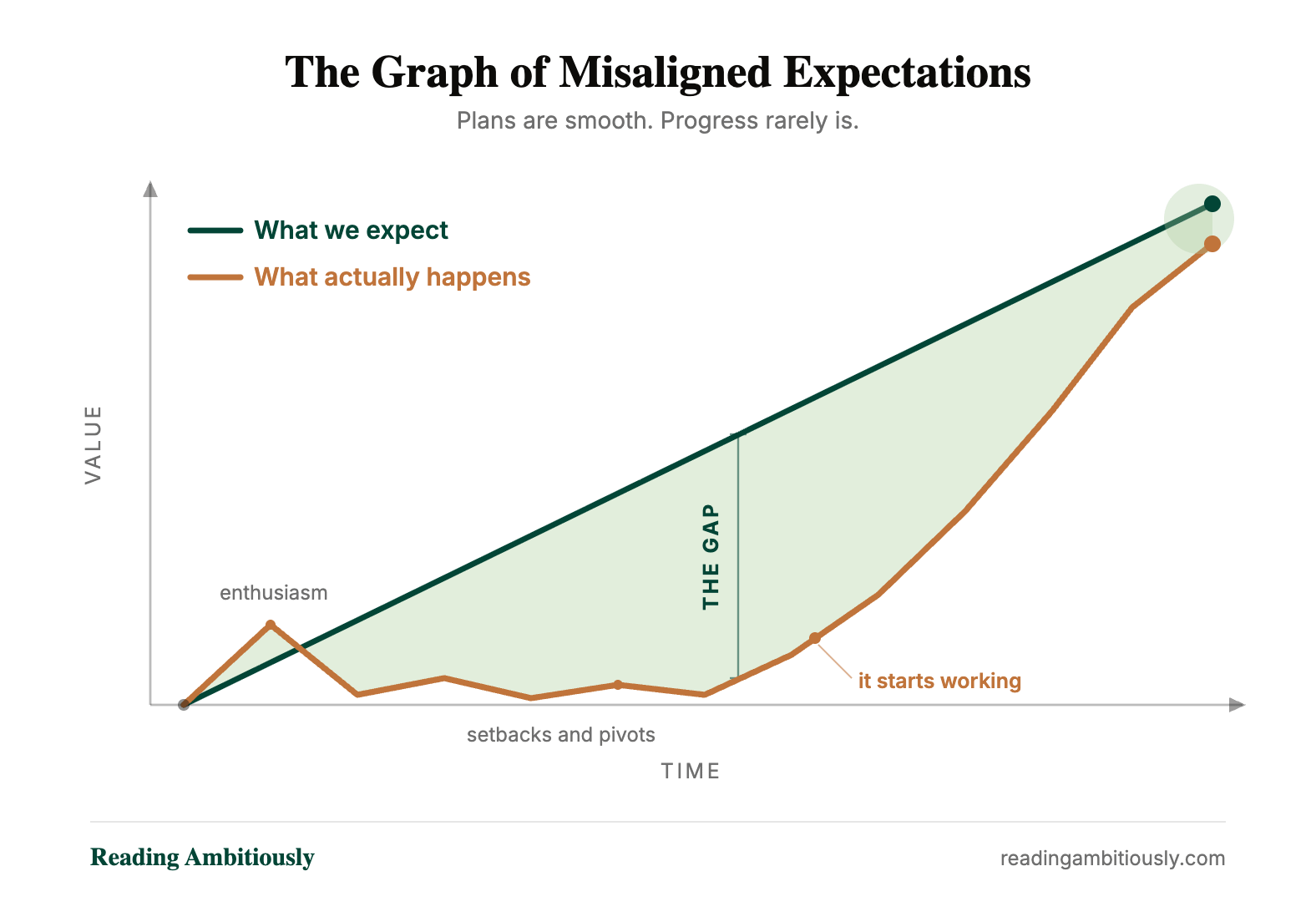
The graph shows how expectations and progress move differently. Expectations respond almost immediately. AI makes this problem especially common because every breakthrough is visible to everyone at once.
Real progress still has to move through discovery, domain expertise, data, workflow changes, trust, training, and adoption. None of that moves in a straight line.
The space between the lines produces strange behavior. Bad forecasts become goals. Goals become promises. When reality fails to follow the straight line, uncertainty starts to look like an execution problem. So we work harder. We add pressure. We measure whatever is easiest to count. We tell ourselves the breakthrough is around the corner.
Sometimes real progress is happening underneath. Sometimes it is not. The leader’s job is to know the difference.
A goal can focus a team. It cannot make an uncertain future predictable.
I found the graph again this week because AI is now living inside it.
Today, the computing power Perot once sold by the room arrives through a browser and fits in our pockets. The AI labs do not have a demand problem. A few of their sales reps are probably having their own 19-day years.
Companies buy thousands of licenses. Someone demonstrates a prototype. Token usage climbs. CFOs are now asking a fair question: “So what are we getting from this spend?”
One CTO recently reported that his company’s token costs were doubling every 45 days while productivity had improved by perhaps 5%. Uber reportedly spent its entire 2026 AI budget in four months after encouraging employees to use more. Apollo looked for evidence of an impact on corporate earnings and found “no visible signs” of rising profit margins outside the technology sector.
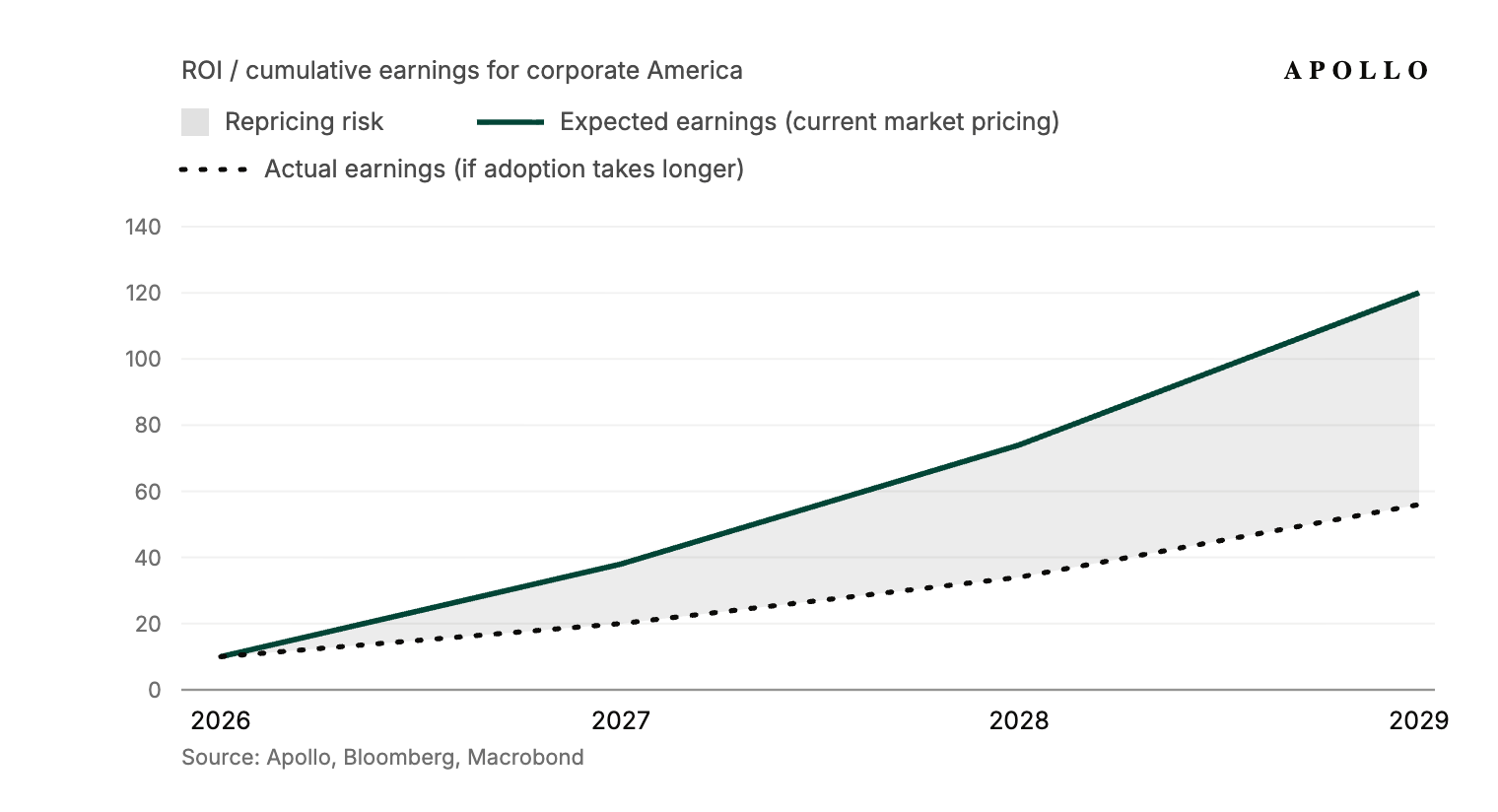
When I saw Apollo’s chart, I recognized the shape immediately. It was the macroeconomic version of a sketch I had drawn seven years earlier.
John Wooden had a phrase for this. Yes, the UCLA legend. He went to Purdue. Shout-out to my fellow Boilermakers.
Never mistake activity for achievement.
The AI boom has produced extraordinary activity. Much of it is healthy. New technologies need room for people to wander and discover what they are good for. Early in a cycle, learning is a genuine achievement. But a pilot cannot stay a pilot forever. At some point, it needs a promotion to production or a funeral.
The largest AI companies appear to understand the problem. Five of them have committed $9.75 billion to embedding engineers inside customer organizations. Microsoft alone recently committed $2.5 billion and 6,000 industry and engineering experts to a new AI implementation business.
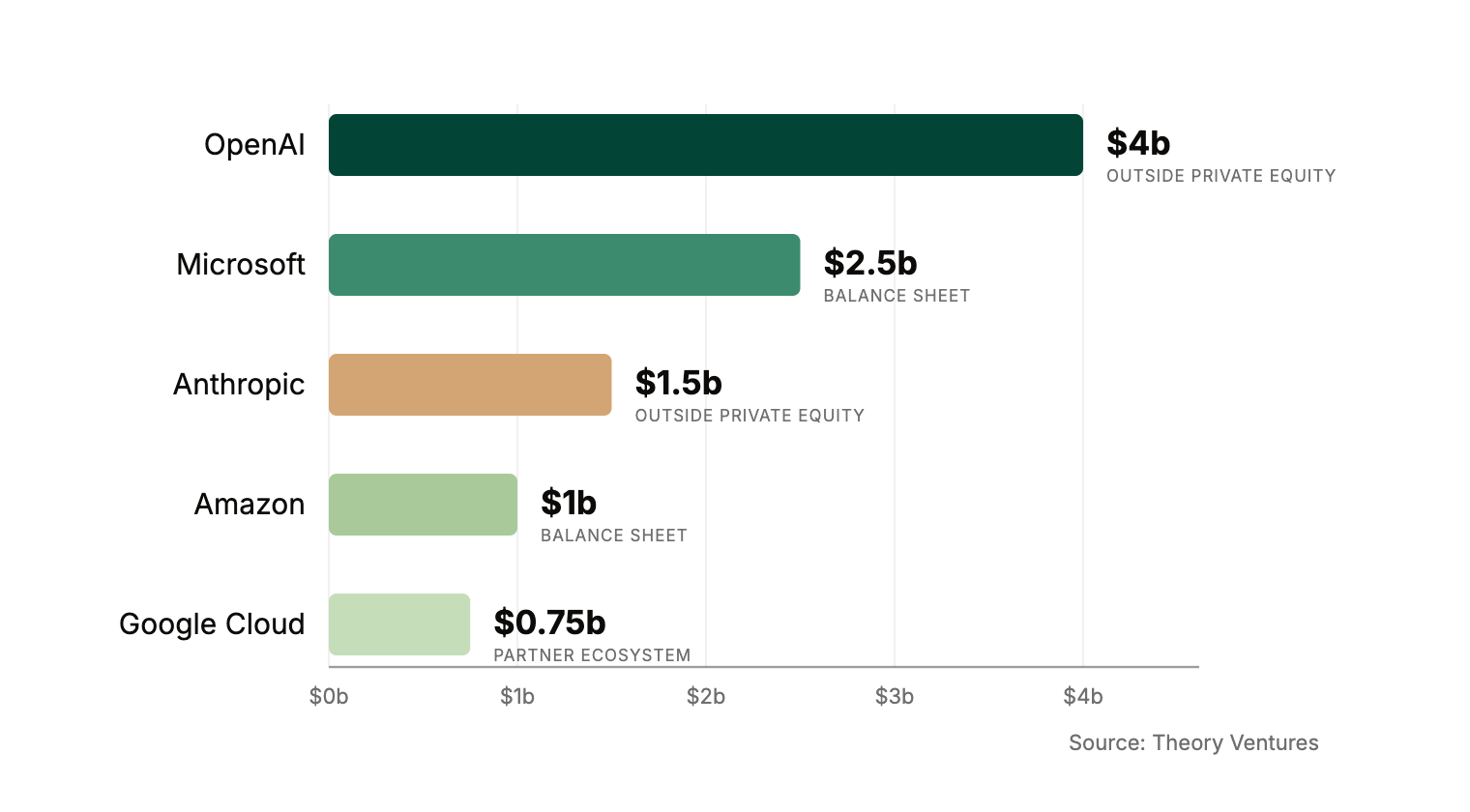
Perot would recognize the solution. Silicon Valley has rediscovered consulting and given it an engineering title: the forward-deployed engineer.
FDEs work alongside customers to understand their business problems, workflows, and data. They build prototypes, connect systems, and apply AI to specific jobs. Repeated use cases become software, tools, and playbooks for the next deployment. Many FDEs spend their days writing code inside the customer’s environment to solve business problems they understand.
Every major computing wave has created a deployment industry. Mainframes produced EDS. Enterprise software produced armies of SAP and Oracle consultants. Cloud computing produced migration specialists and managed service providers. The vendors build technology that can serve many customers. The deployment industry accumulates the domain expertise required to make that technology work for one.
How large could this market become?
Jensen Huang estimates that human intelligence represents 55% to 65% of global GDP, roughly $50 trillion, and believes that work will be augmented by AI. Nobody knows how much additional value will ultimately be created. Even a small share would produce an enormous market for companies that can turn AI models into finished products. It may become one of the largest created by any technology cycle.
The new job title does not change Wooden’s scoreboard. Hiring an FDE does not guarantee an outcome. Neither does buying a license.
That leaves leaders with a harder question: What should count as progress while the two lines remain apart?
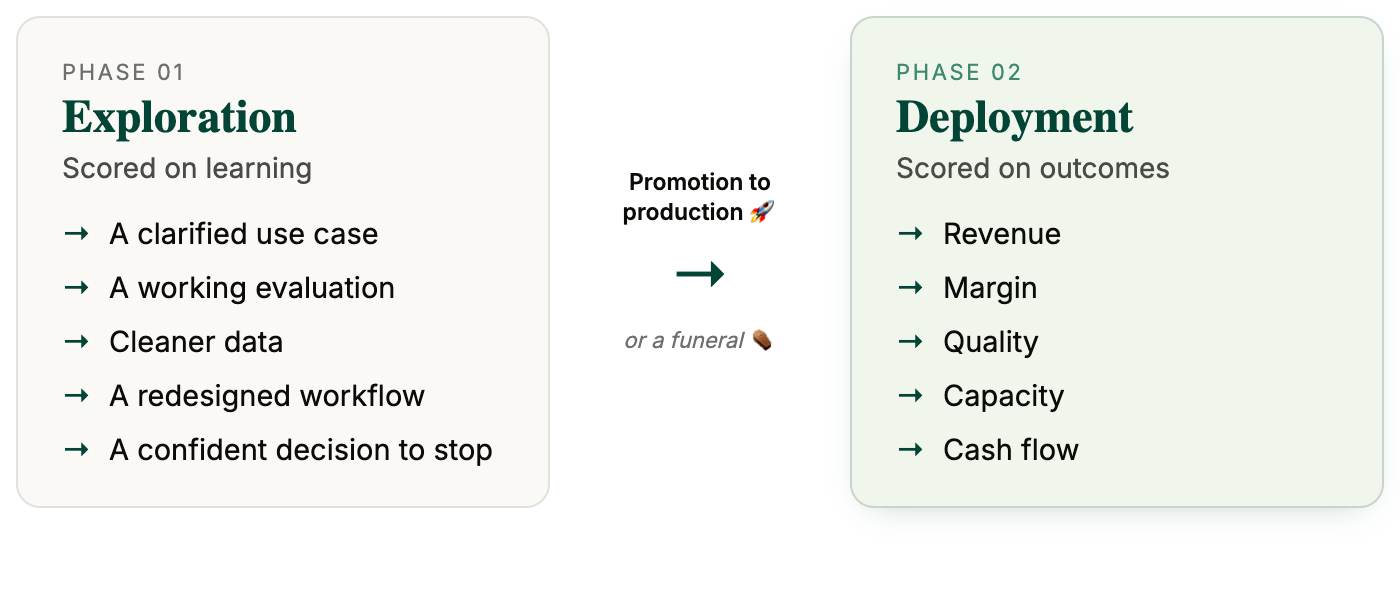
Exploration should leave evidence of learning. Deployment raises the bar to business outcomes.
Leading through the gap means knowing which phase we are in. During exploration, ask: What do we know now that we did not know before? During deployment, ask: What result has changed?
This is a delicate transition. Demand ROI too early and the search ends before people discover what the technology can do. Let experimentation continue forever, and it becomes theater.
Good leaders keep the upper line honest and make movement along the lower line visible. They communicate uncertainty without lowering ambition. They know when the team is learning and when it is time to execute.
When progress is hard to see, pressure can feel like control. It cannot make the lower line straight.
Perot called the combination of hardware, software, programming, operations, and a customer result the finished product.
Sixty-four years later, we are still buying machines faster than we can learn to use them. Fortunes will be made inside that distance.
The finished product arrives when the result does.

Best of the rest:
💊 AI-pilling our company: lessons learned — Sierra’s internal rollout shows that enterprise AI works best as one persistent agent layered across systems of record, powered by company context, and measured by business outcomes rather than token usage. — Sierra
⚠️ Nearly 200 Economists and Tech Leaders Warn of A.I. Threats — A growing coalition of economists, including longtime skeptics, now believes AI could disrupt white-collar work faster than governments can measure the damage or build policies to contain it. — The New York Times
⚖️ Apple’s lawsuit threatens to disrupt OpenAI’s bid to rival the iPhone - Apple may not need to win in court to achieve its goal, because the lawsuit alone could slow OpenAI’s recruiting, product development, and push to build the post-iPhone device. - Bloomberg
🎨 The Most Human Technology Ever Made – AI’s biggest promise may not be saving time, but expanding human agency by making it dramatically easier for anyone to turn curiosity, taste, and ambition into something real. – a16z
💸 AI’s Biggest Winners Have the Lowest Margins — Low-margin, labor-intensive businesses may be AI’s biggest winners because small reductions in coordination costs can drive outsized profit growth, especially when agents are embedded into existing workflows rather than introduced as another tool employees must adopt. — Daniel Kornum on X
🏗️ Anthropic, Blackstone, and Hellman & Friedman Introduce Ode with Anthropic, an Enterprise AI Services Firm — Built on the acquired Fractional AI team, Ode pairs Anthropic’s models with hands-on engineering talent, a clear bet that enterprise AI’s biggest bottleneck is implementation, not intelligence. — Ode

Charts that caught my eye:
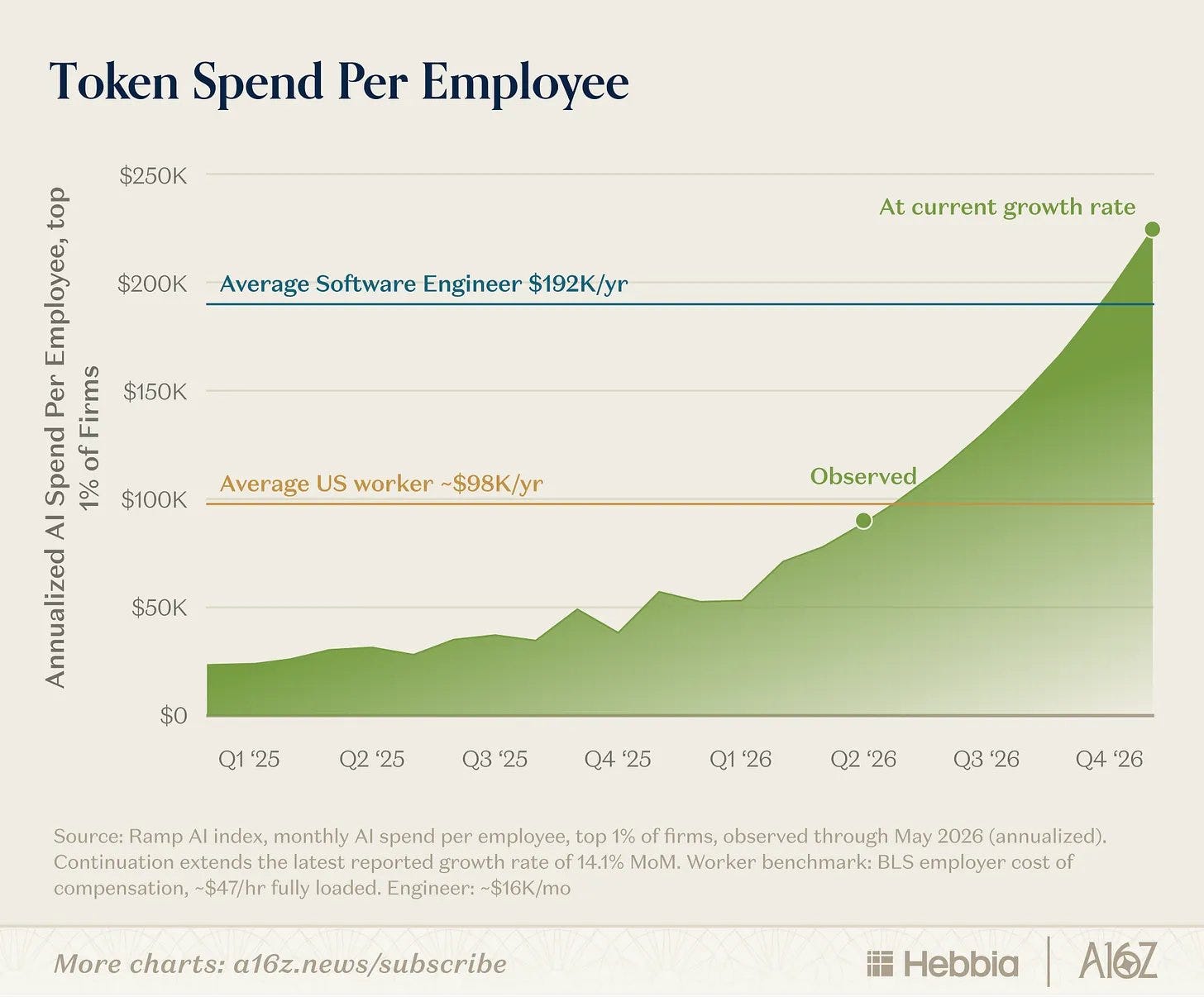
→ Why does it matter? The most aggressive adopters are on pace to spend more per employee on AI than the fully loaded cost of a software engineer.
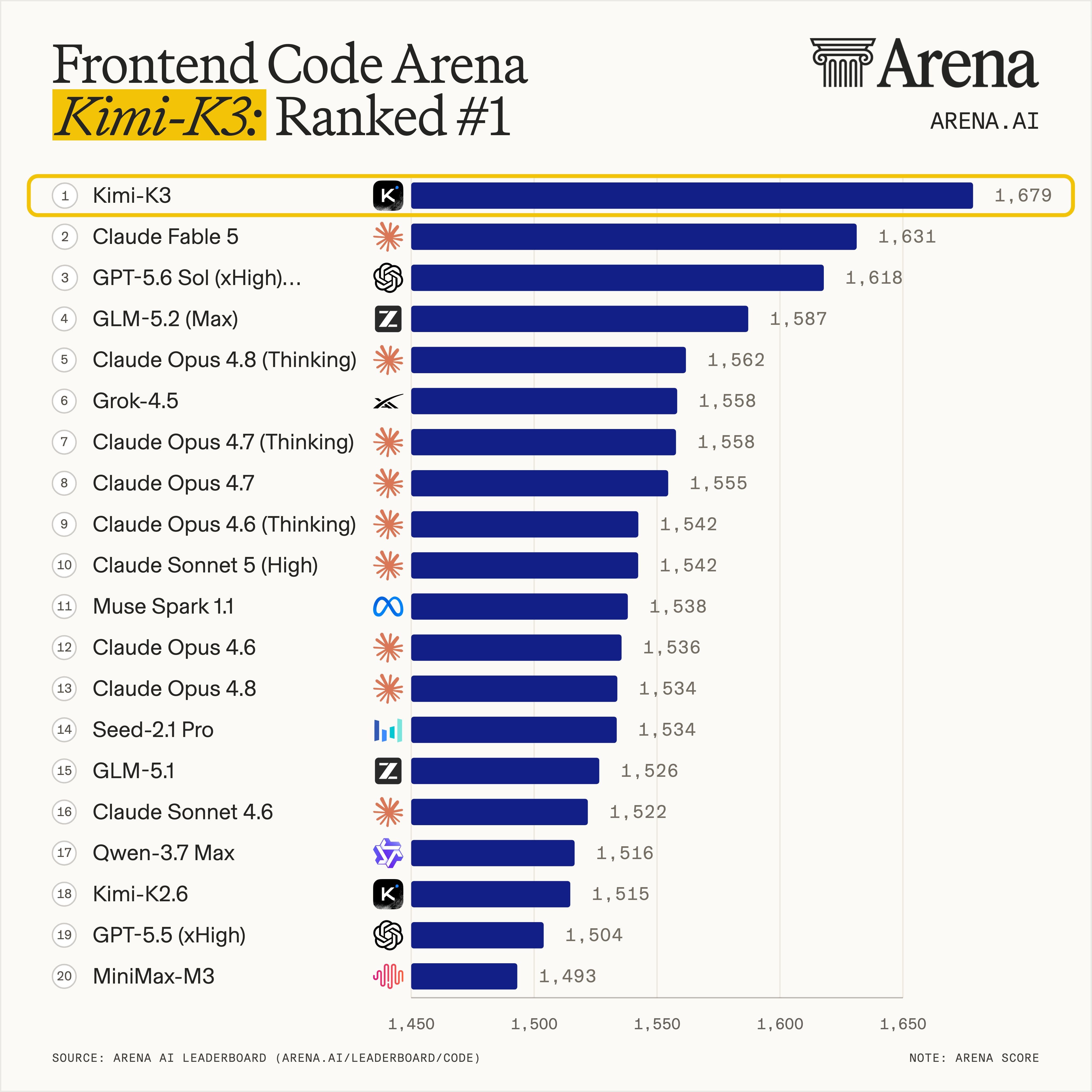
→ Why does it matter? This is a big deal. Kimi K3 took first place on the Frontend Code Arena, beating Anthropic Fable by more than Fable beat GPT-5.6 Sol, while costing the same as tenth-place Sonnet 5 at $3/$15 per million tokens. Moonshot AI, Kimi’s creators, plan to release the open weights on July 27th, which means you can run this on your own hardware!

Tweets that stopped my scroll:

→ Why does it matter? Thinking Machines is coming out of stealth, betting that companies will want to own their AI rather than rent it from a few large providers forever. That gives them more control over how it works, where their data goes, and how they shape it around their business. The strategy brings to mind Linux, an open-source project that became a core building block of modern computing because companies could run, change, and build on it. Thinking Machines is betting that AI will follow the same path, which is why they just released their open model (built in America) to the Apache community.

→ Why does it matter? AI sovereignty seems to be on everyone’s mind, and Satya has found the clearest way to explain why. Every prompt, correction, and workflow teaches the model something about how a company thinks, creating valuable institutional knowledge along the way. It also happens to be hugely important to Microsoft’s future that enterprises keep control of that learning loop, which makes this one especially worth reading.

→ Why does it matter? If cheaper models take share from the highest-margin frontier labs, customers get more intelligence per dollar and use far more of it. That would shift the profit pool from model makers to the companies supplying the compute.

→ Why does it matter? Some additional perspective worth reading on Thinking Machines’ strategy. The bet is that it helps enterprises build custom models rather than trying to win with a single model for everyone.
Worth a watch or listen at 1x:
→ Why does it matter? Money moves at the speed of trust. Most fundraisers focus on proving the opportunity with logic, but capital moves only when desire outweighs fear and the story is simple enough for someone else to repeat.
→ Why does it matter? Guy Oseary says 90% of his decisions happen in the first five minutes. He signed Alanis Morissette after one song, stopped Muse after one song, and later moved quickly on OpenAI and Anthropic!

Quotes & eyewash:
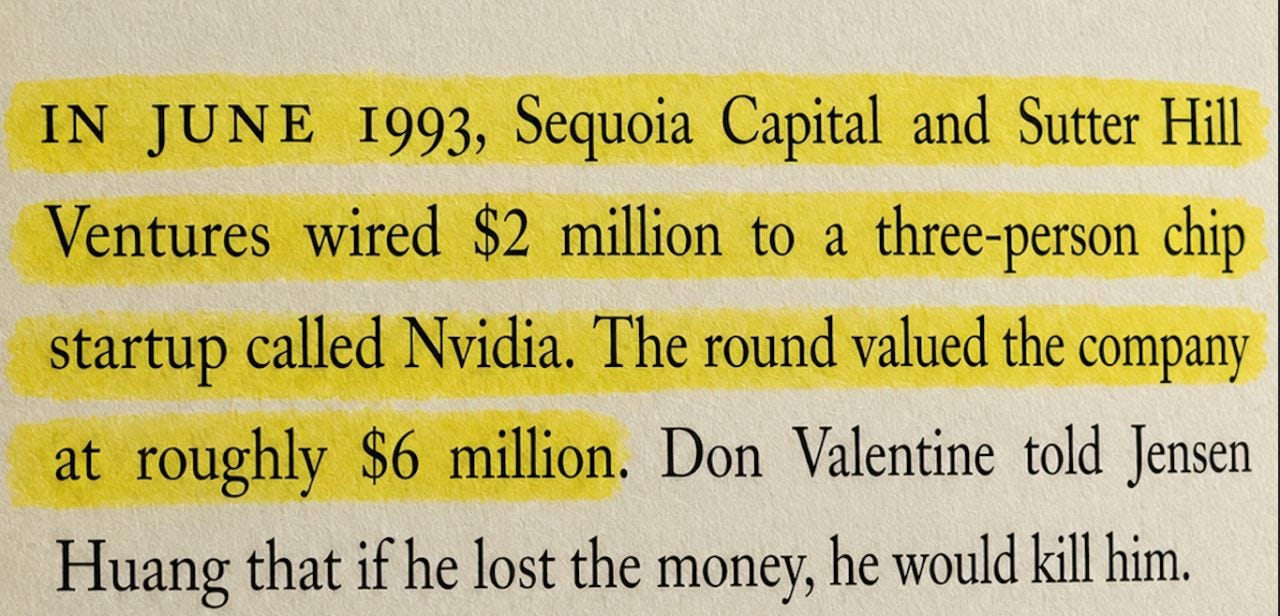
→ Why does it matter? So good. 90’s VC was something else.
The mission:
The Wall Street Journal once used “Read Ambitiously” as a slogan, but I took it as a personal challenge. Our mission is to give you a point of view in a noisy, changing world. To unpack big ideas that sharpen your edge and show why they matter. To fit ambition-sized insight into your busy life and channel the zeitgeist into the stories and signals that fuel your next move. Above all, we aim to give you power, the kind that comes from having the words, insight, and legitimacy to lead with confidence. Together, we read to grow, keep learning, and refine our lens to spot the best opportunities. As Jamie Dimon says, “Great leaders are readers.”
Disclaimer: This content is for informational purposes only and does not constitute financial, investment, or legal advice. Readers should do their own research and consult with a qualified professional before making any decisions.