

Enjoy this week’s big idea read by me:

The big idea: the internet gave us spam. AI is giving us slop.

A year ago, I never questioned whether a thank you note was written by a human. Now I do. So do you.
You may not have heard the term slop yet but you are about to. I predict it’s the Merriam-Webster 2025 dictionary word of the year. And thank God. We’re moving past “rizz”. I still have no idea what that means.
You already know what slop is.
It’s the LinkedIn post that hit your feed this morning:
It’s not about doing more—it’s about becoming more. In a world where change is the only constant, we must lean in, level up, and rewrite the rules. Because disruption doesn’t wait—and neither should you. The result? Teams that don’t just execute—they elevate. And in the end, it’s not about having all the answers—it’s about asking the brave questions.
Wtf did the author just say? It sounds like they watched a TED Talk, sat through a corporate onboarding video, and read half of James Clear’s Atomic Habits (great book by the way).
And what else do you know without being told?
It was written by AI.
The em-dashes—this thing: “—”. I am not even sure where it is on my keyboard. The “It’s not X, it’s Y”. The dramatic “The result?” The random bolding. All of them are dead giveaways.
Once you see slop, you can’t unsee it:
A Microsoft Teams message or Slack post filled with emojis.
The “thank you” note from a job candidate that includes five em-dashes.
The email that’s just a little too long and uses the word “delve”. An AI favorite, now appearing 25x more often in research papers than it did two years ago. (I asked the AI to interpret how Rodin’s famous The Thinker statue feels about slop and he’s shocked)
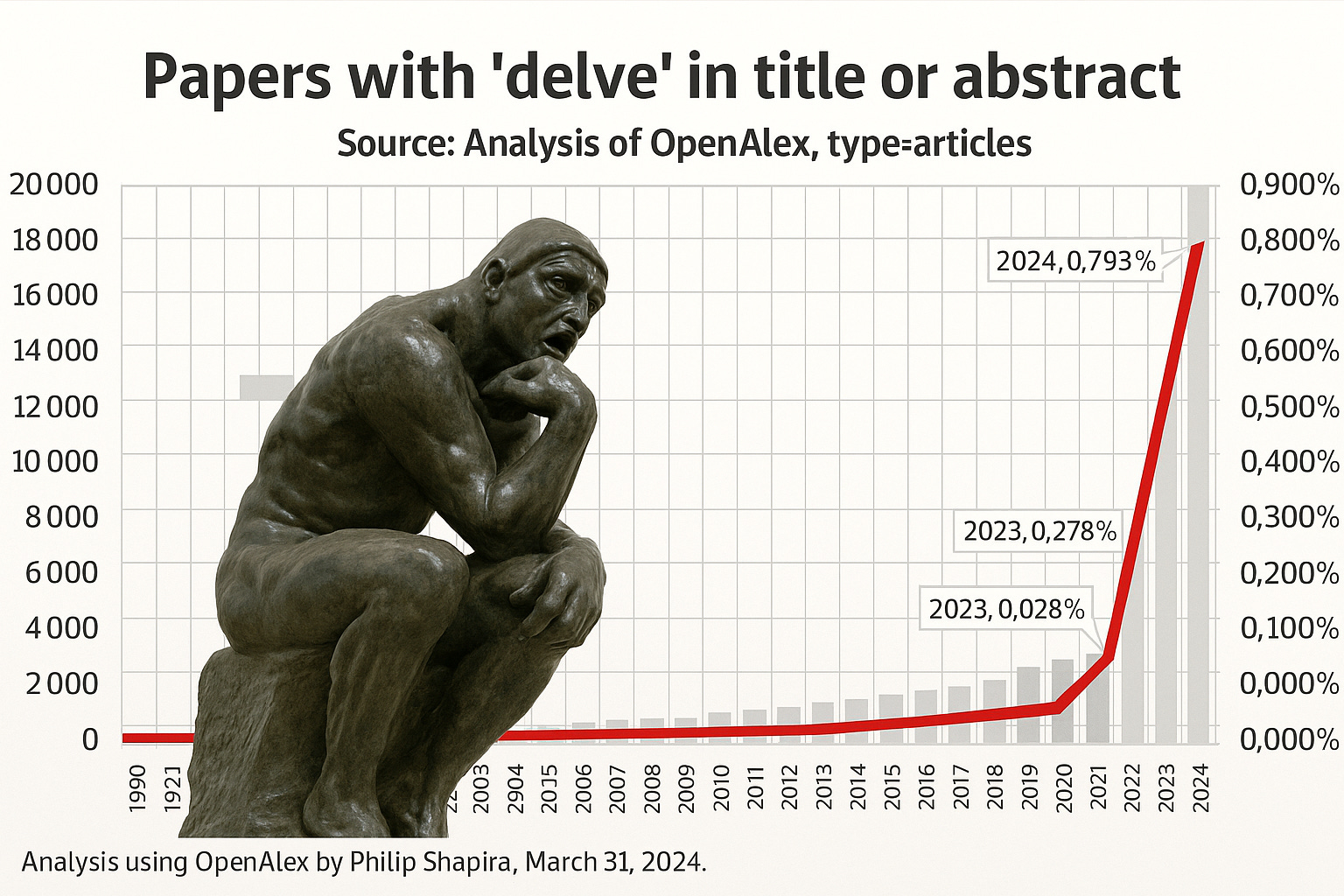
The internet is filling up with this AI-generated junk food and fast. I mean really fast. Spotify and Amazon Kindle are struggling with the volume of AI-generated content on their platforms.
It’s a debate on who coined the term “AI Slop”. Slop describes a rising genre of content that sounds important but doesn’t say anything at all. AI slop has been variously defined as "digital clutter", "filler content [prioritizing] speed and quantity over substance and quality", and "shoddy or unwanted AI content in social media, art, books and search results."
Because of slop, we’re beginning to question everything we read or watch. Much like when spam started overtaking email inboxes. Just like we ultimately had to create spam filters, we’re already training our eyes to create slop filters.
Wait a second. Was this written by a person? Can I trust the voice? Is this a real idea or just repackaged noise? Should I question what I’m reading if I do suspect it’s been generated by AI? How slop-y is this?
A year ago, we never asked those questions. Now we ask them every day.
AI has lowered the cost and time of production but not the importance of carefully crafting what is ultimately produced and the quality with which it is produced.
When you’re making something new, original thinking isn’t just part of the process. It is the reward. And is this process which is at the heart of creating anything of value.
The antidote to slop is original thinking. Without it, you’re just remixing tokens of existing ideas.
Let me be clear: without AI, I could never have launched Reading Ambitiously. But the most rewarding part of writing it each week is not publishing. It’s the making of it, the creative process itself.
My personal favorite parts of that process?
The “aha” moment over the weekend when I land on a topic.
A group text with friends, sharing early drafts and collecting reactions.
The messy outline, anxiousness of a blank page followed by the satisfaction of watching it fill.
The drive to earn the readers attention.
The moment I discover what I actually believe because writing is thinking which forces clarity.
It’s the act of taking raw material including observations, instincts, questions and shaping it into something real. Something yours. But the thrill lies in the process of creation itself, where every step fuels a deeper sense of satisfaction.
AI’s superpowers can support you in a big way. It can accelerate research, help structure your thinking, sharpen phrasing, and suggest headlines. It can be your editor-in-chief, a team of ambitious reporters ready with data and research.
Because the truth is, AI (at least today) kind of sucks at the actual creative part. It lacks taste, judgment, and discernment. The subtle human faculties that tell us what’s resonant, what’s off, and what’s worth saying in the first place. AI can generate text, but it can’t decide what’s good.
Human taste is learned. It’s built from experience, exposure, and emotional intuition. It guides creators to choose not just what is possible, but what should be.
The true power of creating anything lies in wrestling with the thinking yourself. When you pair that with AI’s scale, your discernment shapes something worth experiencing, keeping your mind sharp and staving off the atrophy that comes from outsourcing your brain.
That’s why the best use of AI isn’t as a crutch or ghostwriter. It’s as a mirror. To you, the creator.
The Ownership Test
Here’s something I’ve come to believe in working with AI daily: When you let AI do too much, you don’t feel ownership of the output.
And when you don’t feel ownership of the ideas, you don’t care enough to make it great. And if it’s not great, is it worth it? And will your audience feel the greatness?
I am not just talking about a newsletter like this one. How about a simple thank you note? I’ve got 100’s of them over the years and what I remember most are how the best ones made me feel, not often what the author wrote. Can those feelings be elicited when AI does 99% of the job? I’m not sure.
In a strange way, I’ve learned that while AI is helpful in all sorts of ways, I have to fall in love with how and what ultimately gets made.
Not in some precious, perfectionist sense. But in the sense that I’m proud of what I’ve made. These are my thoughts. I understand them. I believe in what I’m saying. And I’m anxiously waiting with excitement to share, be judged, and not disappoint.
Those feelings don't come from copying.
They come from crafting. Honing your craft is a lifelong endeavor. A 100-year goal that is always within reach but never truly complete. As Jiro Ono says, “I do the same thing over and over, improving bit by bit… I’ll continue to climb, trying to reach the top, but no one knows where the top is.” For Jiro, a sushi master with three Michelin stars, perfection was never a finish line. He just showed up every day to get a little better.
That kind of craft depends on original and independent thinking. It is where value gets created, not copied. And in a world full of slop, to punch through, you’re going to need to hone your craft.
Don’t Waste the Headspace
In the original Netflix culture deck, Reed Hastings includes a deceptively simple curve: as a company grows, complexity increases. As complexity increases, process increases. And as process takes hold, creativity gets squeezed out. Although Reed uses multiple slides to connect high-performers to creativity, I’ve re-created that graph here with my interpretation of his main argument.
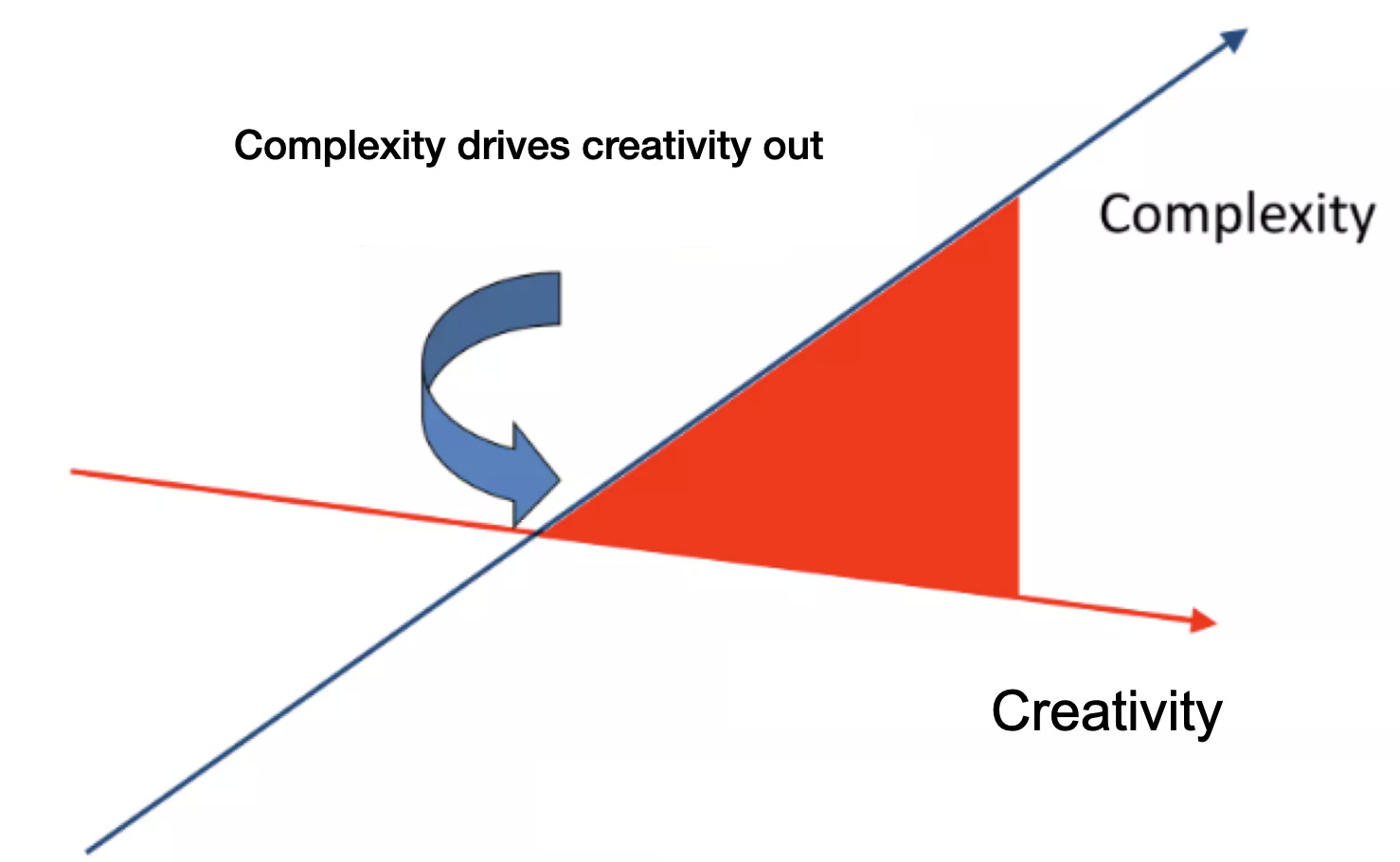
That idea has always stuck with me. Because not just companies but the world seems to be living on that curve.
We have a lot of complexity so we’ve been process-izing things. Consulting things. Globalizing things. Layering in frameworks and systems to scale. And in the process, we’ve slowly professionalized away the space for independent thought.
Now we’re staring down the barrel of something very different. AI gives us the ability to automate huge swaths of process. And that creates a fork in the road.
Path A leads to slop. To laziness, overreliance, intellectual outsourcing. We trust the machine to think for us, and we stop noticing that it never really did think at all. It remixed existing ideas.
Path B is more interesting and more ambitious. It’s also the one I invite you to take. It says: if AI can handle the busywork, the coordination, the repetitive tasks, then maybe we can reclaim the one thing that’s always been in short supply, headspace.
Because that headspace is not just a luxury. It’s the prerequisite for original thought. And original thought is what creates, and creation is where all real value comes from.
AI won’t do that part for us. But it might just give us the room to do it ourselves.

Best of the rest:
📉 CEOs Trumpet Smaller Workforces as a Sign of Corporate Health Executives are openly celebrating staff cuts as strategic victories, framing leaner teams as a mark of efficiency in the AI age. – Wall Street Journal
🌊 You Have to Be in the Water — A thoughtful reflection on timing, technology shifts, and what’s most important — The Browser Company's Blog
Building a company is like surfing. The surfer can control their body, their surfboard, but not the water. In many ways, the biggest decision you have to make is where and when to surf. The wave represents the macro environment and the underlying market shift–some are so large and powerful that no matter what you do, surf or fall, you get carried by the wave.
But the one thing that you have to do is put yourself in the position to catch the wave when it forms. You can’t see it start to build from the shore and expect to paddle out and catch it. You have to be in the water… When a technological seam opens up–you get an expanding frontier. When the area to innovate is increasing, the only thing that matters is your rate of innovation.
🧠 Process Is Dead, Long Live Process — Ethan Mollick pits AI’s “bitter lesson” (brute compute beats cleverness) against the “garbage can model” of messy human decision-making and argues we’re now testing which truly leads to better outcomes. – One Useful Thing

📉 Fintech Middlemen Are 'Massively Taxing' JPMorgan — The bank says data brokers like Plaid are slamming its systems with nearly 2 billion API calls a month—most of them unnecessary and not triggered by customers. – CNBC

Charts that caught my eye:
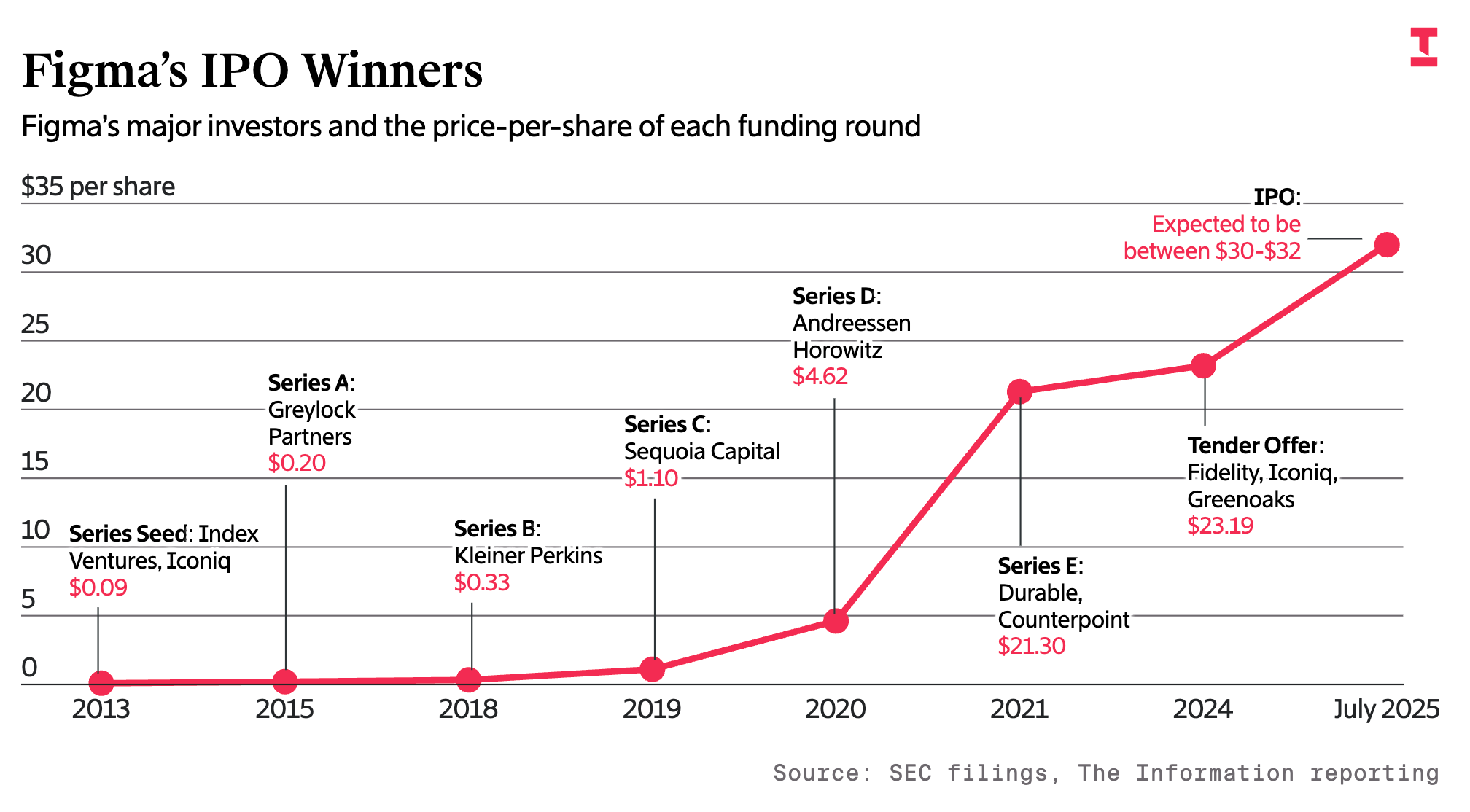
→ Why does it matter? Figma’s IPO is set for Wednesday, and shares will start trading on Thursday. At the high end of the range, $28 a share, Figma would be valued around $16 billion (wrote that earlier this week, Figma opened at $33 trading was halted at $115/share. 🤯 Wow! Big winners include Iconiq Capital who led a $1.5 million seed investment. Iconiq’s early stake from 2013, according to The Information, is expected to be worth at least $500 million.
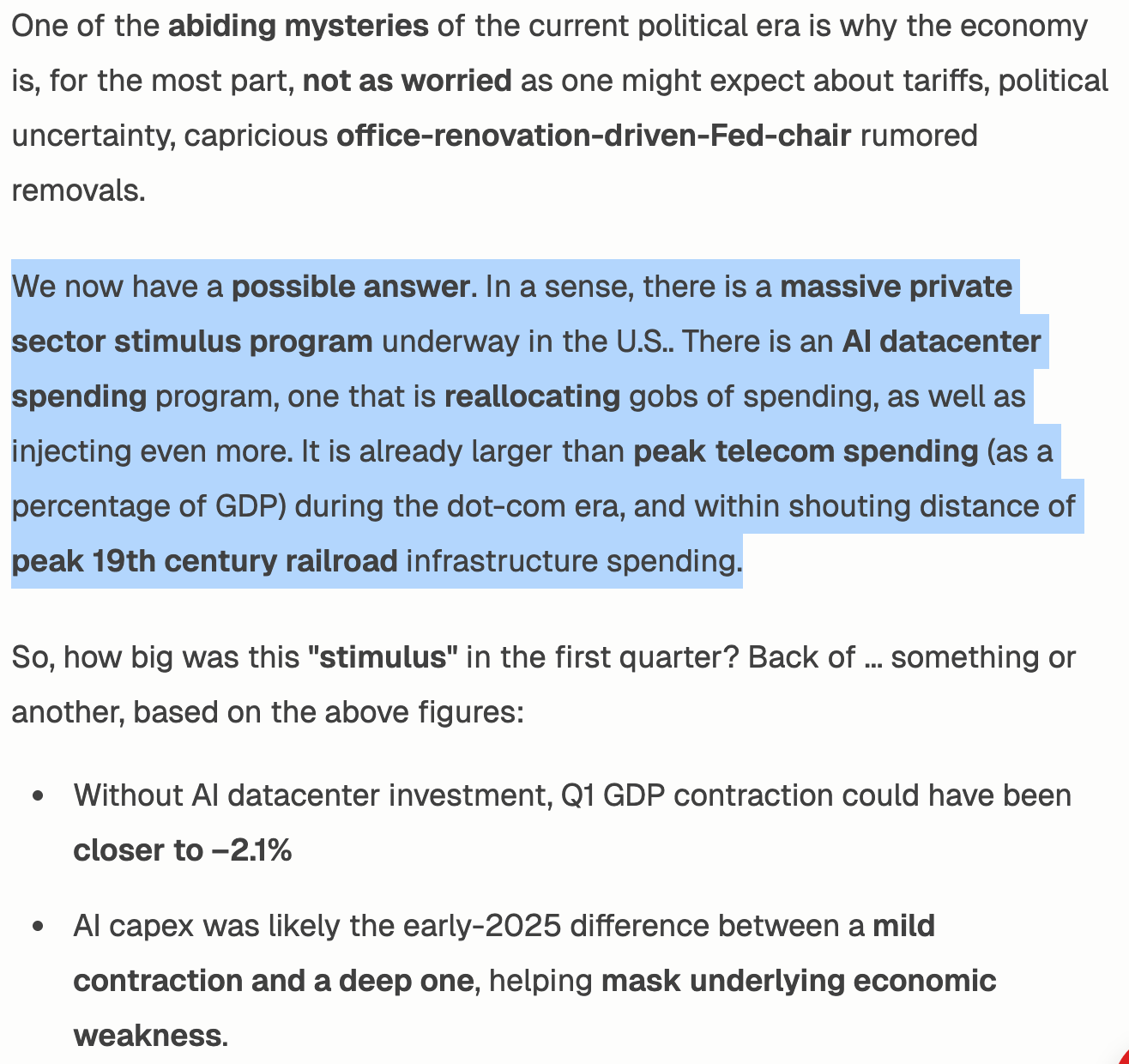
Honey, AI Capex is Eating the Economy (Paul Kedrosky)
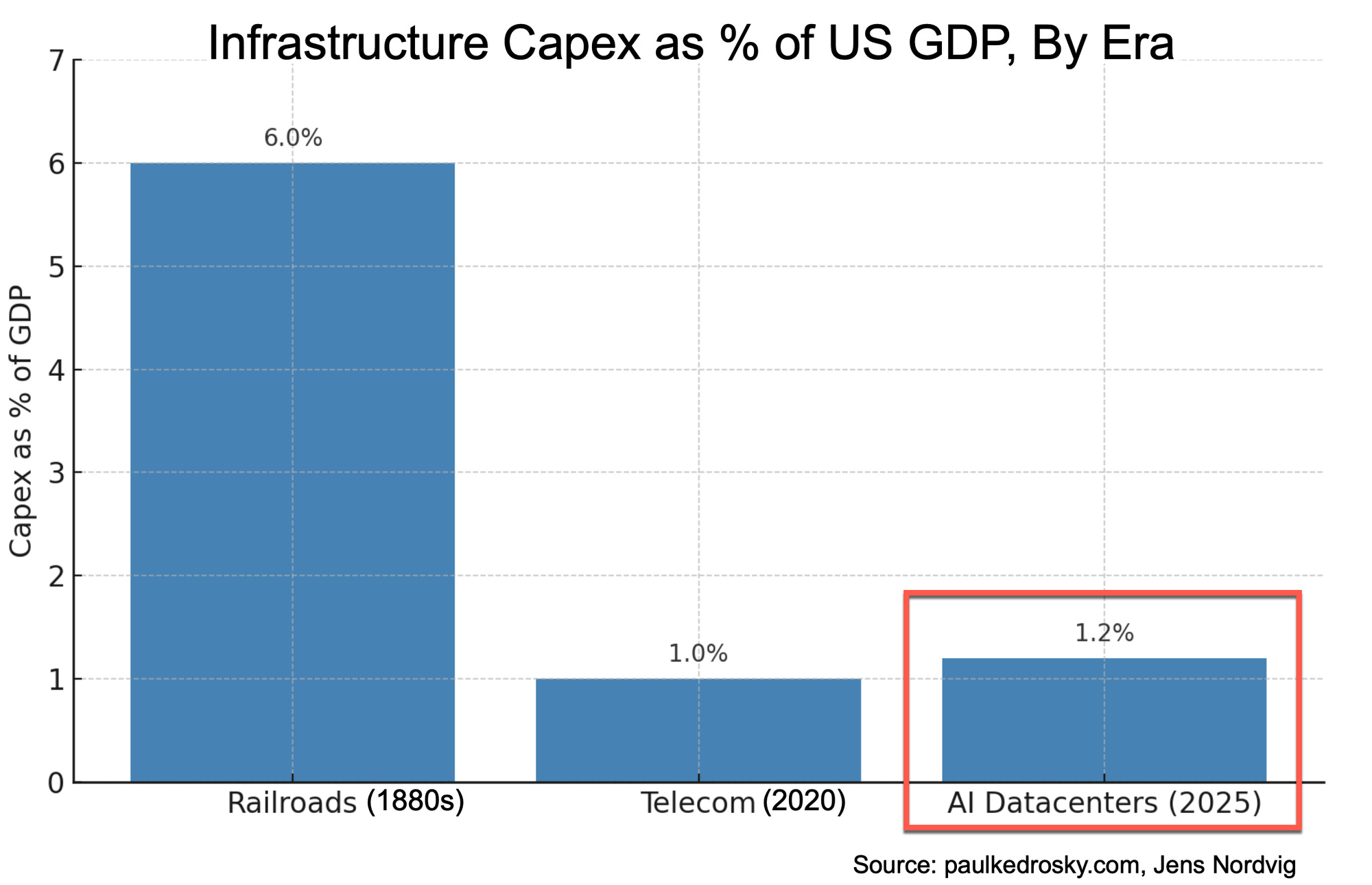
→ Why does it matter? AI datacenter spend is already bigger than the telecom buildout and catching up to the railroad boom. If Nvidia’s sales numbers hold, it could hit 2 percent of GDP next year putting it in the same league as the infrastructure waves that reshaped the economy. We don’t know if this is the peak or just the beginning, but either way, it’s a big deal.

Tweets that stopped my scroll:

→ Why does it matter? You read that correctly, Meta is offering compensation between $200M - $500M to join their “Personal Super Intelligence” team. It’s rumored that one person was offered a $1B package. Zuck offered thoughts this week on what they’re building (https://www.meta.com/superintelligence/). Don’t forget to accept the cookies before you give it a read.

Worth a watch or listen at 1x:
→ Why does it matter? Pricing in AI is still unsettled. Most companies are using the same core models like GPT-4o, Claude, Gemini, or Mistral, but there’s no generally agreed upon way for how they should cost or how to price them into products. One of our readers called pricing a dark art, and right now it’s the wild west. Madhavan has spent years helping software companies figure it out.
→ Why does it matter? Bret Taylor has helped shape some of the most widely used products on the internet. But in this conversation, it’s his simplicity that stands out. He says the one lesson he’d give his younger self is to focus less on technology and more on solving a real customer need. It sounds basic, but it’s easy to forget, especially in AI where the tools can be so distracting. If no one’s paying for your product, the problem might not be your sales pitch. It might be the product.
→ Why does it matter? I didn’t know Ramtin Naimi’s story before Dom’s Colossus profile last week. Now some of his thinking is living rent free in my mind. He went from personal bankruptcy to building the seed fund with the highest graduation rate to Series A. He used AngelList as infrastructure, treated venture like art collection, and built trust by being the first yes. Patrick and the Invest Like the Best team pulled back the curtain with care in this episode. Can’t wait for the in-print version of the Colossus Review.

Quotes & eyewash:

→ Why does it matter? Mercedes-Benz announced they’re integrated Microsoft Teams directly into their vehicles starting with the CLA model. Really? Because you want to join a Microsoft Teams meeting from your convertible?!

→ Why does it matter? Too funny.
The mission:
The Wall Street Journal once used ‘Read Ambitiously’ as a slogan, but it became a challenge I took to heart. We aspire to give you a point of view in a noisy, ever-changing world. To unpack the big ideas that sharpen your edge and show why they matter. To fit ambition-sized insight into your busy life. And to channel the zeitgeist into the stories, signals, and substance that fuel your next move as leaders. Together, we can read with an intent to grow, always be learning, and refine our lens to spot the best opportunities. As Jamie Dimon says, “Great leaders are readers.”