

Enjoy this week’s Big Idea read by me:

The big idea: Beware the shiny objects, eat the frog, and challenge the status quo.

Last week, the internet and markets lost their minds when MIT researchers reported that 95% of AI pilot projects have failed. It was a perfect storm: The academic report landed just after GPT-5’s perceived disappointing launch, Sam Altman's warning that we might be in an “AI bubble,” and the Fed meeting in Jackson Hole. Suddenly, this became evidence that AI progress is slowing.
But what are people really looking for here? Proof that AI technology doesn’t work? A reason for correction in financial markets? An expectations reset of AI’s potential? A pullback on spending? Perhaps. A healthy market needs both bulls and bears.
If you read the research itself (since pulled from MIT’s website), the 95% figure came from whether companies publicly reported receiving value from AI. The methodology was weak. But the patterns it highlighted are worth paying attention to.
MIT calls it the GenAI Divide. On one side, a handful of companies are extracting millions in value. Conversely, most are stuck in proof-of-concept purgatory, waiting for IT and compliance to approve even basic ChatGPT usage.
A few findings stood out:
Nearly 70% of AI budgets went into sales and marketing use cases such as lead scoring, generative campaign content, and outbound email drafting.
The most significant ROI came from back-office finance, procurement, and claims processing automation.
Pilots failed not because AI “doesn’t work,” but because enterprises couldn’t embed it into workflows.
None of this is surprising. When new technology arrives, the instinct is to push it as close as possible to value creation and chase the shortest-term wins. But that instinct usually produces shiny objects and good demos, not systems that survive in production.
The divide MIT describes is the same one entrepreneurs face daily: the temptation of the quick win versus the discipline to build for the long haul. It also tees up three lessons that I have experienced as an entrepreneur that apply not only to AI pilot projects, but to building anything new, and even more broadly to life.
Lesson One: Resist Shiny Objects
With new technology, everything feels possible. The instinct is to chase the shiny object, the quick win. That is why so many AI budgets in this survey flowed straight into sales and marketing use cases that promised immediate visibility and measurable results.
I saw this dynamic firsthand during my time with IBM Watson. After Watson’s victory on Jeopardy! Every executive wanted to explore the "art of the possible." I sat in conversations about Watson stopping theft in diamond mines, predicting inventory levels, and helping sales teams close deals. The imagination was boundless.
Most of those ideas never made it past proof of concept. They weren’t anchored in workflows, data, or the daily operations grind. In the diamond mines, theft involved miners training carrier pigeons to smuggle stones. How was AI supposed to solve that? (Technology eventually helped, using biometric sensors that flagged employees likely to participate in illegal acts.)
The "art of the possible" can lead to a build trap. Teams keep building impressive features but fail to deliver sustained value in production. When the focus is on what’s possible, not what’s probable, demos impress in a conference room but never scale.
MIT’s findings showed the same pattern. Enterprises poured money into front-office experiments and eye candy, but the real ROI came from the back office. These are less visible, harder to explain, and are in a different part of the organizational chart. But that is where complexity lives, data accumulates, and automation creates real value.
The lesson is simple: resist the shiny object. Don’t confuse what’s possible with what’s probable. Transformation happens where the problems are hardest and least glamorous.
Lesson Two: Eat the Frog
Transformation doesn’t come from quick wins. It comes from eating the frog, which is to say tackling the hardest problems first.
There’s a line often attributed to Mark Twain:
“If it’s your job to eat a frog, it’s best to do it first thing in the morning. And if it’s your job to eat two frogs, it’s best to eat the biggest one first.”
The advice in the early stages of any ambitious build is predictable: start small, deliver something visible, spin up an overlay. It sounds reasonable. And while you want to be agile and iterative its equally important to be grounded in outcomes.
Seasoned builders push back on this advice. They are hyper-aware of the hidden complexity. They know those projects are what one leader called “gizmos and gadgets,” distractions that consume energy without creating lasting value.
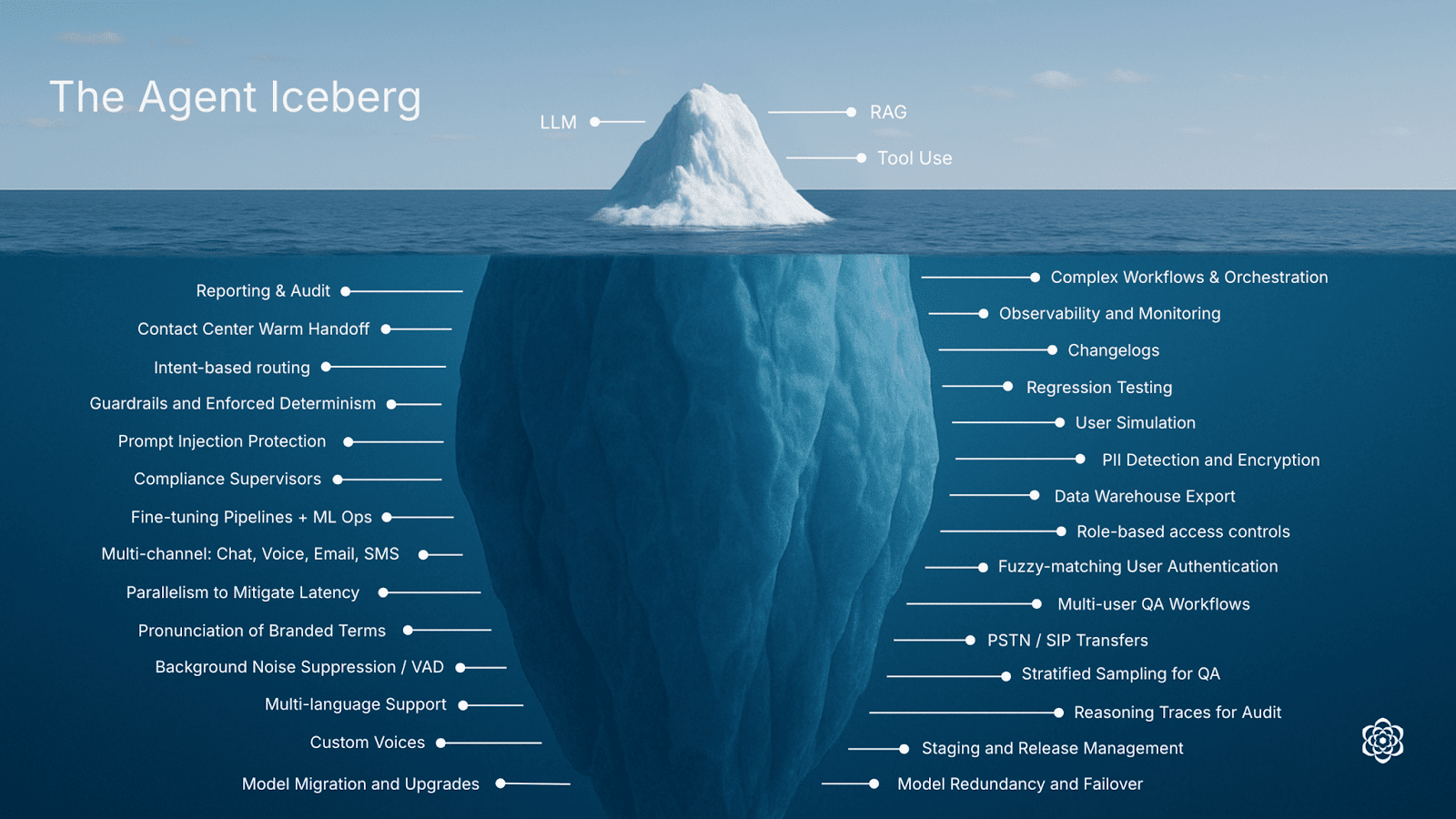
When building AI systems, the frogs are underneath the iceberg. Getting messy data into shape and embedding AI into core workflows and designing tools that improve with use instead of stalling after a demo. It is slower, riskier, and more complex to explain in the boardroom, but it is the only compound path.

We shared this advice in last week’s Reading Ambitiously. Warren Buffett is often credited with saying:
“Compounding is the eighth wonder of the world. He who understands it, earns it; he who doesn’t, pays it.”
AI pilots face the same fork in the road. The easy path is to bolt a chatbot onto existing dashboards or wrap an API in a demo. The more challenging path is to build on the proper foundation: data, workflows, and integration. Embrace the complexity. That is the frog. Eat it first.
Lesson Three: What Got Us Here, Won’t Get Us There
The hardest foe of all is the status quo. Think of it as the “final boss” in a video game, the one that shows up after you’ve beaten all the earlier levels, harder than anything that came before. In transformation, that final boss is change itself.
Anyone can buy technology, but change has to be led. It means undoing habits, redesigning workflows, and pushing people out of familiar ways of working. It means spending as much energy on change management, process design, and user training as on technology.
Pilots flopped not because AI “doesn’t work,” but because enterprises didn’t know how to weave it into workflows. The “learning gap” was the real killer. As Saanya Ojha, Partner at Bain Capital Ventures, put it: “Without redesigning processes, ‘AI adoption’ is just a Peloton bought in January and used as a coat rack by March. You didn’t fail at fitness; you failed at follow-through.”
The MIT research shows the difference clearly. The few companies crossing the GenAI Divide are not winning with better demos. They are changing how they buy technology, re-architecting processes that have been stable for decades, and partnering with vendors. They are not avoiding change. They are leaning into it. That is how you beat the final boss.
And that is the lesson: what got us here won’t get us there. Organizations must face transformation head-on to cross the divide by challenging the status quo.
The Bottom Line
The MIT report may have sparked headlines about AI slowing down, but the technology is very real. The story is simpler: building new things is hard. Most pilots failed because they chased shiny objects, avoided the frog, and never confronted the final boss.
The companies on the right side of the GenAI Divide did the opposite. They resisted the art of the possible and focused on the probable. They ate the frog, integrating AI into core data and workflows instead of wrapping it in demos. And they leaned into transformation, beating the final boss by redesigning processes, training users, partnering with vendors, and pushing past the inertia of the status quo.
This is essential in building anything meaningful and long-lasting. It is not about speed or spectacle. There are no shortcuts. It is about doing the hard things first and leading change all the way through.

Best of the rest:
⚡ Context Kills Schema – Brett Queener argues the old software model—fixed schemas, armies of consultants, endless configuration—is collapsing under AI’s speed. Systems of action now matter more than systems of record, contextualized software will reshape entire industries, and $750B in implementation and admin spend is ripe for elimination. – Tales from The Bonfire
🛡️ AI Won’t Kill Enterprise Software – A $1.2T and growing market won’t be displaced by “vibe coding” as incumbents embed agents and enterprise realities—complex workflows, compliance, and cross-app orchestration—keep Salesforce and Workday firmly in the game. – The Wall Street Journal
🕵🏻♂️ Detecting and Countering Misuse of AI – Anthropic’s August 2025 report exposes how criminals are weaponizing Claude for “vibe hacking” extortion schemes, fraudulent employment, and ransomware, and outlines the safeguards being built to stop them. – Anthropic

Charts that caught my eye:
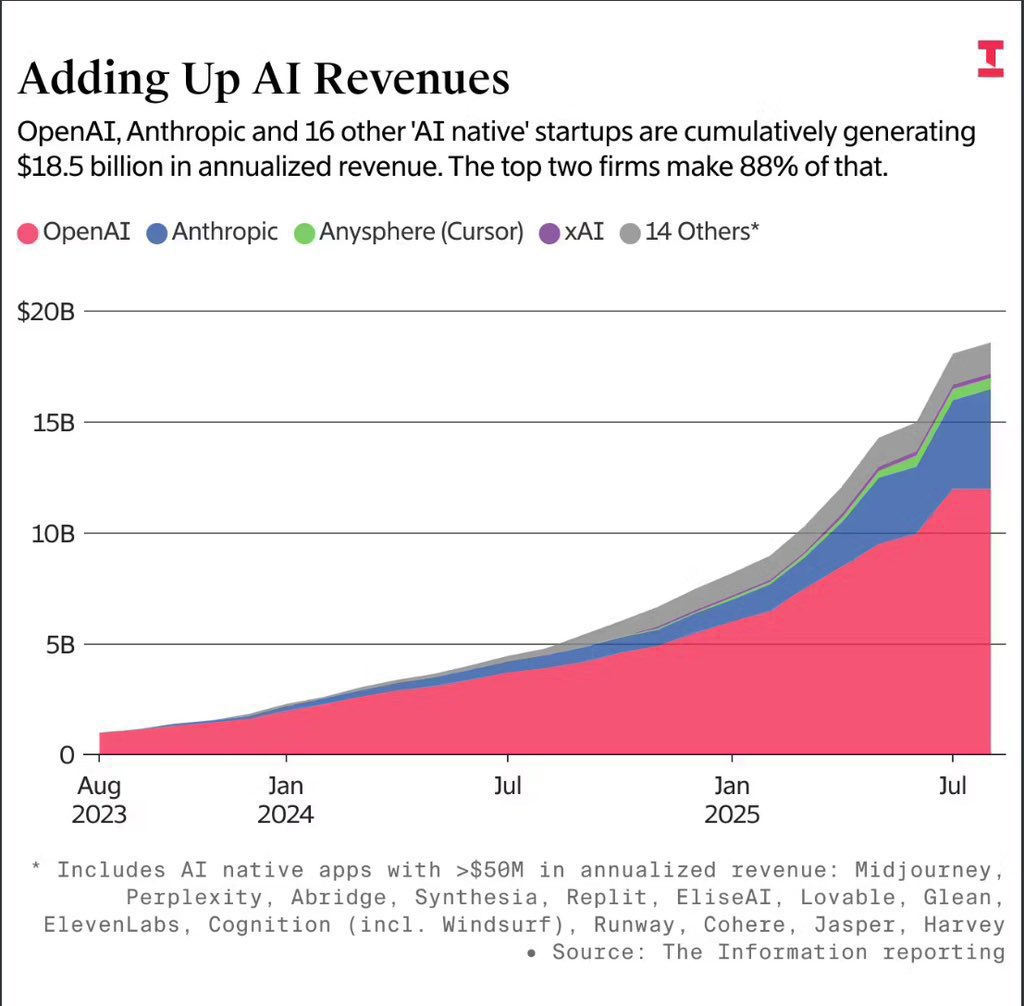
→ Why does it matter? Every week, readers ask me to track the return on $1T+ of AI spending. OpenAI and Anthropic now generate 88% of the revenue across the top 18 “AI-native” startups. Together, those 18 are approaching $20B in revenue. The contrast is striking: explosive growth in just 2 years, but still a small number relative to the scale of investment.
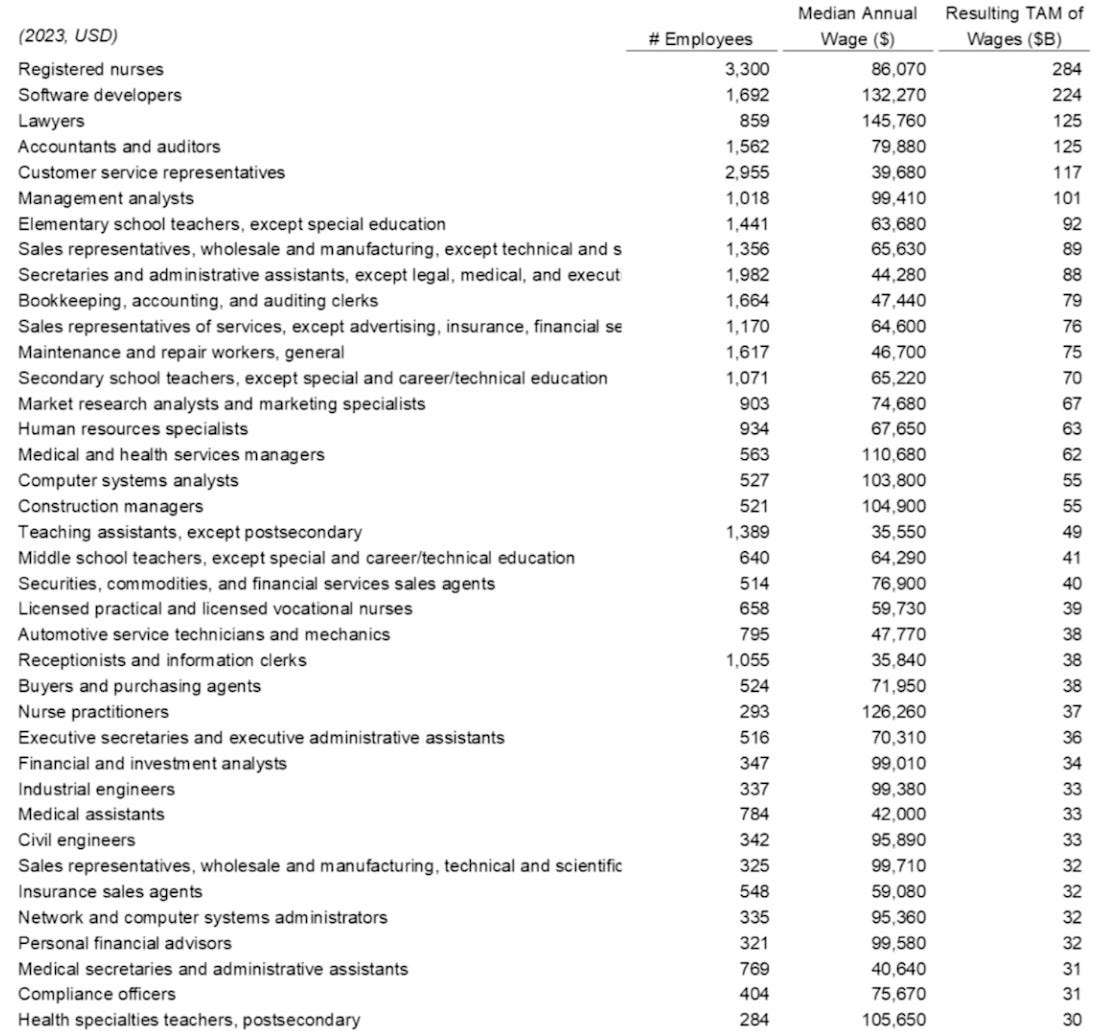
→ Why does it matter? If you buy the idea that software used to give users the tools to do their job and will soon be able to do the job itself, you’re really talking about services. This chart from Sequoia ranks the largest services-led industries. According to their team (full presentation linked below), these represent the future TAMs for AI. Wild.
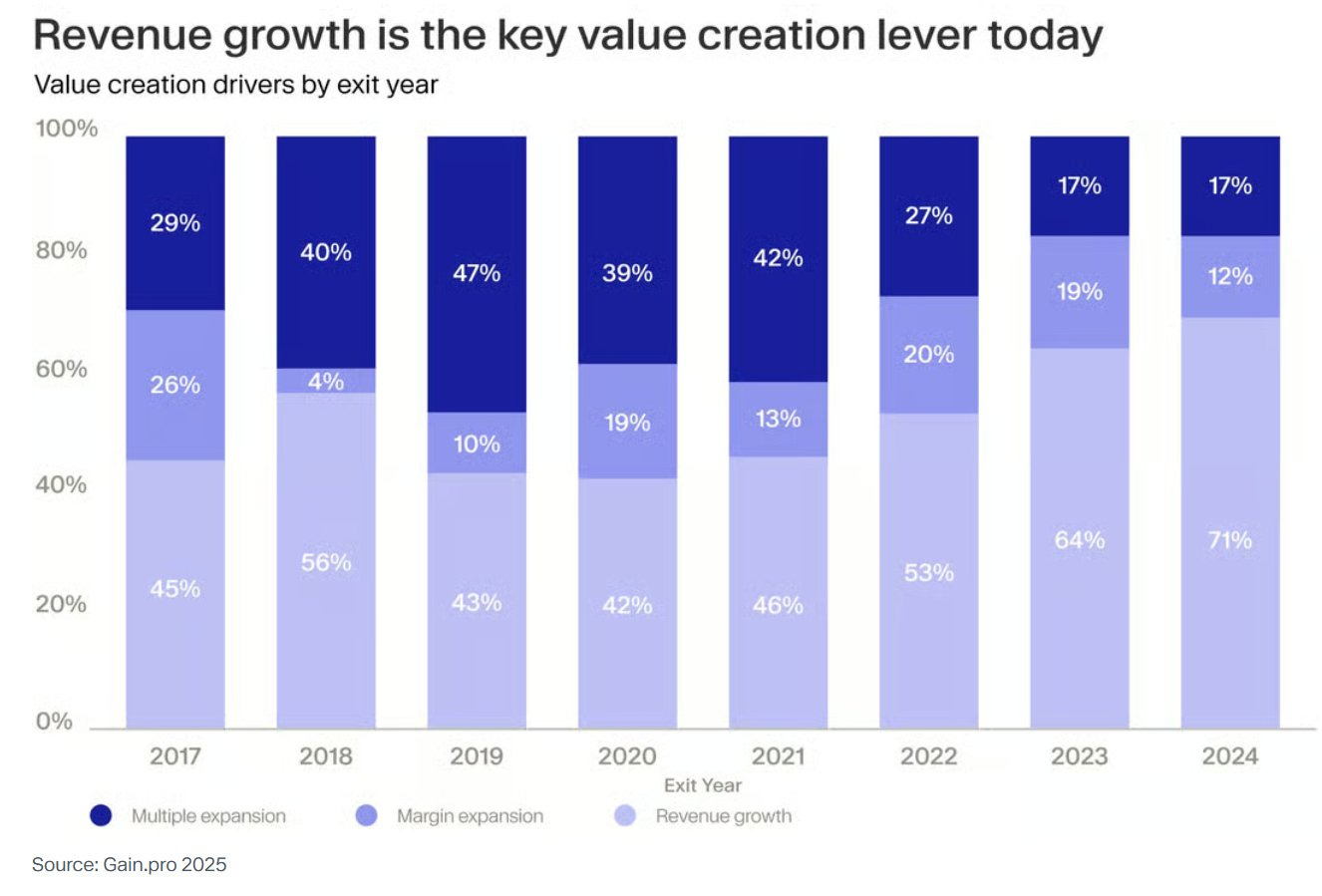
→ Why does it matter? We’ve been following the P/E story this year in Reading Ambitiously, and this may be one of the most interesting charts yet on the changing dynamics in P/E land. In 2019, margin and multiple expansion drove as much as 57% of value. Today, they account for just 29% which is a -28% drop. With money no longer cheap and rates higher, the premium on top-line growth has never been greater.
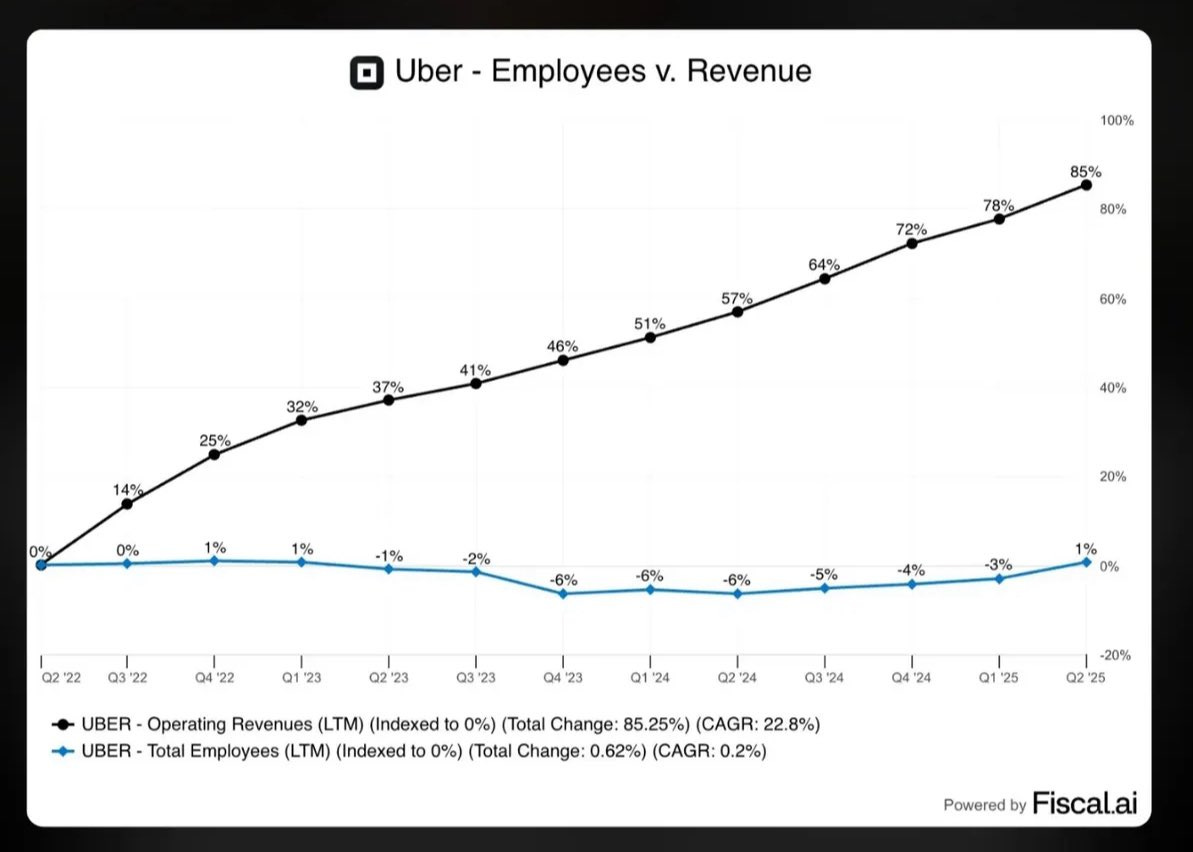
→ Why does it matter? Remember when Uber IPO’d and investors said profitability would never come? Look at revenue per employee climbing while headcount stays flat. And like me, I bet you’ve felt it too in Uber’s prices that only ever seem to increase.

Tweets that stopped my scroll:
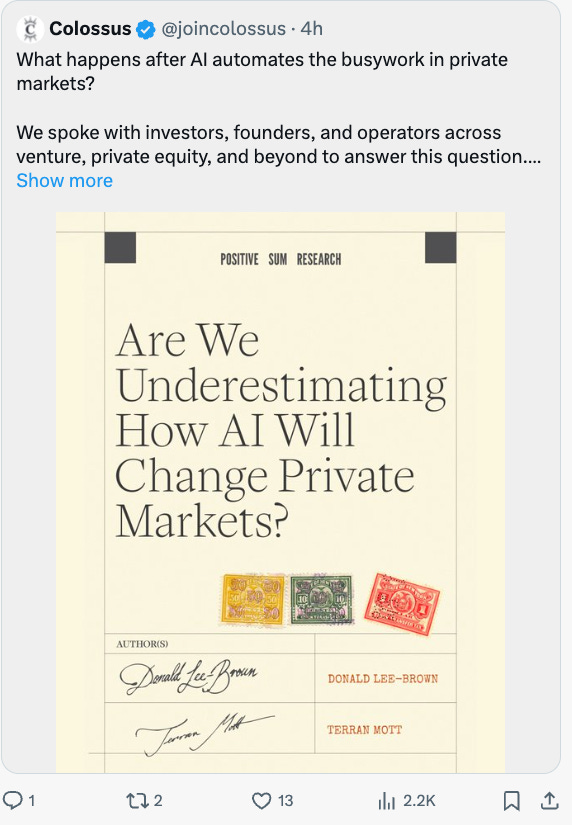
→ Why does it matter? Colossus is out with an in-depth report on how AI will impact private markets. The full read is linked here. We had the opportunity to collaborate with Donald Lee-Brown and Terran Mott on this piece and go along for the ride on their fascinating research journey.
Ultimately people—founders, builders, and investors—are what will drive AI’s impact on private markets. Technology alone won’t transform the trajectory of venture and PE over the next decade. Jack Lynch has perhaps the best advice to offer for anyone looking to successfully navigate the new opportunities created by AI. “The best investors are intellectually curious, they are contrarian, they are independent thinkers,” he explained. “Investing is of course a science, but equally an art. The science now promises to be enabled by new technology, but the art is what the world’s greatest investors have in common.”

Worth a watch or listen at 1x:
→ Why does it matter? Marc Benioff is the OG of OG’s in SaaS. He’s back in the arena with AgentForce. Harry Stebbins sent 53 cold emails inviting him onto the 20VC pod. Finally, he said, Yes. They cover a lot of ground here, and Marc has a tower in SF, worth a listen!
→ Why does it matter? Andrew Ng has been one of the most influential voices in AI for two decades. He co-founded Google Brain, led Baidu’s AI efforts, and made machine learning accessible to millions through his Stanford course and Coursera. Interested in how he’s approaching architecting Agentic systems? Give this a watch!
→ Why does it matter? Konstantine Buhler of Sequoia is one of the best storytellers in the business. He and his team are sizing what they see as a $10T AI market opportunity. The 15-minute presentation is well worth a watch.

Quotes & eyewash:
→ Why does it matter? Oh my gosh. South Park nails ChatGPT.
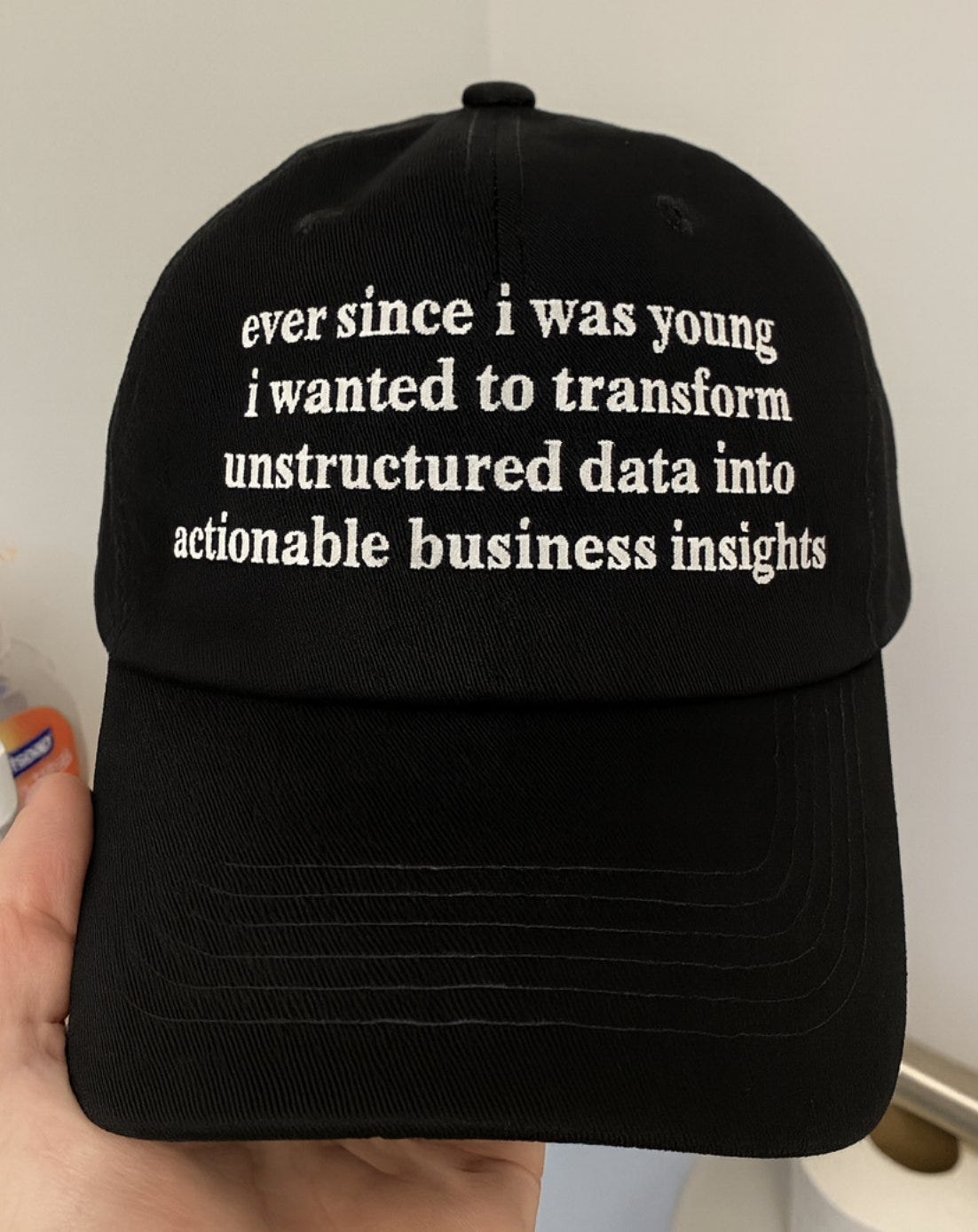
→ Why does it matter? I’d wear it!
The mission:
The Wall Street Journal once used “Read Ambitiously” as a slogan, but I took it as a personal challenge. Our mission is to give you a point of view in a noisy, changing world. To unpack big ideas that sharpen your edge and show why they matter. To fit ambition-sized insight into your busy life and channel the zeitgeist into the stories and signals that fuel your next move. Above all, we aim to give you power, the kind that comes from having the words, insight, and legitimacy to lead with confidence. Together, we read to grow, keep learning, and refine our lens to spot the best opportunities. As Jamie Dimon says, “Great leaders are readers.”