

Enjoy this week’s Big Idea read by me:

The big idea: If AI’s boldest predictions for software became reality, what would your leadership team do?

I can’t remember another period in my career when there were more predictions about how the world would change because of a new technology. Every day brings a new take: because of AI, this will be different.
And while many industries will shift, the world I’ve spent my professional life in is software. The predictions about how software will change are extraordinary. So it got me thinking: if these things were to happen, what would we do about them? That’s the question every management team should be asking.
This week’s Big Idea is meant to help with that exercise. We’ll discuss five popular predictions. Then, talk through how leadership teams might respond if they become true. The exercise is meant to force interesting thought starters. It helps separate the noise of today’s hype cycle from the structural changes that could alter your strategy for tomorrow.
The data control point is threatened
There is a reason Larry Ellison is worth $270B. Oracle’s primary product is a database. That has been the traditional moat logic: control the data, and you control the enterprise. Enterprises use systems of record to hold not just data but metadata, the data about the data, which has long been the oxygen that AI breathes.
Marc Benioff, founder and CEO of Salesforce, agrees. Remember, the “it” in AI is the dataset.
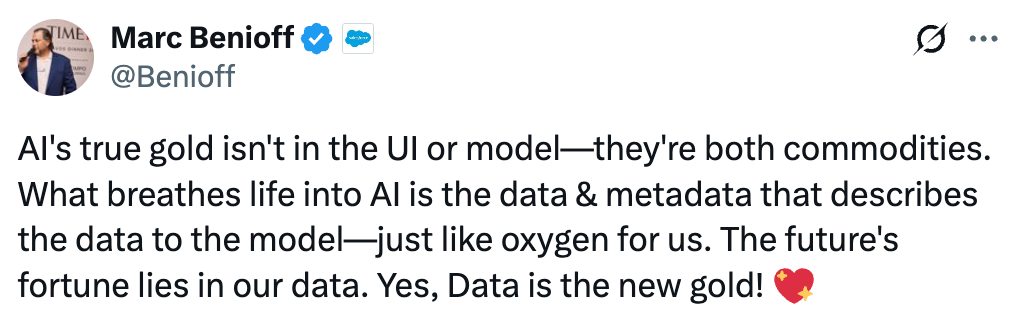
But does AI change this fortress logic? Some believe it does. Model Context Protocols, APIs, and LLM-native integrations now make it possible to hoover up data and metadata into a system of action on demand. Data moves from being locked away to becoming a raw ingredient that powers the job to be done. Salesforce knows the risk. Earlier this year, it changed agreements to restrict customers from exporting metadata into AI products like Glean.
Synthetic data pushes the boundary further. It is artificially generated to mimic the structure and statistical properties of real-world datasets. If you know the schema of the system of record - accounts, transactions, positions - you can generate synthetic replicas that behave like the real thing. With MCP or similar connectors, an action layer can use synthetic data as if it were live. The software cannot tell the difference.
A true system of record will always remain the authoritative source with persistence and ground truth. That persistence and statefulness is the fortress moat. Yet the moat may not hold forever. Systems of action could begin to accumulate their own records as they execute jobs. Synthetic or replicated data could be “good enough” for many tasks. And as users trust AI more to perform work, they may stop caring whether the underlying ground truth is canonical.
In regulated industries, the system of record likely remains mandatory. So if you’re building one of those, hooray for you! Everywhere else, the advantage tilts toward the system of action that gets work done faster and smarter. That is how the moat of ground truth could be penetrated.
That feels less like enterprise plumbing and more like the plot of an alien invasion movie.
AI writes all the software
For decades, the cost of building software has been dominated by the people who write it. Teams of engineers debated, designed, coded, tested, and released features. A software company's most valuable intellectual property has historically been the code.
Does AI change this? We have already moved from copilots that help humans write code, to agents that can stitch together entire workflows, to “vibe coding,” where entire modules are created in a weekend.
Earlier this year, Wix acquired Base44, an AI-powered vibe coding startup, for $80 million in cash. Base44 was built by a solo founder, Maor Shlomo, who grew it to 250,000 users in six months. The company was profitable and scaling despite heavy LLM compute costs. One person, with the right tools, built, scaled, and sold a software company in less than a year. That outcome would have been unthinkable in the prior software era.
This is the structural change leadership teams need to wrestle with. If a solo founder can spin up a product and reach escape velocity in months, what does that mean for a company with hundreds of engineers and a multi-year roadmap? The old calculus of resourcing, roadmaps, and release schedules breaks. Competitive advantage no longer comes from the size of your engineering team but from how quickly you can frame the right problems, prompt the right solutions, and deploy them safely.
Engineers do not disappear in this world. Their role shifts. They supervise, validate, and secure what AI creates. Engineering moves higher on the value chain. The moat, however, is no longer the code itself. It becomes the speed of iteration, the depth of customer insight, and the ability to orchestrate humans and machines into outcomes that competitors cannot replicate.
Implementation and adoption are led by AI
Implementation has always been a significant part of enterprise software. Customers invest time with consultants and integrators who learn the business, configure the product, and help teams adopt it. It is often the most resource-intensive stage of turning on something new.
Does AI change this? Instead of large project teams, SaaS products could ship with their own onboarding and deployment agent. The agent asks questions, pulls context from discovery, reviews existing data, and configures the system in hours instead of months. It does not just set up features. It recommends processes, flags unused capabilities, and guides adoption in real time.
This prediction challenges the services model. Systems integrators and professional services teams have long filled the gap between software and specific customer needs. If AI can close that gap, the traditional model will shrink, and implementation will become part of the product.
Services revenue may decline, but adoption speed improves. Time-to-value shortens. Expansions become easier because new features can be deployed continuously, and the same agents can help with adoption.
For leadership teams, the question is whether you see this as a threat or an opportunity. If you depend on services for revenue, the model is at risk. If you treat services as a bridge to adoption, you now have the chance to replace it with onboarding that scales.
The moat shifts. Not to who has the largest services bench, but to who delivers the smartest deployment agent and the fastest path from sale to value.
Purpose-built adaptive interfaces replace UI’s
The history of technology is the history of better interfaces. From command line, to graphical windows, to mobile touchscreens.
Most software still relies on standard screens, tabs, and dashboards. These are well-designed for broad use but necessarily general, and great software allows its customers to configure, making small adjustments to fit their work into the product.
Does AI change this? Instead of navigating menus, the software can generate the exact screen needed for the task at hand. Approving invoices might show only the relevant data points. Managing a construction project could combine weather, site photos, and schedules into a live workspace. The interface adapts to the context, not the other way around.
This matters because user experience is not just aesthetic. It shapes productivity, adoption, and trust. Static interfaces ask people to adapt to the tool. Adaptive interfaces allow the tool to adapt to the work.
Designing a “one-best” interface may no longer create a durable advantage. The moat shifts to the system that can assemble the right interface in real time, with speed and accuracy.
For leadership teams, the question is how much of your roadmap is tied to interface design. If adaptive generation proves real, the long tail of UI requests for new screens, new layouts, and new workflows shrinks. What matters is the quality of the models and the depth of context they can draw on to assemble the interface that gets the job done.
Software molds itself to the customer context, leading to infinitely personalized applications
Most modern software companies pride themselves on running all customers on a single version of the product. This simplifies maintenance, ensures consistency, and accelerates development. But it also enforces uniformity. Every customer gets the same schema, workflows, and dashboards. The best software companies offer a high degree of configuration to dial it all in.
Legacy vendors face the opposite problem. Years of branching and custom editions have left them with multiple versions of the same product to maintain. Customers often lag on upgrades, leaving vendors split between supporting the old and pushing the new.
Does AI change this? Instead of one-size-fits-all software, applications can adapt to each customer’s unique context. A construction company and a law firm could buy the same project management product and receive completely different systems—one optimized for job sites and permits, the other for case timelines and billing cycles. As a side note, I think this is in part why Atlassian is buying The Browser Company for $610m.
This is not customization in the old sense. It is a hyper-personalized system that generates the right schema, workflows, and interfaces automatically. It molds itself in real time based on the customer’s data, industry knowledge, and patterns.
The product adapts while the core code base remains stable. The advantage shifts to whoever can combine domain knowledge with adaptive models to make the product feel tailor-made on day one.
For leadership teams, the question is how close your product is to this vision. Are you still enforcing uniformity? Are you stuck supporting multiple versions? Or are you building toward a personalized system that learns from each customer and molds itself to their context?
The Bottom Line
Nobody has any idea if these predictions are going to be true. That’s why they’re predictions. And they probably won’t play out exactly as written. But they are useful thought experiments, and it’s a great exercise with your leadership team to ask the hard questions.
What if the moat of ground truth erodes?
What if code itself is no longer the scarce resource?
What if onboarding becomes software, not services?
What if interfaces assemble themselves?
What if the product molds to each customer?
AI shifts advantage away from static assets—schemas, codebases, services benches, fixed UIs—and toward dynamic systems that adapt in real time. The moat moves from ownership to action, from uniformity to personalization, from human labor to orchestration.
Clay Christensen framed the core choice in The Innovator’s Dilemma: “Will you protect the past, or build the future?” Maybe just as important: how long will you wait to see if these predictions become true, and what bets and risks will you take now to gain an advantage?

Best of the rest:
⚖️ Anthropic’s $1.5B Copyright Reckoning — The AI startup will pay a record sum to settle with half a million authors over pirated books used in training, a landmark deal that signals the industry’s shift toward costly upfront licensing. — The New York Times
📉 Salesforce cuts 4,000 jobs for AI efficiency – Marc Benioff bluntly says he needs “less heads” as AI takes over more work, making this one of the starkest examples yet of white-collar displacement at scale. – NBC Bay Area
🚀 The Jensen Huang Playbook – Nvidia’s rise wasn’t customer obsession or management orthodoxy, but Huang’s contrarian bets: skipping 1:1s, chasing overlooked markets, and building a trillion-dollar juggernaut by doing what others wouldn’t. – The Generalist
💰 AI Won’t Make You Rich — Jerry Neumann argues generative AI is a late-wave technology where value accrues to customers and incumbents, so the model and app layers will compress returns while the real upside flows downstream to cost-cutting service businesses. — Colossus
💸 Ellison Tops Musk — Oracle’s Larry Ellison surged past Elon Musk to become the world’s richest man, adding $101 billion in a year as investors reward his AI-fueled cloud pivot. It certainly helps that OpenAI just inked a $300 billion cloud deal with Oracle starting in 2027 — Bloomberg

Charts that caught my eye:
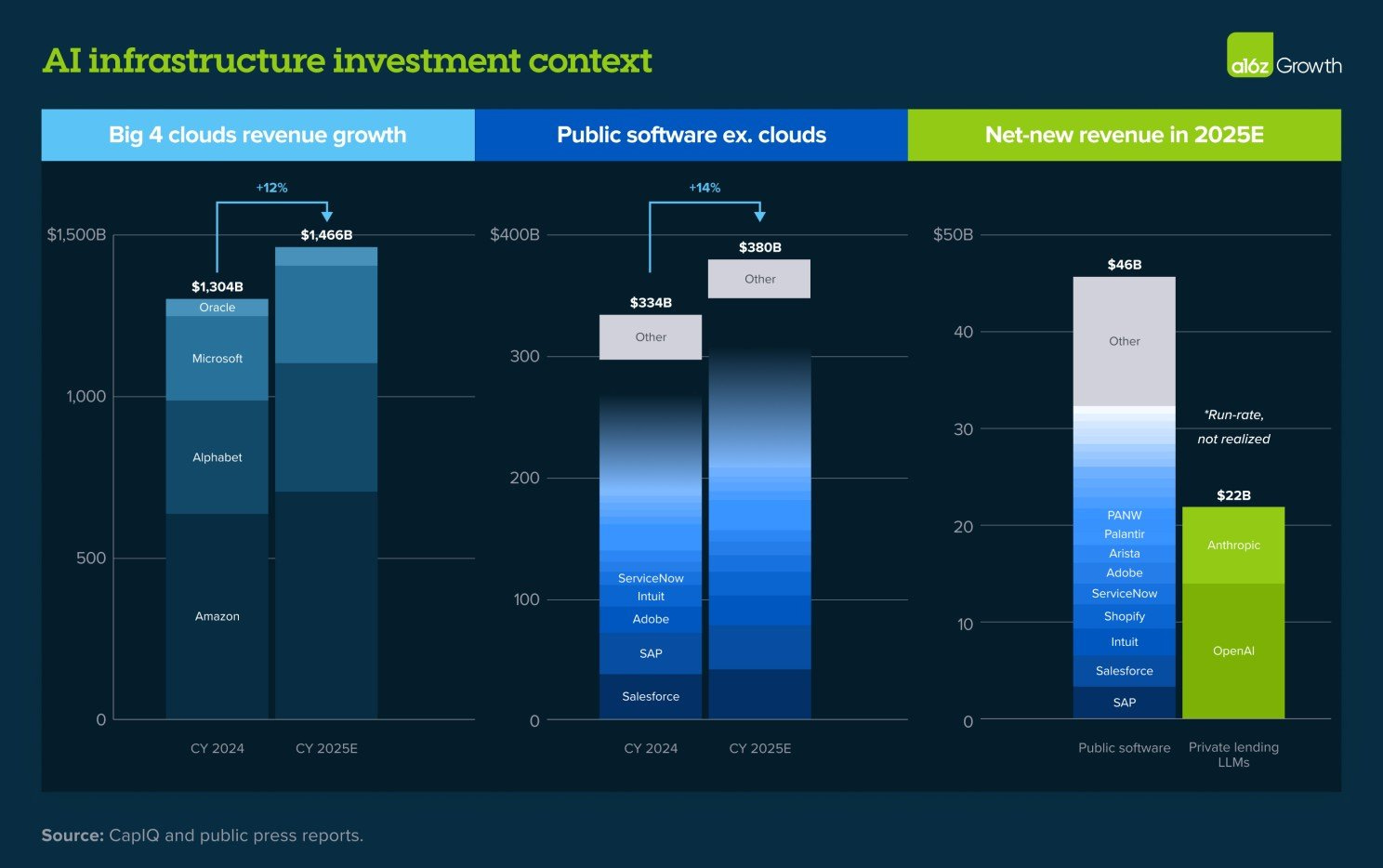
→ Why does it matter? OpenAI & Anthropic are adding the majority of new revenue of all public SaaS except Mag 7 this year.
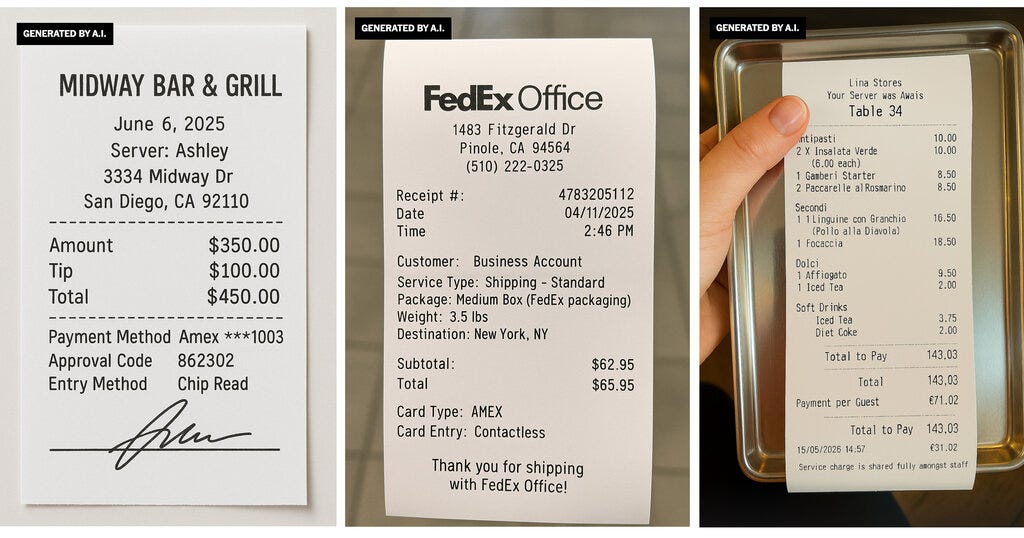
→ Why does it matter? These are all AI-generated receipts that people submitted for expense reimbursement. 🤯

Tweets that stopped my scroll:
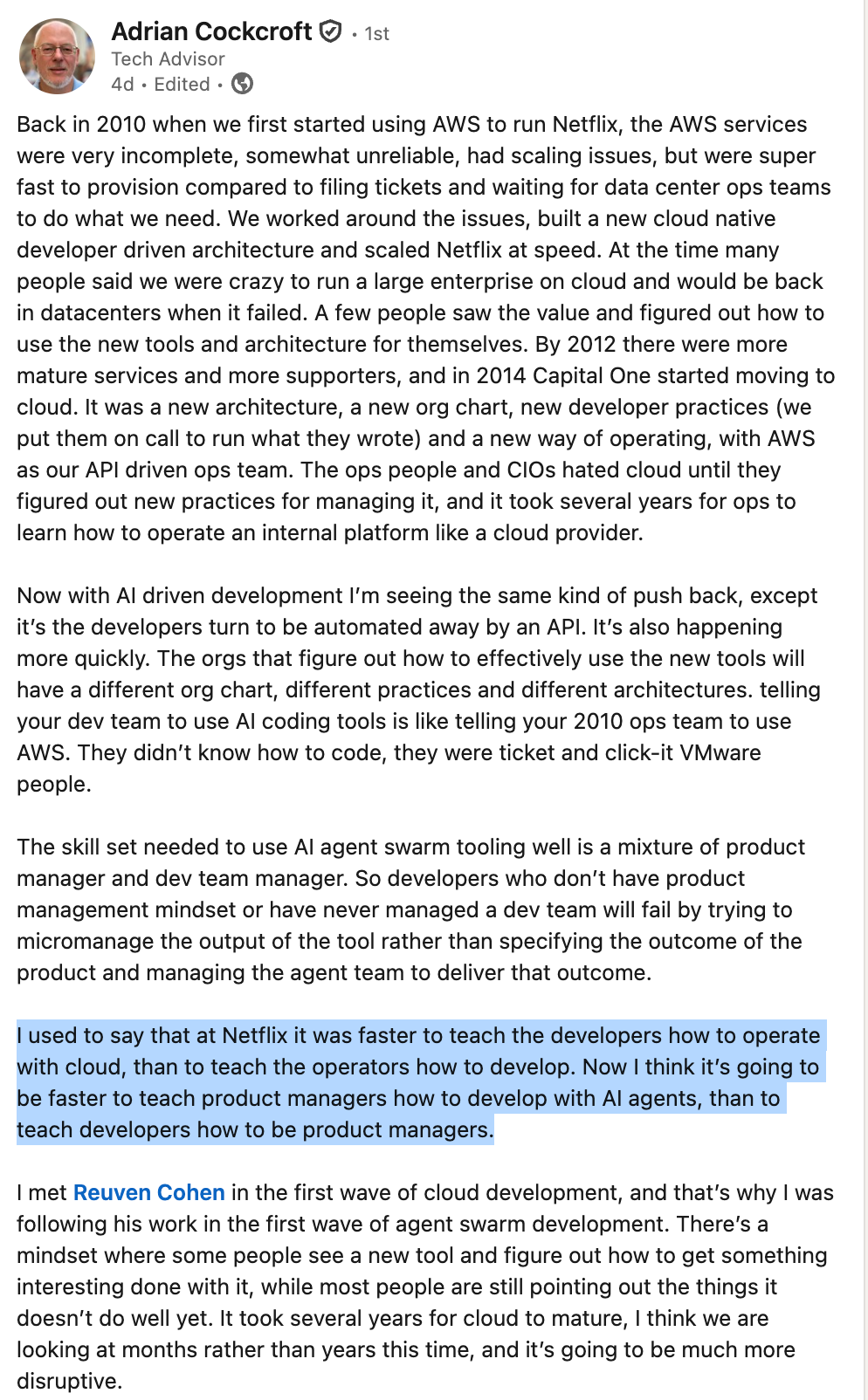
→ Why does it matter? Adrian Cockcroft, architect of Netflix’s migration to AWS. He’s a guru amongst cloud technologists. What he’s alluding to is the current $64,000 question: how does work change?

→ Why does it matter? Earlier this year, Sam Altman elevated Fidji Simo (ex-CEO, Instacart) to CEO of Applications. They’re incubating all sorts of products, including this one, a competitor to LinkedIn. Reminds me a bit of Google in the early days, first came search, then came Gmail, Chrome, Maps, Music… and well, you know the story.

→ Why does it matter? This is not a new chart, nor does the internet think it’s entirely accurate. But let’s say it’s directionally correct, the AI opportunity in healthcare is massive!

→ Why does it matter? Well, here is some further evidence of one of those predictions from this week’s Big Idea. Wow. 🤯

Worth a watch or listen at 1x:
→ Why does it matter? Perhaps you don’t want to watch this entire 3-hour live stream of Palantir’s annual conference, I get it. But I do suggest two things. First, 30:00 is Dr. Alex Karps’ keynote, worth a listen to how he’s positioning Palantir and AI. Up next are a lot of Palantir demos with their customers, like American Airlines. Palantir is notoriously opaque when showing the world its product. This is the most I’ve ever seen of their product.
→ Why does it matter? The bullish take on Robinhood is that they’re the next Charles Schwab, and you only get one of those per generation. It's worth listening to their CEO describe that vision.
→ Why does it matter? Disclaimer: This pod is a trip. In my sophomore year of high school, I was introduced to Joseph Campbell’s Hero’s Journey. It taught me that every story—ancient myth or modern film—follows archetypes. Wade Davis has spent his career rediscovering a new appreciation for the diversity of the human spirit and these archetypes, as expressed by culture.
→ Why does it matter? It’s Apple week, and we got all new iPhones. Marques Brownlee is one of my favorite tech reviewers these days. If you’re thinking about getting the new iPhone 17, he has a great take of choices. While that iPhone Air is quite tempting and an “ode” to the design language Apple is taking over the next few years, beware the trade-offs. It’s been going in and out of my cart for the reasons Marques lays out!

Quotes & eyewash:

“Don’t worry about the level of individual prominence you have achieved; worry about the individuals you have helped become better people.”
Clay Christenson
The mission:
The Wall Street Journal once used “Read Ambitiously” as a slogan, but I took it as a personal challenge. Our mission is to give you a point of view in a noisy, changing world. To unpack big ideas that sharpen your edge and show why they matter. To fit ambition-sized insight into your busy life and channel the zeitgeist into the stories and signals that fuel your next move. Above all, we aim to give you power, the kind that comes from having the words, insight, and legitimacy to lead with confidence. Together, we read to grow, keep learning, and refine our lens to spot the best opportunities. As Jamie Dimon says, “Great leaders are readers.”