

Enjoy this week’s Big Idea read by me:

The big idea: Stop scrolling, start thinking

I recently came across a video that stopped my scroll and caused me to think.
Hundreds of smartphones were lined up in the back room of a coffee shop. See the ranges? 451 to 460. That’s the count. Each device ran fake Instagram accounts, programmed to like, share, and comment automatically. They were manufacturing popularity to drive real customers through the door.
This is a bot farm, and it reveals something unsettling about the world. If a small business can fabricate influence this easily, what could a well-resourced operation be capable of? A nation-state?
We are at an important moment in history. Critical and independent thinking are on the line, and the social media platforms that promised to connect us now risk systematically dividing us.
From Reading to Gambling
After 75+ editions of Reading Ambitiously, the biggest lesson I have learned is that writing is 90% thinking and 10% typing. The hard part is not putting words on paper. It is carving out the space to think. Thinking produces beliefs. Beliefs create conviction. Conviction leads to a story worth telling.
Reading is one of the best ways to think. It is not passive absorption. It is a dialogue with another mind on the page. It sharpens perspective, tests assumptions, and reveals new connections. Reading is an extension of thinking.
The number one thing people are reading these days is social media. Pew Research reports that one in five Americans now gets their news from “influencers” on social platforms. And those algorithmic feeds are designed for one purpose: maximum engagement.
Every time we open X, TikTok, or Instagram, we are not simply reading. We are stepping into a system engineered with the same psychological mechanics as a casino. Former Facebook and Google insiders admitted that variable rewards - likes, shares, and infinite scrolls - were modeled directly on slot machines. Every swipe is a pull of the lever. Sometimes, nothing. Sometimes, the dopamine jackpot.
The platforms are not neutral tools. They are tuned for engagement, which often means amplifying what is outrageous, polarizing, or emotionally charged. That does not make them the sole problem. It does mean we have to approach what we consume with skepticism and awareness.
The Compromised Web
When I first signed up for Facebook, I “friended” a few people and shared photo albums. It was a small community, limited to classmates, family, and friends.
Two decades later, that world is gone. Social media is way less about connection. It has become a system for industrially manufacturing visibility and influence.
The coffee shop bot farm is not an outlier. Much of the internet is already compromised. Researchers have documented coordinated campaigns using the same tactics to shape what people see and believe. False stories spread faster than true ones, and platforms continue optimizing for engagement over accuracy. This is not unique to social media, traditional outlets also face their own incentives and biases.
Consider what this means for anyone trying to understand what is actually happening in the world. How much of what we see is real signal versus manufactured noise? When “grassroots” movements can be bought for the price of a few dozen smartphones, how do we separate authentic trends from coordinated manipulation?
This is why the responsibility shifts back to us: to verify before trusting and to look for depth beyond the headline.
A Generation Distracted
The stakes are highest for young people. Last year I read The Anxious Generation. Jonathan Haidt’s research shows how the rise of smartphones and social media in the early 2010s coincided with a sharp increase in anxiety, depression, and self-harm among teenagers. Rates of teen depression in the United States nearly doubled between 2011 and 2019, just as smartphones became universal.
But the damage extends beyond mental health. A generation is growing up without sustained attention, without learning to sit with difficult thoughts, and without developing the patience required for deep work. When our brains are rewired for three-second videos, how can one read a 300-page book? How do we think through complex problems that don’t have quick answers?
And this isn’t just about teenagers. The same platforms are reshaping adult cognition. How often do we catch ourselves jumping to the next notification or struggling to stay focused in a meeting while Slack or Teams pings in the background?
Without space to think, there is no room for belief, conviction, or deep work.
The New Cigarette
This is not the first time a generation has awakened to the harm of a product once thought harmless. For decades, cigarettes were marketed as glamorous, even healthy. Doctors appeared in ads recommending specific brands. Only later did people realize the health consequences and their addictive power.
The industry faced a reckoning. Philip Morris, the world’s largest cigarette manufacturer, tried to distance itself from the damage by rebranding as Altria. The products did not change. Only the name.
Sound familiar? Facebook became Meta. Twitter became X. Google became Alphabet. Rebrand the company, pivot to the Metaverse or AI, and shift attention away from the product’s current costs.
But unlike tobacco, which primarily harms the body of the smoker, social media is systematically degrading our collective ability to process truth. It undermines our ability to agree on facts, think independently, and engage in good-faith dialogue.
Reclaiming Attention
The call to action is not simply “put the phone down and go outside,” though that helps. The deeper challenge is how we choose to consume information.
It all comes down to critical thinking, trusting only after verifying, and engaging in thoughtful debate on important issues. All of this takes time. And time is exactly what feels most scarce in our fast-paced world, even as we live with the most advanced technology in human history at our fingertips.
The task, then, is balance. Use social media with clear limits. Treat it like a tool, not a default. Pair it with practices that restore depth: primary sources, long-form reading, and conversations that stretch our perspective. Old books that have stood the test of time can sharpen judgment in ways no feed ever will.
If you are a parent, start by educating yourself. If you haven’t read The Anxious Generation, I recommend it. Then equip your children with the skills to navigate this environment, without being consumed by it.
Guard The Most Valuable Asset
When I sit down to write, the hardest part is not typing. It is finding the space to think. That space is shrinking for all of us. The platforms profit by filling every gap with noise.
Independent thought is now the rarest resource we possess. It cannot be manufactured, rebranded, or automated, and worse, it cannot be outsourced to AI (Reading Ambitiously 8-1-25). It comes only from protecting our attention, creating space, and choosing carefully what we consume.
The challenge is balance. Technology gives us extraordinary tools, but without discipline, it erodes the very focus we need to use them well. Critical thinking, verifying before trusting, and engaging in thoughtful debate take time. Guard that time.
The platforms will not change because the attention casino is too profitable. We all have the agency. Either keep pulling the lever or stay awake to how influence is manufactured and reclaim the space to think. Independent thought is the most valuable asset we have, and protecting it makes a better future possible.

Best of the rest:
🔥 Irrational Dedication — Everything we take for granted—hotels, businesses, entire industries—exists only because someone pushed through years of pain, doubt, and near-collapse with a stubborn refusal to quit. — Farnam Street
🛡️ Netskope Targets $7.3B IPO – The cloud security firm is raising its price range ahead of a Nasdaq debut, looking to pull in $908M and test investor appetite for cybersecurity bets in a volatile tech market. – CNBC
💰 Microsoft’s $170B Bet on OpenAI – A restructured OpenAI could soon be valued near $170 billion, with Microsoft poised to take a 30% stake and the nonprofit parent retaining a $100 billion-plus slice, cementing this as one of the most lucrative AI partnerships in history. – Financial Times

Charts that caught my eye:
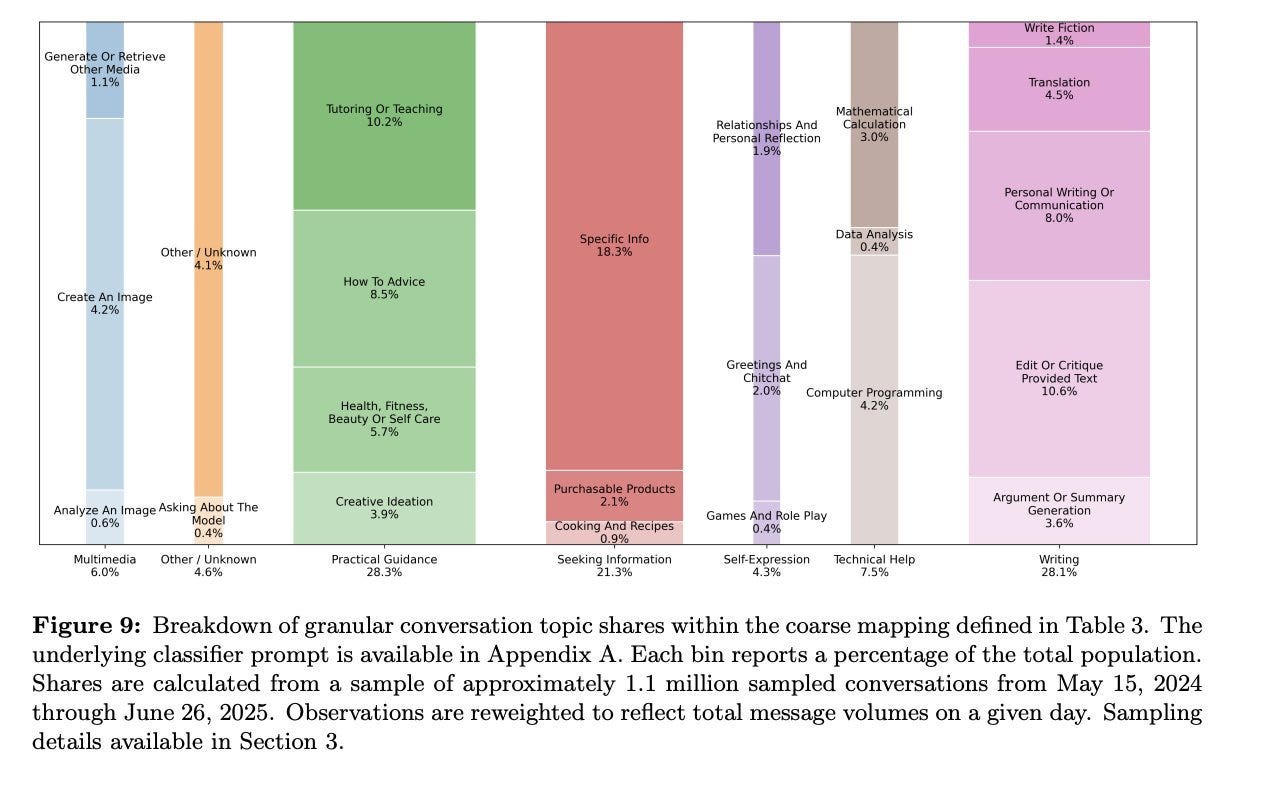
→ Why does it matter? ChatGPT now has 700 million weekly users sending 18 billion messages, about one in ten adults worldwide. OpenAI’s new research shows how they’re using it, and the patterns surprise: 73% of usage is non-work, including 2% just for “Greetings & Chitchat.” Turns out even saying Hello is getting outsourced.
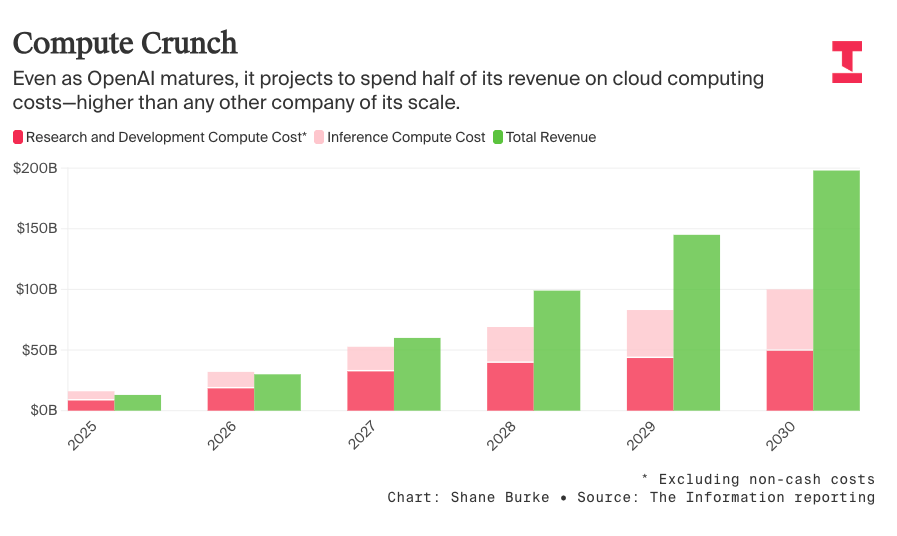
→ Why does it matter? OpenAI’s growth runs on an expensive treadmill. By 2030, it expects three-quarters of revenue to go to compute and talent, half to cloud alone. That locks margin power with Microsoft, Oracle, and others, unless OpenAI builds its own capacity (which it has hinted at) or invents cheaper ways to route queries.
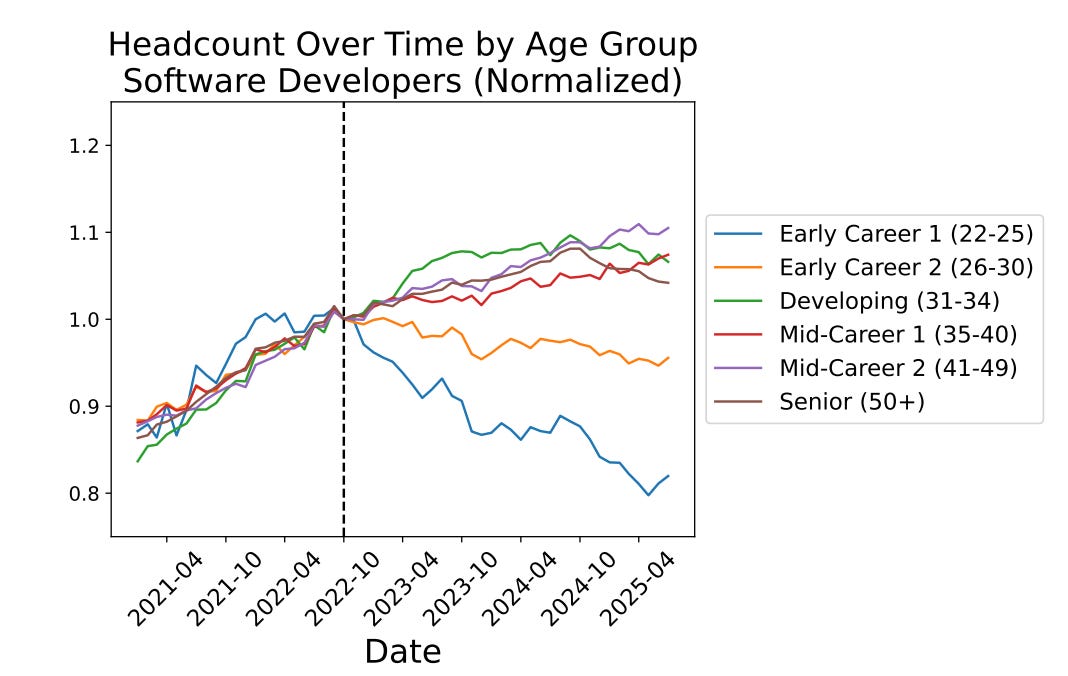
→ Why does it matter? Interesting chart from the paper Canaries in the Coal Mine. Is AI replacing entry-level software development work? If so, that’s progress. But it means we need a systematized way to hire and train junior talent. Think of Google’s Associate PM program or Sierra’s APX program. Grooming young talent isn’t optional. It’s how organizations ensure a future.
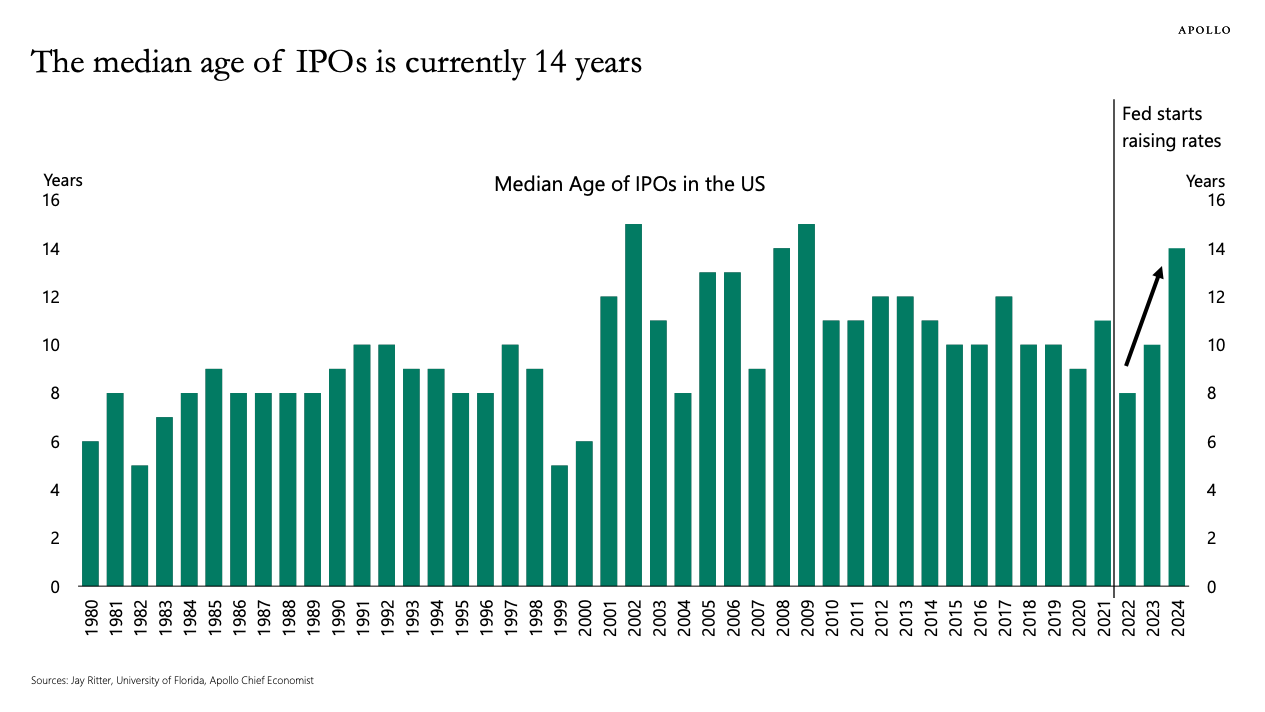
→ Why does it matter? Apollo points out that U.S. IPOs are now on average taking 14 years, and 2025 deals line up with that. WaterBridge Infrastructure (10), Pattern Group (12), and Netskope (13). StubHub is the exception at 25 years, but most entrants this year cluster close to the median. Amazon, by contrast, went public in just 3 years. Companies are staying private much longer.

Tweets that stopped my scroll:

→ Why does it matter? The best product feels “magical”. Think about the first time you used ChatGPT? Magic. As one designer pointed out to me, it’s all about “surprise” and “delight”.

→ Why does it matter? The Bloomberg Terminal is an icon. Owning one signals status as much as access. It’s one of the rare products where users want to be photographed in front of it, because the image alone conveys everything they want the world to know. I came across an older video of Michael Bloomberg giving a world tour that is worth a watch.

Worth a watch or listen at 1x:
→ Why does it matter? Arthur Brooks, author of The Happiness Files, makes a sharp case for why boredom matters and how leaning into it can unlock deeper focus and creativity. A quick watch, about five minutes, and worth it.
→ Why does it matter? If you work in or around software, don’t miss Patrick O’Shaughnessy’s interview with Jeff Horing, founder of Insight Partners. Venture capital has become far more institutionalized, and hearing Jeff outline his approach gives a perspective on the playbook of one of the best.

Quotes & eyewash:
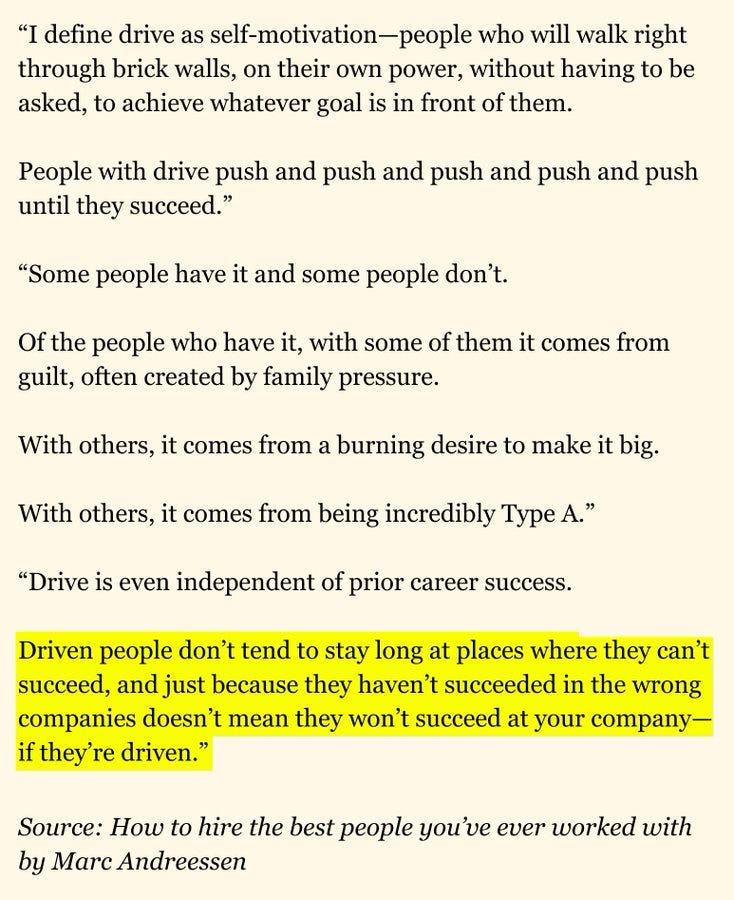
→ Why does it matter? High agency is one of the strongest predictors of success. My favorite definition: “Find a way to get what you want, without waiting for conditions to be perfect or blaming the circumstances.”
The mission:
The Wall Street Journal once used “Read Ambitiously” as a slogan, but I took it as a personal challenge. Our mission is to give you a point of view in a noisy, changing world. To unpack big ideas that sharpen your edge and show why they matter. To fit ambition-sized insight into your busy life and channel the zeitgeist into the stories and signals that fuel your next move. Above all, we aim to give you power, the kind that comes from having the words, insight, and legitimacy to lead with confidence. Together, we read to grow, keep learning, and refine our lens to spot the best opportunities. As Jamie Dimon says, “Great leaders are readers.”