

Enjoy this week’s Big Idea read by Mark & Pat:

The big idea: Business is more than numbers. It’s a narrative. Software can tell the story.

Since the beginning of commerce, businesses have tracked their numbers. The earliest evidence of bookkeeping goes back to 3000 BCE, when the Mesopotamians recorded goods, labor, and taxes on clay tablets. Centuries later, double-entry bookkeeping in the Middle Ages came, and today, we rely on cloud software to track debits and credits. We call this the System of Record. It is timeless, essential, and incomplete. Any business owner will tell you that numbers only tell half the story.
A business is more than its metrics. It is a narrative shaped by millions of decisions made by employees, customers, partners, and the world around them. Those decisions create the actions that produce the records. This narrative data is critical, but until now it has been largely untapped. The context of your business has been lost to history, and its lessons forgotten, simply because we lacked the technology to capture and analyze it.
Generative AI changes that. It can read and synthesize unstructured content from multiple modalities at scale, revealing nuances that numbers alone cannot. This is not just a new tool. It is a new paradigm for how we build software and the value we expect from it.
Unlocking this opportunity requires more than better bookkeeping. It requires a new kind of system, one built not just to record but to understand intent. A System of Intent.
Capturing the why
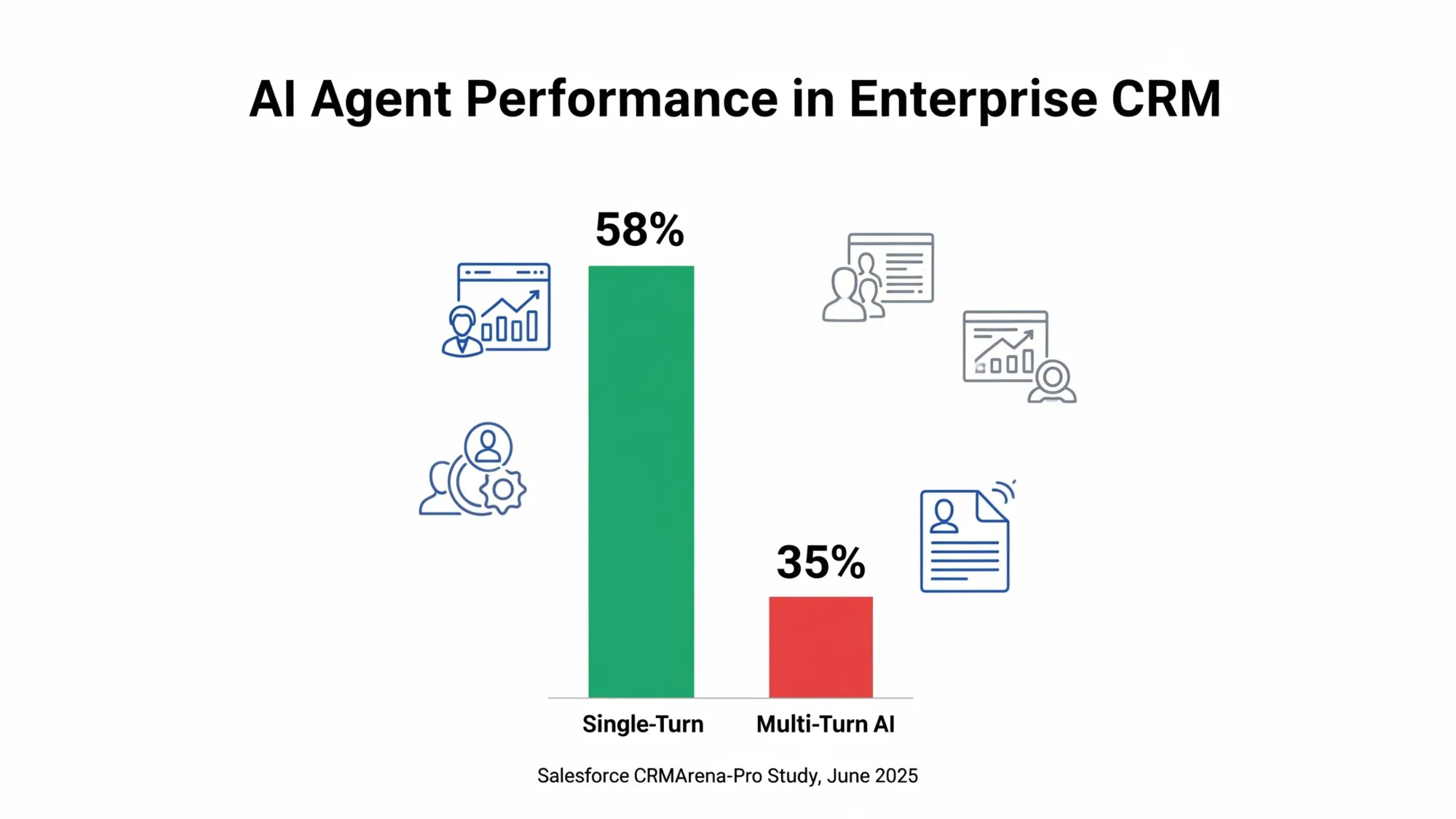
Companies are deploying Generative AI broadly but not seeing the gains they expected. A recent Salesforce study revealed that leading [AI] agents achieve only 58% success rates in single-turn business scenarios, with performance plummeting to 35% in multi-turn interactions.
Is this the Gen AI bubble bursting? Not at all, what we’re seeing is the natural trajectory of a new technology. Large Language models are powerful tools for building great products, but they are rarely the product itself. Roads aren’t valuable because they’re made of asphalt, they’re valuable because they take you somewhere you want to go. In the same vein, AI isn’t valuable in isolation; it’s valuable for what it enables. The companies that will excel in this new era are those weaving AI seamlessly into products that solve real problems.
OpenAI recently launched an Enterprise consulting division to help embed AI into corporate workflows. The Price Tag? At least $10 million. Our takeaway from this investment is that simply handing employees an enterprise ChatGPT license puts the burden on them to become expert prompt engineers and system integrators when in reality, the product should absorb that complexity. AI can accelerate individuals, but to accelerate an entire organization, you need to redesign the underlying systems themselves.
Building AI-native systems within your business requires equipping LLMs with the appropriate context they need to be effective. LLMs need your firm's institutional knowledge and the historical context of a seasoned employee, yet most businesses don’t have this data stored.
The systems most businesses have relied on up until now.
The System of Record is the “what”. Your CRM holds customer data, your ERP tracks inventory, and your financial system records transactions.
The System of Action is the “how”. Your email platform sends messages, your project management tool assigns tasks, and your e-commerce platform processes orders.
The missing piece is the why. Why did someone perform the actions that created the records?. The why is scattered in Slack threads, buried in emails, locked in private notes, or known only to the team members who experienced it firsthand. That critical context has rarely been centrally captured, but is now essential for finding success with Gen AI.
Business Intelligence tools were meant to fill this gap. By analyzing the what and the how, it sought to uncover the why through data analysis. But those “whys” were always indirect patterns, not explanations. Correlation, not causation.
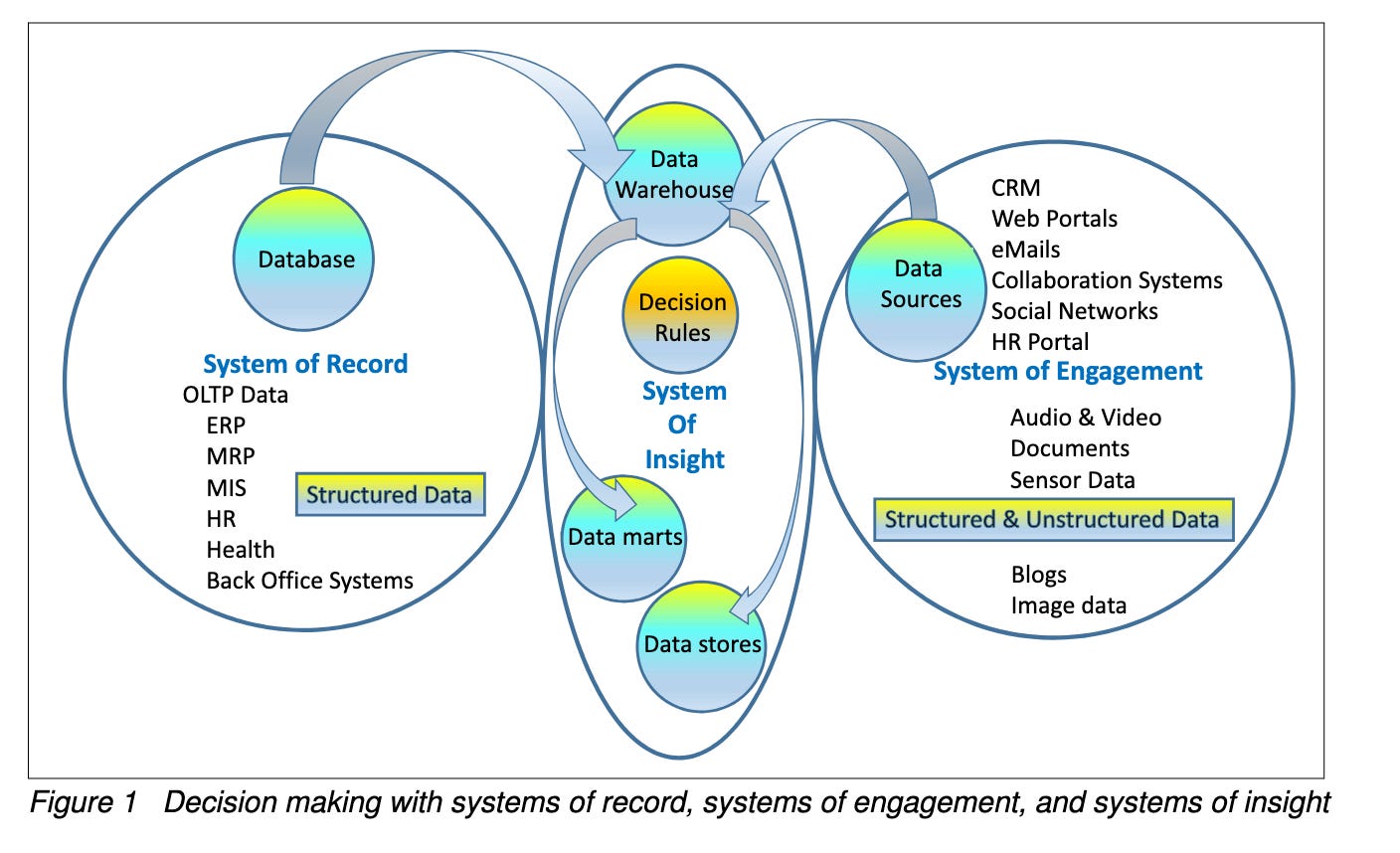
Generative AI has opened the door to an entirely new era of software. For decades, the Systems of Record and Action have been limited to structured records of what happened, line by line, field by field. Useful, yes, but always limited to what could be captured in neat rows and columns.
Now, large language models can interpret nuance, connect patterns, and understand the messy, unstructured reality of business. They can chew through years of meeting notes, documents, emails, and chats, then marry those insights with the structured records of what occurred. Suddenly, your systems don’t just track history, they begin to tell the story of your business.
Agentic AI takes this shift even further. It compounds the value of understanding by acting. These are not passive systems waiting for a query; they are active participants, delivering insights, recommendations, and automation based on your firm's unique context.
To unlock this potential requires a new kind of platform: a System of Intent. This isn’t just another software layer, it’s a foundation that captures the reasoning, institutional knowledge, and context behind every action. A System of Intent doesn’t just preserve what your organization did, it preserves why. And when the why is captured, it can be reapplied, feeding into future decisions, anticipating needs, and shifting automation from reactive to proactive.
This is the frontier of enterprise AI: software that does not record the past but understands the present and shapes the future.
Imagine a CRM that doesn’t just record a deal as “lost.” Instead, it recognizes that the rep sensed price sensitivity in the customer’s tone, compares that pattern to similar deals, and suggests a more effective pricing strategy for the next prospect.
This isn’t the future, it’s possible today. But most firms aren’t set up for success. For AI to leverage intent, that intent must first be captured and organized. This requires two shifts. Culturally, employees must move from simply doing their work to also documenting the reasoning behind it. Technologically, firms need platforms that can capture and structure that reasoning for future use.
Fortunately, AI can play a role here, too. A System of Intent can proactively gather context from emails, meeting notes, deal characteristics, and support histories, assembling a complete picture of not just what happened, but why. It then proposes this context for quick human review and approval. At first, these micro-interactions may feel like added steps. But as the system learns, the friction fades. Prompts give way to suggestions, until confirming intent takes seconds, not minutes.
The real breakthrough comes when captured intent feeds back into the system. Faced with a similar situation, it doesn’t just surface history, it explains the why and recommends the next best action. With every cycle, it becomes more adaptive, more anticipatory, and more seamlessly woven into the fabric of decision-making.
Context, the minimum required but no less
Capturing all of this intent is challenging, but using it effectively to yield good results through agentic automation is another hurdle. Agents succeed when they’re given the right balance of context and actions. Much like briefing an executive, you provide only the information that matters and the levers they can pull, nothing more, nothing less. Too little context, and the Agent can’t reasonably act. Too much, and its discernment falters. Clarity matters more than volume.
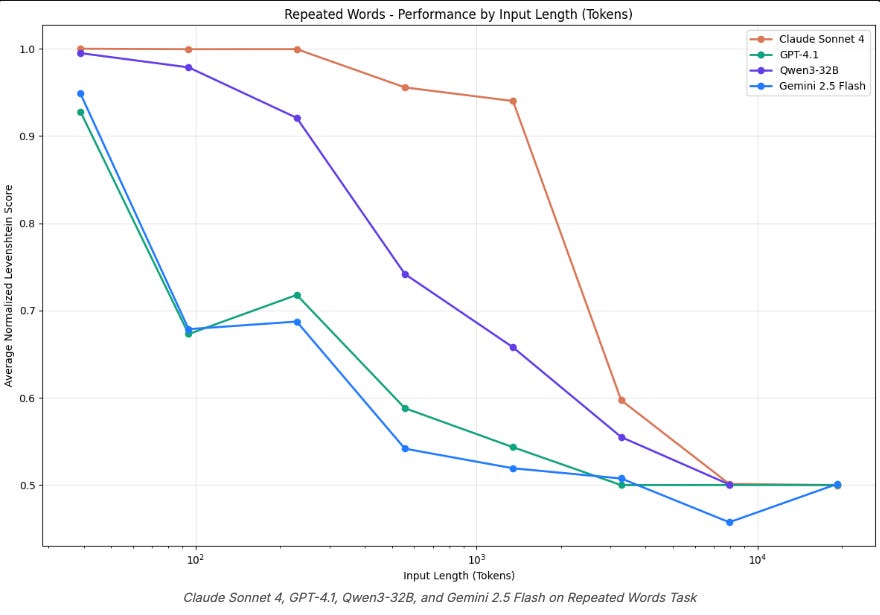
As model context windows expand, it’s tempting to believe that “more input” equals “better results.” Research suggests otherwise. Context rot shows that long context is far from a solved problem: effectiveness often degrades as input context size increases, and benchmarks underestimate how difficult long-context reasoning really is in real-world applications.
Intent becomes the bridge between human judgment and Agent action. Effective systems ensure that the reasoning captured in past situations aligns with the levers an Agent can act on in the present. That alignment allows the Agent to map current context to prior intent, infer the right course of action, and improve through a feedback loop: human reasoning → captured intent → AI context → better automated decisions.
The idea of feeding past experience into AI isn’t new. Many GenAI products already offer “memory,” but most fall short. They often store what happened, but not why. As Sam Altman put it, “People want memory, people want product features that require us to be able to understand them.” That understanding depends on capturing intent: the reasoning behind the action. Intent turns memory from a static log into actionable context: the difference between simple recall and true understanding.
In the end, thoughtful product design ensures that intent is not just recorded but operationalized. That alignment between the what, the why, and the how makes agentic automation truly effective.
The Bottom Line
We are at an inflection point. For decades, enterprise systems have captured what happened and how it happened, but not why. That missing layer of reasoning is the key to unlocking the true potential of AI.
The future isn’t about AI as a standalone product. It’s about what AI enables when it’s paired with thoughtful product design and a deep understanding of human intent. That is the promise of a System of Intent: a foundation that captures context, operationalizes reasoning, and transforms memory into action.
If you can capture intent, deliver it clearly, and design systems that work seamlessly for both humans and AI, your business will not only keep up with the AI era but define it.

Best of the rest:
⚖️ Google Dodges a Breakup – A federal judge ruled that Google abused its search monopoly but stopped short of drastic remedies, requiring only data-sharing with rivals instead of the sweeping structural changes the government sought. – New York Times
🤖 Personality Without Personhood – Mustafa Suleyman warns that “seemingly conscious” AI is imminent and urges firms to design companions that help humans without claiming feelings or rights, pushing for clear guardrails before society confuses simulation with sentience. – Mustafa Suleyman
💸 Fintech IPO Fever Returns – Klarna is back on the public markets track, aiming to raise $1.27B at a sharply reduced $14B valuation, while blockchain lender Figure is chasing a $4.1B debut—two big tests of investor appetite for fintech’s next chapter. – TechCrunch and Reuters

Charts that caught my eye:
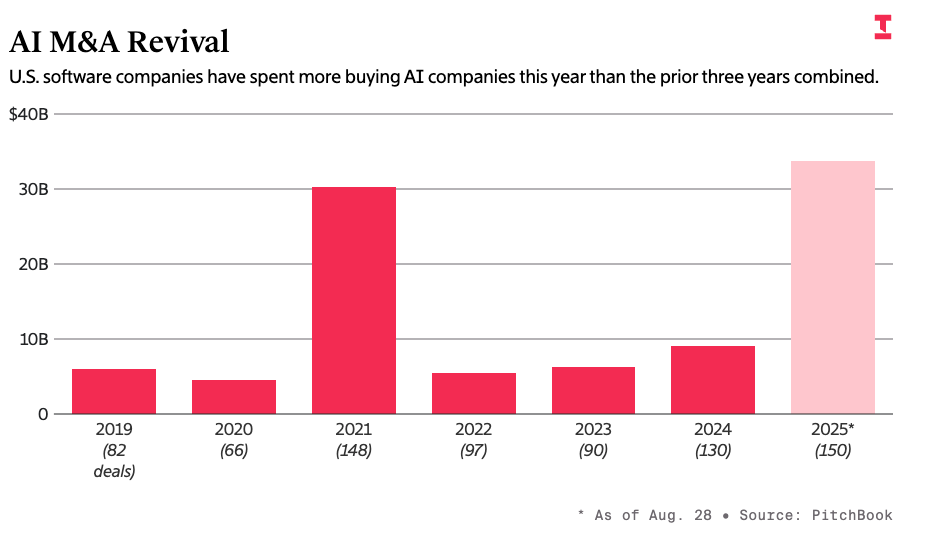
→ Why does it matter? According to The Information, so far this year, U.S. software companies have spent nearly $33.8 billion on 140 completed AI acquisitions, surpassing the combined volume of the past three years, according to data provider PitchBook.

Tweets that stopped my scroll:

→ Why does it matter? You can enable and play around with the new AI-enabled Google Finance. Try this link: Google Finance Beta

→ Why does it matter? Disruption leads to reinvention, but first, there is a lot of fear, uncertainty, and doubt. It’s so interesting to see this rhetoric used across the industry to drive different agendas. Palantir has a different take on it: “the most prosperous era in our history.”
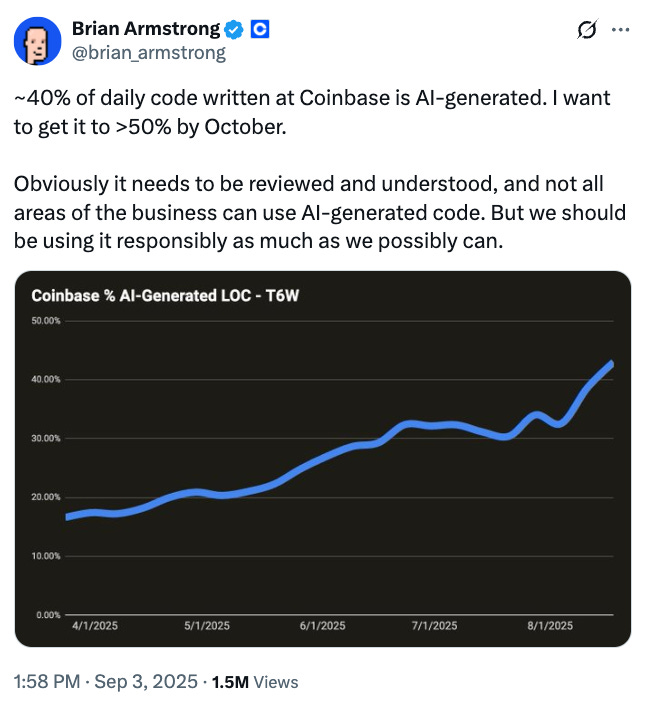
→ Why does it matter? Coinbase now generates about 40% of its daily code with AI, aiming for more than half by October. On its own, that number is a bit of a vanity metric. But for a $78 billion company in the S&P 500, it shows how quickly AI is becoming part of the fabric of day-to-day work. Engineers are leaning on tools like Cursor and Copilot to move faster, and management is measuring AI use alongside traditional productivity metrics. The detail worth watching isn’t the percentage itself, but the way a large, regulated company is normalizing AI in production software.

Worth a watch or listen at 1x:
→ Why does it matter? If you want an up-to-date perspective on U.S.–China relations and the AI race, this is worth listening to. Bill Gurley just returned from a trip to China with first-hand insight into what’s really happening on the ground. China’s VCs and entrepreneurs are intensely focused on AI and emerging tech, sometimes spotting and scaling trends faster than their Western peers. Gurley’s take offers a reality check on how execution, capital flows, and policy priorities are shaping the balance of innovation between the U.S. and China.
→ Why does it matter? If you have 42 seconds to watch this demonstration of Google’s new Veo3 model, it’s most definitely worth it!
→ Why does it matter? Marc Rowan’s definition of alts? Any alternative to publicly traded stocks and bonds. Family Offices are now 50%+ private investments and Apollo intends to make these investments more available to retail investors. While he’s quite bias, worth listening to him explain the convergence of public and private markets.

Quotes & eyewash:
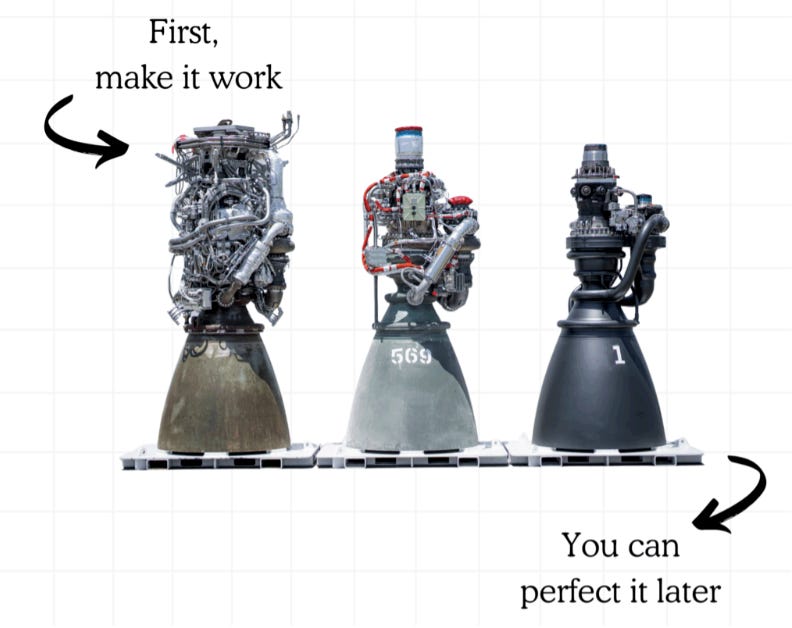
→ Why does it matter? I think about this chart often. Reid Hoffman has a great line here: “If you are not embarrassed by the first version of your product, you’ve launched too late."
The mission:
The Wall Street Journal once used “Read Ambitiously” as a slogan, but I took it as a personal challenge. Our mission is to give you a point of view in a noisy, changing world. To unpack big ideas that sharpen your edge and show why they matter. To fit ambition-sized insight into your busy life and channel the zeitgeist into the stories and signals that fuel your next move. Above all, we aim to give you power, the kind that comes from having the words, insight, and legitimacy to lead with confidence. Together, we read to grow, keep learning, and refine our lens to spot the best opportunities. As Jamie Dimon says, “Great leaders are readers.”