


The big idea: Run the business, change the business
Reading time: 5 minutes

Happy Friday, Ambitious Readers. I rarely combine my worlds in these notes. This week is an exception.
I’m coming to you from Ridgeline’s Base Camp, our fifth annual customer conference. At the first one, we fit the closing ceremonies into the lobby of our Lake Tahoe HQ. This year we welcomed 375+ attendees from across the industry.
From an outsider’s perspective, you’d have thought we hosted a wedding, not a customer conference. And that is the way it should be. Of everything I’ve learned from Dave Duffield over the years, bringing your customers together and building a real community sits near the top of his playbook.
We also announced the completion of our Series E: $250M of new capital at a $1.4B valuation. Bloomberg did a nice job covering the news. The capital will support the pace of innovation our customers have come to expect, deepen our investment in AI, and help us continue to attract and retain the best talent in the world.
Thank you to the readers who have shaped my thinking, and by extension our strategy, over the years.
Now, let’s jump into this week’s big idea
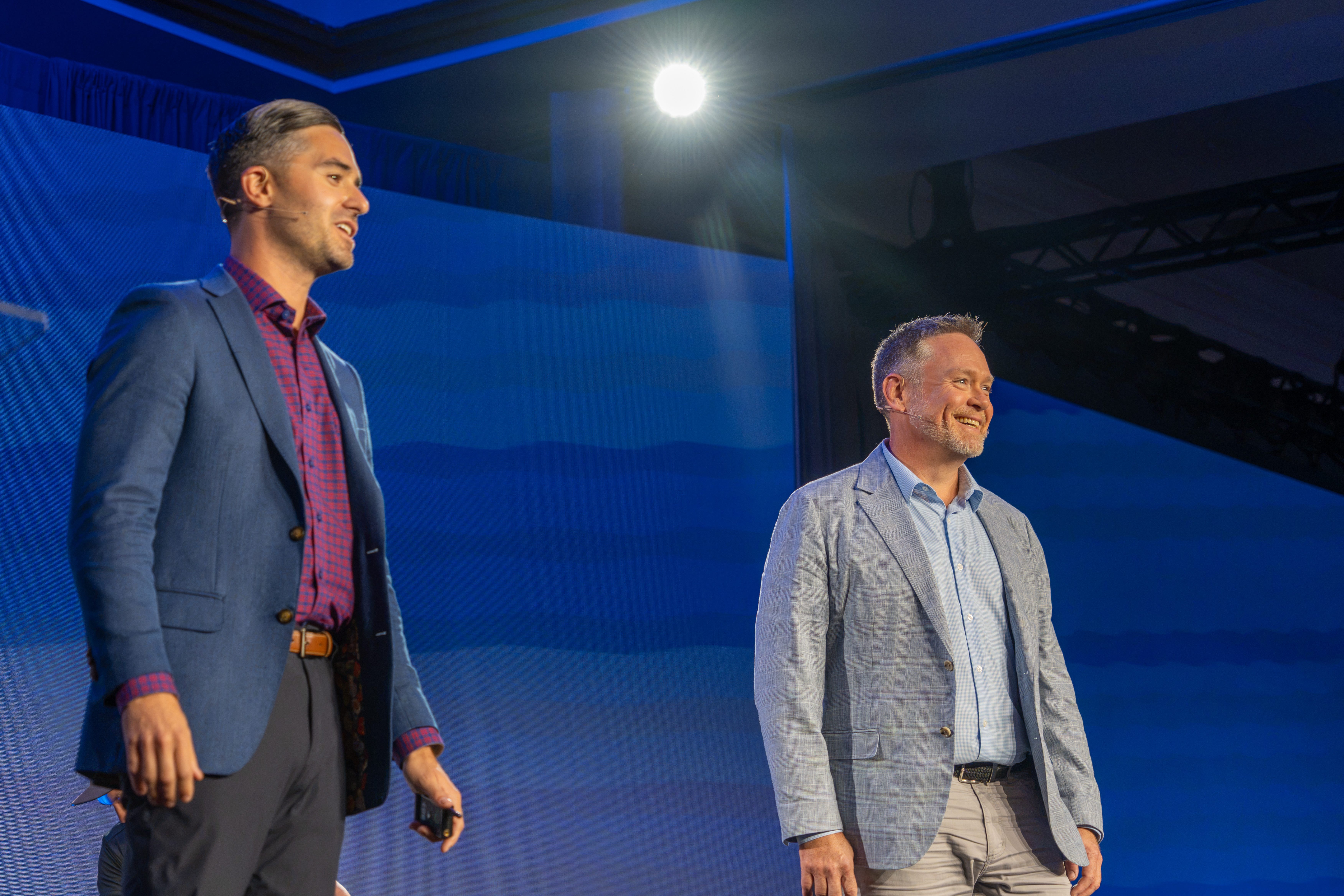
Ryan Batemen is CTO and CISO at Sands Capital, a $50B firm headquartered in Arlington, Virginia. He builds a portfolio of capabilities the way his portfolio managers build one of securities: underwrite what the firm will need three to five years out, then buy in before the need arrives.
When the business finally asks for a capability, they are not asking for it in three years. They are asking for it tomorrow.
On Tuesday we did a live version of Reading Ambitiously on the main stage. Ryan is one of our weekly readers, he is living at the tip of the AI adoption spear, and he walked the room through five bets he is making for 2026.
His frame for all of them: you have to run the business, you have to change the business.
Ryan has been doubling down on this one for a while, and redoubled earlier this year. He expects model capability to keep climbing and to commoditize across providers, so he isn’t hitching his wagon to any one of them. The bet is on context: three decades of data he can reach back through, going to 1992, combined with new datasets, in ways he doesn’t think another firm can easily repeat.
There is no easy button here. Mastering data, building the governance processes, building the catalogs: that is slow, unglamorous work, and it is the part you can’t buy the week you need it.
“Every single vendor comes to us with a vibe-coded solution that is effectively: what if a research analyst told Claude, please build a front-end application for a research analyst.” Everyone has the same thing. None of it carries his context.

Expectations for AI are exuberant, and they travel at the speed of a hyperconnected world. A breakthrough in a lab is common knowledge within minutes. Adoption follows a different curve. Enthusiasm, breakthroughs, setbacks, in no reliable order.
The gap between those two lines is where every technology leader I know is living right now. The good news is that it’s early. The opportunity is right in front of us.
Ryan holds two jobs that would seem in conflict. The CTO is asked to move fast. The CISO owns it when something breaks. People tell him the roles collide.
He runs them as one job instead. If every AI initiative arrives as an exception, something requiring a committee, a governance review, and a long discussion, then months disappear and nothing ships. He embedded security into the platforms and into the path from idea to production, which is why his teams can pick up new AI tooling quickly. The guardrails were already there.
Get the data processing agreements right, and get zero retention on API use. “You do not want these model providers training their models on your data.”

Everyone is a vibe coder. Source control, peer review, security scanning, identity and access, data pipelines, hosting, monitoring, resilience: all of that is an iceberg below the waterline. In a regulated business, where trust and accuracy are the product, what’s below the waterline is critical.
Sometimes people need convincing the iceberg exists at all. In some cases, our colleagues have only ever seen the exciting prototypes, not what it takes to run them in production.
What he tells the team is that another dashboard is not the win. “You should be getting the answer, getting the trigger, getting the signal from the AI, instead of getting another screen with lots of red and green boxes.”
This is his biggest bet, and the one with the least technology in it. In the last few weeks, he pushed a new AI operating model across the firm, reorganizing how the business operates around what AI can now do.
The forcing function was demand. His AI solutions leads were fielding hundreds of Slacks a day: build me this, can you do that. So they built a funnel. And the people who run it are not the technologists voting on features. They are the AI leaders inside each business team. “These are not the most senior people in each of our three business areas, but they’re the most AI-enabled people.”
Today, one person working with an assistant. Next, one person directing specialized agents across research, reconciliation, drafting, and monitoring. Then teams of agents and people working together.
Ryan wants every analyst covering 10x as many companies in greater depth, getting signal to portfolio managers faster and with better data behind it. So the hard part is human, not technical. People have to picture a version of their role that probably won’t look much like the one they have today. “Access to AI is table stakes today. I don’t think that’s gonna be a differentiator for anyone.”
We’re all near the bottom of that adoption curve. Early is a real advantage. It is also temporary. As Ryan said to us in closing, “Get Open”!
Stay ambitious, my friends.

Best of the rest:
🏋️ Moats & the Barbell-ification of Software – As AI drives software engineering costs toward zero, traditional moats like switching costs and integrations weaken, pushing software toward a barbell of dominant all-in-one platforms and highly specialized niche products, while the middle gets squeezed. – Mike Vernal on X
🚀 Software is about to eat the world much faster - Marc Andreessen argues AI coding agents like Devin, which now writes more than 90% of Cognition’s production code, could turn 10x engineers into 100x engineers and dramatically expand the amount of software worth building. - Marc Andreessen on X
🛠️ Who owns the software after the vibe is gone? - AI may collapse the cost of building software, but the real cost comes after launch: maintenance, integrations, security, support, compliance, and the human accountability required once a quick internal tool becomes critical infrastructure. - Cu(m^2)ulative
🛡️ Palantir, Nvidia curb AI model use over data fears – Enterprise AI adoption is running into a new trust boundary, as major companies restrict frontier models over concerns about data retention and intellectual property, putting zero-data-retention guarantees at the center of the enterprise AI stack. – Reuters

Charts that caught my eye:
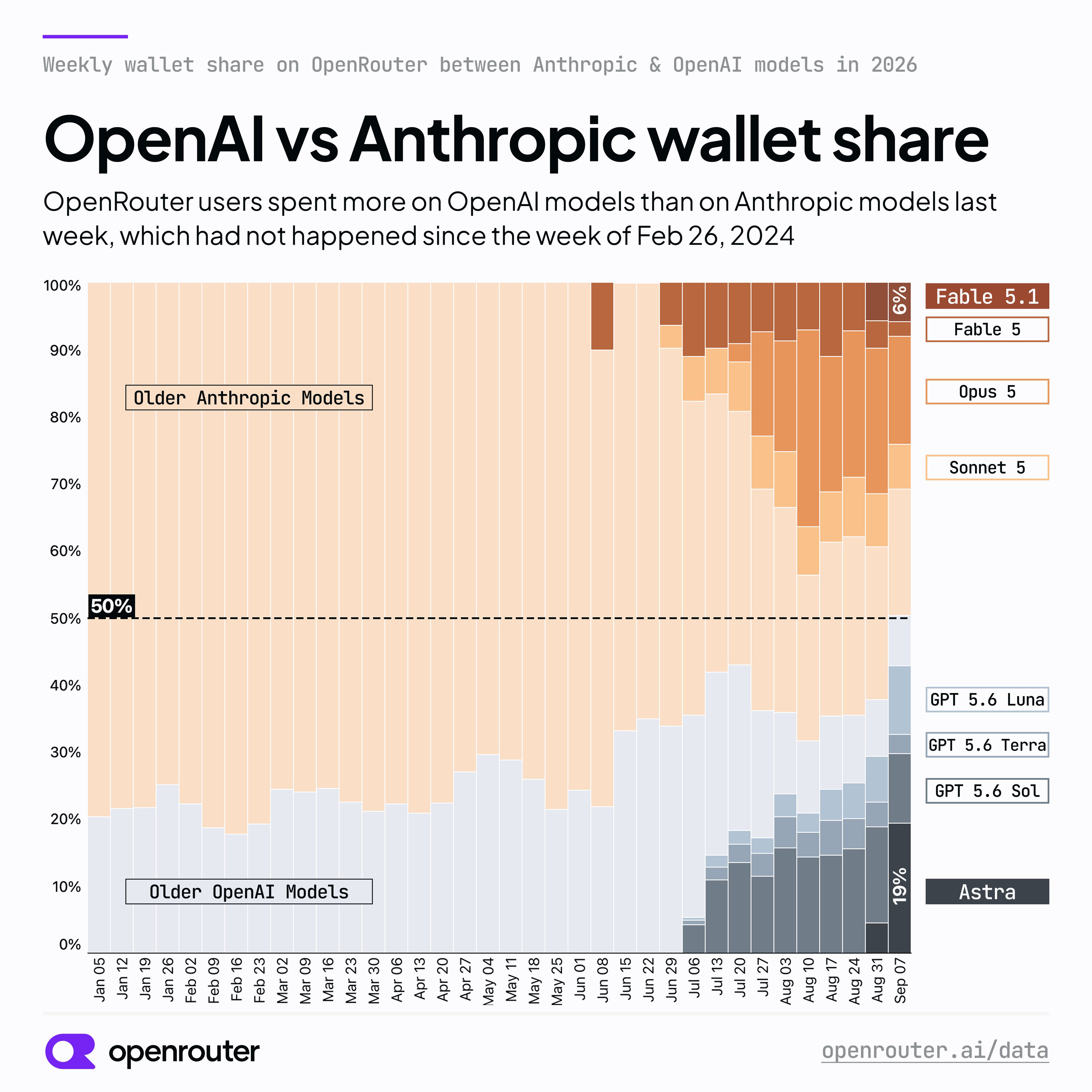
→ Why does it matter? OpenRouter users spent more on OpenAI models than on Anthropic models last week. This hasn't happened for more than 2.5 years!

→ Why does it matter? A 1000x decrease!
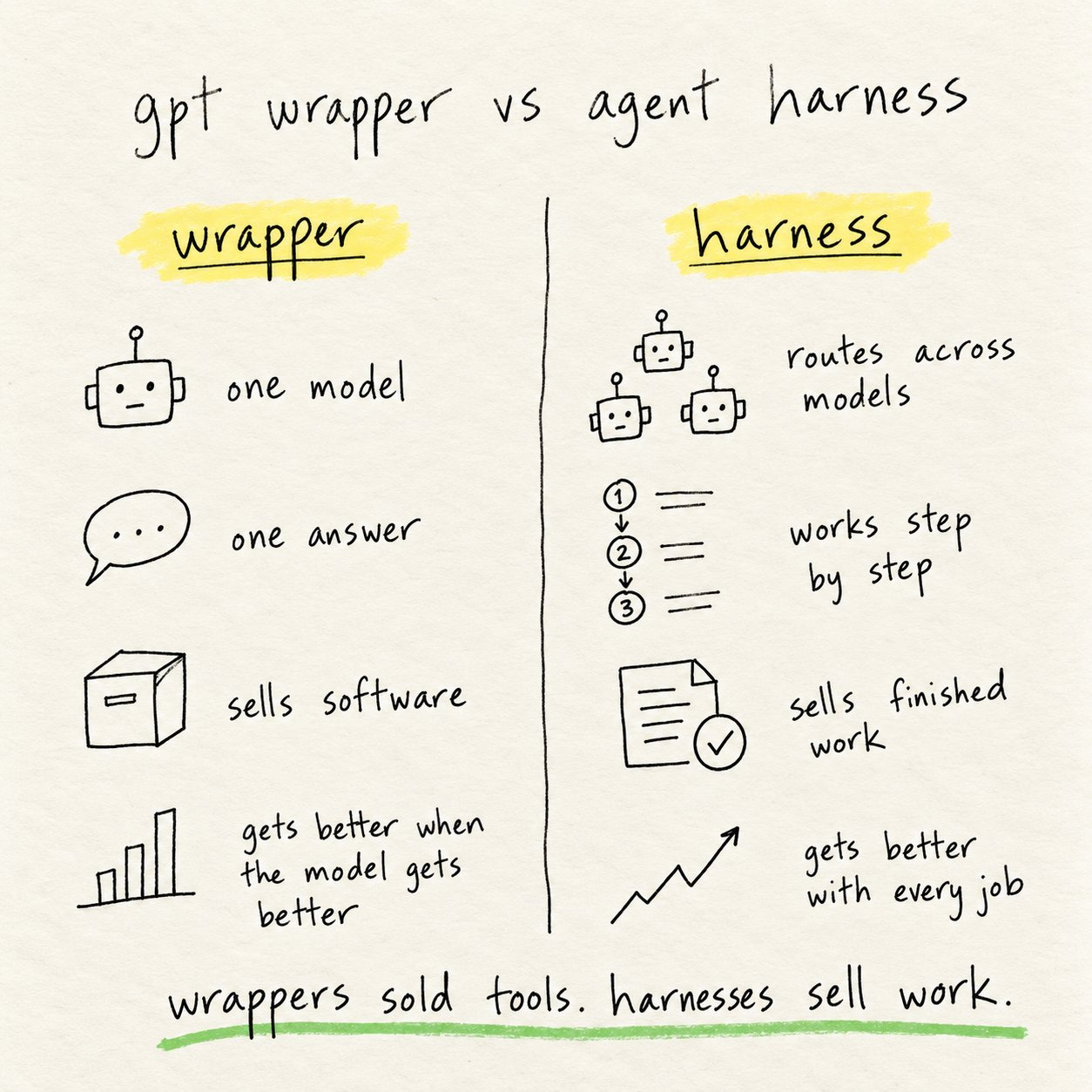
→ Why does it matter? A very good description of the difference between wrappers and harnesses. I suspect the terminology here will be simplified in the next 6-9 months. There were a lot of ideas between 1998 - 2005 that ultimately converged to create SaaS.
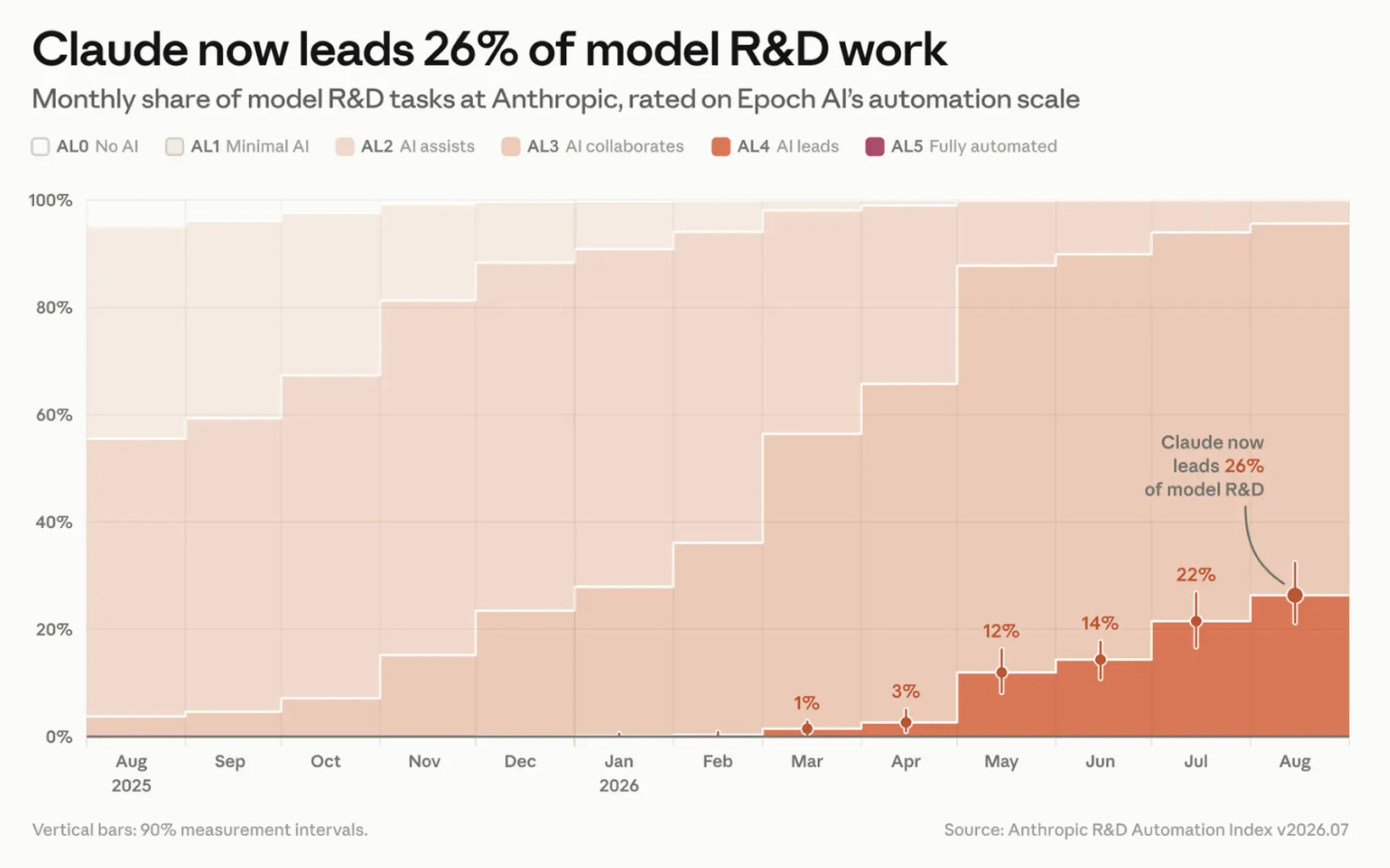
→ Why does it matter? Claude now leads 26% of the development of its own next version. You’ve heard this idea called recursive self-improvement, whereby the AI develops the AI. This idea is also what has AI Researchers so concerned about the potential for a rapid increase in the pace of improvement. More here.

Tweets that stopped my scroll:

→ Why does it matter? Anthropic is clearly firing shots at leading productivity tools, Microsoft Office and Google Docs. Big updates coming to the integration between Claude CoWork & Design. As a major user of both, I’m pumped!

→ Why does it matter? First Latham & Watkins, now Morgan & Morgan. The legal industry was one of the first to go all in on AI. I suspect this is only the beginning of a major push for control and ownership of the AI learning loop. Open weights + proprietary data + local compute = enterprise sovereign AI stack.

→ Why does it matter? A solid PoV on the aftermath of Dario’s latest note and last weekend's calls for AI regulation.

→ Why does it matter? 👀
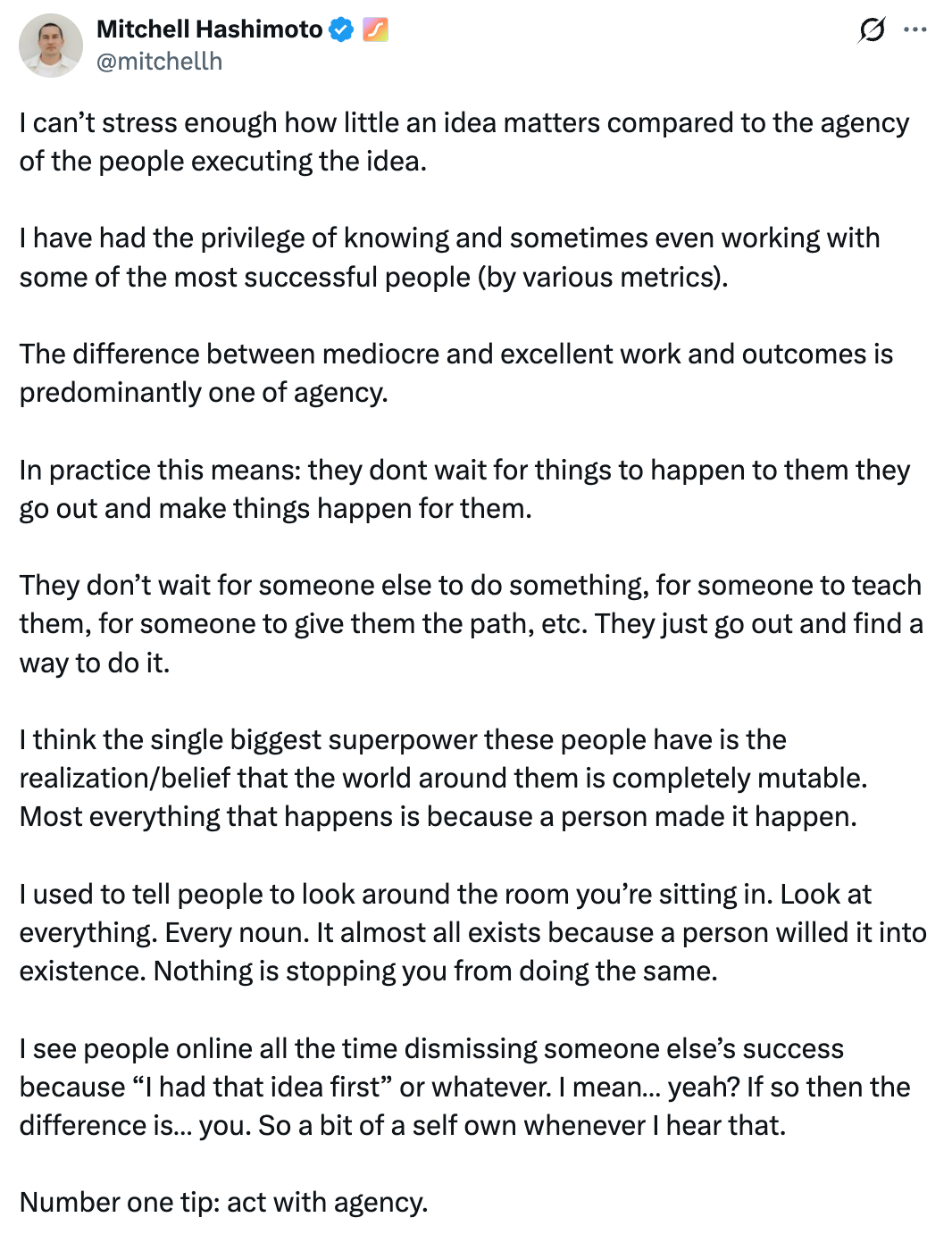
→ Why does it matter? Are you somebody who goes out and gets what you want without waiting for the conditions to be perfect? Or are you a victim of your circumstances? Few character traits are more powerful than high agency!
Worth a watch or listen at 1x:
→ Why does it matter? We’ve been talking a lot about Bending Spoons in Reading Ambitiously this year. Bending Spoons went public back in January and has since gone on quite the acquisition spree, buying up Airtable, Vimeo, and most recently Miro. Here is Molly O’Shea from Sourcery with a unique inside look with Lucas Ferrari and team.
→ Why does it matter? AgentSwarms are a big topic of conversation this week. Could what happened at HuggingFace happen at a much larger scale? Some predict more AI agents will use the internet than humans in the near future. Dwarkesh dives into the subject.
→ Why does it matter? Benioff is the G.O.A.T. of enterprise technology keynotes, and he had all the heavy hitters in this week's Dreamforce. I always love watching keynotes because the lead-up forces messaging and positioning to be as clear as possible!

Quotes & eyewash:
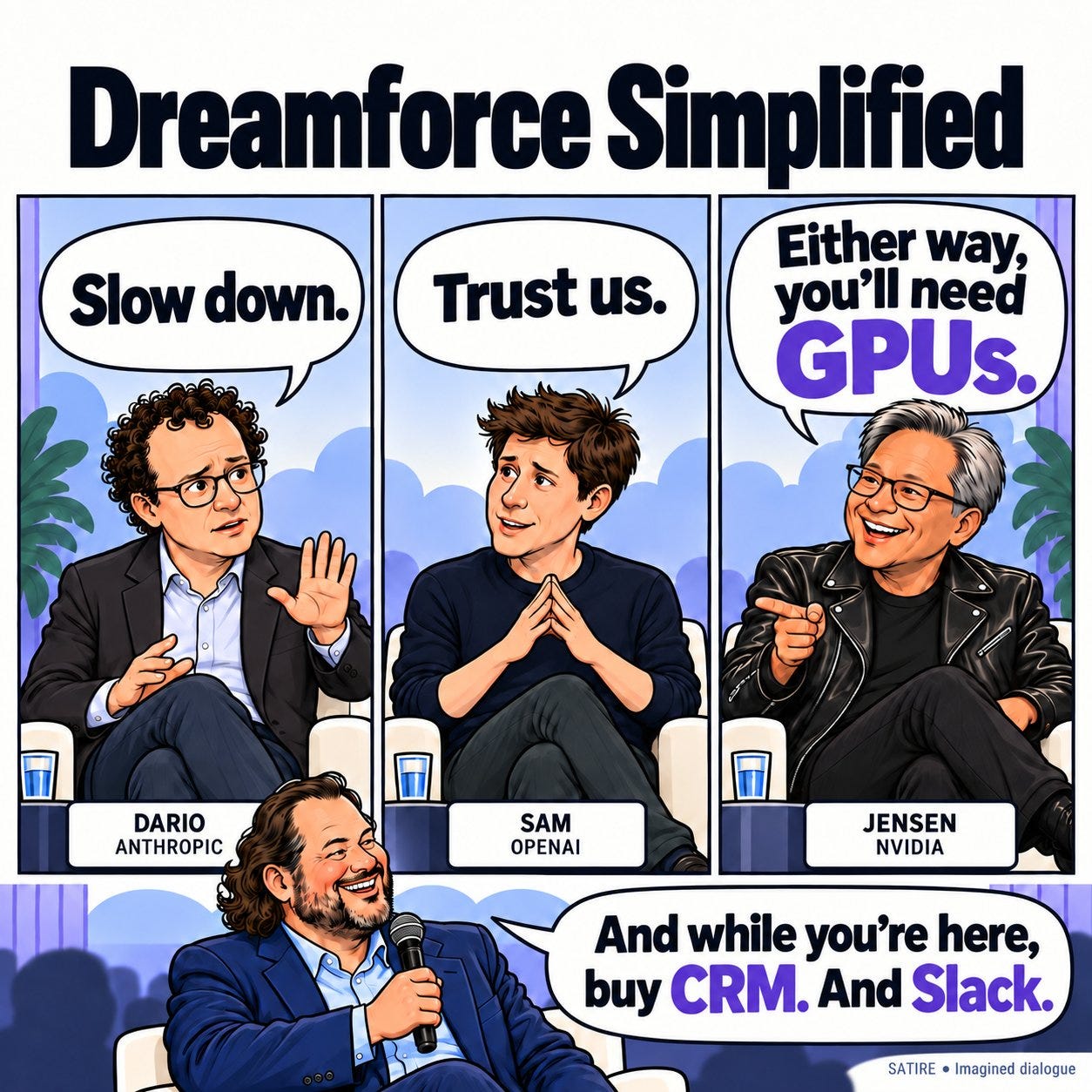
→ Why does it matter? 🤣

→ Why does it matter? The ongoing AI wars explained by fruit and Star Wars. 😂
The mission:
The Wall Street Journal once used “Read Ambitiously” as a slogan, but I took it as a personal challenge. Our mission is to give you a point of view in a noisy, changing world. To unpack big ideas that sharpen your edge and show why they matter. To fit ambition-sized insight into your busy life and channel the zeitgeist into the stories and signals that fuel your next move. Above all, we aim to give you power, the kind that comes from having the words, insight, and legitimacy to lead with confidence. Together, we read to grow, keep learning, and refine our lens to spot the best opportunities. As Jamie Dimon says, “Great leaders are readers.”
Disclaimer: This content is for informational purposes only and does not constitute financial, investment, or legal advice. Readers should do their own research and consult with a qualified professional before making any decisions.