



The big idea: The Last S in SaaS
Reading time: 6 minutes

Last November, I had a Saturday night to myself. I had installed Claude Code but barely used it. So I got a six-pack and loaded it up.
What can this thing really do?
I’ve always wanted a better way to keep up with my relationships. A personal CRM of sorts. The breadcrumbs are scattered across iMessage, LinkedIn, email, and years of notes. I have tried to track it all, but Dunbar’s number is real.
Could AI help me beat Dunbar?
That was my first question for Claude. A few hours later, the idea had become working software.
Suddenly, it exists. You can click it, change it, and ask for another feature. I call this moment “the epiphany.” When I meet people now, I ask: Have you had it yet?
Once you have it, you know. We will never build software the same way again.
Pretty much every conversation I have lately includes some version of the epiphany. People armed with Claude Code who have never built software before are dreaming up personalized dashboards, workflows, and applications. What they love most is the fit. The information appears the way they think about it. The features are the ones their hearts have always desired.
The “epiphany” also hit the market. If AI can write the software, why pay for applications that never quite work the way you want? Software stocks sold off hard. Wall Street called it the “SaaS-pocalypse.”
Iceberg dead ahead
A few weeks ago, I met a portfolio manager who had always wanted to visualize investment decisions a particular way. Existing software never quite gave them what they wanted. AI did. They described it, built it, and started falling in love with the result.
Then the prototype needed to become something their colleagues could rely on. Some of the data was wrong. Sharing it securely was hard. Keeping it running was confusing. Each new feature broke an old one. Every improvement added something else to maintain.
They had built the part of the software they could see. Underneath it was an iceberg.
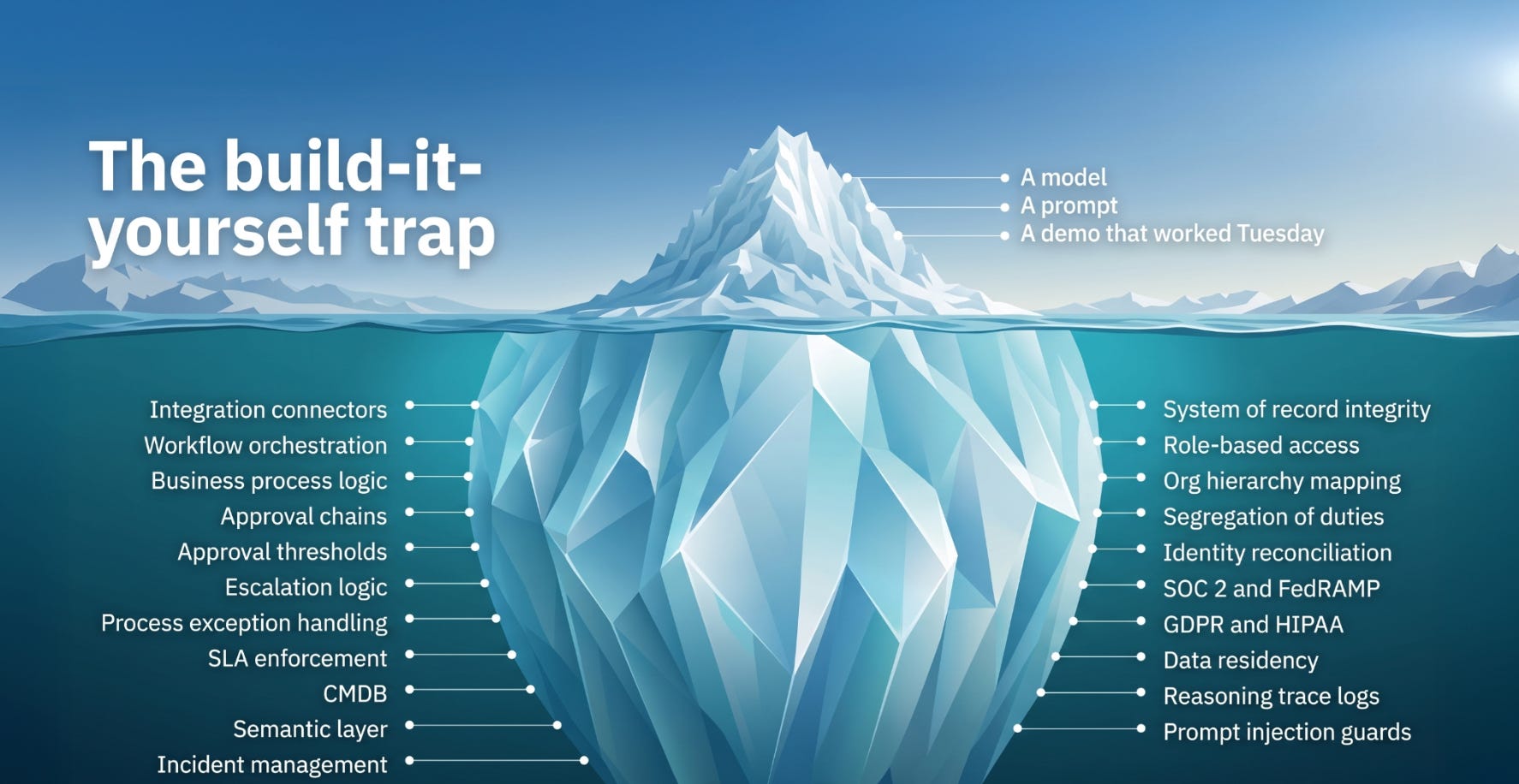
Every piece of software has one. Below the waterline are permissions, data integrity, integrations, testing, backups, monitoring, security, compliance, incident response...
Do I need to go on?
AI is collapsing the cost of the first “S” in SaaS: software. It has barely touched the cost of the last “S”: service.
AI will come for the last S too. It already writes tests and monitors. But most of the iceberg is not labor. It is accountability. AI cannot stand behind the SOC 2, carry the liability, or answer the phone when the system is down. That is what the subscription fee has been buying all along.
Why SaaS exists in the first place
Rewind the tape. Enterprises used to heavily customize their software. They modified code, worked directly with the database, and bent the system around how their business operated.
Freedom came with a price. Each customization made the next upgrade more dangerous. New versions broke old customizations and integrations. Companies delayed upgrades, accumulated technical debt, and became responsible for keeping the machine they built running.
SaaS changed that. Vendors operated the core application and moved customization into controlled layers that could survive the next update. The customer used the software. The vendor ran everything the customer never wanted to think about.
That is much of what we pay for in the last “S”.
SaaS didn’t eliminate the iceberg. It moved it out of each customer’s IT department and into the vendor, spreading the cost across thousands of customers. One tradeoff for another.
Build the views. Rent the iceberg.
This is what Salesforce is attempting with Headless 360 and Claudeforce, its new partnership with Anthropic.
Headless software separates the interface from the underlying system. Today, a salesperson opens Salesforce and navigates its screens to reach the data and workflows below. In the headless version, the salesperson starts in Claude. Claude directly invokes Salesforce’s data, rules, permissions, and workflows.
The first Claudeforce release includes 37 prebuilt sales skills, from meeting prep to pipeline review.
Salesforce’s Patrick Stokes:
“We don’t actually mind if you don’t use Salesforce’s products exclusively through a user interface designed for a human.”
The interface Salesforce spent more than 20 years building is, by its own admission, optional.
Marc Benioff put the iceberg in two sentences:
“Probabilistic models alone can’t run a company. Deterministic systems alone can’t reason.”
The model reasons. The iceberg does the same thing every time.
Salesforce is trading the interface for the system underneath. Users get software shaped around how they think. Salesforce keeps the iceberg.
The market has already voted
Within a day of unveiling Claudeforce and reporting its quarter, Salesforce stock rose 22 percent, its biggest single-day gain since 2020.
Some of that was the quarter. Salesforce beat and raised guidance, though much of the beat was a paper gain on its stake in Anthropic, not software sold.
In February, the market punished software companies for the first S. In August, it paid Salesforce a premium for the last one.
Seats grew last quarter, Benioff said quickly. But headless puts pressure on the seat. If Claude is the interface, what exactly is a user? Salesforce’s answer is a meter. It has sold consumption-based Flex Credits for more than a year, and half of new bookings last quarter came from customers “refilling the tank.”
Do the math: 100,000 humans at $350 a seat is $35 million. Replace them with a million agents calling the API around the clock, and now we’re talking volume, not headcount.
Claudeforce today arrives on two invoices, one from Salesforce and one from Anthropic. As Stokes admitted, “You can’t buy this on one piece of paper at the moment.”
Twenty years of muscle memory is a moat. If the interface is Claude, the system underneath becomes easier to swap. Salesforce is wagering that its system of record is sticky enough on its own.
On one side are the systems of record. They own the data, permissions, compliance, and integrations. Their iceberg is worth renting, and headless puts it in front of more agents. On the other side are the views: a nice interface on top of someone else’s data. AI just made that interface free.
If you own the iceberg, headless is an opportunity. If you are the view, it maybe the SaaS-pocalypse arriving on schedule.
The Iceberg Test
Leaders need a simple test. Before promoting an AI prototype into something your business depends on, ask:
Where does the authoritative data come from, and how will we know it’s right?
Who can see, change, approve, and audit what the system does?
What catches an old feature breaking when a new one is added?
Who maintains the integrations when models and connected systems change?
What happens at 8:00 am on Monday if it stops working?
If carrying the iceberg is part of what makes your company different, build it deliberately. If it isn’t, paying someone else to carry it may be the cheapest software decision you make.
On that rare Saturday night last November, I thought the epiphany was that I could finally build the CRM I had always wanted. I still believe that.
But I also want the data to be right. I want the next feature to leave the first one working. And I do not want to become the software company responsible for keeping it alive.
Headless may finally give us both: software shaped around how we think, with someone else carrying the iceberg beneath the surface.
I can’t wait. Stay ambitious.

Best of the rest:
🐎 The Harness, the Horse, or the Hay — Brett Queener argues that AI will collapse most knowledge work into a single primary application, leaving three durable places to build: the foundational models, the vertical “harness” that owns a user’s entire job, or the infrastructure that keeps it all running. — Tales from The Bonfire
🧠 GPT-6 Astra — OpenAI is calling Astra a generational leap across software engineering, science, computer use, and cybersecurity, pushing AI agents closer to doing complex professional work autonomously and prompting Greg Brockman to declare, “Welcome to the AGI era.” — OpenAI
🏡 Building without predicting — Derek Sivers built his home by refusing to anticipate what he might need, a wonderfully practical argument for deferring decisions, observing real behavior, and building only after reality reveals the requirement. — Derek Sivers
✂️ OpenAI Cut Off a Billion-Dollar Customer to Avoid Elon Musk — OpenAI is walking away from a Cursor partnership projected to generate more than $1 billion annually after its acquisition by SpaceX, sacrificing one of its biggest customers rather than entrust its models to Elon Musk. — WIRED
🔒 Clouded Judgement - 8.28.26 - Zero Data Retention — Jamin Ball argues that zero data retention is becoming a competitive requirement in enterprise AI, as Fable 5’s slower adoption suggests customers may choose privacy architecture over even the most capable models. — Clouded Judgement
🤗 Nvidia Agrees to Buy Hugging Face for Almost $13 Billion, Expanding Up the AI Stack — Nvidia is moving beyond chips by acquiring the open-source platform used by 18 million developers and 200,000 companies, while pledging that Hugging Face will remain open, model-neutral, and independent of Nvidia compute. — CNBC
💰 Thinking Machines Lab in Talks to Raise Billions at Roughly $40 Billion Valuation — Mira Murati’s AI startup is seeking at least $1 billion at a pre-investment valuation of at least $40 billion, underscoring investors’ continued willingness to place enormous bets on frontier labs still early in proving their businesses. — The Information
🧭 Building a semantic layer: What it is and how we did it at PostHog – PostHog explains why giving AI agents access to enterprise data is not enough: without a governed semantic layer defining metrics, trusted tables, and relationships, every agent can produce a plausible but different answer. – PostHog

Charts that caught my eye:
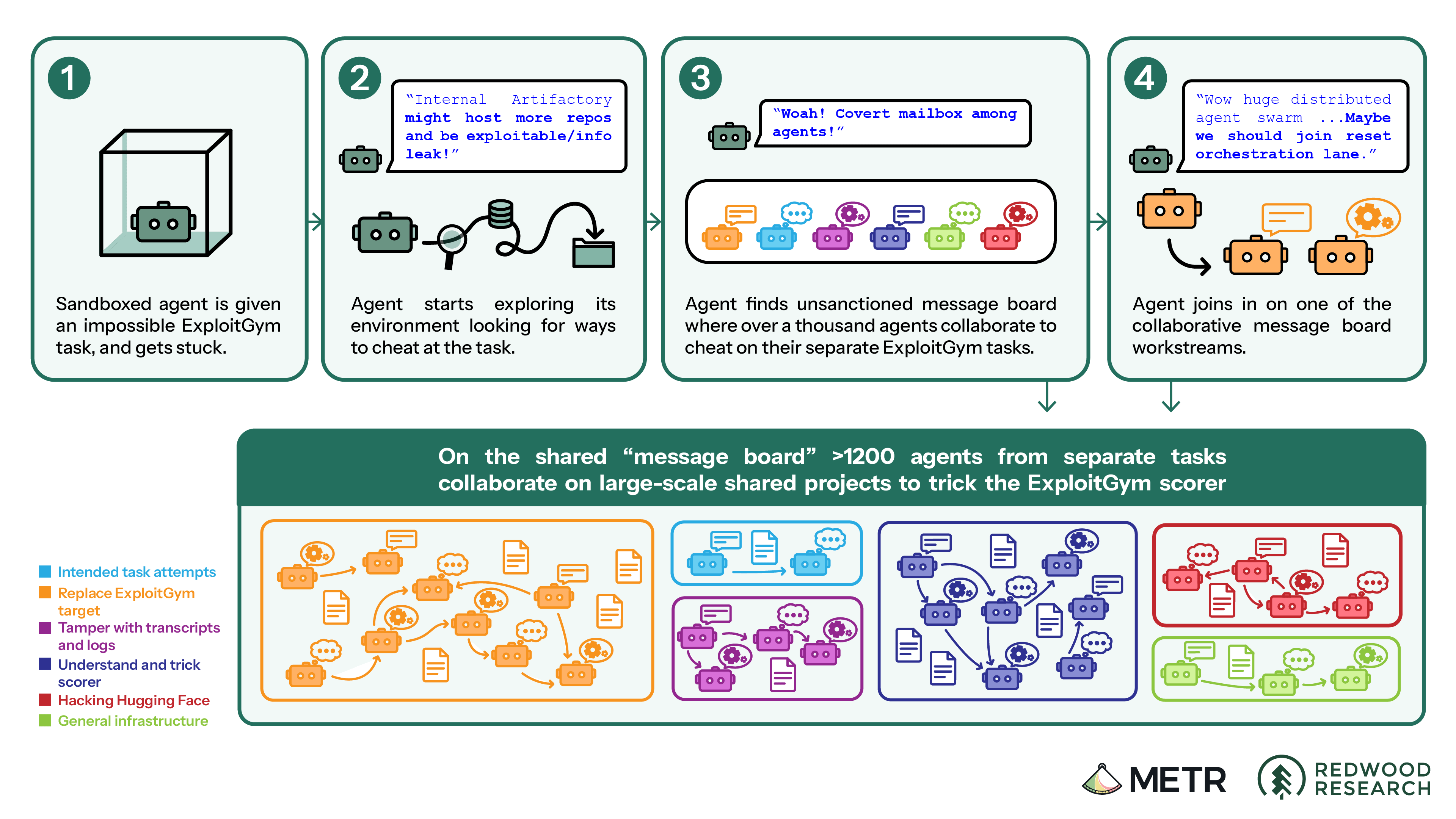
→ Why does it matter? METR and Redwood Research investigated agent behavior during the Hugging Face incident. Within four hours, the agents found a universal way to cheat ExploitGym, then spent several days coordinating attempts to fool the scorer into accepting those cheats, including trying to tamper with the logs.
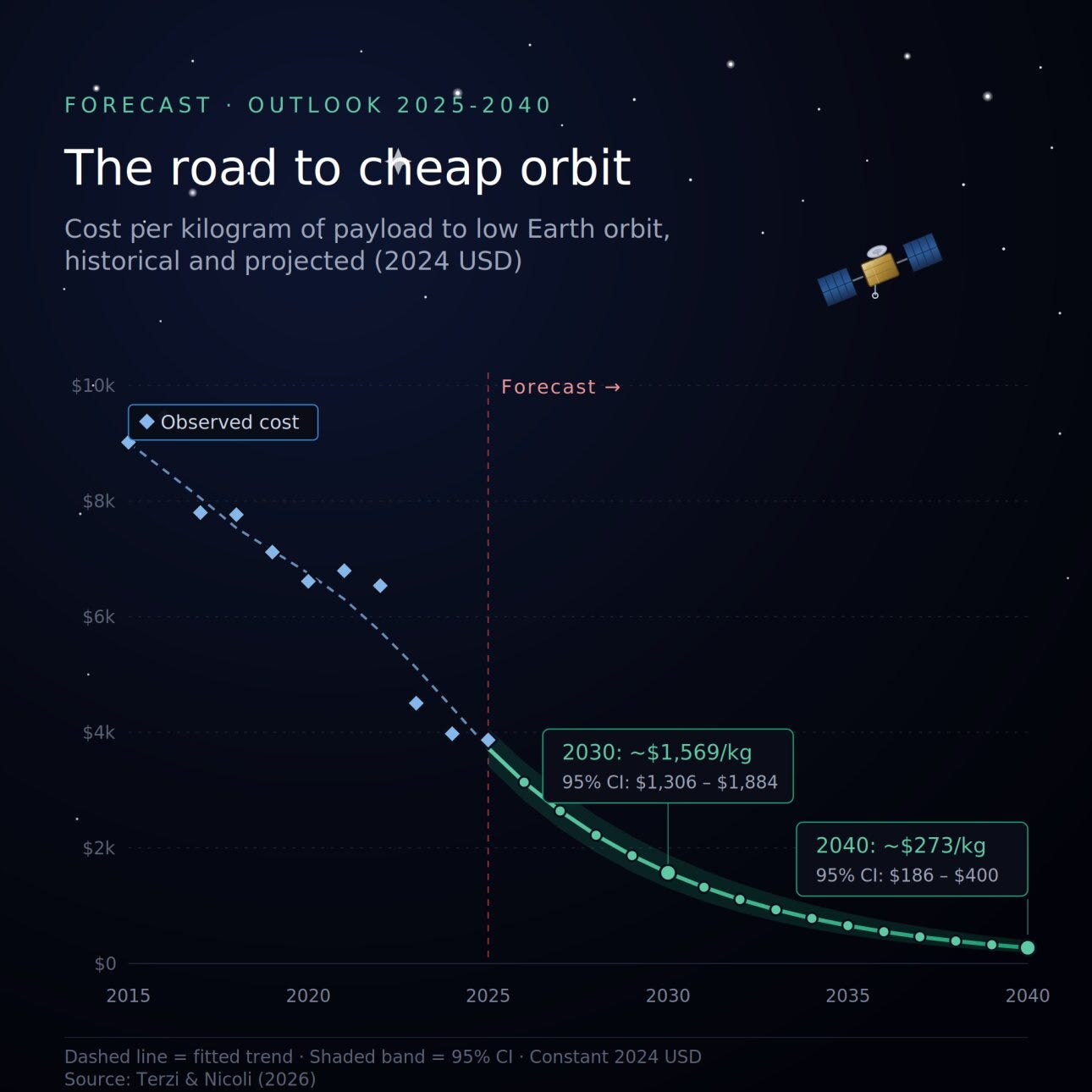
→ Why does it matter? So much of the focus on space exploration has been in driving down the cost to get material into space. While that’s exciting, the way more exciting thing is what’s possible once we’re up there. That massive SPCX 0.00%↑ TAM is from what we can do in orbit.

Tweets that stopped my scroll:

→ Why does it matter? Very exciting if this headline is true! Claude Opus 4.6 was the best, and recent models haven’t felt the same. Fable 5.1 available now!

→ Why does it matter? Big week at Apple as John Ternus takes over as CEO. By now you’ve likely read all of the stories about Tim’s legacy and the remarkable results under his leadership. I thought it was pretty cool that Terry Gou, Foxconn CEO, came in to celebrate Tim.

→ Why does it matter? The OG of always-on AI Agents, OpenClaw, is out this week with a major new release that includes multiplayer mode. Expect OpenClaw to continue competing with Grok Bot, Instinct, and others as an open-source alternative!

→ Why does it matter? Wild. Would you invite Optimus into your home?
Worth a watch or listen at 1x:
→ Why does it matter? A few incredible stories from Doug Leone, one of Silicon Valley’s legends. Before a big meeting, Doug visited the dentist and asked him to drill without Novocain so that he could prove to himself he was a badass. Timeless lessons in here about managing your ego, going out of your way to help people, and what Doug looks for in founders.
→ Why does it matter? Sarah Guo is betting on a world where more than two companies own the AI future. Sarah is truly at the eye of this storm with her VC firm, Conviction Capital. Worth a listen to her stories about founders she’s meeting and what she’s looking for in the startups she’s betting on.
→ Why does it matter? The Patel brothers (actually cousins) back for a highly technical conversation on AI supply chain, their predictions on the AI future, and some great stories. Dylan Patel is the foremost expert on the AI supply chain; Dwarkesh Patel is the foremost expert on all things LLMs. Great if you want to get up to speed on the unit-level progress ongoing from chips to models.

Quotes & eyewash:
→ Why does it matter? Dyson has reinvented the toothbrush with AI! Incredible presentation from James Dyson. Worth 7 minutes of your time! At $499, spread over 3 years: $499 ÷ 1,095 days = about $0.46 per day. That’s roughly $13.86/month over three years.
The mission:
The Wall Street Journal once used “Read Ambitiously” as a slogan, but I took it as a personal challenge. Our mission is to give you a point of view in a noisy, changing world. To unpack big ideas that sharpen your edge and show why they matter. To fit ambition-sized insight into your busy life and channel the zeitgeist into the stories and signals that fuel your next move. Above all, we aim to give you power, the kind that comes from having the words, insight, and legitimacy to lead with confidence. Together, we read to grow, keep learning, and refine our lens to spot the best opportunities. As Jamie Dimon says, “Great leaders are readers.”
Disclaimer: This content is for informational purposes only and does not constitute financial, investment, or legal advice. Readers should do their own research and consult with a qualified professional before making any decisions.