


Programming note: Reading Ambitiously will be off to Disney World next week for fall break. See you on October 16.
The big idea: Everyone wants a business like Windows
Reading time: 5 minutes

“Developers, developers, developers.”
Steve Ballmer’s famous chant was a pretty good explanation of Microsoft’s strategy. Microsoft supplied Windows, the operating system. Developers built applications customers wanted. Those applications gave customers a reason to choose Windows, which gave more developers reasons to build for it.
Microsoft supplied software like Office and Outlook. Other companies supplied much of the rest. Microsoft’s Software Development Kit (SDK) made that possible, giving developers capabilities like menus, printing, and file access so they could spend more time building applications.
Over time, that flywheel helped make Windows the default platform for business computing.
Now OpenAI and Anthropic are running a similar playbook. Anthropic offers the Claude Agent SDK, and OpenAI offers its Agent Builder. Both want developers building AI with their technology.
The SDK capabilities are different this time. You’ll hear them called the “harness”: the software that helps a model use tools, access information, and coordinate work. It’s the stuff AI developers need but may not want to build themselves.
You can see the appeal.
What’s the bargain this time?
What makes this bargain feel different to me is ownership. As you teach an AI system how to do your work, you’re putting years of accumulated judgment into it. Once you’ve operationalized AI across your business, how much freedom and control will you want? And what are you willing to build, buy, or partner for to achieve it?
This is essentially the question behind AI sovereignty: how much authority and independence a business has over its AI. At the extreme, total independence would mean taking responsibility for the whole stack:
Applications
Harness
Models
Compute
Silicon & GPUs
Land & power
Most enterprises will draw the line somewhere along the way. They may rent the compute while insisting on control over their models. Others may buy the entire application and accept the dependencies that come with it.
The choices enterprises must make at each layer are coming into focus. Those choices will determine how easily they can change providers, control costs, and keep using what they’ve built.
The AI labs have every reason to want it all. But what will their customers bear?
I think the labs understand this. OpenAI president Greg Brockman recently said, “The model is not the product.” The business they’re building extends into the software and capabilities around it.
So where do we go from here? I think we can glean a thing or two by watching the current generation of AI startups attack the opportunity.
Harvey
This company has raised over $1 billion to build AI for the legal industry.
Harvey and OpenAI were close from the beginning, with OpenAI as an early investor. Harvey built around OpenAI’s models and tooling, turning the technology into useful applications for lawyers.
Then, Harvey built its own harness. Earlier this year, it explained why: it needed to work across models, meet customer data-retention requirements, and control costs. Harvey took ownership of that layer.
More recently, it announced its Private Model Program, extending its ambition into the model layer too. Cofounder Gabe Pereyra said, “we’re seeing huge demand from law firms to own their intelligence leveraging private data”.
Harvey is going for it here, and I commend them. They have a chance to become the operating system for their industry, provided their customers are comfortable with the dependencies.
Some want more control.
Latham & Watkins announced it's buying Nvidia servers and fine-tuning open-weight models they own. Morgan & Morgan made a similar announcement. These firms are basically saying, it’s still not enough control for us.
If we leave legal for a second and look at financial services, Jane Street appears to be heading in a similar direction, reaching further down the stack.
It has Etched chips running in its data centers and a $6 billion commitment to CoreWeave for computing capacity. It has also invested in Thinking Machines, which is building tools to help companies develop private models. My bet is that Jane Street’s relationship with Thinking Machines will extend into training private models together.
These companies will still have suppliers. But they’re choosing where they want control and what they’re willing to build to get it.
An asset you own
My read is that these firms want to retain control over the knowledge that makes them good at what they do.
When an experienced lawyer reviews an AI-generated agreement and explains why a clause needs changing, that correction draws on decades of judgment. Capture enough of those corrections, and the system could begin to reflect how the firm thinks.
That right there is IP they want to keep.
Satya Nadella made a similar argument recently when he said, “enterprises should retain full control over their unique and tacit knowledge”.
For plenty of firms, trusting Harvey with this will be a good enough bargain to accept the dependencies. Building and operating more of the stack is a job in itself. Which may be where Harvey is headed next.
In a recent interview, Gabe from Harvey says they’re transitioning from “applications into a full stack AI company.” Helping guide customers through figuring out which parts of the stack customers should own, which Harvey should supply, and which to leave to outside providers.
Some businesses will gladly pay someone else to take that responsibility.
Others will decide their accumulated knowledge is worth the effort of controlling more themselves. It’s still unclear where enterprises will draw that line.
Personally, I’m convinced they’ll want to own and control their intelligence far more than we’ve seen so far.
If using AI well means putting a lot of what has made you great at your work into a system, you’ll want that effort to create an asset that compounds for you rather than rent. You’ll want to keep benefiting from what you’ve taught it, even if you decide to change who supplies the technology.
Some dependencies and lock-in will be accepted. But I suspect the terms will look different from those we’ve seen in this initial AI boom.
Every day, we see more useful AI applications.
The question is, how much freedom and control will you want in the pursuit of those benefits?

Best of the rest:
🛡️ Nvidia releases software platform to stop AI agents from misbehaving — Nvidia’s new platform sets guardrails around AI agents and can stop them when they break containment. — CNBC
💰 Broadcom agrees to lend Anthropic up to $42 billion for its AI buildout — The financing is tied to Anthropic’s massive compute expansion and could eventually convert into equity, deepening Broadcom’s role as both a chip supplier and financier. — Benzinga
🧠 OpenAI’s real advantage may be distribution, not just better models — a16z argues OpenAI’s durable edge comes from creating new AI behaviors and reaching a massive, diverse user base, giving it a powerful learning loop that compounds across products, models and its broader platform. — a16z
🤖 The rise of the automation engineer — Serval CEO Jake Stauch argues AI is creating roles focused on automating business processes, citing SeatGeek’s redeployment of IT staff after automating over half its requests. — Jake Stauch
🧭 Why we’re building Muse — Alexandr Wang outlines his vision for a personal AI manager that turns ambitions into action by planning, coordinating, and clearing everyday obstacles. — Alexandr Wang

Charts that caught my eye:
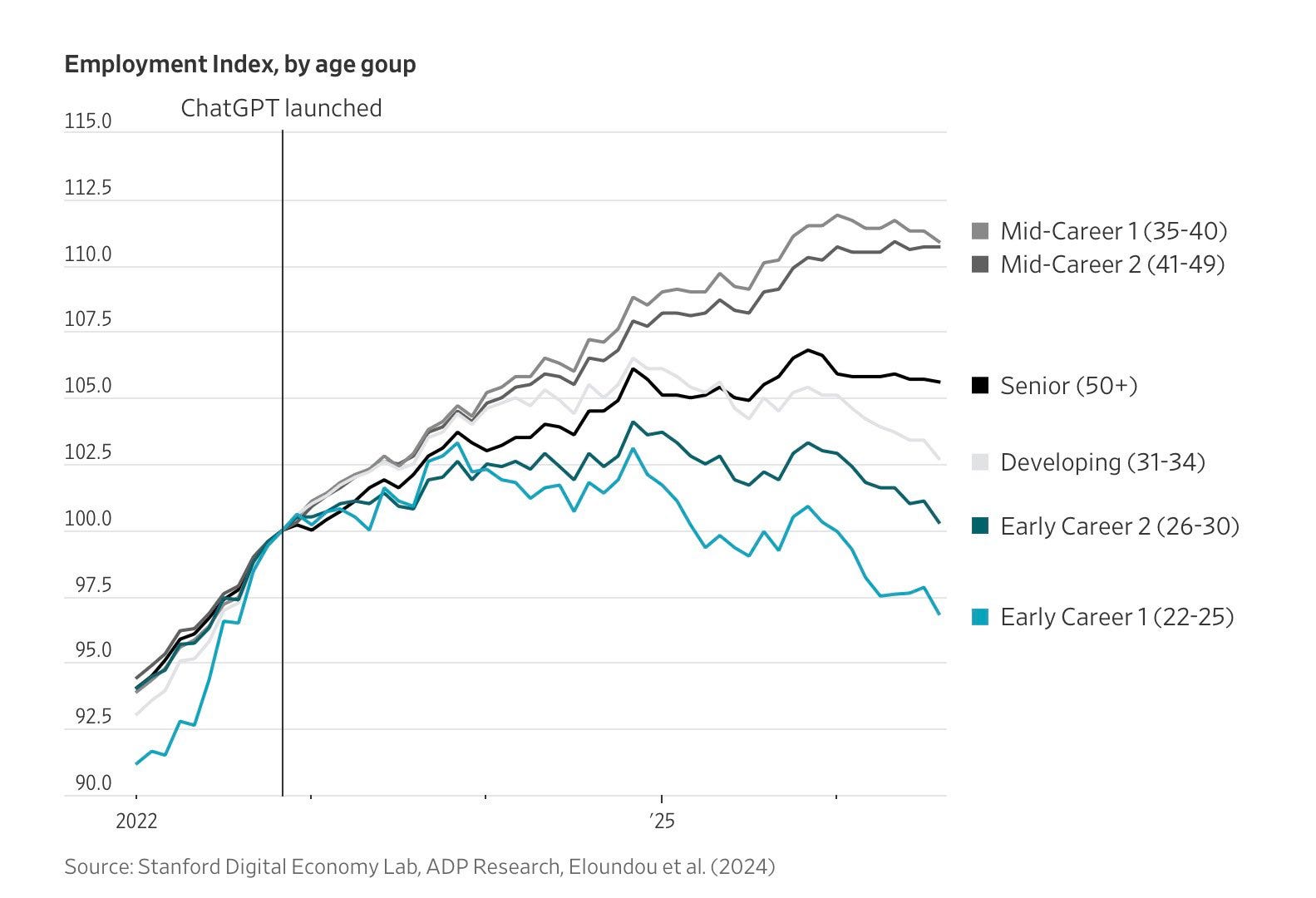
→ Why does it matter? Reporting here from the WSJ on the employment index by age group. Is AI the reason we’re seeing such a dip in early career hiring?
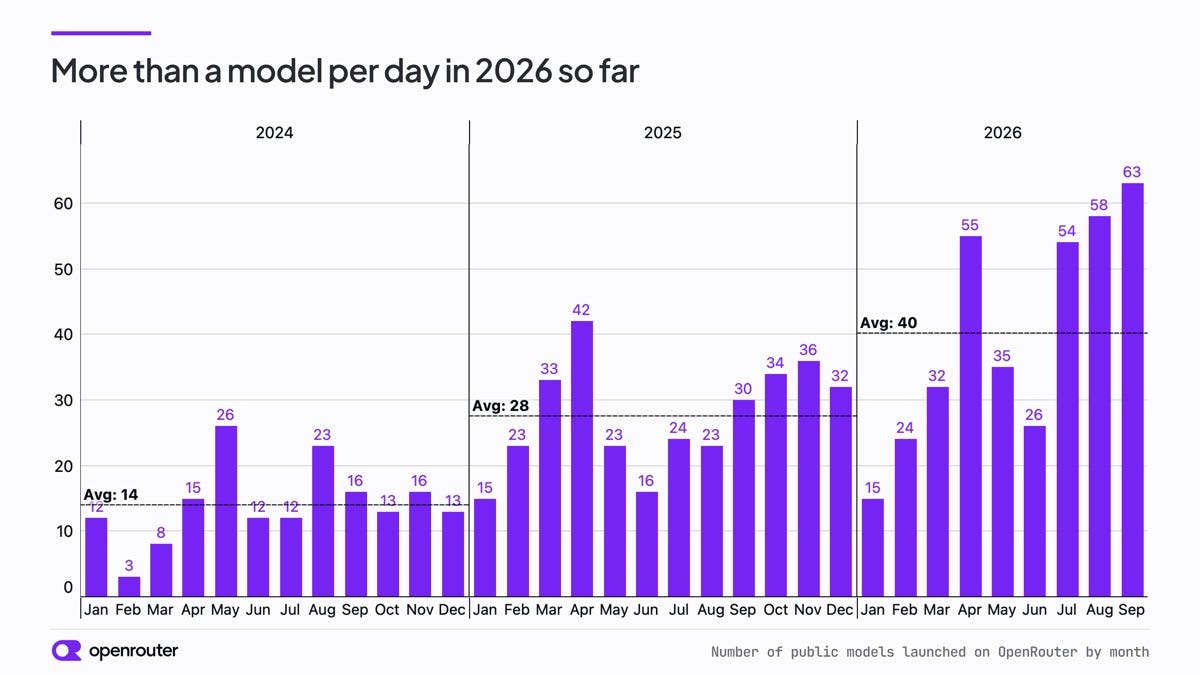
→ Why does it matter? 63 new models were released in September! We’re seeing a new LLM every day in 2026. Some open, some closed, some focused on very specific capabilities like Jev. Wow.

Tweets that stopped my scroll:

→ Why does it matter? Dot is OpenAI’s answer to Grok Bot, Muse, and, to a certain extent, OpenClaw and Hermes. The Always-On AI Agent! We wrote about this back in RA 4-10-26.

→ Why does it matter? Would it have even been possible before AI? If so, how long would it have taken? Pretty cool.

→ Why does it matter? Google just dropped Gemini 4 Argon, a new State-of-the-Art model that is right up there with GPT-6 Astra and Claude Fable! Remember, they’re the ones who wrote the paper "Attention Is All You Need” that led to what we now know as an LLM! They were also the 17th entrant into search Engines back in the day! Buckle up.

→ Why does it matter? Marco Rubio, with a Steve Jobs-like Apple presentation, is here to roll out the new America.gov! Go check it out if you haven’t already. Rumors say a Chinese open-weight model powers it. 😂

→ Why does it matter? Wow. Watch this demo. Warn your family this exists.
Worth a watch or listen at 1x:
→ Why does it matter? Pat Grady of Sequoia has all the best mental models to put into perspective where we’re at with AI. You’ll enjoy his presentation to Boston College.
→ Why does it matter? Bill Ackman is covering a lot of ground in this conversation. I particularly enjoy his traditional investing lens in a highly uncertain AI landscape. I once saw him in Central Park, and all I could think to say was, “I hope you get those Herbalife bastards”… For those of you who saw the Netflix documentary.
→ Why does it matter? Dan Shipper is Founder & CEO at Every, a tastemaker in all things AI. A fascinating conversation with Sam after OpenAI’s Dev Day.

Quotes & eyewash:
“People can’t see every choice you make, so they use the details they can see to infer the quality they cannot see.” - Shane Parrish
→ Why does it matter? The little things add up to the big things
The mission:
The Wall Street Journal once used “Read Ambitiously” as a slogan, but I took it as a personal challenge. Our mission is to give you a point of view in a noisy, changing world. To unpack big ideas that sharpen your edge and show why they matter. To fit ambition-sized insight into your busy life and channel the zeitgeist into the stories and signals that fuel your next move. Above all, we aim to give you power, the kind that comes from having the words, insight, and legitimacy to lead with confidence. Together, we read to grow, keep learning, and refine our lens to spot the best opportunities. As Jamie Dimon says, “Great leaders are readers.”
Disclaimer: This content is for informational purposes only and does not constitute financial, investment, or legal advice. Readers should do their own research and consult with a qualified professional before making any decisions.