



The big idea: Building AI-Native Products. Where’s the IP?
Reading time: 8 minutes

A strange thing is happening in software.
For most of my career, the origin of value creation was relatively clear. The company owned the source code. The code became the product. The product created the workflow. The workflow created the business.
AI has made that answer less obvious.
That is why I keep coming back to this topic. Not because I have the answer. I don’t. But because I think this is the question sitting underneath almost every AI-native product right now:
Where’s the IP?
If you’re one of our weekly readers, by now you might be thinking I’ve become a bit obsessive with this topic.
I think you’re right. It’s also for good reason.
Software is, was, or will be again a $4 trillion asset class. Software, now mostly delivered “as a Service,” has matured over the course of my career. I remember the early days of cloud, well before AWS, GCP, and Azure became the dominant hyperscalers. I remember when Salesforce.com and Workday paved the way.
Today, you can practically get a bachelor’s degree in building a SaaS company. The business model has a well-understood set of unit economics: CAC, LTV, net retention, gross margins, the Rule of 40, and other metrics that have helped create a common language for valuing software companies.
If a SaaS company delivered a product, found the market, and demonstrated efficient growth, investors felt reasonably confident in its ability to generate long-term, predictable cash flows.
AI has put that idea into question.
Some people call this the “SaaSpocalypse”: the notion that SaaS becomes less valuable as AI can write software, automate workflows, and compress the value of many point solutions. We’ve written about that before and believe that not all software is created equally.
And it is an important context.
Because my obsession with AI-native products is really a pursuit of understanding the fundamentals of how value gets created in the new era.
If the above is the well understood, time tested way to create value in SaaS? What is that in AI?
The harness is the product
Many of us assumed AI products might be monetized in ways that look familiar. SaaS companies launched AI features and priced them as an add-on.
But the pattern emerging for building and monetizing AI-native products may differ significantly from SaaS.
I am not talking about model producers like OpenAI or Anthropic. I’m talking about the application companies that rent the model through an API and then harness it to deliver predictable output.
Glean is a good example: a harness around Anthropic and OpenAI models designed to help enterprises find answers across their knowledge base, including Google Drive, Slack, and the other systems where work already happens.
There is now a rapidly growing ecosystem of AI-native applications companies doing something similar. These are the application companies built on this new technology.
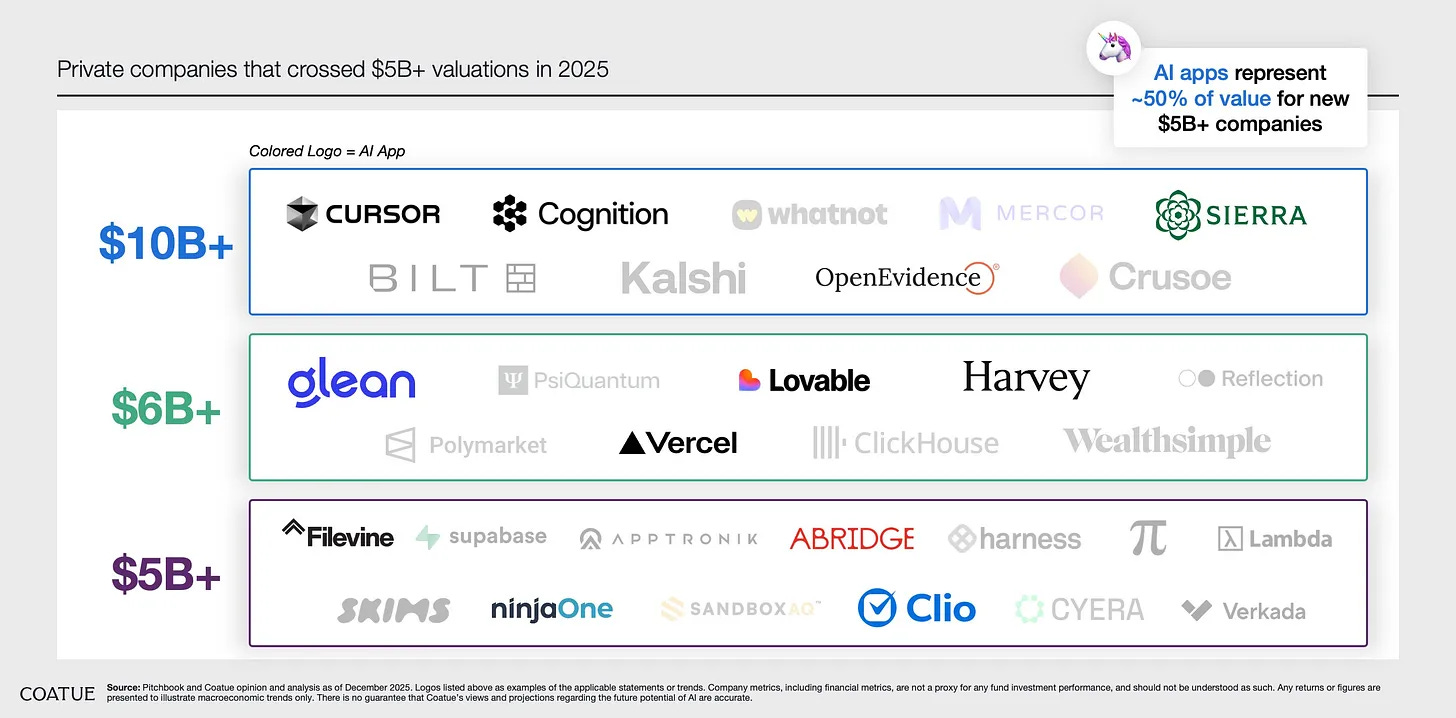
What they are doing is harnessing the LLM and pointing it at a specific output.
The harness is the AI-native product.
At least today.
Think of it this way. You strap the LLM into an exoskeleton. Then you build everything into the suit that the AI needs to deliver reliable work.
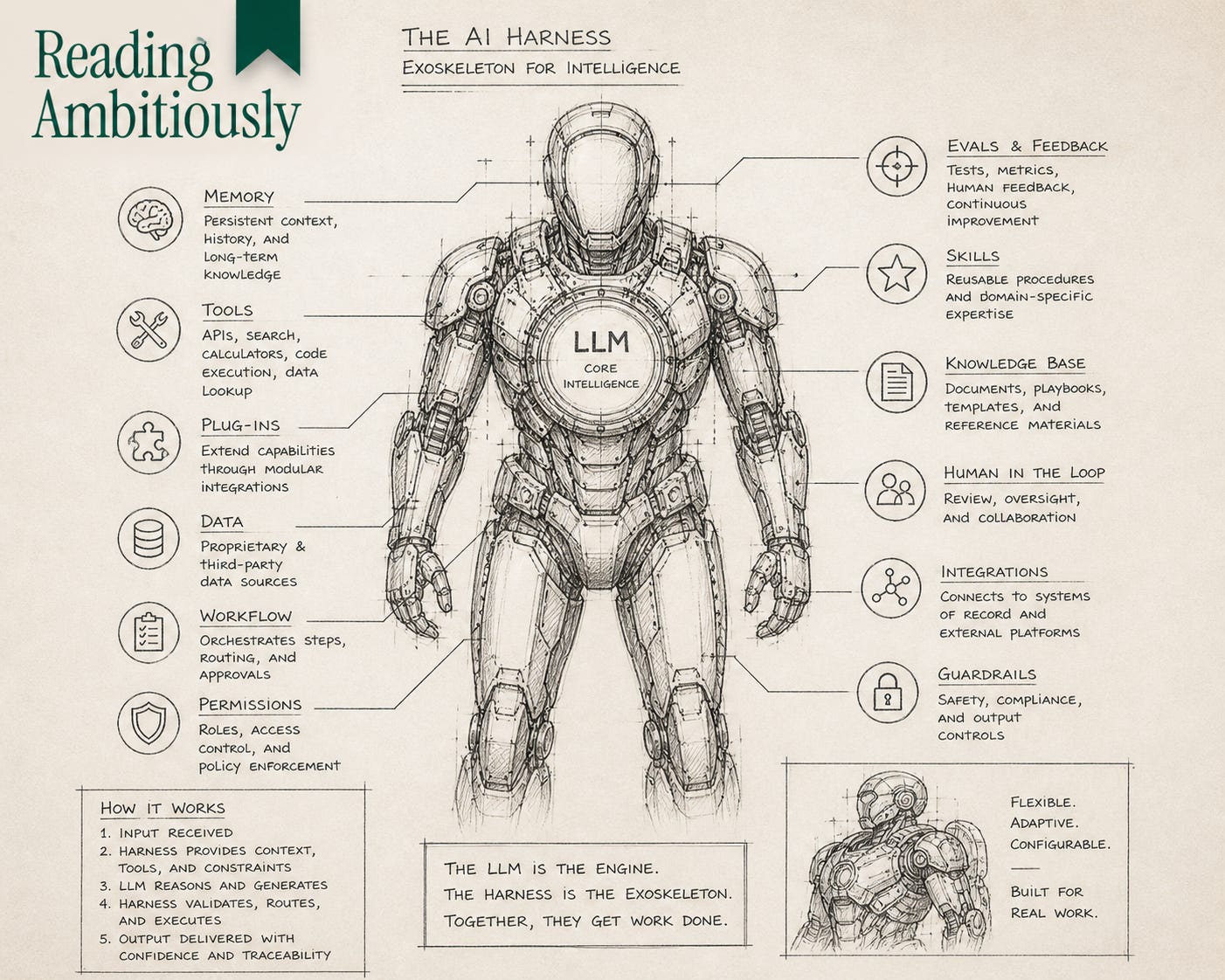
The suit needs memory, so it can remember what matters.
It needs tools to know when to use a calculator instead of asking the model to guess.
It needs plug-ins and integrations, because real work doesn’t happen in a blank chat window. It happens in Google Drive, Slack, Salesforce, Outlook, Word, Excel, and the systems where the business already lives.
It needs proprietary data, so the model can be augmented with examples and documents that improve the quality of the output.
It needs permissions to know what it can touch, what it can change, and what needs approval.
It needs skills, so repeated work can be encoded into reusable procedures with your secret sauce baked in.
And it needs evals, so the system can learn the difference between output that sounds right and output that actually is right.
Building this exoskeleton is what R&D teams at AI-native application companies are working on. If you are building one of these products, technical breakthroughs across these areas, and the specific way they are combined, can add up to real competitive differentiation.
That is the theory.
But a strange thing is happening in legal AI that puts the theory under pressure.
A real-world test case
Legal AI is becoming the perfect test case because the work is valuable, text-heavy, high-stakes, and still deeply dependent on trust.
There is currently a race in the market between Harvey and Legora. Recently, Legora hired Jude Law to be its spokesperson.

Harvey has done an incredible job creating urgency in the legal industry, turning a profession that is typically late to adopt technology into one of the earliest enterprise adopters of AI.
Harvey recently raised $200 million at an $11 billion valuation. Legora raised $550 million at a $5.55 billion valuation. You might think they are running away with the market.
Then last week, former Latham & Watkins lawyer Will Chen launched Mike, an open-source legal AI platform. Mike describes itself as an open-source alternative to Harvey and Legora, with “feature parity,” zero cost, and a self-hostable codebase that law firms can own and extend.
Mike’s point was not subtle: much of the visible application layer can now be rebuilt and distributed for free.
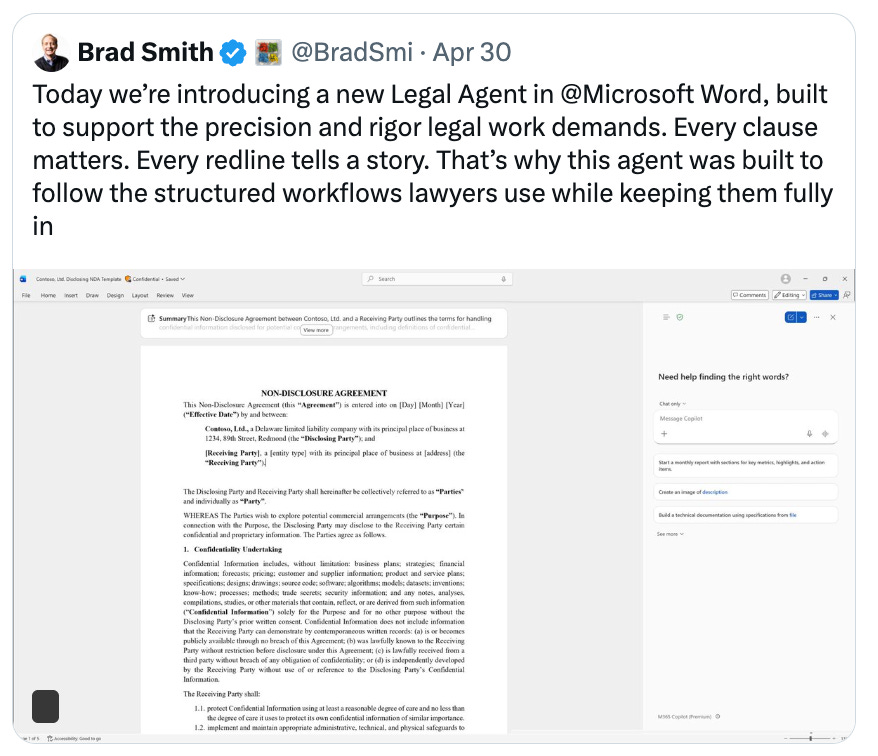
To pile on, Microsoft introduced a Legal Agent directly inside Word, where much of legal work already happens today.
So it begs the question sitting underneath almost every AI application company right now, and those valuations:
Where’s the IP?
In SaaS, this question was easier to answer. The company owned the code. The code became the product. The product created the workflow. The workflow created switching costs. Customers paid for access.
AI-native software is harder to understand.
The model may belong to OpenAI, Anthropic, Google, Meta, or xAI. Those companies are making a lot of money, or at least they are today, although they also face pressure from open-source alternatives.
The interface may be easy to copy. The integrations may sit on top of APIs available to everyone. And the customer may not actually care about the software at all.
They may just care about the work getting done.
That is why the legal AI moment forces the harder question: is the value of the product in the visible application layer, or does it lie deeper?
This is where I keep getting stuck.
The easy answer is that the harness is the IP. I think that is directionally right. But it is also incomplete.
Because not every harness is equally defensible.
If the harness is just a chat interface, a project folder, a tabular review workflow, and a few saved prompts, then maybe the critics are right. Maybe that application layer is thinner than we thought. Maybe it can be rebuilt faster than investors want to admit. Maybe Microsoft can absorb it into a Word feature. Maybe an open-source project can give customers enough of the visible product to make the premium vendor harder to justify.
That is the uncomfortable version of the argument.
But there is another version.
Maybe the visible application layer is not the real product. Maybe it is just the part we can see.
In most serious enterprise workflows, the value is not just the screen. It is the accumulated understanding of how work gets done: the weird edge cases, approval paths, partner preferences, security model, integrations, and trust required to put the system into production.
That stuff does not show up cleanly in a demo. It sits underneath the iceberg.
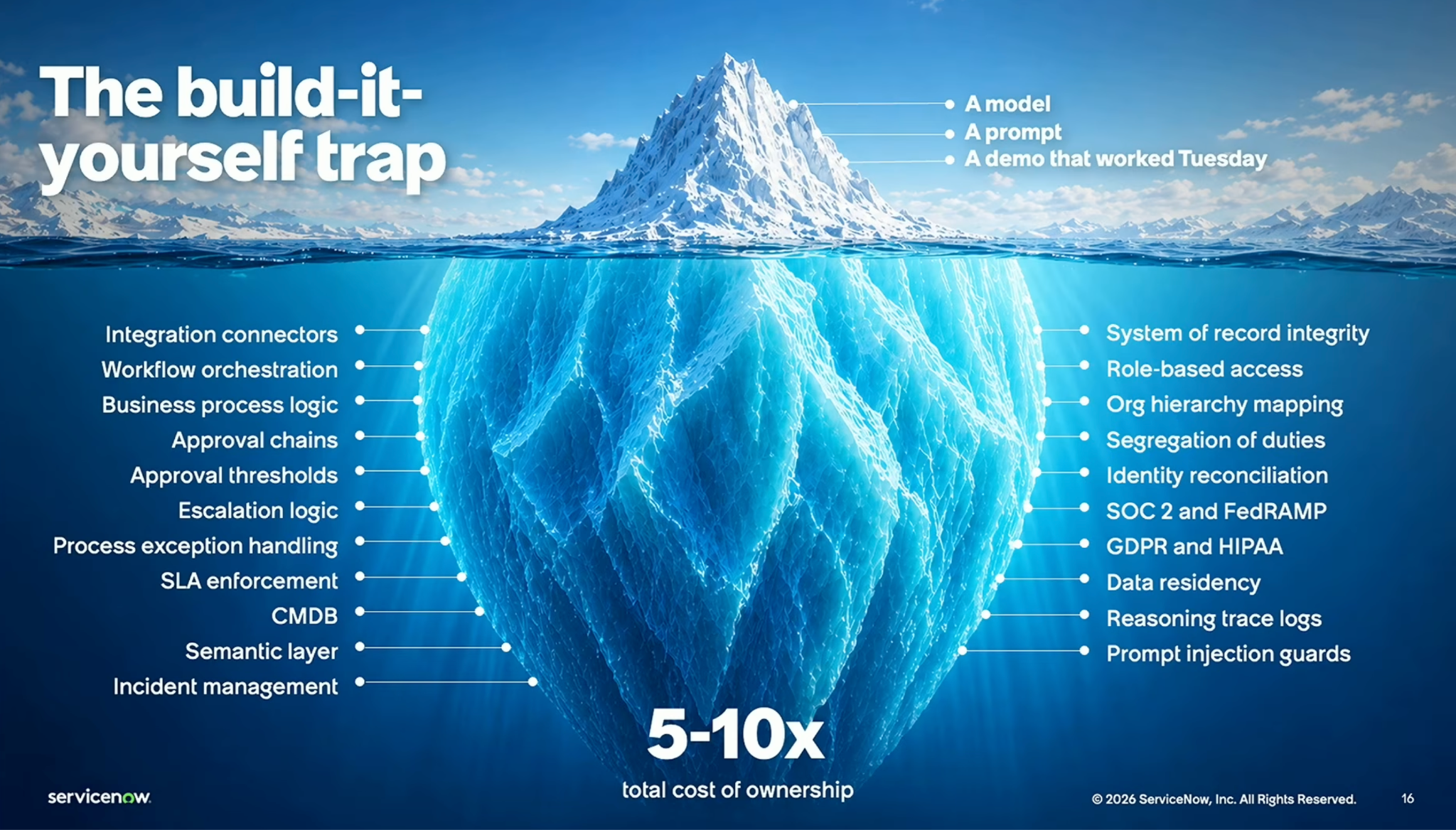
In enterprise software, the visible product has never been the whole story. The real product is often the system of work behind it.
AI makes that more true, not less.
A good harness does not just help the model answer questions. It teaches the model how a specific kind of work should be done. It encodes the difference between a plausible answer and an acceptable one. It knows what should never be touched without a human in the loop.
That is a different kind of product.
It is less like selling software and more like building an operating system for a category of work.
The question is whether that operating system becomes defensible enough to support large standalone companies, or whether the value gets pulled apart by platforms, model companies, open source, and customers building for themselves.
I do not know the answer.
But I think this is the right question.
Because the next generation of AI application companies will be judged on whether they can turn that output into a repeatable, trusted, governed workflow that customers are willing to depend on.
That is where the moat may get seriously deep.
At the point where the system becomes trusted enough to own part of the work.
The “business” of AI
This is the part I keep coming back to.
In SaaS, the product was the software. In AI-native companies, the product may be the harness. But the business of AI may be delivering the outcome.
That distinction feels important because the buyer may not actually want another application.
The buyer wants the work done.
There is an old adage:
“People don’t want to buy a quarter-inch drill. They want a quarter-inch hole.”
A law firm needs documents reviewed, contracts redlined, and work product delivered to a standard that partners and clients will trust.
A CFO does not need another accounting copilot. She needs the books closed.
An insurer does not need another claims assistant. It needs claims to be processed accurately.
This is where the IP question starts to move beyond software.
Maybe the most defensible AI-native companies will not just sell the harness. Maybe they will use the harness to do more of the work.
My friend Sean O’Connell, who is fittingly a lawyer, came up with a phrase for this: tech-shoring.
Offshoring moved labor to a cheaper geography. Tech-shoring moves labor into a technology-mediated system. The work is still supervised by humans where judgment, trust, and accountability matter. But the leverage comes from the AI and how it is harnessed.
This is not pure software. It is not traditional managed services. It is not simply giving people a copilot and hoping productivity improves.
It is using software to deliver the service itself.
That changes the business model.
If you sell the harness, the customer can ask whether they should build it. If you sell the outcome, the customer has to ask a different question: Can you deliver the work better than I can, and are you willing to stand behind it?
Better may mean cheaper. It may mean faster. It may mean more consistent. It may mean more auditable. It may mean less dependence on hard-to-find labor. It may mean the service improves over time because every job teaches the harness something new.
That is a more interesting moat because the value is not just in the tool. It is in the operating system around the work: the process, the data, the human review, the liability, the quality control, the service levels, the customer-specific knowledge, and the feedback loop from doing the work repeatedly.
This is where the IP may start to look less like software IP and more like institutional capability.
That is harder to see from the outside.
It is also harder to copy if it compounds.
Why it matters
We are still using an old software map to navigate a new market.
In SaaS, the questions were relatively familiar: Who owns the code? How sticky is the workflow? What is the retention? How efficient is the growth?
In AI-native products, the questions are different.
If the model is rented, the interface can be copied. The company has to prove it owns something deeper than the screen.
That might be a harness that compounds. It might be proprietary workflows. It might be customer-specific data. It might be trust, governance, or liability. It might be the ability to deliver the outcome better than the customer can.
For builders, this changes what is worth building.
For buyers, it changes what is worth buying.
For investors, it changes what is worth valuing.
The easy answer is to call everything a wrapper. The harder answer is to understand which systems are merely wrapping the model and which are learning to own the work.
The most valuable AI-native companies may not be the ones with the best demo. They may be the ones who turn rented intelligence into work.
The model may be rented. The harness may be the product. The outcome may be the business.
And the IP may live in the system that connects all three.
Stay ambitious, my friends.

Best of the rest:
🤖 DeepSeek nears $50 billion valuation in first fundraising round — China is signaling serious intent in the global AI race, with state-backed capital and tech giants lining up behind a breakout model player that could reshape competitive dynamics. — Reuters
💸 Corporate Card Startup Ramp Raising Funds at $40 Billion Valuation — Ramp’s reported $750 million raise shows investor appetite for AI-powered finance automation is still running hot, with fintech’s category winners continuing to pull away from the pack. — The Wall Street Journal
🧠 Do I belong in tech anymore? – A raw, searching essay on AI burnout and the collapse of tech’s old self-image, arguing that speed without care is hollow because the real work of building software is human judgment, friction, and craft. – ky.fyi
⚙️ A.I. Should Elevate Your Thinking, Not Replace It – A sharp line in the sand for the AI era, arguing that the best engineers will use AI to remove drudgery and deepen judgment, while the ones who outsource thinking will quietly make themselves irrelevant. – Koshy John

Charts that caught my eye:
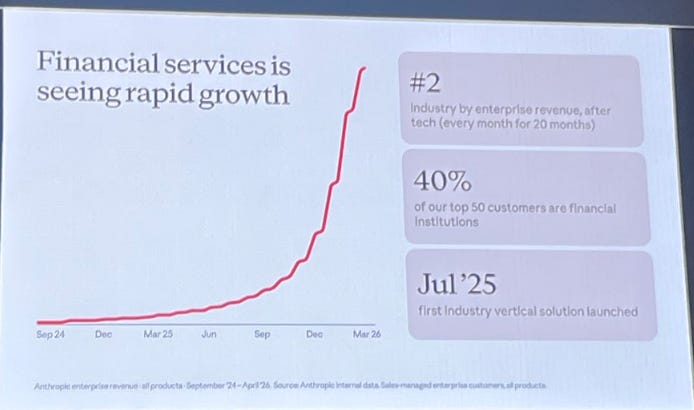
→ Why does it matter? Financial services went from a rounding error to Anthropic’s #2 vertical in about 18 months, with 40% of top customers being financial institutions. Banks tend to be slow buyers of frontier tech. Not this time.

→ Why does it matter? Talent density is everything when capital is abundant. Paraform’s ranking is a view into where the market thinks the best builders are clustered.

Tweets that stopped my scroll:
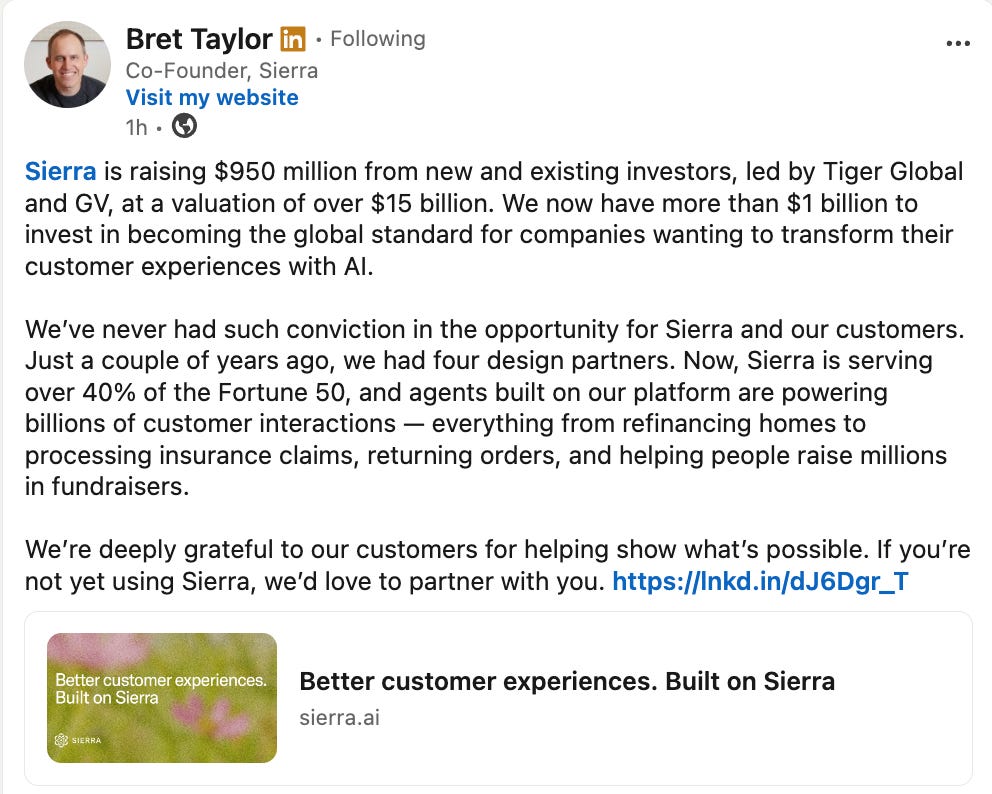
→ Why does it matter? Sierra went from four design partners to 40% of the Fortune 50 in roughly two years. And now they’re raising a $1B warchest. Also, Bret is the current chairman of OpenAI and is seen as a logical successor to Sam Altman.

→ Why does it matter? Perplexity Computer is an always-on AI harness, and this week, they’re announcing a new offering focused on Financial Services, giving access to datasets from MorningStar, Daloopa, and beyond. This is a direct shot at Bloomberg Terminal, and it’s compelling.

→ Why does it matter? Sam Altman texts then-OpenAI CTO Mira Murati during the BOD meeting where he was ousted.
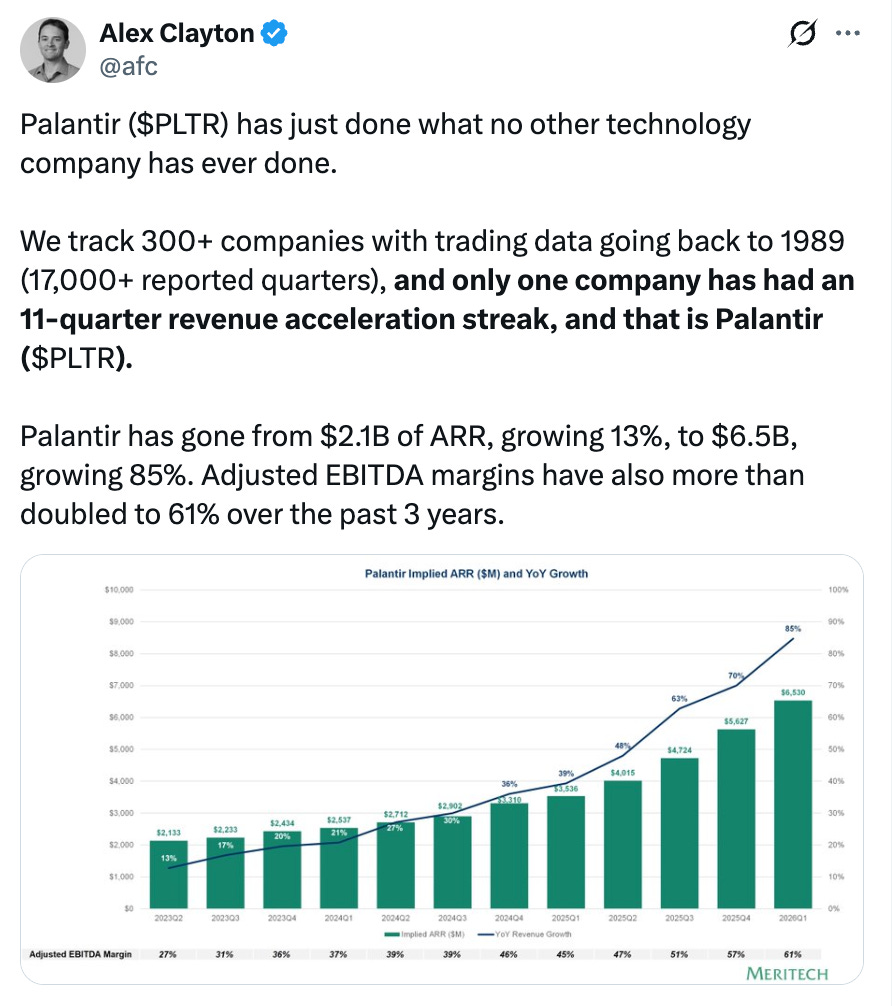
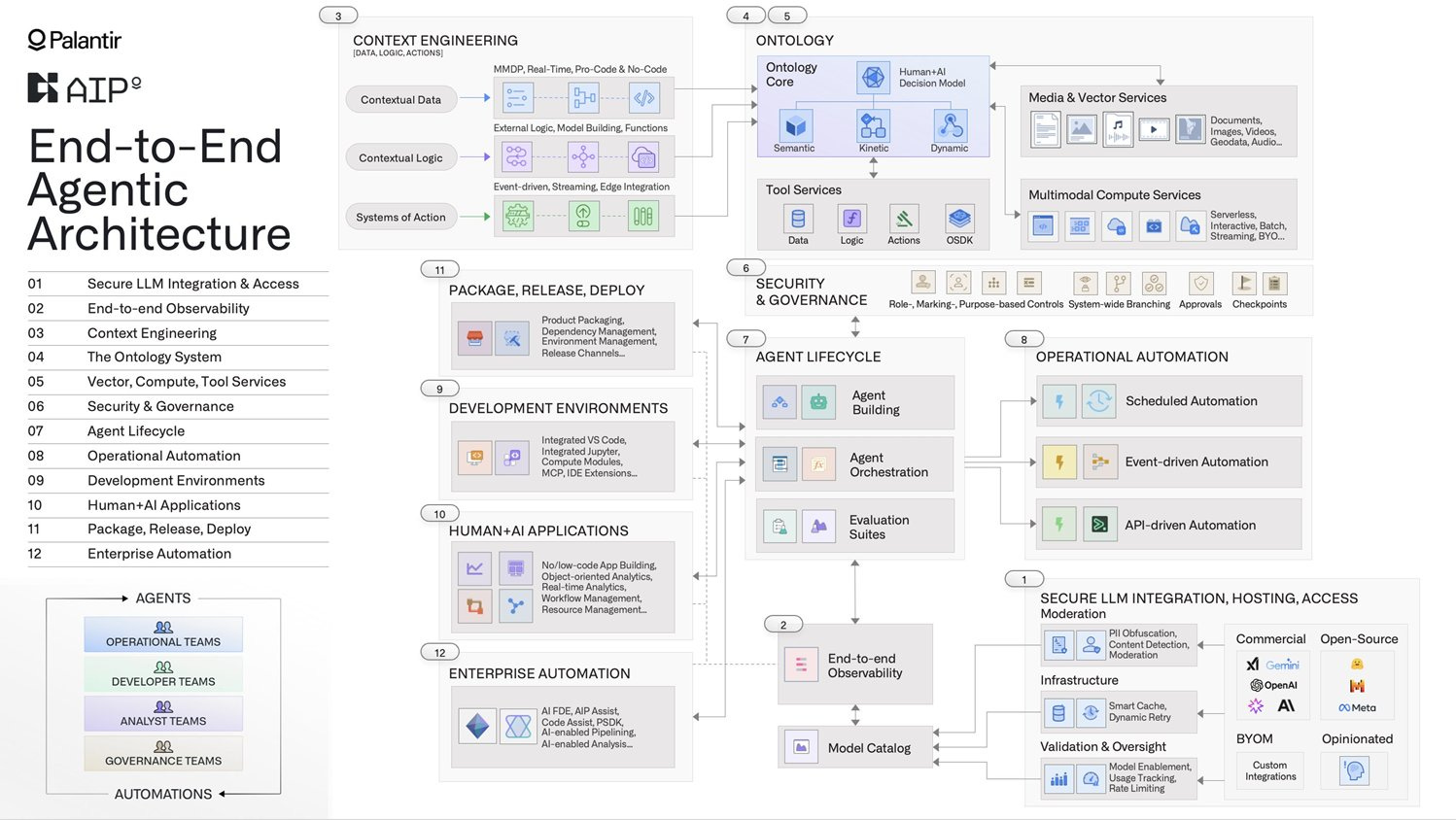
→ Why does it matter? Incredible growth from Palantir. A nice architectural overview of AIP, their AI-focused front-end to the Palantir platform.

Worth a watch or listen at 1x:
→ Why does it matter? You’re doing something right if your first customer conversation is with Jamie Dimon. Anthropic laid out a compelling vision for financial services, its second-fastest-growing market behind technology, and made clear why the category matters: high-stakes workflows, dense information, and customers with both the urgency and resources to put AI to work.
→ Why does it matter? A master class in presenting company strategy from Bill McDermott and the ServiceNow team, with cameos from Jensen Huang and Anthropic’s lead engineer on Claude Code. ServiceNow told a clear story about where enterprise AI is headed and why workflow sits at its center. Financial Analyst Days are always incredible forcing functions. They make companies do the hard work of turning strategy into story, and story into conviction.

Quotes & eyewash:
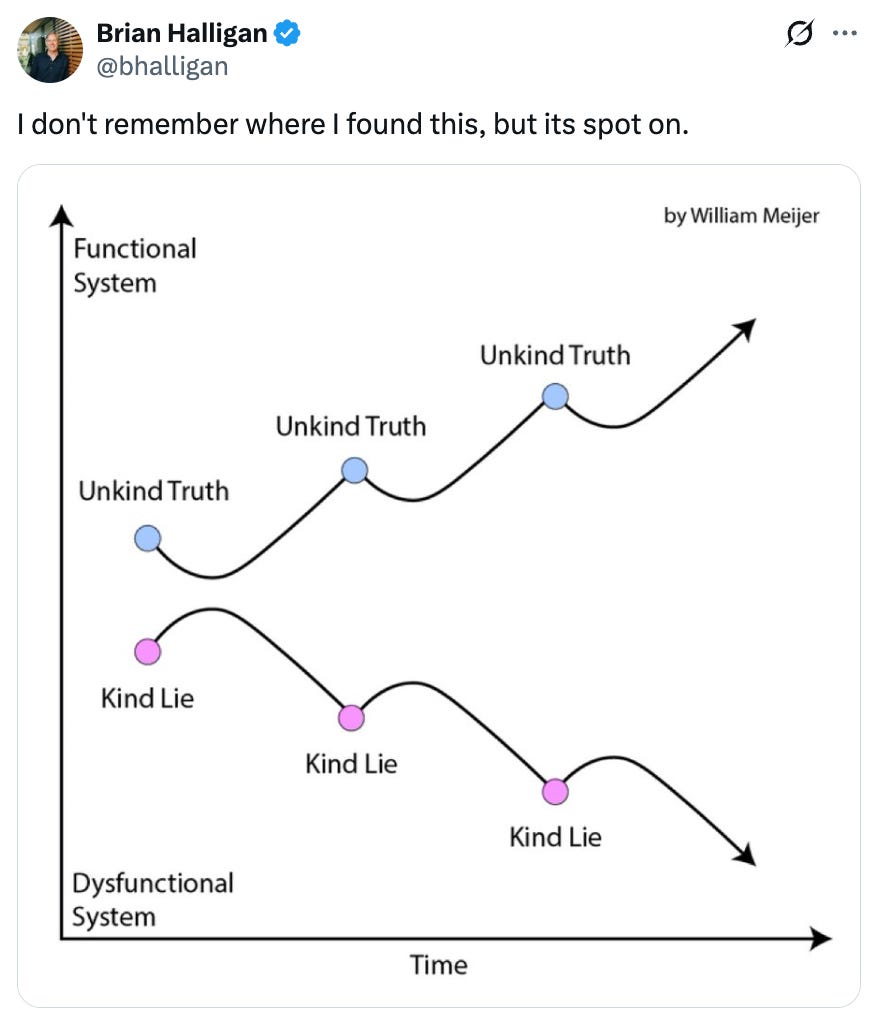
→ Why does it matter? Build a high agency team and strive for intellectual honesty. A few years ago, I stumbled upon this great book on the subject: Mistakes Were Made (but Not by Me): Why We Justify Foolish Beliefs, Bad Decisions, and Hurtful Acts.
The mission:
The Wall Street Journal once used “Read Ambitiously” as a slogan, but I took it as a personal challenge. Our mission is to give you a point of view in a noisy, changing world. To unpack big ideas that sharpen your edge and show why they matter. To fit ambition-sized insight into your busy life and channel the zeitgeist into the stories and signals that fuel your next move. Above all, we aim to give you power, the kind that comes from having the words, insight, and legitimacy to lead with confidence. Together, we read to grow, keep learning, and refine our lens to spot the best opportunities. As Jamie Dimon says, “Great leaders are readers.”
Disclaimer: This content is for informational purposes only and does not constitute financial, investment, or legal advice. Readers should do their own research and consult with a qualified professional before making any decisions.