



The big idea: The Seven Primitives of an AI-Native PersonalOS
Reading time: 8 minutes

“When was the first time I ever wrote about a personal AI operating system?”
Bam. A few seconds later, I had the answer.
January 30, 2026 — Building AmbitiousOS & AI Agents w/ Claude Code
In the old world, I would have gone to ReadingAmbitiously.com, searched the archive, and eventually found it. Not a difficult task, but an annoying one.
And right now, I think most of the world still thinks of AI as an answer engine. A technology a tad better than Google.
That’s a version of AI. In my opinion, the least interesting.
So let’s ask a different question.
“Hey AmbitiousOS, how has my thinking on AI changed since we initially launched?”
Now we’re cooking.
AmbitiousOS did not just retrieve the first post. It reconstructed the arc across 30 data points and five editions:
January 30 — The initial build. A personal operating system to help with the newsletter.
February 20 — Memory. The idea shifted toward memory, and the implication that near-perfect recall would belong to people who choose to document.
February 27 — The dataset. The “it” in AI: the dataset, often selected, created, and curated by people.
April 10 — Always-on intelligence. AI proactively working in the background and the hidden tax of broken memory in knowledge work.
May 22 — The new knowledge work. A new approach to knowledge work: externalizing your process, turning it into skills, and letting AI agents run the parts of the job that are really the “work about the work.”
Now this is the power of AI.
In the old world, I could have eventually identified this pattern. I would have read through the old editions. In the new world, AmbitiousOS already had the context.
There is a great line from John Culkin, the Jesuit priest: “We shape our tools, and thereafter our tools shape us.” Silicon Valley loves this quote because it captures something that feels obviously true once you see it.
For much of 2026, I have been writing about the shape of these tools. Now, in a small but increasingly real way, many of those ideas are making their way into the PersonalOS I’ve built, AmbitiousOS.
The path (only 4 months in length) looked something like this:
The Reading Ambitiously archive, now more than 100 editions, became searchable.
The searchable archive became a knowledge graph that shows how concepts connect.
The graph evolved into the first version of system memory.
Memory expanded into claims, predictions, and trajectories.
The tools we developed became callable.
The workflows involved in manufacturing the newsletter became skills.
The routines and scheduled jobs started running those skills in the background.
MCP made the same AmbitiousOS brain accessible across other AI environments, such as ChatGPT, Claude, and Codex.
I know that sounds technical. Great products ultimately feel magical and frictionless. Those are coming. But in a hobbyist way, I think these capabilities are starting to reveal the emerging system architecture for AI-native work.
What becomes clearer to me every day is that every knowledge worker, team, and company will want some version of this.
The primitives of AmbitiousOS
AmbitiousOS is currently built around seven primitives: context, memory, skills, tools, routines, portability, and the build loop.
1. Context: what are the inputs, and how do they relate?
The original dataset in AmbitiousOS consisted of about every edition of the newsletter and all the primary research that went into writing them. With the help of Claude Code, we built a database and labeled the data. Very quickly, it became clear that the AI needed help understanding all of this new context.
A knowledge graph is a map of how things relate. People, companies, ideas and themes all “live” near other things. Useful knowledge is rarely an isolated fact. It is usually about connection.
In the Reading Ambitiously context, OpenAI is not just a mention in an old issue. It sits near ChatGPT, Anthropic, Sam Altman, xAI, DeepSeek, Microsoft, Nvidia, tokens, agents, and the broader question of where AI value will accrue. Since I started writing, OpenAI has been mentioned 54 times in the archive. That is no longer a single note. It is a neighborhood of thought.
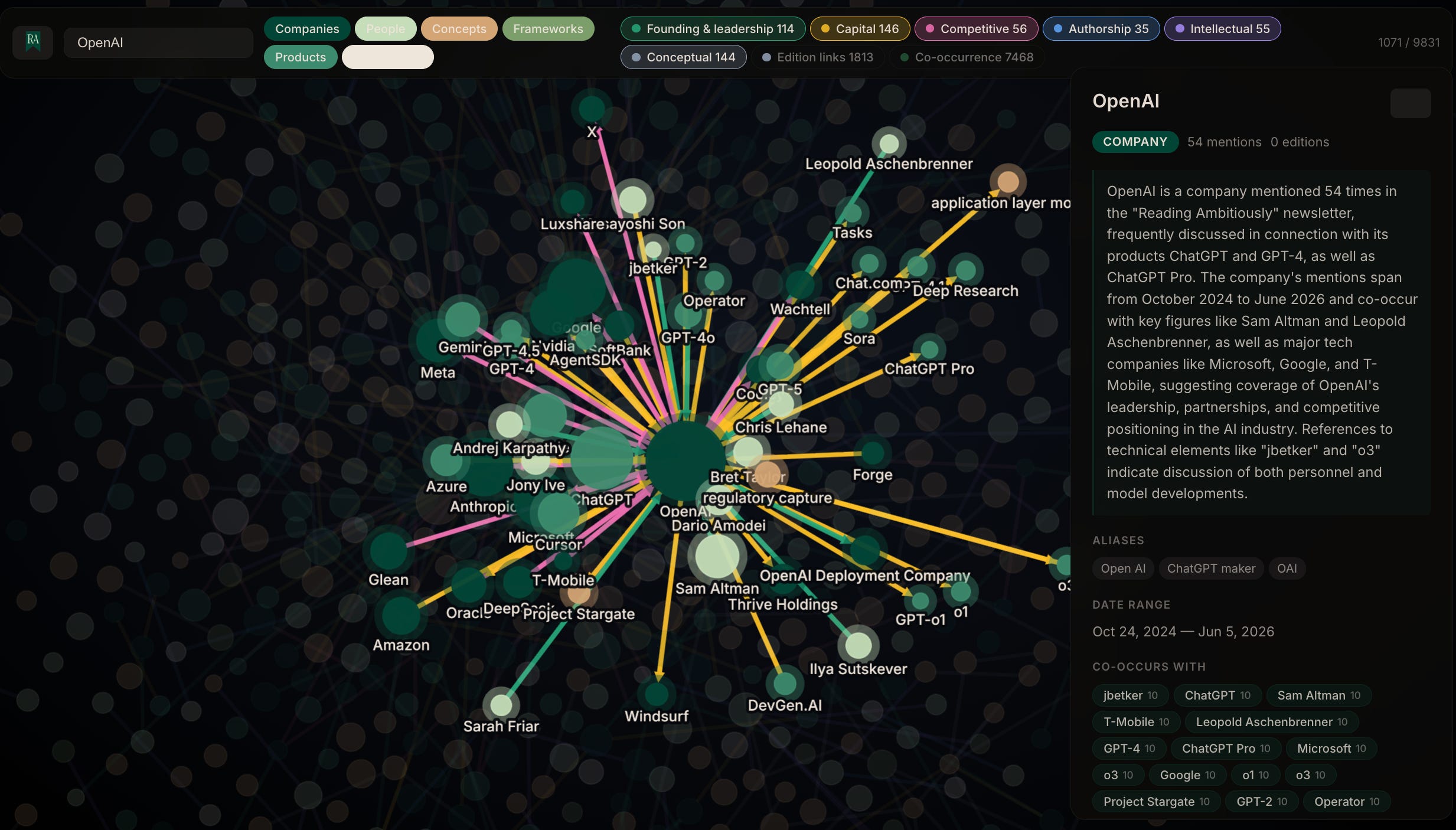
The power comes when your ideas are no longer disconnected notes. Once the relationships are visible, both you and the AI can start seeing the shape of your thinking. As of this writing, we track 1,071 entities and 9,831 connections amongst them.
Context provides AI with the right inputs and an understanding of how they relate.
2. Memory: what do I believe, and has it changed?
Memory is different from storage. Memory helps preserve the meaning.
A good memory system should let you rewind the tape and see how your thinking changed over time. What did you believe? When did you believe it? What changed? Does the claim still hold? Was the prediction right, wrong, partial, or unresolved?
The latest version of AmbitiousOS now tags claims, predictions, recommendations, opinions, confidence, dates, and resolution status. That means the system can help me reason across my own thinking, not just retrieve old words from the archive.
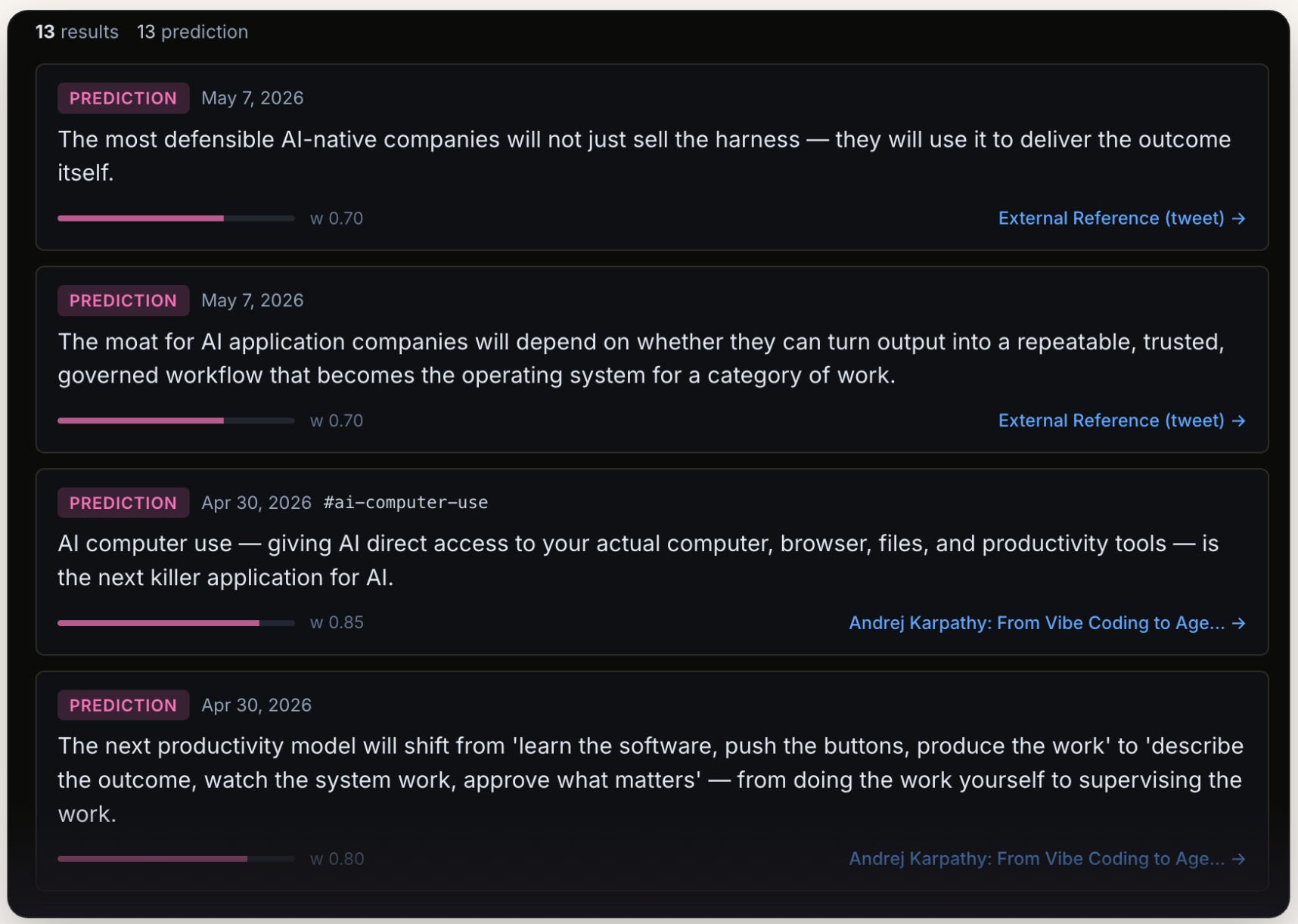
That is a meaningful shift. If I ask, “What have I written about OpenAI?” I get retrieval. If I ask, “How has my thinking on OpenAI changed?” I get memory. The first question finds artifacts. The second question helps me reason through how my thoughts have changed over time.
Memory is what helps the AI understand how context has evolved over time.
Right now, memory is a new and emerging space. Next time you’re using ChatGPT or Claude, ask it to “commit this to memory” which is a start. Better solutions are coming.
3. Skills: how should this work be done?
Skills are repeatable procedures. Think of a skill as a good onboarding document for your agents. You spell out the task, explain the process, define what good looks like, and make clear what “done” means.
This is important because much knowledge work is repetitive. Every week, I have to gather inputs for Reading Ambitiously, evaluate links, decide which charts matter, check whether I have used something before, draft “why it matters” blurbs, copyedit, source check, and assemble the final issue.
For years, most of that process lived in my head. AmbitiousOS is helping me turn that process into skills.
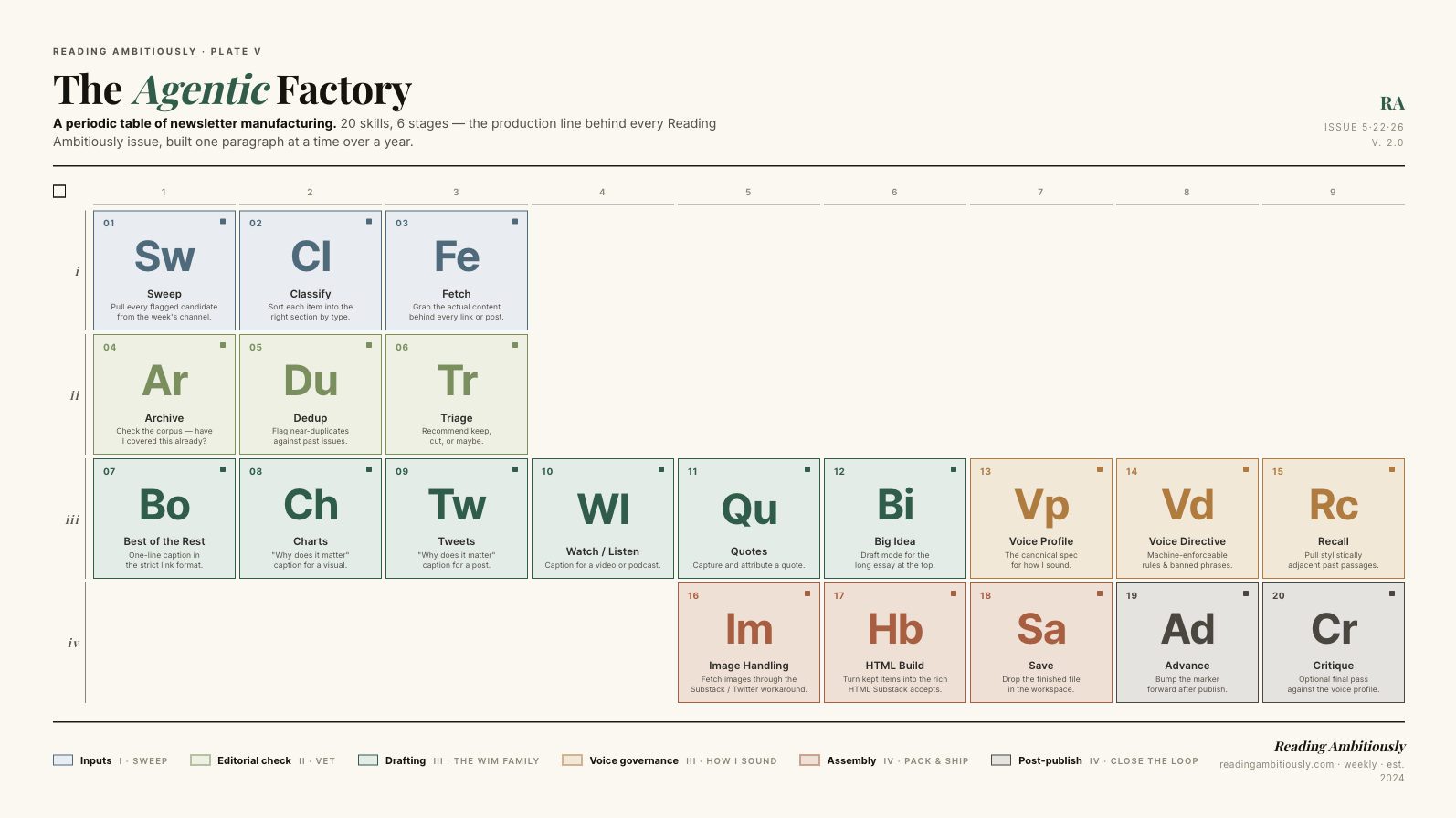
Once you write down a skill, it can improve. It can be versioned. It can be reused. It can be handed to an agent when the same work comes up again. A skill turns one piece of a messy process into something an AI can run more reliably. Many skills together start to look like a new way to manufacture knowledge work.
The practical lesson is straightforward: look for the work you repeat. What do you do every week? What do you explain over and over again? What process would you teach a new hire if they joined tomorrow? Write that down. That is the beginning of a skill.
Skills tell the AI how the work should be done.
4. Tools: what can the system actually do?
If skills are the onboarding instructions, tools are how the AI becomes operational.
A model can reason. A tool lets it do something. Search the archive. Query the knowledge graph. Pull recent editions. Check prior claims.
Without tools, the AI mostly talks. With tools, it can operate inside a workflow.
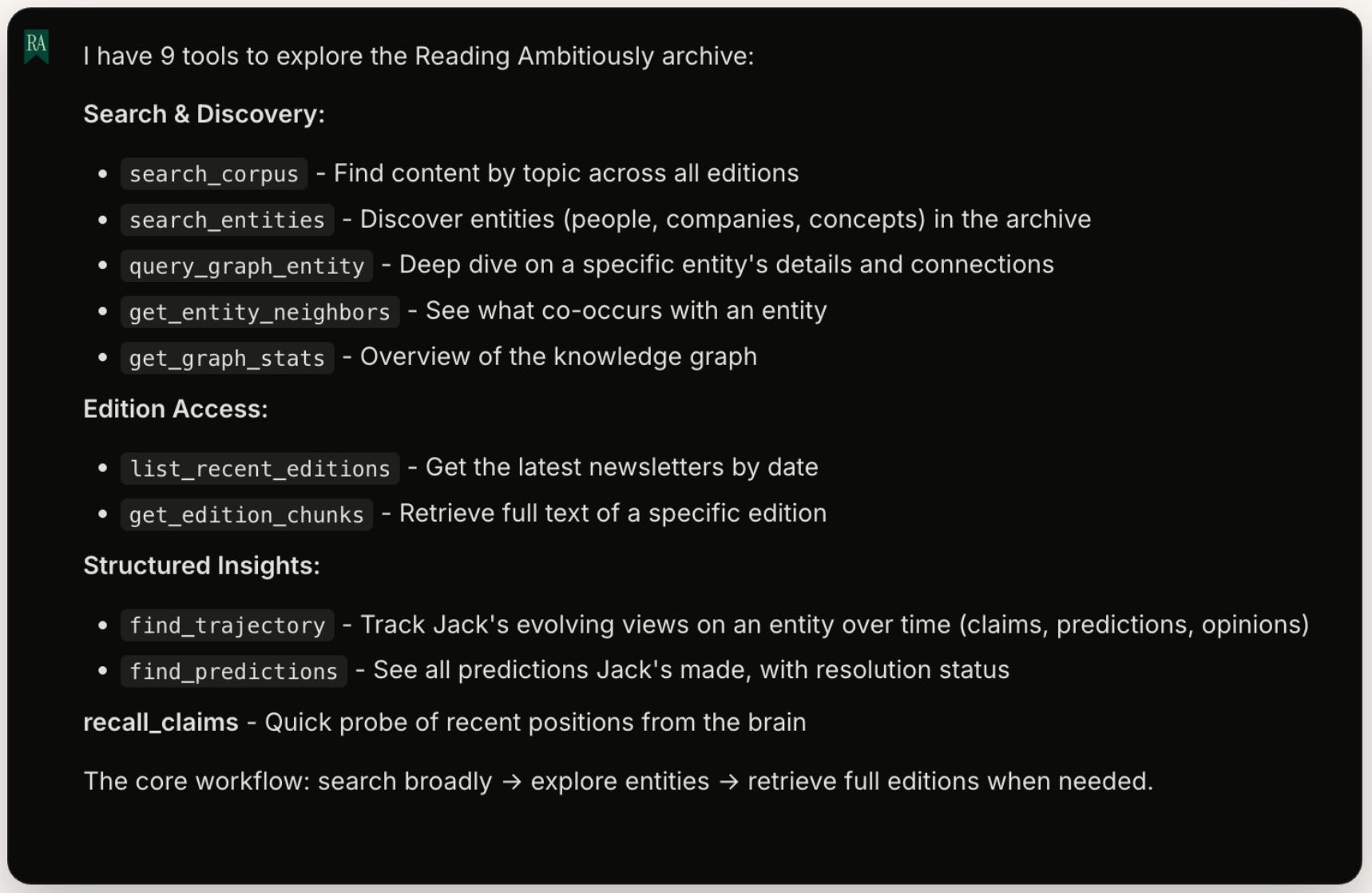
When I start a new edition of Reading Ambitiously, these tools help the model move through the archive and retrieve grounded context from previous editions. Instead of vaguely remembering that I talked about “the transition tax,” it can fetch the issue. Instead of saying OpenAI has been important in the archive, it can query the graph and show how often it appeared and what it connects to.
Tools are where the action happens. This is the question to ask in your own work: what would an AI need besides the answer? Should it pull files? Search a note-taking app? Check a CRM? Query a database? Draft a follow-up? Compare a document against prior decisions?
Tools give the AI the ability to act.
5. Routines: what should happen without me asking?
Routines are the heartbeat of the system.
A system that only works when I remember to prompt it is still dependent on me to start the work. That is useful, but it is not always on.
Scheduled jobs and automations create background loops. AmbitiousOS can ingest new information, prepare briefings, update the graph, refresh memory, and keep the knowledge base current. Every night while I am asleep, AmbitiousOS can go through a kind of “dream cycle” in which it gardens the underlying knowledge base and ensures it is up to date.
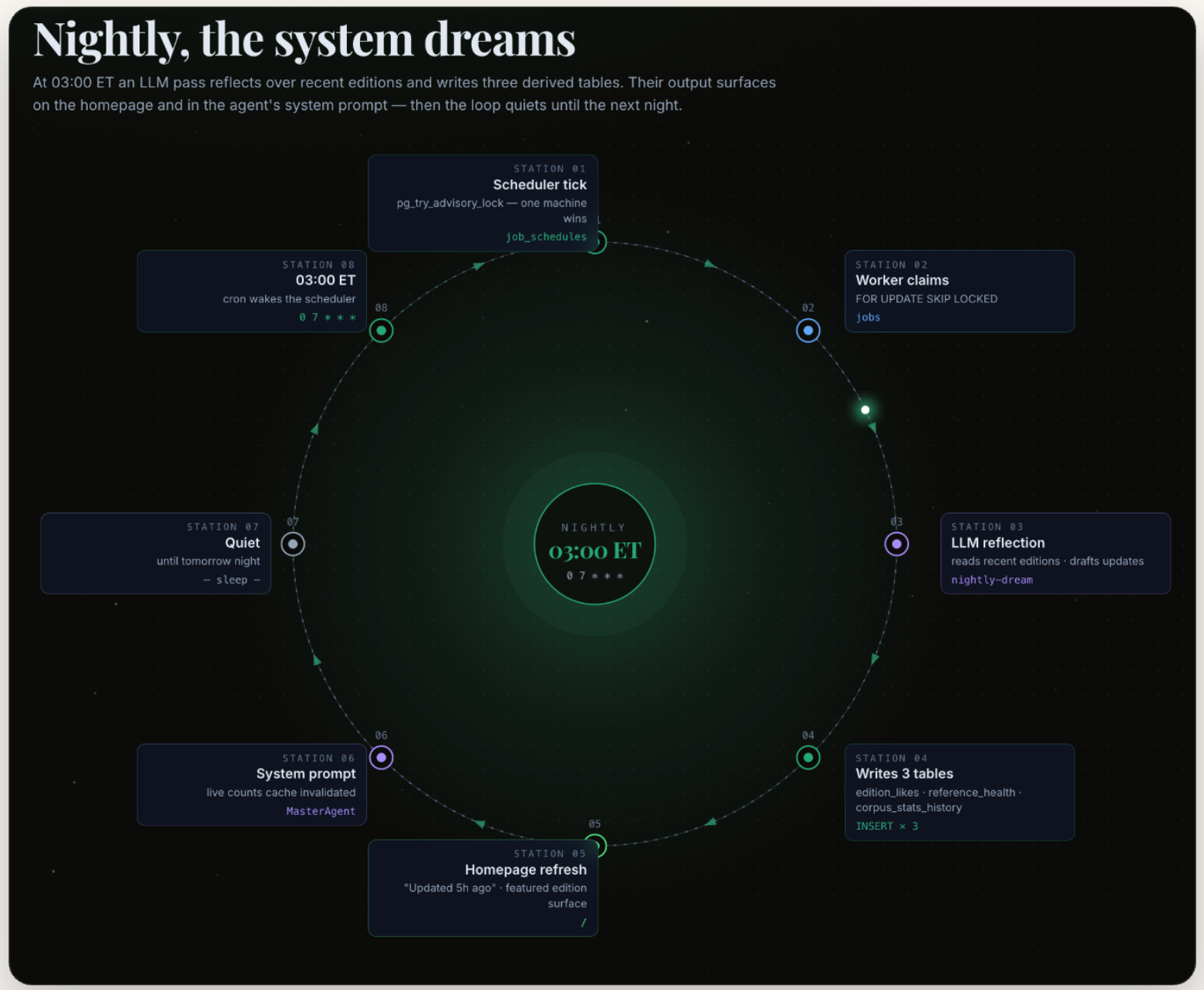
In software, these are often called cron jobs. The word Cron derives from Chronus, meaning time. A cron is a time-based job. The system does not need to wait for me to constantly update its knowledge base. It can routinely run jobs to do that itself.
This is one of the most important primitives because so much knowledge work is maintenance. Keeping track of what changed. Revisiting old assumptions. Connecting the new thing to the old thing.
Routines are how AI becomes a system working alongside you that’s “always on”.
6. Portability: where else should the brain be accessible?
The current best version of this is the Model Context Protocol (MCP). MCP is a technical phrase, but the plain-English version is simple: it lets the brain travel.
Early versions of AmbitiousOS were trapped inside our own interface. If you wanted to use the system, you had to go to AmbitiousOS. Sometimes I want to think in ChatGPT. Sometimes I want to build in Codex. Sometimes I want to work in Claude.
Now, via MCP, AmbitiousOS can be accessed from other AI environments.
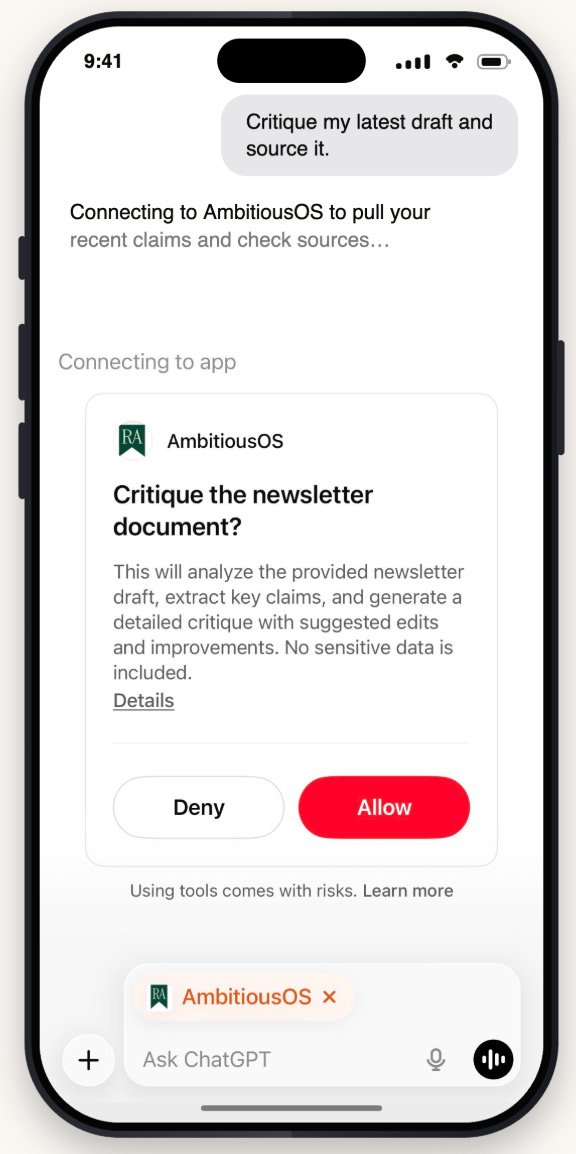
AI becomes more valuable at the moment of work. If I am drafting a reply to an email, I do not want to leave the workflow, go to a separate archive, search for context, copy it back, and then write. I want the AI working with me to be able to tap into the relevant brain at the right moment.
In a harness like Claude, ChatGPT, or Codex, AmbitiousOS can be connected alongside other MCP’s that bring in email, calendar, Slack, documents, or code.
This is also why people talk about software becoming “headless.” The interface becomes less important than the capability. The value is not always the screen you log into. Increasingly, the value lies in the service, context, or action an agent can call on when it needs it.
Portability puts the brain where the work happens.
7. Build Loop: how does the system improve itself?
Codex and Claude Code drive the build loop.
This is the newest and most exciting part of AmbitiousOS. I can now use Codex to build the next version of AmbitiousOS while giving Codex access to what AmbitiousOS is supposed to become.
The first version of AI coding was: ask AI to write code.
The next version was: let it work inside your code repository.
The emerging version is: give it the latest edition of Reading Ambitiously and let it improve itself.
After I publish an edition of Reading Ambitiously, Codex can pick it up, understand the concepts, translate them into a product roadmap, and start helping build the feature set. If I write about the seven primitives, those ideas can be taken up by the AmbitiousOS and Codex.
The system I am building becomes part of the environment used to build the system. That is sometimes called a recursive system.
This one is mind-boggling, I know. We are only touching the tip of the iceberg.
But even at this early stage, this is pretty cool. The build loop improves the system with its own context.
Zooming out
The applied lessons are these:
AI needs the right context and an understanding of how concepts relate to one another.
Memory helps explain how that context has evolved over time.
Skills give the AI instructions for how to do the job.
Tools give the AI what it needs to do the job well.
Routines let the jobs run in the background.
Portability puts the AI where the work happens.
The build loop lets the system improve with its own context.
As of June 12, that is my best description of the emerging architecture of AI-native work.
Make sure the AI captures that claim.
The more I build in this direction, the more I believe this is where knowledge work is going.
AI changes what is possible, but only if the AI has access to the right context, in the right place, at the right time, with the right tools to act on it.
We shape our tools, and thereafter our tools shape us.
Stay ambitious, my friends. And if you’re really ambitious and ask your favorite AI to give this edition a read and start building yours today.
Request access to AmbitiousOS today.

Best of the rest:
💸 OpenAI Files Confidentially for Its IPO – One week after Anthropic, with an $852B private mark, a Musk lawsuit cleared, and Microsoft’s 27% stake set for a public price. – Yahoo Finance
🔒 The 24-Year-Old Running $20B on an AI Thesis – Leopold Aschenbrenner’s Situational Awareness is up 1,000%+ since launch, and Jane Street, which rarely backs outsiders, invested. – WSJ
💼 The Moat Was Never the Code – Agents made translating a domain into software cheap; knowing what right looks like is the part you still can’t prompt for. – Aaron Brethorst
🧠 The Case for Cancelling Your AI Subscription – A prolific builder lists 17 projects he never needed, calls the tooling a “thermonuclear ADHD amplifier,” and argues friction was the product. – David Wilson
🔒 OpenAI Eyes a 10-Gigawatt Ohio Campus – A 20-year lease on federal land, Nvidia guaranteeing the financing, and a build that could run $500B. – The Information
🤖 From Wizard to Patron – Mollick’s Fable review: nine-hour autonomous builds, finished work back, and his unease that steering is no longer the same as doing. – One Useful Thing
🏛️ Dario’s Policy Playbook for the Exponential – Amodei moves past transparency: FAA-style testing for frontier models, wage insurance for displacement, and a democratic coalition locking down the supply chain. – Dario Amodei

Charts that caught my eye:
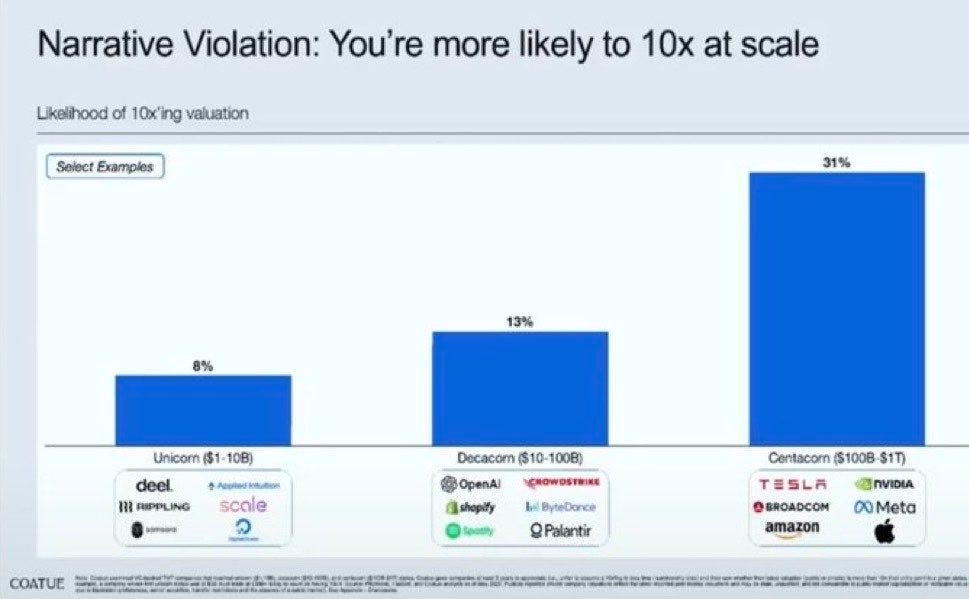
→ Why does it matter? According to Coatue, a business valued between $100B and $1T has a higher statistical likelihood (31%) of multiplying its value by 10x compared to smaller, earlier-stage unicorns (8%).
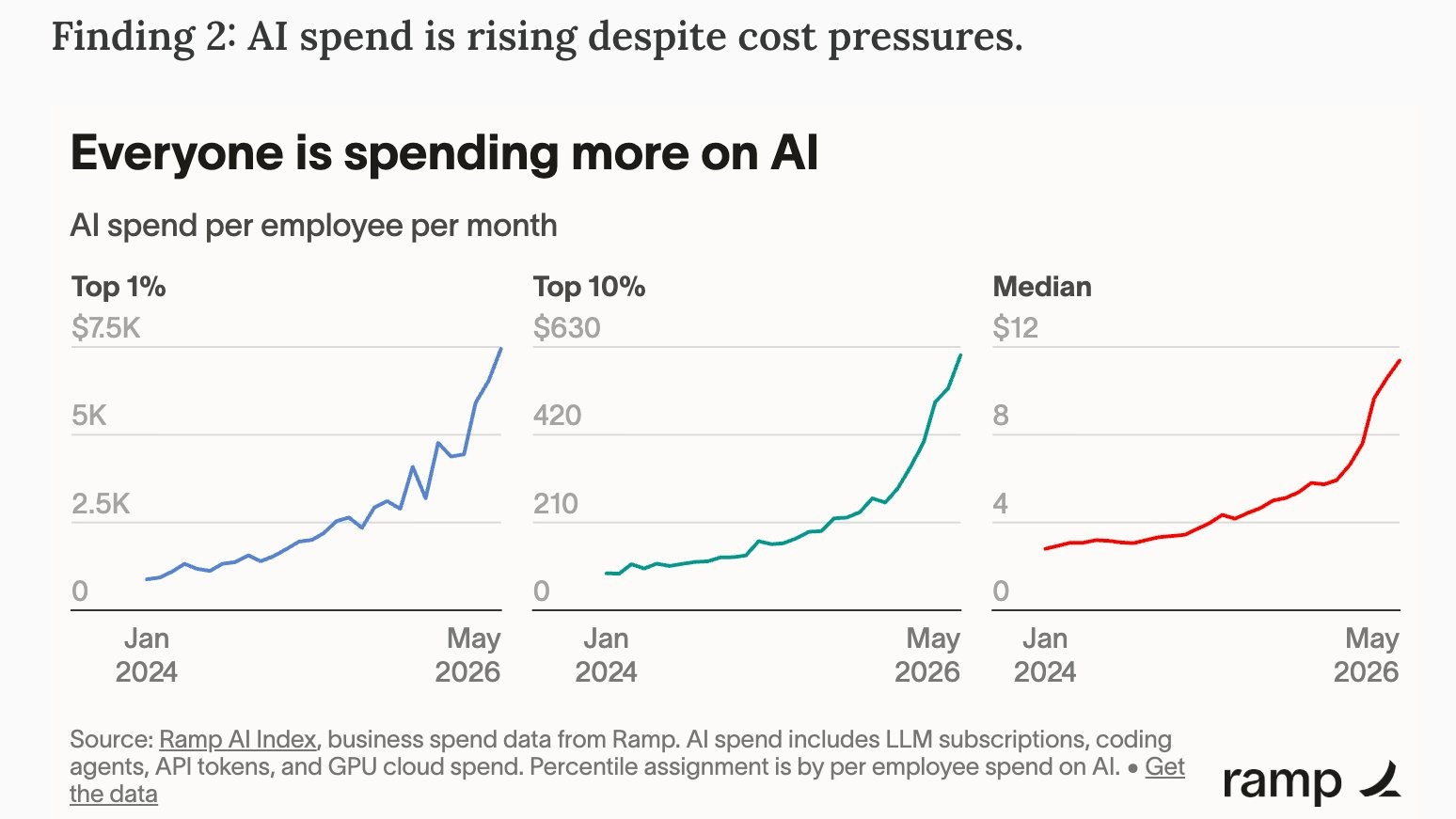
→ Why does it matter? The median RAMP customer is paying $12/month per employee on AI. The top completely AI pilled decile? Closer to $9k/month per employee. The top 0.01%? $90k/month per employee.
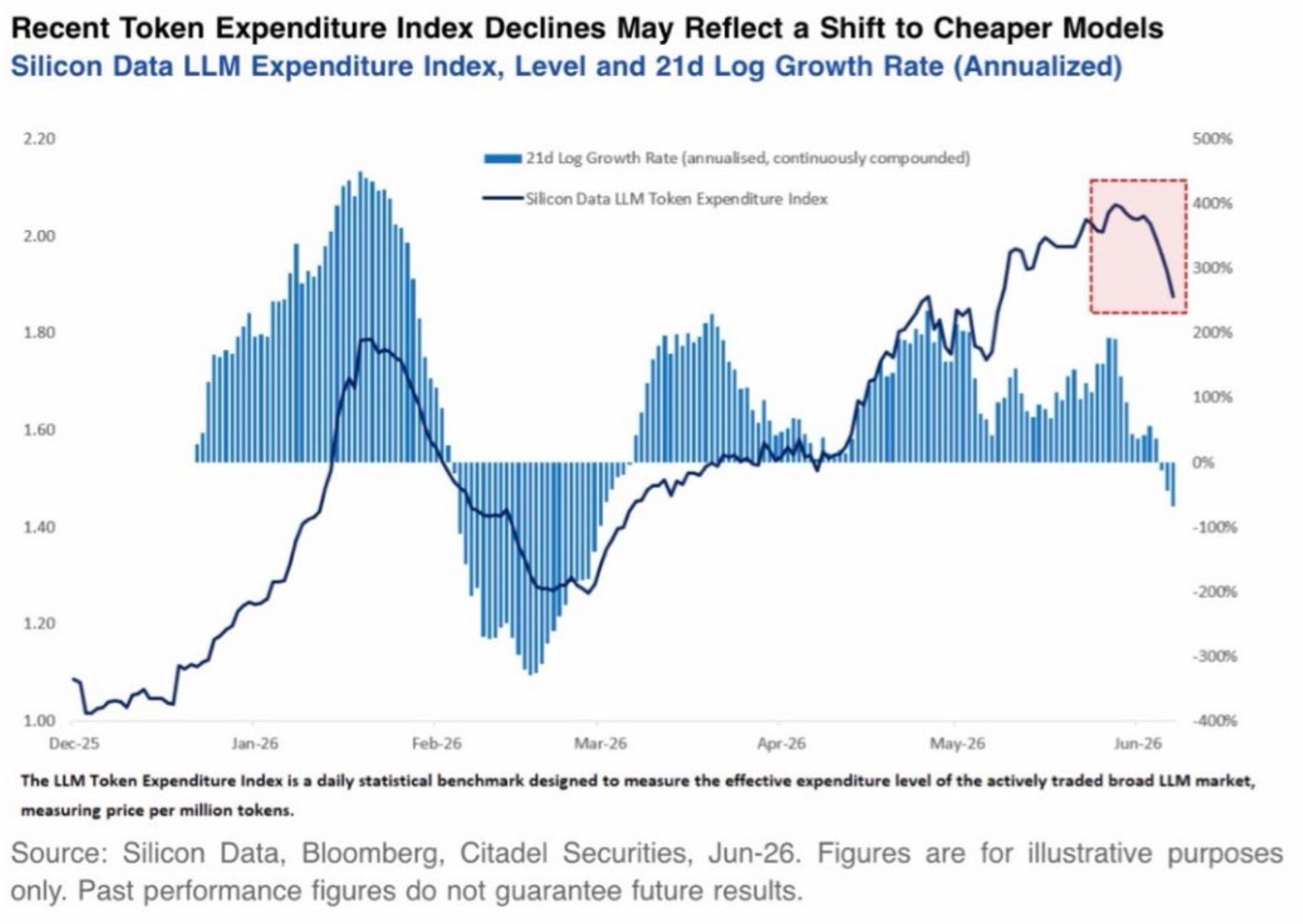
→ Why does it matter? The Silicon Data LLM Token Expenditure Index, a benchmark for how much the market is actually spending on AI tokens, has started rolling over. According to Citadel this is a shift toward cheaper models. Companies substituting away from expensive frontier AI toward "good enough" alternatives.
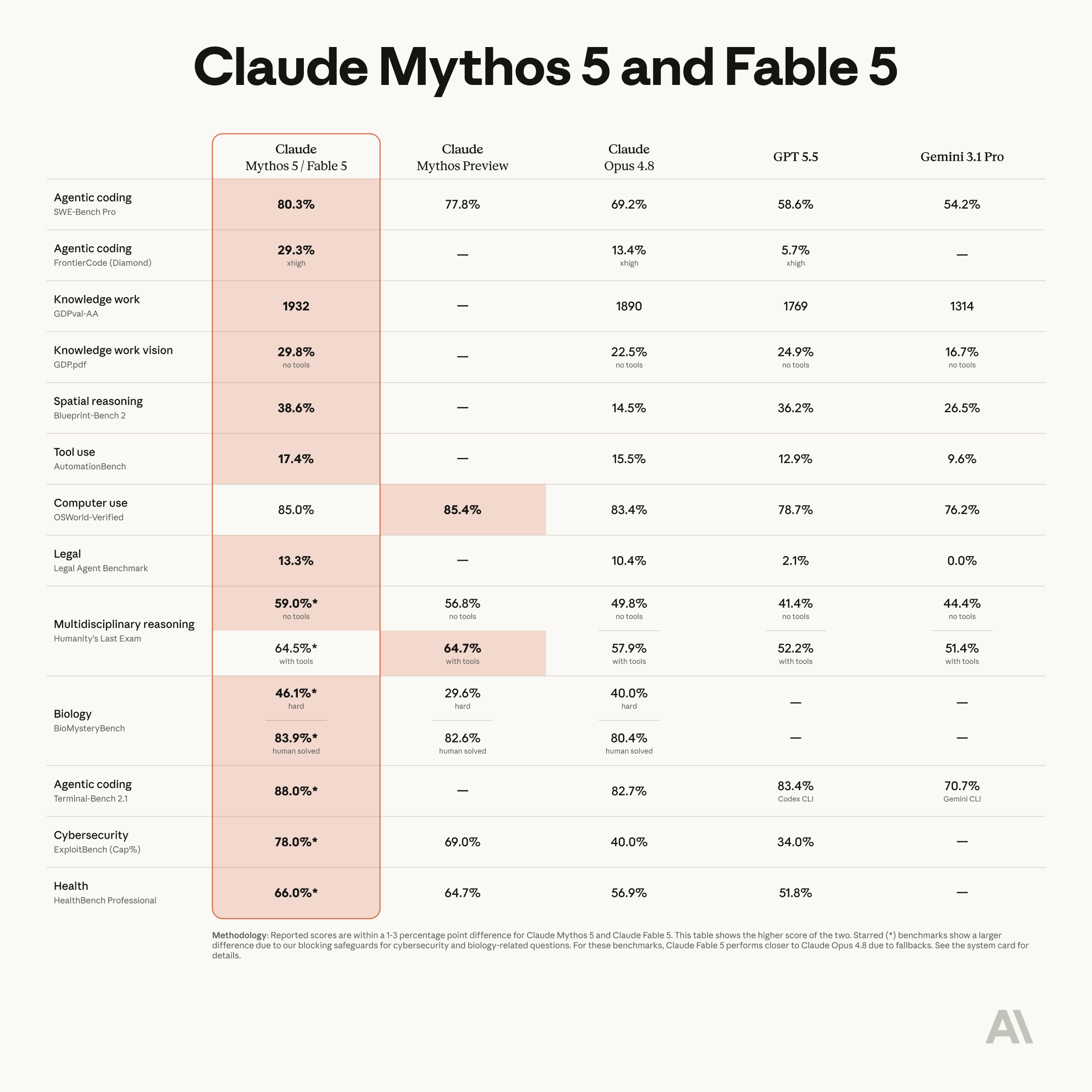
→ Why does it matter? Fable (the publicly available version of Mythos) is a beast!
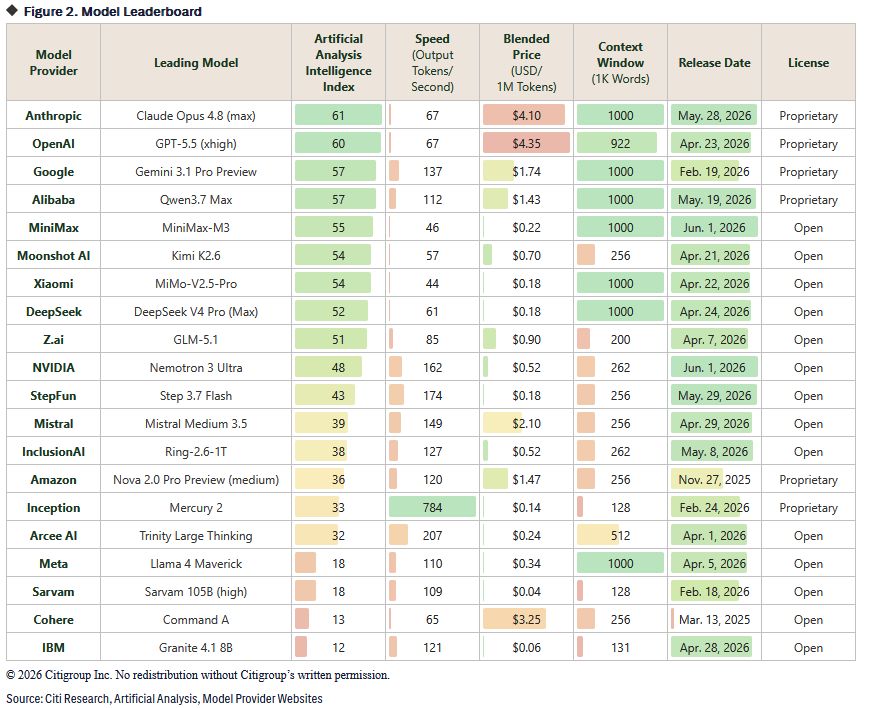
→ Why does it matter? This chart doesn’t include Anthropic’s Fable out this week but it’s a comprehensive LLM landscape!

Tweets that stopped my scroll:

→ Why does it matter? So, spend the the time in the meetings you’re most stressed as those are likely the ones where you’re making the hard decisions? Amazing how AI can rapidly create and personalize a dashboard like this.

→ Why does it matter? I too get the impression OpenAI will soon be back to #1 on the LLM leaderboard. Remember, we’re just starting to train models on Nvidia’s latest Blackwell series, and Vera Rubin is next.

→ Why does it matter? An important list to keep an eye on.
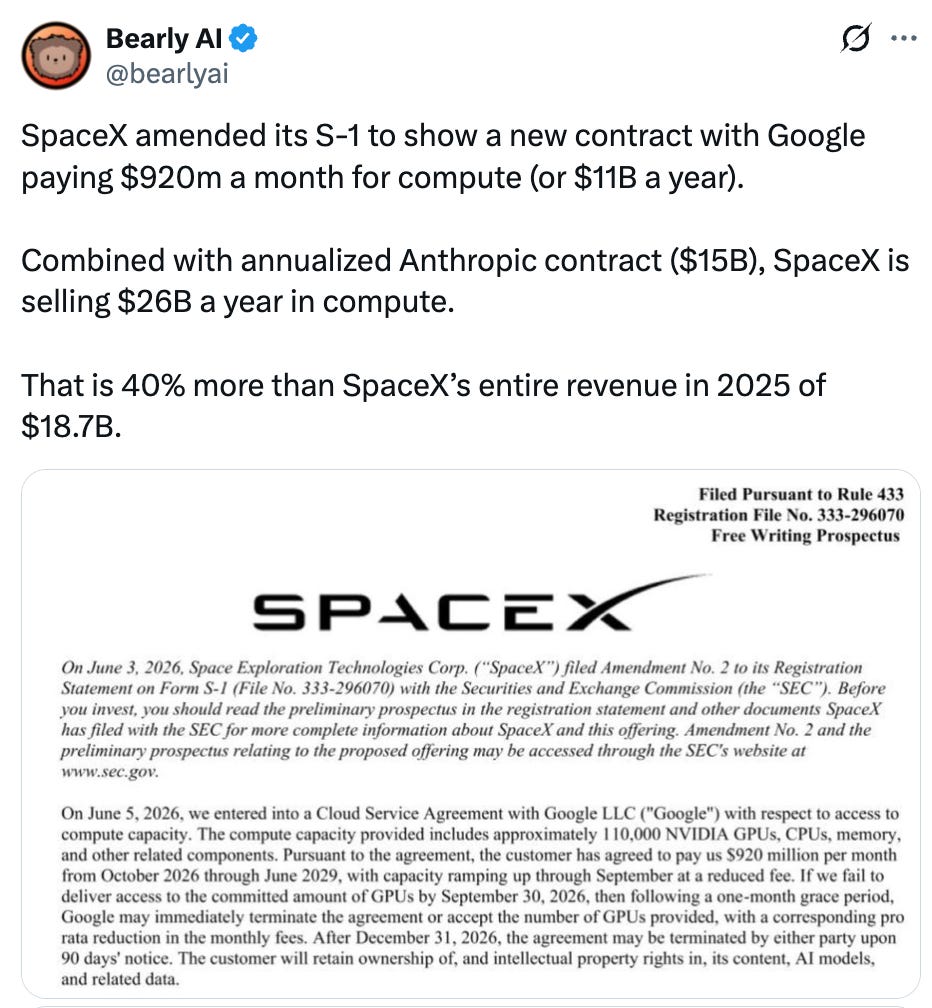
→ Why does it matter? A lot of talk about Elon Web Services (EWS). Well, here it is. 40% of SpaceX’s 2025 revenue.

Worth a watch or listen at 1x:
→ Why does it matter? AI may not hurt the people who “did everything wrong.” Tyler Cowen’s worry is that it hurts the people who did everything right. The consulting partner making $1.4 million does not become unemployed. He becomes a $300,000 energy executive in Houston. Financially, he is fine. Psychologically, he is not. Politically, that may matter a lot.
→ Why does it matter? Dan Shipper, CEO of Every, spent a week testing Anthropic’s Fable 5, a Mythos-class model that scored a 91 out of 100 on Every’s senior-engineer benchmark!
→ Why does it matter? If you know me, you know I’ve never seen an S-Curve I didn’t like!

Quotes & eyewash:
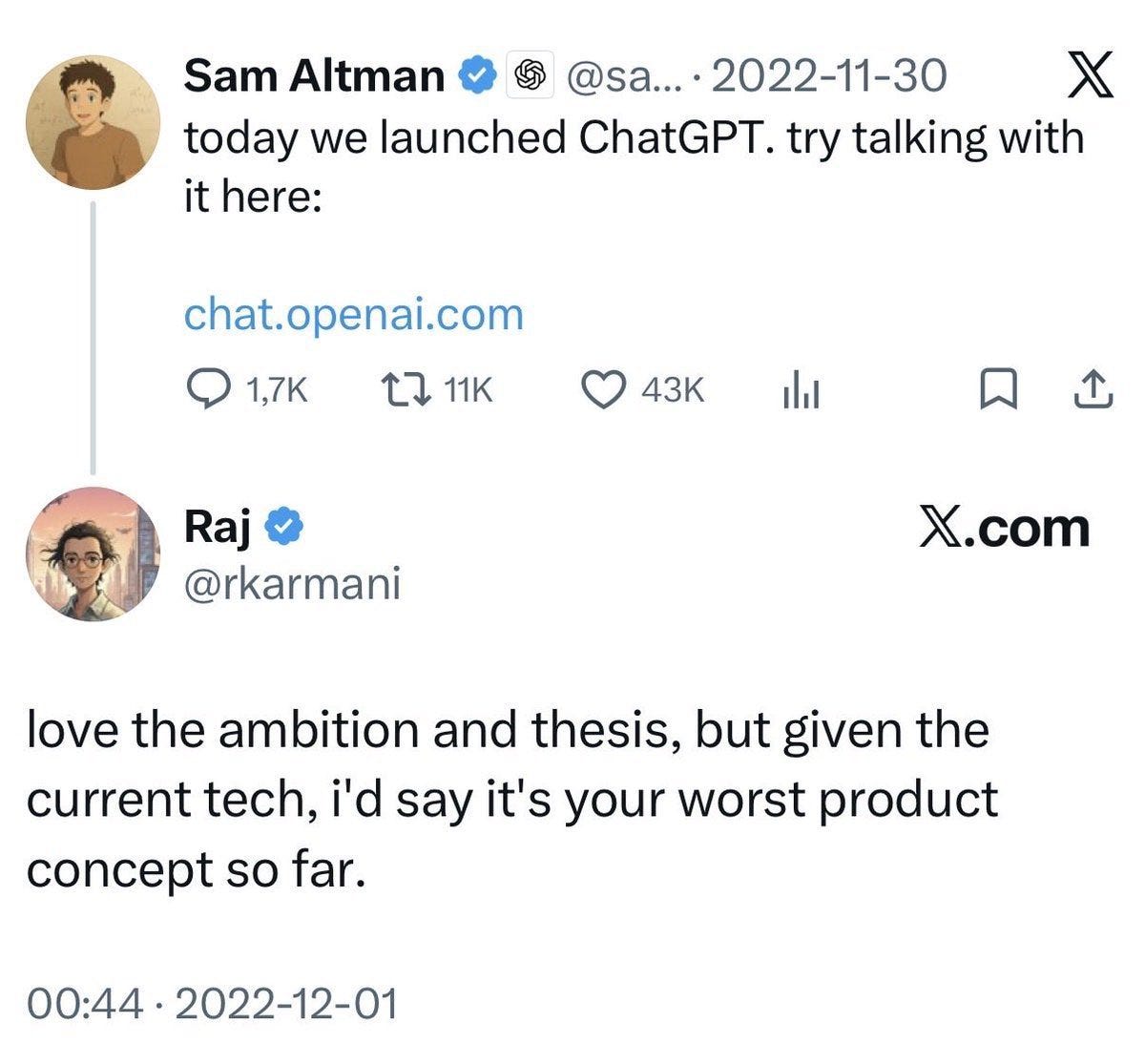
→ Why does it matter? Haters going to hate.
The mission:
The Wall Street Journal once used “Read Ambitiously” as a slogan, but I took it as a personal challenge. Our mission is to give you a point of view in a noisy, changing world. To unpack big ideas that sharpen your edge and show why they matter. To fit ambition-sized insight into your busy life and channel the zeitgeist into the stories and signals that fuel your next move. Above all, we aim to give you power, the kind that comes from having the words, insight, and legitimacy to lead with confidence. Together, we read to grow, keep learning, and refine our lens to spot the best opportunities. As Jamie Dimon says, “Great leaders are readers.”
Disclaimer: This content is for informational purposes only and does not constitute financial, investment, or legal advice. Readers should do their own research and consult with a qualified professional before making any decisions.
I just built my Loh-Down Command Center it’s own email so I can shoot off articles or thoughts really easily on the go, and I also signed up for investor relations alerts for all my investments in their inbox. I am working with one of the agents in Codex on various rules of ingesting that information properly and shipping any pertinent knowledge downstream to other agents that have specific jobs in my Command Center.
Anyway, always love checking out ‘Reading Ambitiously.’ Gives me good inspiration!