



The big idea: Electrons → Tokens → Outcomes
Reading time: 7 minutes

Every technology era finds a unit of account.
Small units have a way of becoming organizing principles. A barrel of oil was just a barrel of oil until the world learned how to refine and consume it. A kilowatt-hour was just electricity until factories, homes, and grids reorganized around it.
The token may be the same kind of unit for the AI economy.
In a recent interview, Jensen Huang compressed Nvidia’s mission into one sentence:
“We convert electrons into tokens.”
Electrons go in. Tokens come out. In the middle sits the world’s most valuable company.
Tokens are the units AI consumes to read, reason, and generate a result. The more information you give the model, and the more work it produces, the more tokens it uses.
Most AI initiatives are focused on the same basic thing: using tokens to generate an outcome.
The simplest frame I can come up with to put it all together is: Electrons → Tokens → Outcomes
Nvidia converts electrons into tokens. The model providers, OpenAI, Anthropic, and Google, build the engines that use those tokens. Everyone else converts tokens into outcomes.
That is overly simplified. It is also useful.
Because isn’t that what we’re all trying to figure out? How to get the AI to do what we want?
The Harness
The current best answer is the harness.
The harness is what it sounds like. A horse has power, but the harness lets you direct it. A model has intelligence, but the harness lets you aim it at work.
There is a new term called harness engineering. It is the discipline of building systems around AI, so the model can perform useful work repeatedly.
A good harness provides the model with the richest inputs possible, in the correct order. Those inputs go into the model’s scarcest resource: the context window.
Think of the context window as the model’s working memory. Context windows are measured in token size. The current start-of-the-art models offer 1M token windows. If something is not in the context window, it is not reliably in play.
The context window is the AI’s mind’s eye.
The idea is not to give the model an ocean of inputs. It is to provide the model with the essential inputs, in the right order, at the right time. Token by token.
This is why so many of the recent AI breakthroughs rhyme. MCPs, skills, memory, proprietary datasets, config files, voice, and vision can sound like separate technical ideas. They are better understood as parts of the same emerging AI native system architecture.
Each one ultimately expresses tokens that shape context.
That is the harness’s job. It determines what the model sees, what it remembers, what tools it can use, what rules it follows, and when a human needs to step in.
That is where much of the applied work in AI is happening. If you hear about a new company raising money to “build AI for X,” there is a good chance it is not training a frontier model. It is renting models from OpenAI, Anthropic, and Google, and spending its R&D dollars on the harness. This is likely what internal tech teams are doing as well.
The Product Is Not the Model
Claude Code is a useful example of a harness. Sierra, Harvey, Legora, Cursor, Decagon, and Glean are others.
There is a big difference between Claude in a blank chat window and Claude inside a software development environment. In the blank chat window, the model can answer questions and write code. Inside Claude Code, the model can see the code repository, understand surrounding files, edit code, run commands, respond to errors, and keep moving through a task.
The difference is the harness. The harness helps input all of the coding context into the model.
Ultimately, we want the work done. In the case of Claude Code, high-quality code generated.
The Business of AI
Augmentation is the easier one to understand because it’s familiar. Give people AI products and help them do more. Let engineers write more code. Let analysts read more filings. Let customer service teams resolve more tickets.
This is already happening. R&D teams using AI coding tools can build more software.
But augmentation keeps the current structure mostly intact. The user still owns the outcome. The AI is a tool. The customer still pays for seats or usage.
That version feels familiar because it looks like software with new killer features.
Service-as-software sells the work itself. The software performs the service and delivers the outcome.
When you sell traditional software, the core questions are product questions. Is it useful? Does it meet my requirements? Is it easy to install?
When you sell an outcome, the questions become operating questions. Can you do the work better than the customer can? Can you do it repeatedly? Is it of high quality? Who is liable when it’s wrong?
That is not a small shift. It changes pricing, gross margins, customer expectations, and liability.
A SaaS company can say, “Here is the tool.” A service-as-software company says, “These tools also do the job.” Then it must back it up.
And likely, future application providers will be a combination of both.
The Thrive Bet
This week, it was reported that Thrive Holdings plans to invest more than $1 billion in an AI-powered accounting roll-up. OpenAI had already taken an ownership stake with a focus on accounting services.
I do not know exactly what they are building. But here is my best guess.
They are not going to sell software to accountants. They are building a harness that is exceptionally good at accounting, then put it into the hands of their CPAs to deliver the accounting outcome faster, cheaper, and with the same or better service level.
That is service-as-software. The accounting firm is not just a distribution channel. It is the laboratory.
Inside that laboratory are the ingredients that matter: proprietary data, domain expertise, process knowledge, and a customer who expects the job to be done correctly.
And what are they going to do? Convert as much of it as possible into tokens, then drive better outcomes than the competition.
If a typical accountant can handle only 10 clients today and 100 or 1,000 tomorrow with the right harness, that is the opportunity.
When AI performs the work, someone still has to stand behind the work. That is where audit trails, human review, service levels, and liability come into play. The companies that can prove reliability will not just have better products. They will be easier to trust.
That trust is what allows the outcome to become the business.
Adding It Up
So the current best Reading Ambitiously frame for how to think about the business of AI is this:
Electrons → Tokens → Outcomes
The harness is the conversion system between tokens and outcomes.
That is where many AI companies will live. It is also where buyers and investors should spend more of their time. Not asking whether a company “uses AI,” but asking what it can reliably produce with it.
The hard part of AI right now is adding it all up without losing the plot.
Electrons become tokens. Tokens move through a harness. The harness produces work. The work creates an outcome. The outcome creates value when someone trusts it enough to depend on it.
That last step is the hard one.
It is also where the business lives.
And unless you’re building picks and shovels, that’s how you’re going to make money.
The trusted outcome.
If you plan to build an AI business, this is what you need to work backward from.

Best of the rest:
💸 Anthropic Confidentially Files Its Draft S-1 — Anthropic submitted a confidential draft S-1 to the SEC on June 1, putting it in the 2026 IPO race alongside SpaceX and OpenAI, on a run rate north of $47B. — Anthropic
⚖️ Kirkland to Spend $500M Building Its Own AI Platform — The world’s highest-grossing law firm is building, not buying: $500M over three to four years to own its AI outright, a direct bet against renting from Harvey or Legora. — Reuters
🧮 Building Finance AI Agents — OnlyCFO breaks a finance agent into its four parts (a skill, a system prompt, MCP connectors, a trigger) and shows one flow turning a two-hour reconciliation into five minutes. — CFOpilot
🛠️ 11 Ready-to-Use AI Skills — Khe Hy hands over eleven copy-paste Claude skills for everyday knowledge work, the kind you install once and forget you are running. — Khe Hy
🧠 Where the Winners Get Built — Brett Queener argues the next durable software companies get built inside specific, messy domain workflows, not horizontal AI, because that is where context and trust compound. — Tales from the Bonfire
🐆 Riding the Leopard — Packy McCormick’s talk-turned-essay on composure and creative nerve: if you are a piece of the universe experiencing itself, the job is to be the fullest, strangest version of you. — Not Boring

Charts that caught my eye:
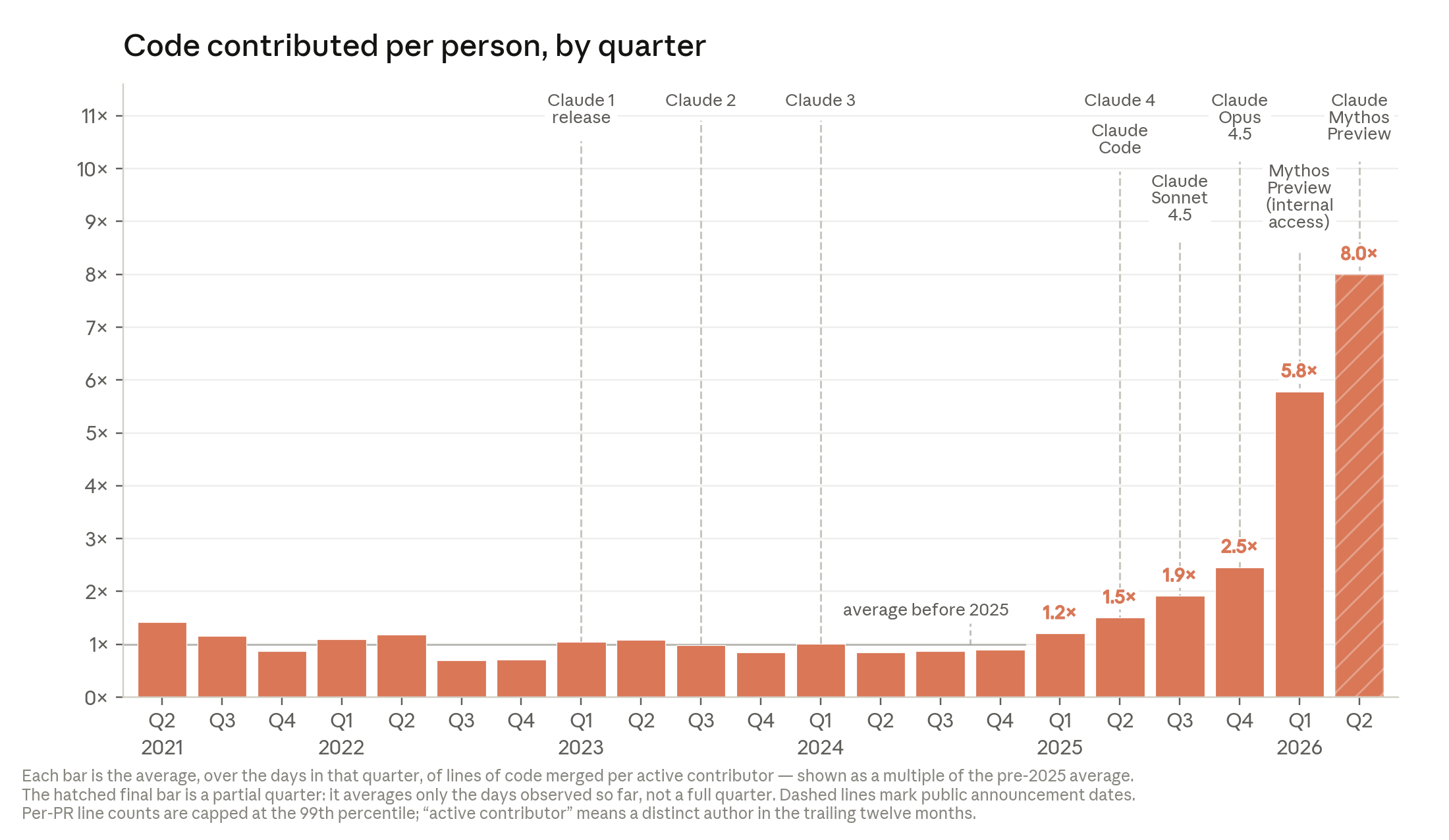
→ Why does it matter? Anthropic engineers, on average, ship 8x as much code per quarter as they did in 2021-2025.
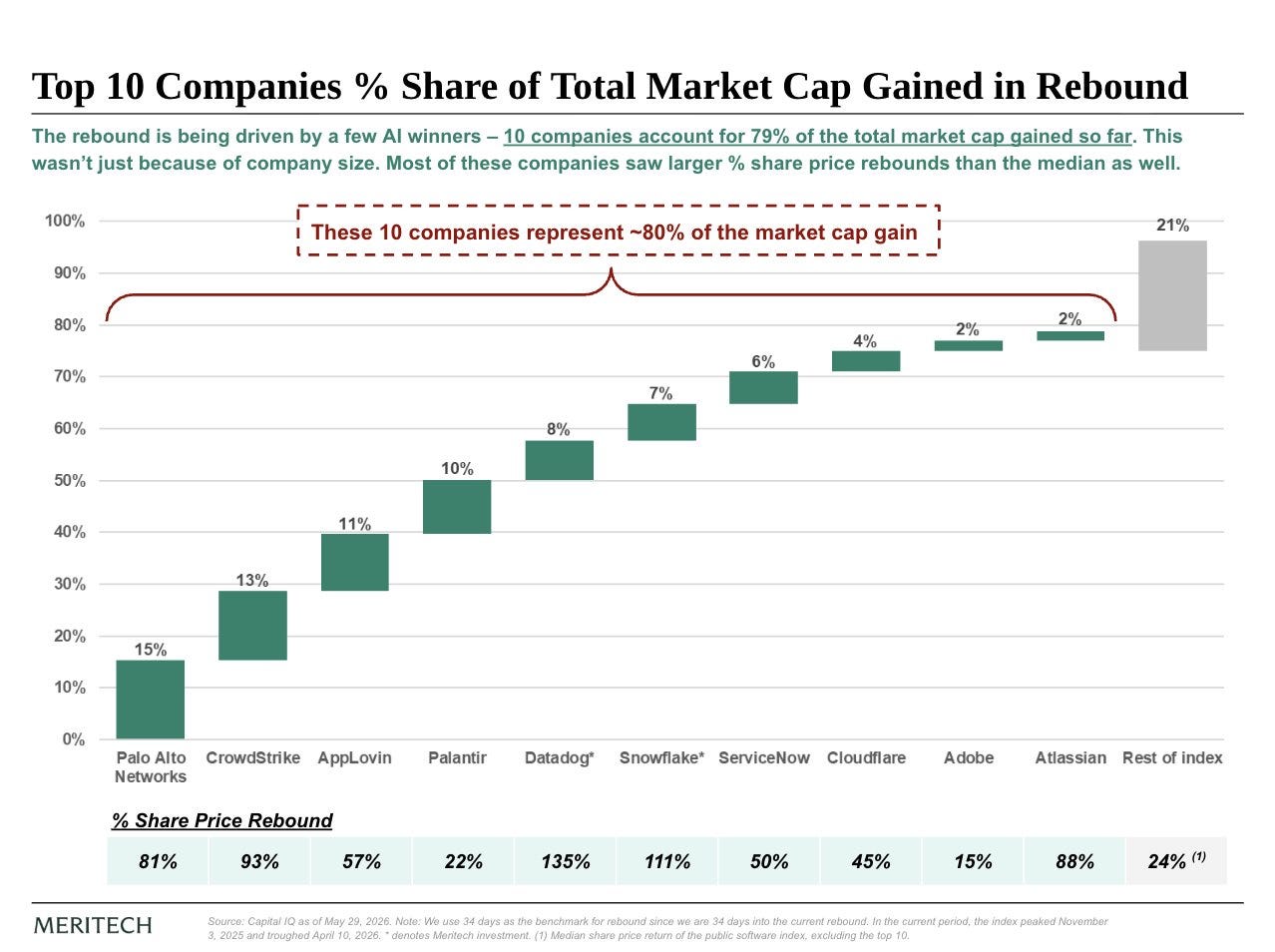
→ Why does it matter? Just 10 SaaS companies accounted for ~80% of the market cap regained over the last 34 days. Full update from Meritech here.
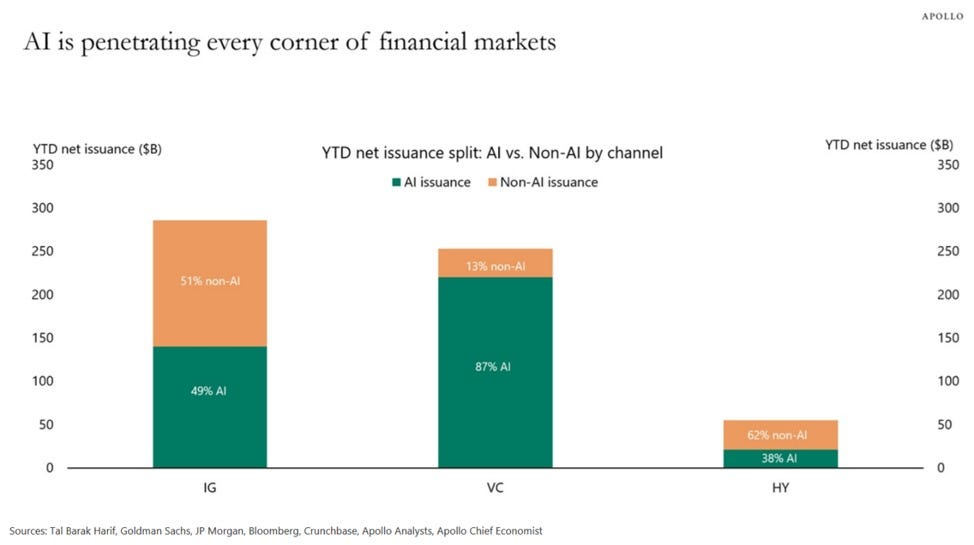
→ Why does it matter? AI-related companies have issued ~$140 billion in investment-grade bonds year-to-date and attracted ~$220 billion in venture capital funding, making up 87% of the total. H/t: The Kobeissi Letter.
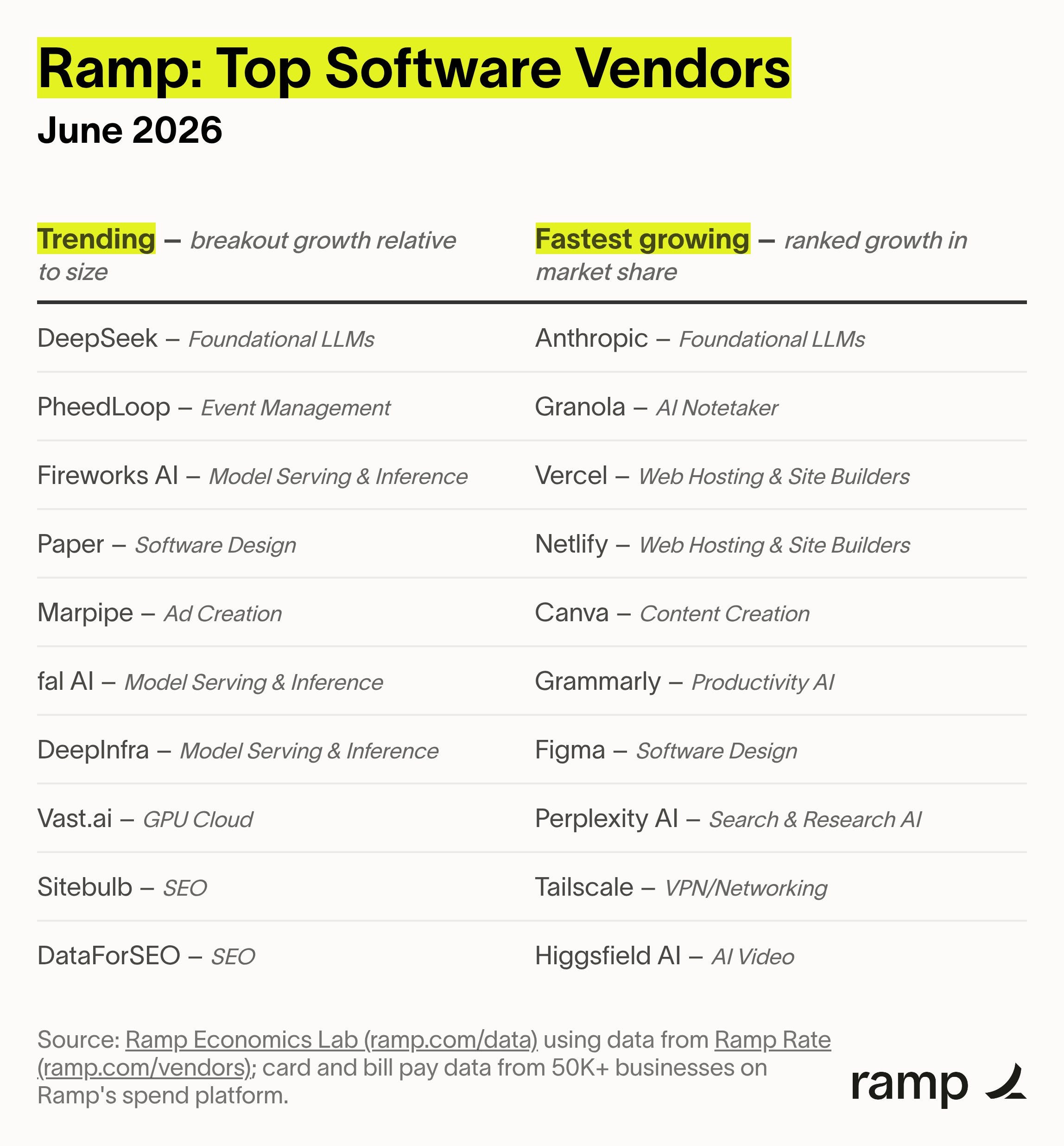
→ Why does it matter? DeepSeek (open-source Chinese LLM) on top of the trending?! 👀
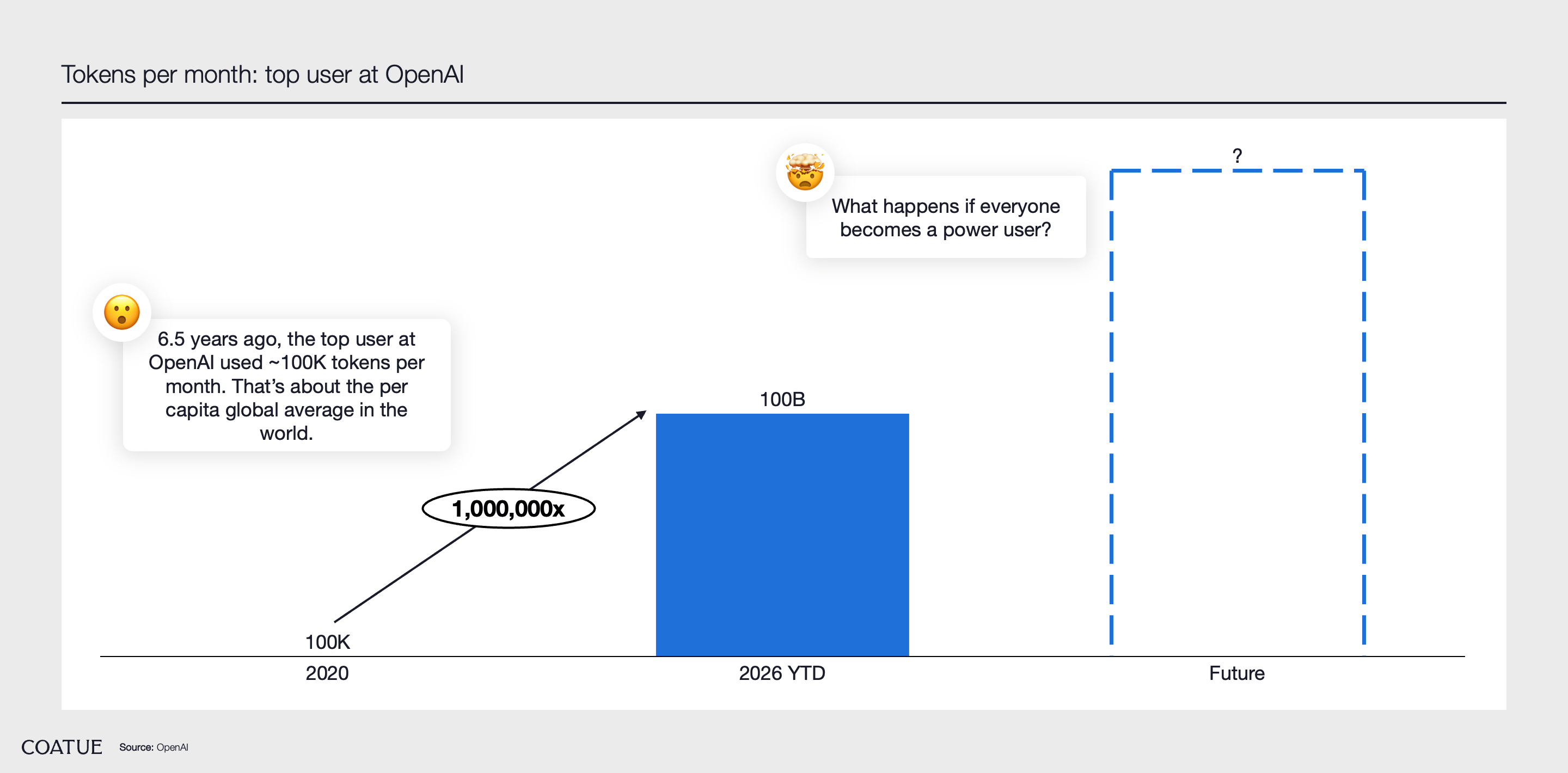
→ Why does it matter? Do we have the compute?

Tweets that stopped my scroll:

→ Why does it matter? $84 vs $954 across the same 100 tasks. 11x cheaper! This is the power of open-source alternatives to the state-of-the-art closed source. The question is: would you trust a Chinese open source model to do it?

→ Why does it matter? Imagine what Siri will be capable of in 1-2 years? And Apple plans to run these models locally. The rumored MacBook Ultra (an unreleased Apple laptop) is considered to be even more powerful than the MacBook Pro.

→ Why does it matter? This is AI for good. My first grader and I are already using Claude Code together. Be sure to check out Reading Ambitiously 4-17-26 if you missed it.

→ Why does it matter? Jonny Ive’s rumored OpenAI device?! During Jon’s years at Apple, the leaks weren’t always unintentional. Jonny loved to build the hype.

Worth a watch or listen at 1x:
→ Why does it matter? Sarah is one of the best CFOs in the game and no doubt spent a ton of time preparing for her remarks here. There has been a media driven story about whether she and Sam are on the same page about the spending. Lots to unpack!
→ Why does it matter? Remember when Uber IPO’ed and people said it’d never be profitable? Dara has masterfully executed and shares a lot of the story with Patrick.
→ Why does it matter? Fred Wilson co-founded Union Square Ventures in 2004. USV has backed Twitter, Etsy, Coinbase, Kickstarter, and MongoDB. After 40-years in the industry, Fred is rethinking how to organize the firm and how AI is going to play a major role in it.

Quotes & eyewash:
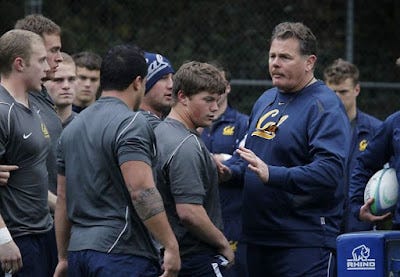
→ Why does it matter? Earlier this week, I had the opportunity to meet Coach Jack Clark. The Cal Rugby coach with the highest winning % of all time in collegiate rugby, #2 place isn’t even close. Jack offered some incredible thoughts about leadership. Non-cognitive grit, mental toughness, grateful for everything, entitled to nothing, team. He sends his team through a tunnel every game (a reminder that you’re coming into our world) a world where your deeds speak louder than your words, a world where we all win together. An incredible model for leadership which you can read more about here.
The mission:
The Wall Street Journal once used “Read Ambitiously” as a slogan, but I took it as a personal challenge. Our mission is to give you a point of view in a noisy, changing world. To unpack big ideas that sharpen your edge and show why they matter. To fit ambition-sized insight into your busy life and channel the zeitgeist into the stories and signals that fuel your next move. Above all, we aim to give you power, the kind that comes from having the words, insight, and legitimacy to lead with confidence. Together, we read to grow, keep learning, and refine our lens to spot the best opportunities. As Jamie Dimon says, “Great leaders are readers.”
Disclaimer: This content is for informational purposes only and does not constitute financial, investment, or legal advice. Readers should do their own research and consult with a qualified professional before making any decisions.