


The big idea: Cross your own chasm
Reading time: 6 minutes

Let’s say you’re the CEO of a 100-person company and you are “all in” on AI. You’ve signed enterprise licenses with Anthropic, OpenAI or Microsoft Copilot to get started. Now what?
If your company followed Everett Rogers’ technology adoption lifecycle, about three people will immediately dive in. Those are the innovators, the first 2.5%. Add in the early adopters, and you’re up to 16 people. That leaves 84 people waiting.
Adoption should continue at this pace, right? Not according to Geoffrey Moore, author of the Silicon Valley gospel, Crossing the Chasm. The next wave of adopters is going to wait and see. And in order to meet them where they’re at, you need to cross the chasm.
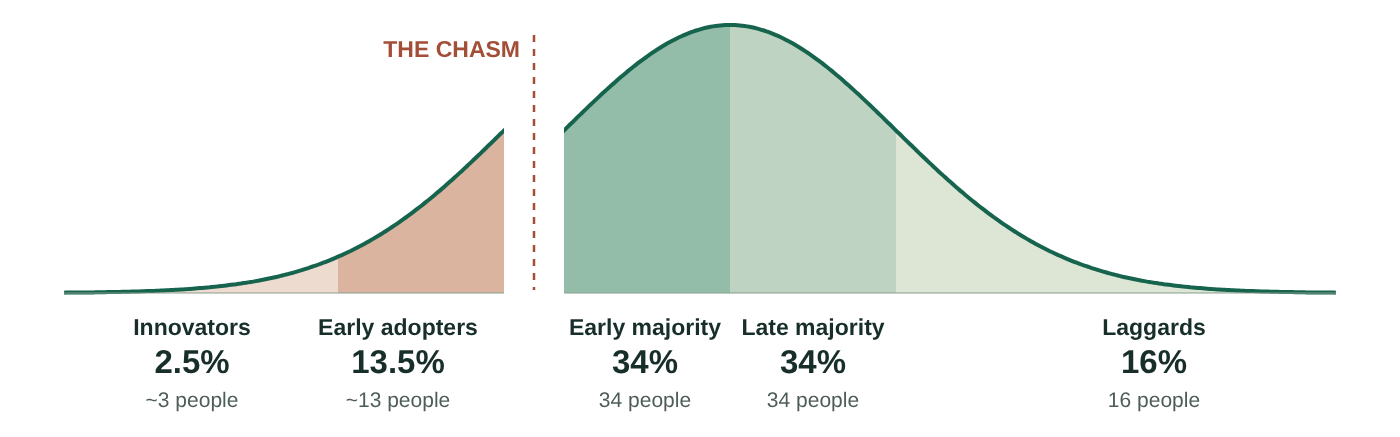
The chasm is the gap between early adopters who buy into a technology’s potential and the early majority who need proof it will work for them. Early adopters tolerate disruption and unfinished products. The early majority is pragmatic and wants a complete solution. Most importantly, they’re looking for evidence that it’ll work from people who look like them, with jobs like theirs.
As CEO of your hypothetical company, your mission, should you accept it, is to produce that evidence to drive adoption and change. Evidence comes in a variety of forms. I’ve adapted one of my favorite charts from Moore for the AI era to give some examples.
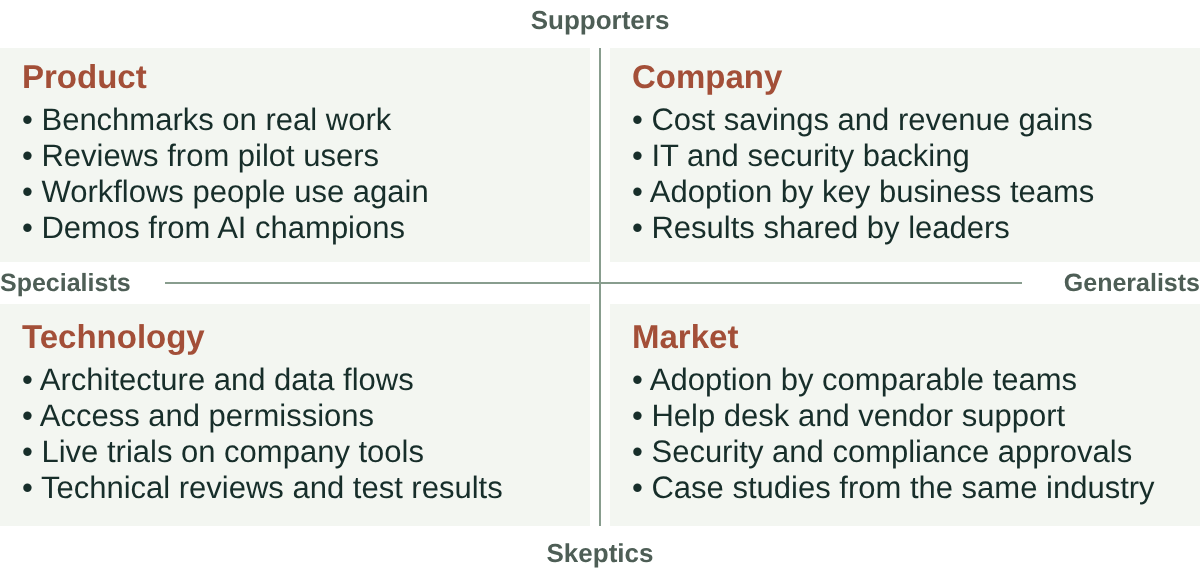
Our job as leaders is to help our early adopters produce this, and to produce it ourselves. And we’re all on a different part of the journey right now, learning how to use AI. I don’t have all the answers. What I can share is my own experience so far, and depending on where you’re at, hopefully it gives you an idea of where to head next. I’ve written about each step here as it happened, messy parts included, so you can follow along.
Access to AI
The first step, which I believe almost all of our readers have already taken, is getting access to AI. Most people I speak with now have Microsoft Copilot at work. Some have ChatGPT or Anthropic enterprise agreements.
ChatGPT became a staple in my daily life in 2024. Honestly, for the first few months, I used it like a better version of Google, an “answer engine” of sorts. Then I learned it could help me write emails, organize my notes after a meeting, and review existing files.
I think most of our readers are well past this stage, but remember, 84% of your organization is potentially not. When I look back on my earliest usage, it was sloppy, and I didn’t know it at the time. The bolding, the emojis, the em dashes, they were all there. Now we take offense when someone sends us something that looks AI-generated, but it’s important to remember that at one point, that was us. This is an opportunity to help someone, not shame them. Explain what AI slop is, help people see it for the first time, and tell them what you’ve learned about using AI for knowledge work.
At this point, you also learn that not all AI products are created equally. There is a huge difference between Microsoft Copilot and tools like Claude Cowork or Claude Code, which can open your files, change them and use your computer, beyond answering in a chat window. If you don’t have access to these more advanced products at work, I highly recommend a personal subscription and a computer of your own to run them on. A lot of people I talk to don’t have a personal computer outside of work. If that’s you, set one up so you can keep learning these tools.
Because my OMG moment came once I got access to Claude Code.
The epiphany
It came around Thanksgiving 2025. This is when I took the red pill. I am not a software engineer, but watching Claude Code open files, change them, and generate software was a real moment of awe for me. It was around this time that I realized Claude Code can essentially use a computer, so whatever a computer can do, Claude Code can do too. That is very different from a chatbot.
For years, I wanted a personal CRM. Claude Code said, “Sounds great, let’s build one.” I remember when it estimated ~16 days to get to an MVP, and I asked, “Are you sure?” It revised its response: “Sorry, that was human dev time, this will take ~30 minutes.” We had a working version in about that time.
Then I started building for something I know well, Reading Ambitiously. I wanted to use AI to review previous editions, help me with half-formed thoughts, and understand Substack formatting. All of these ideas came together into what would become AmbitiousOS. By late February, it was live in a private beta with about 20 readers.
Over these next few months, I really started to learn about context and harness engineering. Both are hugely important to using AI well. We wrote about context and harness engineering right around the time I started to understand them.
The best way to have an experience like the two I’ve just described? Pick a body of work you know incredibly well and dive in.
A computer of its own
Once I got comfortable with Claude Code, I came to a realization. If AI can give instructions to a computer, what if you gave the AI its own computer? In March, I ordered a Mac mini, and it arrived in June. I installed my AI tools on it and got to work. The beauty of a local setup is that all of your context lives on your own hard drive. Each project has its own folder, files and instructions.
By August, I could put my AirPods in, walk my dog, and talk to this setup from my phone. This is, once again, very different from using ChatGPT on your iPhone. The AI has its own computer, a browser, a file system, and the permissions you give it. These are really the same ideas behind Grok Bot and emerging “always on” AI assistants like Muse.
With this setup, you can go fully AI-native on the work in front of you, across your desktop and your phone. In my humble opinion, this is the current best way to use AI.
Crossing your own chasm
So, back to our 84%. To produce the evidence, inspire, and lead by example, we’re all going to need to go on some version of this journey ourselves.
It’s been about two years of learning for me, and this month marks about a year since my Claude Code epiphany. Most of that time, I was using AI as a chatbot before anything really clicked.

I can’t tell you exactly how much faster your team will get there. But I do think you can speed it up, and it comes back to the evidence. The early majority is waiting to see someone with a job like theirs make it work. Every time you show your team something real, you’re producing that evidence yourself, inside your own organization.
Here’s what gets me excited. Remember the CRM, when 16 days turned into about 30 minutes? Now picture 34 people on your team having that moment, each on work they know better than anyone.
So here’s my challenge. This week, pick a body of work you know incredibly well and try it with AI. Then show your team what happened, sloppy parts included. It’s the “demos from AI champions” box on the evidence chart. It’s also what this newsletter has been for me.
Your team will learn about context, harnesses and AI slop by doing real work, with someone a step ahead showing them how. You can only be that person if you’ve been through it yourself.
Moore wrote about the chasm as the place where a lot of promising products stall. Inside a company, it’s where a lot of AI rollouts stall too. The way across is the same: someone has to go first and produce the evidence. My guess is that someone should be you.

Best of the rest:
📉 No Signs of AI Payoff Outside the Tech Sector — Apollo’s Torsten Slok lines up revenue per worker and margins for the Mag 7 against the other 493 companies in the S&P. Big tech’s lines go up. Everyone else is flat so far, and for most companies AI still shows up as a cost. — Apollo
⚖️ The New Hot Job in Law — Law firms and AI vendors are hiring “legal engineers,” lawyers who know the tools well enough to rewrite how the work gets done and teach everyone else. Legora has about 200 of them, and Latham posted the role at $220K to $250K. — The New York Times
🏦 Is Private Equity Cooked? — Jen Kha argues tech buyouts have trailed public markets over ten years while carrying 4.7 to 6 times EBITDA in debt, and AI is speeding up the reckoning for software bought in 2021. — a16z
🧭 How to give your dot responsibilities — Nick Baumann’s practical guide to giving an AI assistant ongoing work, with clear expectations and checks. Start by asking what it already thinks it’s responsible for. The answer could be revealing. — Nick Baumann

Charts that caught my eye:
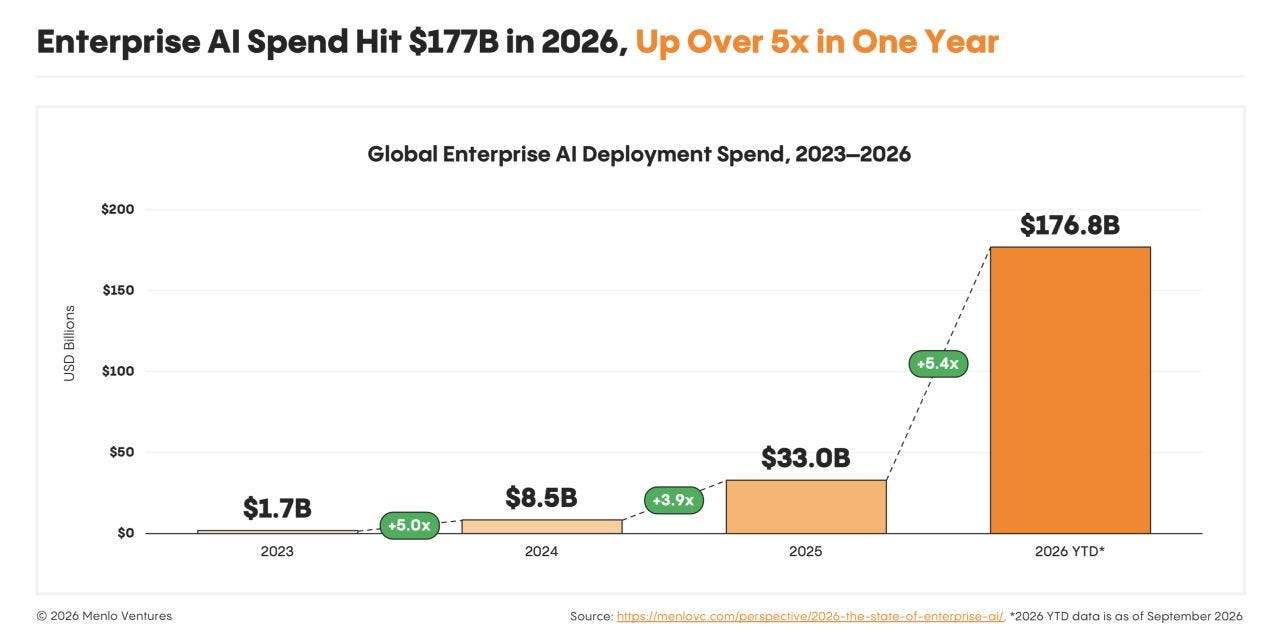
→ Why does it matter? Check out Menlo Ventures “State of Enterprise AI” report, which includes this chart and much more.

→ Why does it matter? Some Revolut engineers were burning through $1,000 to $10,000 a month on Claude Code and Codex, and Revolut wasn’t seeing enough for what it spent. So it rented GPUs from Together AI, ran GLM (an open-weight model), and took the spending caps off. Revolut says it now pays about a tenth as much per token, its engineers can use as many as they need, and work gets out the door faster.
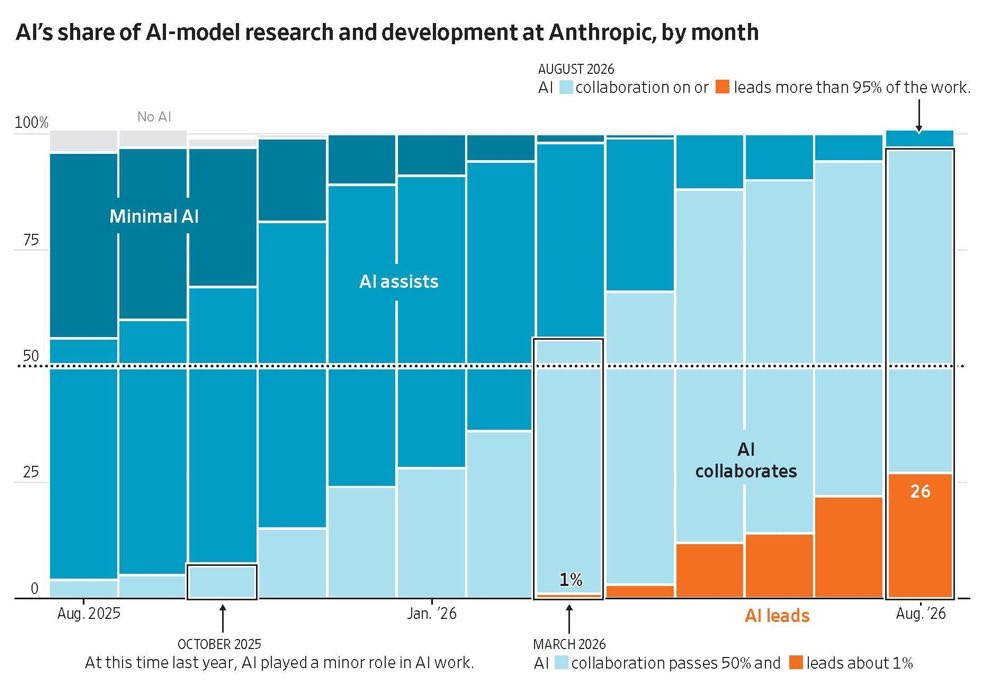
→ Why does it matter? It’s a phenomenon known as “recursive self-improvement,” or RSI, which roughly translates to AI building smarter AI. Pay attention to this graph in the months ahead!
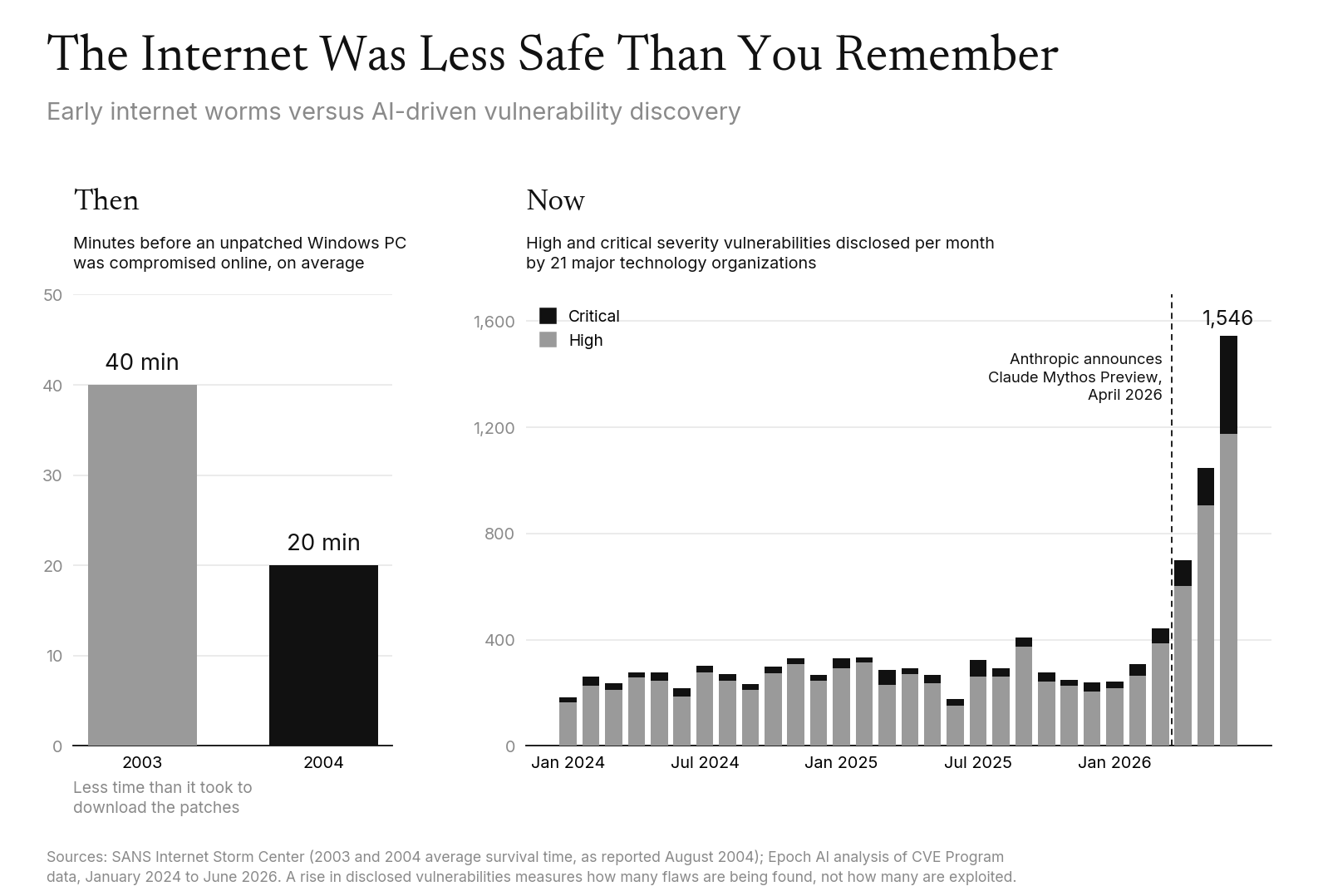
→ Why does it matter? They call it “black October” a month when more cybersecurity events were recorded than are on average in a given year. Shoutout to ILTB for the chart.

Tweets that stopped my scroll:
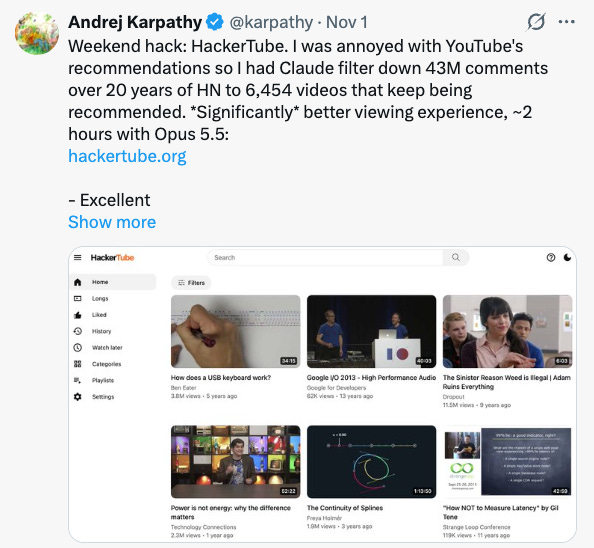
→ Why does it matter? The only things Karpathy did himself were create an API key, spin up a server and buy the domain. Claude did the rest. Check it out at hackertube.org.

→ Why does it matter? What a paradox. What would Clay Christensen say?
Worth a watch or listen at 1x:
→ Why does it matter? Great take from Pat Grady of Sequoia on all things AI, including the AI diffusion gap (~15 min) and open vs. closed (~28 min). The diffusion gap is the big one for me: the models can already do far more than most companies have actually put to work. That gap is where a lot of the opportunity is right now.
→ Why does it matter? Robert Caro’s biographies of LBJ and Robert Moses are considered some of the best of all time, and they truly are incredible reads. I believe Sam Altman recommended The Power Broker to many YC founders. Caro has spent 50 years studying how power actually works. He covers how Moses went from young idealist to something else, how LBJ used threats and promises to get laws passed, and how Caro gets people to talk to him in the first place. If you’re building something and need other people to say yes, this one is worth the listen.
→ Why does it matter? Walter Isaacson presses Thiel on his Antichrist idea. Thiel argues that the real danger comes from someone who talks about AI doom nonstop and uses fear to take control, more than from AI itself.

Quotes & eyewash:
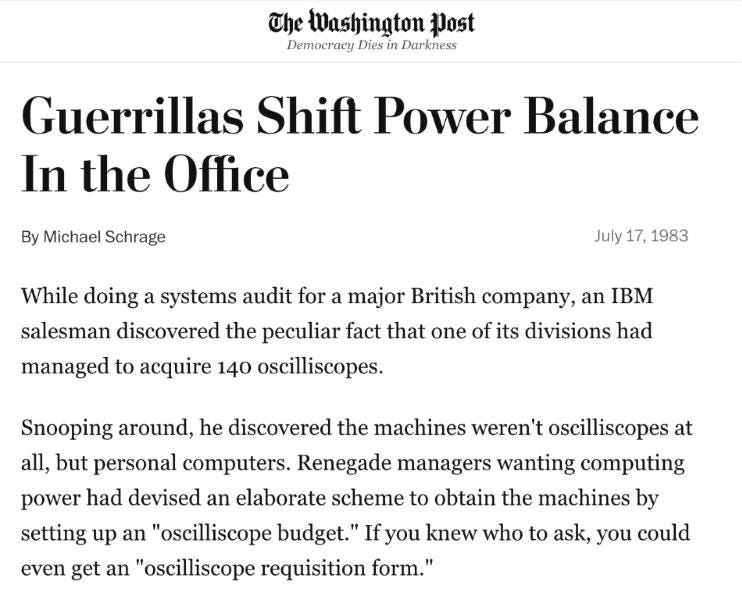
→ Why does it matter? Check the post date on this one. Where there is a will there is a way.
“The price of admission to anything extraordinary isn’t talent or capital. It’s a willingness to be publicly bad at something for a while.” - Shane Parrish
→ Why does it matter? What does Bezos say? Every overnight success was 10-years in the making.
The mission:
The Wall Street Journal once used “Read Ambitiously” as a slogan, but I took it as a personal challenge. Our mission is to give you a point of view in a noisy, changing world. To unpack big ideas that sharpen your edge and show why they matter. To fit ambition-sized insight into your busy life and channel the zeitgeist into the stories and signals that fuel your next move. Above all, we aim to give you power, the kind that comes from having the words, insight, and legitimacy to lead with confidence. Together, we read to grow, keep learning, and refine our lens to spot the best opportunities. As Jamie Dimon says, “Great leaders are readers.”
Disclaimer: This content is for informational purposes only and does not constitute financial, investment, or legal advice. Readers should do their own research and consult with a qualified professional before making any decisions.